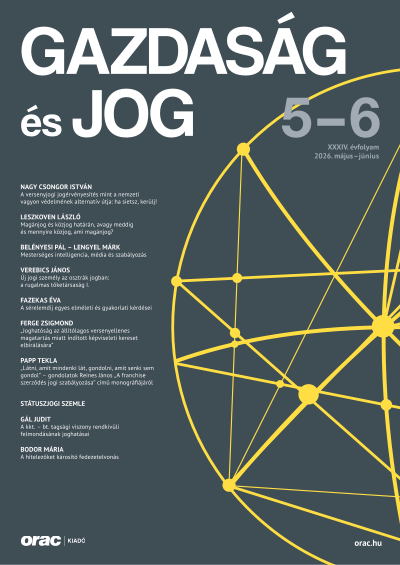
The December 2025 special issue of Economy and Law follows a deliberate editorial concept, organised around two major thematic blocks that together provide a comprehensive overview of the defining questions of contemporary legal thought. The first part of the issue examines current challenges of economic life in their international context, while the second block analyses the functioning, powers and institutional-constitutional role of the Court of Justice of the European Union. The special issue concludes with a reflection on the European intellectual legacy of Ferenc Mádl, offering historical and conceptual depth to the questions explored herein.
This special issue is, unusually, in English, sending the message that legal topics closely related to economic life are an integral part of international discourse.
The first six studies - addressing legal challenges emerging from the economic and social environment - span a remarkably broad spectrum. Zsuzsa Wopera's contribution places the best interests of the child at the centre of the analysis of cross-border parental responsibility enforcement, demonstrating how EU and Hungarian law have reshaped the classical logic of enforcement by foregrounding fundamental rights considerations over procedural rigidity.
Kinga Pázmándi examines the triangular relationship between economy, law and the corporate form in the context of Hungarian company law. Drawing on transaction cost theory and the concept of legal personality, she analyses how company law navigates the tension between stability and adaptability, supported by detailed statistical insights into the economic relevance of micro, small and medium-sized enterprises.
Adrienn Nagy explores current dilemmas in enforcement law, analysing how the evolution of limitation rules reflects the tension between creditor priority and limited debtor protection. She also provides a forward-looking perspective on the challenges of cross-border enforcement within the EU and the future regulation of enforcement directed at digital assets.
Róbert Szuchy discusses the adaptive nature of EU climate governance, analysing the interplay between the "Fit for 55" legislative package and the "REPowerEU" plan. His study highlights the EU's efforts to reconcile ambitious climate goals, energy security concerns and social fairness in a rapidly changing geopolitical environment.
László Leszkoven synthesises codification and implementation experiences related to Book Six of the Hungarian Civil Code. Drawing on the findings of the "Codification and Enactment" national conference series, he provides an overview of key legislative and interpretative issues in one of the most dynamic fields of Hungarian private law.
Renáta Hrecska-Kovács examines the possibilities of industrial action in the public sector under the constraints of the loyalty obligation. Her study addresses the complex relationship between the right to strike, freedom of expression and alternative forms of collective action, highlighting how affected sectors seek legally compliant and socially legitimate avenues of interest representation.
The second major thematic unit focuses on the functioning, legitimacy and institutional role of the Court of Justice of the European Union. György Marinkás analyses developments in the principle of judicial independence within the EU judicial architecture, with special regard to judicial appointments, case allocation and the Court's evolving role in shaping Union law.
Julianna Sára Traser provides a comprehensive comparative legal analysis of the national procedures for selecting candidates for judges and Advocates General of the CJEU in fifteen Member States. The study fills a significant gap in the literature by mapping the diversity of national nomination mechanisms and examining the work of the Article 255 Committee and the career trajectories of endorsed candidates.
Erika Herédi explores the procedural model of "coordinated dialogue" in the application of EU law. She examines the evolving relationship between ordinary courts, the Constitutional Court and the Court of Justice of the European Union in the tension field between constitutional identity and the primacy of EU law, highlighting the procedural avenues that enable this complex dialogue.
Péter Budai centres his study on Article 13(1) first subparagraph of the Treaty on European Union, interpreting it as a foundational locus of the Union's expansion of competences. Through the metaphor of the "alchemist's amalgam," he illustrates how the institutional framework established by the Member States has become a core material enabling the EU's growing scope of action.
Dóra Horváth's analysis focuses on the practice of case allocation at the Court of Justice, especially in matters concerning the rule of law. By examining informal principles, the President's discretionary powers and the role of judges from the Member State concerned, the study sheds light on sensitive constitutional implications of the case assignment system.
- 3/4 -
The special issue concludes with Endre Domaniczky's study summarising Ferenc Mádl's thoughts on European integration, his scholarly contributions and his statesmanlike role. This contribution is both a historical reflection and a normative point of reference, offering an enduring framework for understanding the evolution and future of the European project.
Presented in a coherent structure yet through diverse methodological and thematic approaches, this special issue maps the intersections of economic life, legal development and the functioning of the EU judiciary, while also returning to the intellectual foundations of European integration. We trust that this rich thematic arc will offer valuable insights not only to legal scholars but also to the broader professional community interested in the interplay between law and economy.
Budapest, December 2025. ■
Lábjegyzetek:
[1] The author is Editor-in-Chief.
[2] The author is Guest Editor.
Visszaugrás