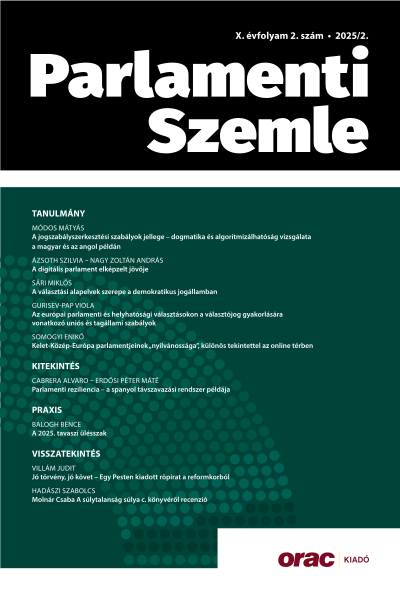
The aim of the study is to examine the nature of legislative drafting rules from both a dogmatic and a practical, algorithmization-oriented perspective, with particular regard to the Hungarian and UK approaches. The author provides an international overview of the established solutions to defining legislative drafting rules, highlighting that the Hungarian practice of operating through binding legislation (hard law) differs from the more widely used guideline- or recommendation-based (soft law) models. The dogmatic analysis shows that in Hungary legislative drafting rules acquired mandatory force on constitutional grounds, derived from the Constitutional Court's case-law on the principle of legal certainty and the requirement of clarity, and subsequently on the basis of the authorization contained in the Act on Legislation. By contrast, in the Anglo-Saxon countries guidance has traditionally been provided by legal scholarship, and in the theoretical debate the central issue has been whether legislative drafting should be regarded as an art or a science.
According to the study, practical aspects prove even more relevant than dogmatic considerations: mandatory rules are more suitable for algorithmization, since their exact prescriptions are more easily transformed into rules amenable to machine processing. By analysing concrete examples taken from the Hungarian decree on legislative drafting and from the United Kingdom's Drafting Guidance - focusing on structure, terminology and logical construction - the author demonstrates that, despite the different legal systems and approaches, significant similarities can be identified, although the algorithmic advantage of hard law regulation is evident.
At the same time, soft law rules - owing to their explanatory nature and illustrative examples - may, in the future, play an important role particularly in the training of artificial intelligence. The study notes that electronic systems already exist in both Hungary and the United Kingdom to support legislative drafting, but none of them yet apply artificial intelligence. The conclusion of the study is that the future path may lie in the combination of rule-based engines and artificial intelligence, for which the best solution would be complementing normative rules with guidance.
Keywords: legislative drafting rules, clarity, digital law-making, hard law - soft law, algorithms and artificial intelligence in legislation
Dr. Mátyás Módos: PhD-student, researcher, Ludovika University Doctoral School of Public Administration Sciences, Ludovika University, Eötvös József Research Centre, Institute of the Information Society modos.matyas@uni-nke.hu
- 161/162 -
This study aims to present an envisioned future of the digital parliament, which already adapts to the technological advancements of our time. According to the outlined concept, information technology tools and artificial intelligence will partially or completely replace traditional legislative and voting processes, thereby increasing the efficiency of these procedures.
Given that the digitalization of parliamentary work can occur in multiple ways, we have attempted to outline one such concept, which discusses the operation of the digital parliament, the changes affecting representatives and citizens, as well as innovations and how artificial intelligence can assist in the drafting, review, and preparation of legal proposals, resolutions, motions, etc. Of course, in addition to detailing the benefits of this topic, it is essential to also address the potential dangers of operating a digital parliament, paying particular attention to cyberattacks, since, as is widely known, threats to information systems pose significant risks worldwide. We briefly highlight some of these potential attacks. Although digitalization of parliamentary work does entail real risks, alongside the possible disadvantages, the use of digital solutions also provides opportunities for more efficient, faster, and potentially more accurate execution of parliamentary tasks.
Keywords: digital parliament, artificial intelligence, cybercrime, transparency, electronic voting
Dr. Szilvia Ázsoth, doktoranda, University of Pécs, Faculty of Law, Department of Criminal Law, azsoth.szilvia@ajk.pte.hu
Prof. Dr. habil. Zoltán András Nagy, PhD, honorary university professor, University of Pécs, Faculty of Law, Department of Criminal Law, nagy.zoltan@ajk.pte.hu
- 162/163 -
The study examines the guaranteeing role of electoral procedural principles in a democratic state governed by the rule of law. Its starting point is that the electoral process is an institutional guarantee of popular sovereignty: it regulates not only the conduct of the vote, but the entire cycle - from the setting of the election date to the final determination of the results - and thus protects the integrity, transparency, and verifiability of the elections. The study points out that the short, time-barring deadlines of the legal remedy system are not mere formalities, but conditions for preserving integrity, in which the fundamental principles - in particular fairness, equal opportunity, voluntariness, good faith and proper exercise of rights, publicity, and support for voters with disabilities - serve as a direct basis for reference.
Historically, modern principles have gradually crystallized; in Hungary, Act C of 1997 organized them into a uniform, enforceable procedural code, while Act XXXVI of 2013 elevated new emphases (publicity, support for people with disabi- lities) to the level of fundamental principles. The principle of publicity is not merely a disclosure technique, but an architecture of transparency: public meetings, accessible decisions and minutes, verifiable accounting, which prevent violations ex ante, reveal them in itinere, and remedy them ex post. Equal opportunity must be interpreted teleologically: even a marginal advantage derived from public authority and public funds may be unlawful if its cumulative effect distorts competition. The general integrity clause of good faith and proper exercise of rights: it provides grounds for sanctions even if the combined effect of formally regular partial elements violates fairness and equal conditions. The study concludes that the principles are not declarations but direct normative standards: through their gap-filling, corrective, and interpretative functions, they constitute independent legal grounds for objections, appeals, and judicial review, requiring institutional discipline (NVI/NVB/ HVI/SZSZB), pre-established and auditable access rules, and transparency of minutes - otherwise democratic legitimacy becomes materially empty.
A Jogkódex-előfizetéséhez tartozó felhasználónévvel és jelszóval is be tud jelentkezni.
Az ORAC Kiadó előfizetéses folyóiratainak „valós idejű” (a nyomtatott lapszámok megjelenésével egyidejű) eléréséhez kérjen ajánlatot a Szakcikk Adatbázis Plusz-ra!
Visszaugrás