

Norbert Merkovity[1]: Mapping Political Communication Research Before the Pandemic - Scopus-Based Scientometric and Thematic Overview (2000-2019)* (FORVM, 2025/2., 143-157. o.)
https://doi.org/10.14232/forvmaip.2025.2.143-157
I. Introduction
This study offers a retrospective scientometric mapping of political communication research published between 2000 and 2019. It focuses on a coherent twenty-year period preceding the structural disruptions associated with the COVID-19 pandemic, accelerated platformization, and the diffusion of generative artificial intelligence. Against this backdrop of expanding scholarly attention to the increasingly complex intersection of media, technology, and politics,[1] the paper establishes a pre-2020 baseline that enables more precise contextualization of post-2020 claims about novelty and disruption in the field.
Using a Scopus-indexed corpus of 2,306 journal articles, the analysis maps the field's structural contours across two decades (2000-2019), with particular attention to publication patterns, geographical references, methodological signaling in titles/abstracts/keywords, and broad thematic clustering derived from exploratory topic modelling. While political communication scholarship has diversified in both topics and approaches,[2] consolidated meta-evidence that jointly captures these dimensions within a single reproducible pre-pandemic corpus remains limited. By establishing such a baseline, the study provides a reference configuration for subsequent comparative meta-research.
- 143/144 -
1. The trends in political communication research
Political communication scholarship has expanded markedly in the twenty-first century, largely in response to the digitalization and platformization of public communication. This growth is reflected both in the scale of publication and in the diversification of the field's empirical objects and analytical vocabularies, as research increasingly addresses how mediated environments reconfigure the relationships among political actors, institutions, and publics.[3] Alongside this expansion, political communication has consolidated its scientific boundaries within the social sciences while simultaneously absorbing adjacent problematics from media studies, political sociology, and digital methods research.[4]
A central, visible trend is the shift from treating media primarily as channels for political messaging to viewing communication as a socio-technical environment that shapes visibility, attention, and participation. In this perspective, digital platforms are not merely arenas for political expression; they are infrastructures that shape interactional possibilities, the circulation of political information, and the rhythms of public controversy.[5] As a consequence, the field has become more attentive to how political narratives are produced, distributed, and interpreted under conditions of continuous connectivity, real-time feedback, and intensified competition for attention.[6]
These developments have also made systematic synthesis both more consequential and more difficult.[7] Rapid diversification - across topics, cases, and methodological
- 144/145 -
repertoires - can obscure whether widely perceived "new" patterns represent genuine ruptures or rather the recombination and scaling of earlier research trajectories. This is particularly salient in the period after 2020, when claims about disruption and novelty proliferate, yet often lack a clearly specified reference configuration. Accordingly, this article establishes a pre-2020 baseline for the period 2000-2019 and maps the field along three structural dimensions: (i) geographical foci, (ii) methodological signalling and repertoires, and (iii) thematic clustering derived from NLP-based analysis.
Three research questions guide the analysis:
RQ1: What are the dominant geographical trends in political communication research from 2000 to 2019, and how do these trends reflect the field's global scope and regional focuses?
RQ2: How have methodological approaches in political communication advanced over the last two decades, and what does this indicate about the field's development?
RQ3: What insights can be gained from the thematic analysis using the natural language processing approach, and how do these themes inform our understanding of the evolution of political communication?
The next section details the data collection and analytical procedures, followed by the metadata and thematic findings and their implications for political communication research.
II. Research design
Building on established meta-research practices, the analysis prioritizes three complementary layers: (1) reference patterns and author relations; (2) metadata of the sampled works; and (3) content-based thematic structure.[8] The article proceeds by first analysing metadata, followed by content-based topic modelling to address the research questions. To address these research questions, we draw on a comprehensive analysis of the provided study, focusing on geographical trends, methodological evolution, and thematic insights in political communication research between 2000 and 2019.
The Scopus search engine was used in this research because it provides more relevant results for publications on political communication than other databases.[9] The database was created using the search term "political communication" within the title, abstract, and keywords data. The search period was set to 2000-2019, and the results were filtered to
- 145/146 -
the social sciences and arts and humanities, with the source type limited to journal articles. This resulting list contains 2,306 records. The data collection was finalized in March 2021.
1. Data processing
The dataset under study covered journal article titles and abstracts indexed in Scopus, focused on 'political communication' from 2000 to 2019. The initial phase of our analysis involved a comprehensive preprocessing of the textual data, a step to ensure uniformity and quality, as often emphasized in text analysis methodologies.[10]
Titles and abstracts were standardized (string conversion) and concatenated into a single document-level text for each record. This approach allowed for a more holistic analysis, ensuring that the articles' immediate focus (as represented by their titles) and their detailed exposition (as outlined in the abstracts) were incorporated into subsequent analytical steps.
2. Text processing
The text data was processed to transform raw, unstructured text into a structured, analyzable format. The text was first tokenized, a process where each document's continuous stream of text was broken down into discrete units, typically words.[11] After tokenization, stop words were removed, and the corpus was vectorized using CountVectorizer to generate a document-term matrix. This step helps us focus on the more meaningful words that are likely to contribute to the thematic understanding of the text.[12],[13]
3. Topic Modeling
The core analytical method used in this study was latent Dirichlet allocation (LDA), a generative probabilistic model known for its effectiveness in identifying latent topics in large text corpora.[14] LDA's fundamental premise is that documents are mixtures of topics, where a distribution of words characterizes a topic.
- 146/147 -
In configuring the LDA model for our analysis, we extracted five distinct topics from the dataset. This choice was informed by the scope and size of our dataset and was intended to provide a comprehensive yet manageable number of themes for analysis. Thus, the n_components parameter of the LDA algorithm, which specifies the number of topics to extract, was set to 5.
Interpreting the LDA model results required examining the most significant words in each identified topic, as these words indicate the thematic essence of each topic. It is important to recognize that the interpretation of topics in LDA models relies heavily on the analysts' discretion and their domain expertise.[15] As such, our interpretations were guided by an understanding of the thematic landscape of political communication research.
III. Results
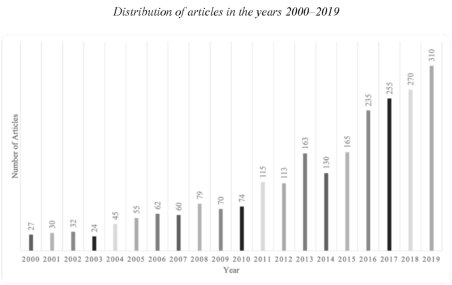
The year-by-year frequency of the 2,306 titles in the database suggests that the use of the term 'political communication' increased in frequency during the 2010s, with the last four years of the second decade standing out. The database contains articles by 1,803 authors published in 729 journals (see figure 1).
Figure 1.
- 147/148 -
Even after a brief overview of the database, the subtopics that have shaped the political communication research of the past two decades are evident. Recurring sub-themes include communication and political research that examines strategic models or local aspects. Another subtheme concerns social media and democracy, including digital media, trust in politicians, and the connections between social networks and populism. There are numerous studies on elections and campaigns, with notable examples including presidential campaigns in the United States, general parliamentary elections in Europe, election strategies, and media coverage.
These sub-themes illustrate the diverse research interests and reflect the progressive nature of political communication research, as well as the integration of digital platforms in political discourse. Traditional media, especially television, are also examined.
We used the database to examine trends in additional authorship, finding 1117 studies with more than one author. The database contains 686 papers with two authors, 323 with three authors, 104 with four authors, and even one with nine, ten, and thirteen authors. Regarding lead authors, the groups led by Anders Olof Larsson and Lance R. Holbert are the most frequent. Assuming that the complex social, media, and political environment is prompting authors to collaborate more frequently, we examined the annual frequency of multi-author studies.
We used the Mann-Kendall (MK) test to determine if there was a trend in the number of publications by year, and Sen's slope estimator to assess the magnitude of the change.[16] During the examined period, the number of articles published increased gradually, indicating a statistically significant positive trend (Z = 5.61).
1. Key facts about the geographical focus (RQ1)
Abstracts of the dataset were examined to determine the geographical focus, resulting in a list of the 15 countries mentioned most frequently. The results can also be used to identify a regional focus, as shown in Table 1. The geographical trends in political communication research in the analyzed decades reflect broad global interests and specific regional focuses. The United States' central role in the field's development is visible, both as a subject of study and as a source of theoretical and methodological frameworks. However, the noteworthy attention paid to countries such as Australia, China, Germany, and Spain highlights the growing recognition of the need to understand political communication in diverse political systems and cultural contexts. Nevertheless, specific regions, including Central and South America, the eastern half of Europe, most of Africa, and certain countries such as Canada, Japan, and New Zealand, are underrepresented. This does not mean that these countries were not researched during the period under review; however, they are not often mentioned in the study's data.
- 148/149 -
Table 1.
Frequently mentioned countries and regions in the database
| Country | Mentions | Region | Number of countries | Mentions |
| United States | 114 mentions | Europe | 7 countries | 262 mentions |
| China | 57 mentions | Asia | 5 countries | 165 mentions |
| Germany | 57 mentions | North America | 1 country | 114 mentions |
| Australia | 56 mentions | Australia | 1 country | 56 mentions |
| Spain | 50 mentions | Africa | 1 country | 19 mentions |
| India | 36 mentions | |||
| Italy | 32 mentions | |||
| Sweden | 32 mentions | |||
| United Kingdom | 32 mentions | |||
| Israel | 31 mentions | |||
| France | 30 mentions | |||
| Netherlands | 29 mentions | |||
| Malaysia | 22 mentions | |||
| Iraq | 19 mentions | |||
| South Africa | 19 mentions | |||
The geographical results reveal the field's Western focus; however, it is also clear that political communication research is visible beyond the Western world. After reviewing the records' abstracts, the following conclusions can be drawn. The United States remains a primary focus of research in political communication. This prominence reflects the country's early adoption of digital and social media in political processes, its vibrant media landscape, and its role in developing theories and methodologies in the field. The equal mention of China and Germany emphasizes the field's interest in diverse political systems - democratic and authoritarian, respectively. The focus on these countries highlights concerns with how political communication operates under different governance models, particularly concerning media freedom, censorship, and the role of digital platforms in shaping public discourse. Australia's significant mention indicates an interest in the political communication dynamics of the Asia-Pacific region, including digital campaigning, media regulation, and the impact of global media on local politics. Political communication research on Spain reflects interests in European political dynamics, including regional independence movements, the impact of the European Union's policies on national politics, and the role of social media in political mobilization.
While mentioned less frequently than the top five, France, India, Iraq, Italy, Israel, Malaysia, Netherlands, South Africa, Sweden, and the United Kingdom still indicate a wide geographical spread in research interests. They represent a mix of developed and developing countries, different political systems, and diverse cultural contexts. This variety suggests that political communication research is global, considering how universal phenomena, like digitalization, globalization, and political polarization, manifest in different regional contexts.
- 149/150 -
2. Key facts about methodological approaches (RQ2)
To categorize research methodologies in the dataset, we used the guidelines in Table 2 to distinguish quantitative, qualitative, and mixed/other methods. Many studies could not determine their research method from the abstracts; therefore, a fifth category, the 'unknown,' also appears in the results. Furthermore, this study combines the mixed and other categories, as their numbers are not individually significant. These categories help organize articles based on their methodological approaches, providing a clearer understanding of the research landscape within the dataset.
Table 2.
Categorization of research methods in the study
| Quantitative methods | Qualitative Methods | Mixed Methods | Other Methods | |
| Definition | Methods that focus on numerical data, statistical analysis, and the objective measurement of phenomena. | Methods that are primarily exploratory and aim to understand how people interpret their experiences, the meanings they attach to them, and the complexities of their natural settings. | This category includes studies that integrate qualitative and quantitative approaches in their research design, data collection, and analysis. | Any methodologies that do not fit neatly into the above categories or are not explicitly mentioned are considered under the 'Other Methods' category. |
| Main characteristics | Surveys and questionnaires with large sample sizes; experiments where variables are manipulated, and effects are measured numerically; content analysis with quantifiable measures, such as frequency counts; statistical models and econometric analysis to examine relationships between variables. | In-depth interviews and focus groups that provide detailed insights into individual perspectives; ethnography and participant observation that involve immersive engagement with participants in their environment; discourse and narrative analysis that focus on the analysis of texts and communication practices; and case studies that provide a detailed examination of single or multiple cases within their real- life context. | The concurrent or sequential use of qualitative and quantitative methods to provide a comprehensive understanding of the research question; triangulation to validate data through cross- verification from more than two sources or methods; integrative designs that link or merge qualitative and quantitative data for analysis and interpretation. | Theoretical or conceptual papers that propose new frameworks or models without empirical testing; systematic reviews and meta-analyses that synthesize findings from existing literature without conducting new empirical research; and descriptive studies that provide overviews of existing conditions without aiming to test specific hypotheses or relationships. |
- 150/151 -
Over the twenty years under review, a growing number of studies have used the research methodology in their abstracts, keywords, and titles. It is clear that quantitative methods are the dominant feature of political communication research, but qualitative methods are also evident. Since the late 2000s, studies using mixed or other methods have also become visible, highlighting the complexity of data analysis. Notably, despite this increase, studies with 'unknown' methodology, which do not specify their research methodology, still account for more than half of all studies on political communication.
If we examine the use of different methodologies across journals in more detail, we can observe a trend in the types preferred by these journals. Quantitative methodology is a prominent and popular research approach. Consequently, the results of this method will influence the appearance of other methodologies. In the case of the journal Political Communication, which features 39 articles in the dataset, the preference for a quantitative approach is particularly striking. Additionally, Information, Communication & Society (18 articles) and the European Journal of Communication (17 articles) are also notable. However, the Journal of Information Technology and Politics (13 articles) and the International Journal of Press/Politics (12 articles) are also included on the list.
The qualitative research methods are most often explicitly referred to in studies published in Journalism (11), European Journal of Communication (9), Political Communication (8), and International Journal of Communication and Journalism Studies (7 each). The mixed/other methodology is referenced in studies published in the European Journal of Communication (16), the International Journal of Communication, the Journal of Information Technology and Politics, the Journal of Political Marketing (7 each), and the International Journal of Press/Politics (6).
3. Key topics (RQ3)
By examining the topics of the records in the database, we aimed to identify common topics in journal articles. Based on word frequency, the analysis identified five main themes, which were distinct from the titles and abstracts of the articles. These five themes are articles that focus on the effects of media and information on political communication, emphasizing social media and data-driven research (topic 1 - 410 articles); articles that center around media coverage, journalistic practices, public policy, and the European context in political news analysis (topic 2 - 282 articles); publications that refer to political campaigning, the use of social media platforms like Twitter, party politics, and election campaigns (topic 3 - 482 articles); articles dealing with public and political discourse, research methodology, and the theoretical aspects of political communication (topic 4 - 688 articles); and finally, publications related to the role of digital and social media in political communication, government, and public engagement (topic 5 - 444 articles).
Articles on social media and data-driven research, topic 1 in the dataset, primarily focus on the impact of various media forms on political communication, with a primary emphasis on their role in shaping public political participation and awareness. This topic introduces how traditional and online media influence political engagement, discussions, and civic knowledge. Its focus aligns with a broader scholarly discourse on the developing
- 151/152 -
nature of political communication in the digital age and its implications for democratic participation and civic engagement.
The research on this topic extensively examines the relationship between news media consumption and political discussions, both online and offline. It examines the impact of various media platforms, including newspapers, television, radio, and the Internet, on political participation, highlighting the significance of political discussions within families, among friends, and in online communities.[17] These discussions serve as fundamental mediators of civic knowledge and efficacy, which, in turn, influence political participation.
One central aspect of this topic is examining how news media use stimulates political discourse, with different outlets exerting varying degrees of influence. Interestingly, while news exposure directly facilitates political discussions, its influence on other mediators, such as civic knowledge and efficacy, is less pronounced.[18] This suggests a more nuanced pathway by which media consumption translates into political engagement, mediated by factors such as knowledge and efficacy.
Articles on media coverage, topic 2 in the dataset, explore media framing and its influence on public perception and political discourse. This theme is reflected in various contexts, ranging from climate communication to gender biases in media coverage.
The abstracts most associated with this topic explain how media organizations frame specific issues and the potential impact of such framings on public opinion and policy. It involves examining how climate change is communicated, with an emphasis on the role of media in shaping public understanding and responses to climate mitigation and adaptation strategies.[19] Others examine the role of media in presidential elections, scrutinizing how media coverage can influence public perception of political figures and events.[20] There is also a notable emphasis on the intersection of media coverage with gender, examining how gender biases may manifest in media portrayals of political figures and issues.[21] Furthermore, analyses of this topic often use a comparative approach,
- 152/153 -
examining differences in media framing across contexts such as countries, media outlets, or periods.[22]
Articles on political campaigning, topic 3, primarily focus on political campaigning, the use of social media in politics, and the dynamics of political engagement and participation in the digital era. The focus is on how political entities and individuals leverage online platforms to influence, mobilize, and engage with the electorate.
A recurring theme in the abstracts is the strategic use of social media platforms, such as Twitter and Facebook, by political parties and candidates. For instance, a study explores how Facebook posts and online networking were employed as campaign tools in the 2017 general elections in Kosovo. This study demonstrates a shift in campaign strategies, in which digital platforms are central to political communication and voter engagement.[23]
The role of social media in shaping political discourse and public opinion is another key aspect that these studies highlight. A study on Canada provides insight into the use of social media in municipal elections, highlighting the increasing significance of these platforms in local political contexts.[24] Similarly, a study on Wales discusses the nuances of language and communication on party websites, emphasizing the role of digital media in contemporary political communication.[25] The impact of digital platforms on political participation and engagement is also a critical area of investigation. For instance, Bente Kalsnes explains the paradox of political parties' social media use, contrasting their strategies with actual practices on platforms like Facebook.[26]
Articles on theoretical aspects of political communication, topic 4 in the dataset, analyze political communication, public discourse, and the theoretical keystones of these concepts. This topic covers a broad range of studies that explore the interplay between political rhetoric, media representations, societal impact, and the conceptual development of theories in political communication.
The studies focus on the discursive construction of political narratives and the role of ideology in shaping these narratives. For instance, Deligiaouri emphasizes the emergence of post-truth narratives in contemporary political communication, examining the discursive construction of truth and its ideological foundations.[27] This study examines the growing complexity of political rhetoric, particularly in the context of post-truth politics.
- 153/154 -
Another aspect highlighted in these studies is the exploration of political culture and memory, particularly in societies undergoing transition. Gutorov, Koryushkin, and Zavershinskyi offer an anthropological perspective on political culture, highlighting its interplay with political memory.[28] This research blends insights into the deeper cultural and historical dimensions that influence political discourse. The impact of political communication on societal safety and security is also a theme explored in this topic. Studies on this topic group provide insights into a systematic literature review and empirical analysis of societal safety and security concepts, contributing to a deeper understanding of these concepts in political communication.[29]
Articles on the role of digital and social media in political communication, topic 5, the last circle of topics, focus on the intersection of media, political communication, and the transformative impact of digital technologies. This topic includes studies that examine how digital platforms have transformed the landscape of political communication, facilitating new forms of public engagement, altering the flow of information, and challenging the authority of traditional media.
The studies reveal a deep interest in understanding the interaction between civil society and media in the digital age. For instance, Häussler explores the dynamics of digital political communication ecologies, examining how online civil society mobilization efforts have reshaped the role and status of traditional media.[30] This study highlights the shift from centralized, media-driven communication to more fragmented and inclusive online debates facilitated by digital platforms. The impact of the internet and social media on societal change is a recurring theme in discussions about societal transformation. Wahid and Usino (2016) study the transformation of Acehnese society in the Internet era, focusing on how political communication through digital platforms has influenced social change.[31]
IV. Discussion and conclusion
The study demonstrates the growth of political communication into a methodologically diverse, globalized, and digitally attuned field. It not only reacts to changes in political media environments but also reflects deeper epistemological and normative commitments
- 154/155 -
within political science, communication studies, and sociology. The findings reinforce the discipline's role in understanding how political meaning is constructed, contested, and circulated in hybrid media systems.
The steady increase in publications, particularly since the early 2010s, suggests a maturing research field characterized by interdisciplinary approaches. This trend echoes broader patterns in the social sciences, where research teams have become the norm, and collective expertise is supported to explore multifaceted questions.[32] The strong correlation between year and authorship indicates the growing complexity of the phenomena under study, which often require a range of methodological tools and disciplinary perspectives.
The analysis of geographical trends (RQ1) confirms earlier observations about the Western-centric nature of political communication research. The results indicate that political communication research remains geographically concentrated, with the United States dominating both as a site of inquiry and as the home of leading authors and journals. Other highly mentioned countries include Germany, China, Australia, and Spain. These findings align with earlier critiques that point to a Western-centric focus in the field.[33] However, the growing presence of non-Western countries - particularly China and India - signals a gradual expansion of the field's empirical and conceptual horizons. Nevertheless, regions such as Latin America, Sub-Saharan Africa, and parts of Eastern Europe remain underrepresented. This imbalance calls for sustained efforts to de-Westernize political communication scholarship and to promote comparative, cross-regional research that captures the diversity of political systems and communicative ecologies, particularly as digital media transcends national boundaries and shapes political behavior in varied regimes and cultural contexts.
Quantitative methods continue to dominate (RQ2), especially in high-impact journals such as Political Communication, Information, Communication & Society, and the European Journal of Communication. However, there is notable growth in qualitative and mixed methods, particularly in periodicals such as Journalism and the European Journal of Communication. This shift suggests a widening methodological pluralism, resonating with earlier calls for greater reflexivity and diversity in research design.[34] The ongoing use of qualitative approaches indicates a recognition that not all communicative phenomena can be fully understood through statistical generalization alone.
Thematic analysis using natural language processing and topic modeling techniques produced five distinct research clusters (RQ3). These topics align with shifts in the field, demonstrating how political communication scholarship has kept pace with technological, political, and societal transformations. In particular, the centrality of social media - highlighted in both the data-driven subfield (topic 1) and digital campaigning studies (topic 3) - confirms the field's responsiveness to the rise of platforms such as
- 155/156 -
Twitter and Facebook, and their role in redefining campaign strategies, political discourse, and citizen engagement.
Meanwhile, topics focused on theoretical discourse, media systems, and democratic practices (topics 2 and 4) demonstrate continuity with the field's earlier concerns about media effects, framing, and political culture. This dual focus - on empirical novelty and theoretical grounding - suggests a productive tension in the field, in which scholars both respond to emerging technologies and reaffirm foundational questions about power, representation, and public deliberation.
Overall, the study highlights persistent gaps and opportunities for improvement. Certain regions remain underrepresented despite the growing diversity of research topics and methods. This limitation restricts the generalizability of political communication theories and underlines the need for a more deliberate effort to de-Westernize the field.
Summary - Norbert Merkovity: Mapping Political Communication Research Before the Pandemic - A Scopus-based Scientometric and Thematic Overview (2000-2019)
This study maps the field of political communication research between 2000 and 2019 using scientometric and text-mining tools, with the specific aim of establishing a "pre-2020" baseline. The author analyzes a corpus of 2,306 journal articles drawn from the Scopus database, in which the term "political communication" appears in the title, abstract, or keywords. The study integrates three dimensions simultaneously: (1) the description of publication dynamics and authorship patterns, (2) the identification of geographical focuses based on country mentions in the abstracts, and (3) the exploration of methodological indications and thematic structure. In addition to metadata analysis, the study employs natural language processing and topic modeling to identify five major thematic clusters from titles and abstracts. The results show that the number of publications in the sample increased notably in the 2010s, and the trend is statistically significant. In terms of geographical focus, a marked Western concentration emerges: the United States is the dominant reference and empirical field, while several regions (a significant part of Latin America, Africa, and many countries in Eastern Europe) are underrepresented. At the same time, the visibility of non-Western cases is increasing (for example, the emergence of China and India), signaling the gradual globalization of the field of research. Based on methodological indications, quantitative approaches are the most common, while qualitative and mixed-methods approaches are also present, and a trend toward pluralism is evident toward the end of the 2000s. An important finding of
- 156/157 -
the study is that a significant portion of the abstracts still fail to make the methodology clear, pointing to a persistent problem with research transparency. The topic modeling identifies five major clusters: (1) media effects, information, and data-driven approaches; (2) media framing, journalistic practices, and European contexts; (3) campaigns, party politics, and platform use (particularly Twitter/Facebook); (4) theoretical and methodological reflections, discourse, and political rhetoric; (5) digital and social media, governance, and public participation. Together, these clusters show that by the end of the period, digital/platform logic becomes one of the organizing axes of the field, while classic issues of media effects and framing do not disappear.
Overall, the study provides a reproducible, pre-pandemic reference point for research on political communication, against which post-2020 "disruptive" claims can be more accurately assessed. The author sees the main contribution in the fact that it links publication trends, geographical focuses, methodological approaches, and thematic structure within a single, unified analytical framework, thereby also highlighting the blind spots in the field. ■
NOTES
* The research was supported by the Digital Society Competence Centre of the Humanities and Social Sciences Cluster of the Centre of Excellence for Interdisciplinary Research, Development and Innovation of the University of Szeged. The author is a member of the Legal, Political Aspects of the Digital Public Sphere research group.
[1] Epstein, Ben: The Only Constant Is Change: Technology, Political Communication, and Innovation Over Time. Oxford University Press. Oxford, 2018.; Graber, Doris A. & Smith, James M.: Political Communication Faces the 21st Century. Journal of Communication 2005/3, 479-507. pp.
[2] Kenski, Kate & Jamieson, Kathleen H. (eds.): The Oxford Handbook of Political Communication. Oxford University Press. Oxford, 2017.; Semetko, Holli & Scammell, Margaret (eds.): The SAGE Handbook of Political Communication. SAGE Publications. New Delhi, 2012.
[3] Graber & Smith 2005.; Kenski & Jamieson 2017.
[4] Blumler, Jay G.: Core Theories of Political Communication: Foundational and Freshly Minted. Communication Theory 2015/4, 426-438. pp.; Mazzolen, Gianpietro & Vaccart Cristian: 20 Years of Political Communication Scholarship: Accomplishments, Changes, and Challenges. Comunicazione politica 2020/1, 5-20. pp.; Semetko & Scammell 2012.
[5] Kreiss, Daniel & McGregor, Shannon C.: The "Arbiters of What Our Voters See": Facebook and Google's Struggle with Policy, Process, and Enforcement Around Political Advertising. Political Communication 2019/4, 499-522. pp.; Fu, King-Wa: Propagandization of Relative Gratification: How Chinese State Media Portray the International Pandemic. Political Communication 2023/6, 788-809. pp.; Woods, Eric T., Fortier-Choutnard, Alexandre, Closen, Marcus, Ouellet, Catherine & Schertzer, Robert: The Battle for the Soul of the Nation: Nationalist Polarization in the 2020 American Presidential Election and the Threat to Democracy. Political Communication 2023/2, 173-198. pp.
[6] Beaufort, Maren: Digital Media, Political Polarization and Challenges to Democracy. Information, Communication & Society 2018/7, 915-920. pp.; Gigltetto, Fabio: Three Consequences of Big Data on the Practices and Scholarships of Political Communication. Comunicazione politica 2020/1.; Kuznetsova, Daria: Broadcasting Messages via Telegram: Pro-government Social Media Control During the 2020 Protests in Belarus and 2022 Anti-war Protests in Russia. Political Communication 2023/4, 1-22. pp.; Jaramtllo-Dent, Daniela, Contreras-Pultdo, Paloma & Pérez-Rodríguez, M. Amor: Right-wing Immigration Narratives in Spain: A Study of Persuasion on Instagram Stories. European Journal of Communication 2022/2, 161-180. pp.
[7] E.g., Saravanan, J., Vineeth, Thomas & Ashikho, Aviini: Mapping the Research Trends on Political Communication in Asia: A Bibliometric Analysis Using R Package and VOS. Asian Journal of Comparative Politics 2023/2, 254-273. pp.; Entman, Robert & Trzcińska, Julia: (2019). Political Communication Around the World: New Trends and Threats. Central European Journal of Communication 2019/3, 379-382. pp.; Davidson, Stewart, Elstub, Stephen, Johns, Robert & Stark, Alastair: Rating the Debates: The 2010 UK Party Leaders' Debates and Political Communication in the Deliberative System. British Politics 2017/2, 183-208. pp.; Pfetsch, Barbara & Voltmer, Katrin: Negotiating Control: Political Communication Cultures in Bulgaria and Poland. The International Journal of Press/Politics 2012/4, 388-406. pp.; Battista, Daniele: For Better or for Worse: Politics Marries Pop Culture (TikTok and the 2022 Italian Elections). Society Register 2023/1, 117-142. pp.; Nord, Lars W.: Americanization v. the Middle Way: New Trends in Swedish Political Communication. Harvard International Journal of Press/Politics 2001/2, 113-119. pp.
[8] Iqbal, Waleed, Qadir, Junaid, Tyson, Gareth, Mian, Adnan N., Hassan, Saeed-ul. & Crowcroft, Jon: A Bibliometric Analysis of Publications in Computer Networking Research. Scientometrics 2019/2, 1121-1155. pp.; Sanchez, Amador D., de la Cruz Del Rio Rama, María & García, José Álvarez: Bibliometric Analysis of Publications on Wine Tourism in the Databases Scopus and WoS. European Research on Management and Business Economics 2017/1, 8-15. pp.; Saravanan et al. 2023.
[9] Anglada-Tort, Manuel & Sanfilippo, Katie R. M.: Visualizing Music Psychology: A Bibliometric Analysis of Psychology of Music, Music Perception, and Musicae Scientiae from 1973 to 2017. Music & Science, 2019/2.
[10] Manning, Christopher D., Raghavan, Prabhakar & Schütze, Hinrich: Introduction to Information Retrieval. Cambridge University Press. Cambridge, 2008.
[11] Aggarwal, Charu C. & Zhai, ChengXiang (eds.): Mining Text Data. Springer Science & Business Media. New York, 2012.
[12] Manning et al. 2008.
[13] Crain, Steven P., Zhou, Ke, Yang, Shuang-Hong & Zha, Hongyuan: Dimensionality Reduction and Topic Modeling: From Latent Semantic Indexing to Latent Dirichlet Allocation and Beyond. In: Charu C. Aggarwal & ChengXiang Zhai (eds.): Mining Text Data. Springer. New York, 2012. 129-161. pp.
[14] Blei, David M., Ng, Andrew Y. & Jordan, Michael I.: Latent Dirichlet Allocation. The Journal of Machine Learning Research 2003/3, 993-1022. pp.
[15] DiMaggio, Paul, Nag, Manish & Blei, David: (2013). Exploiting Affinities Between Topic Modeling and the Sociological Perspective on Culture: Application to Newspaper Coverage of U.S. Government Arts Funding. Poetics 2013/6, 570-606. pp.
[16] Kendall, Maurice G.: Rank Correlation Methods. Griffin. New York, 1948.; Mann, Henry B.: (1945). Nonparametric Tests Against Trend. Econometrica, 1945/3, 245-259. pp.; Sen, Pranab Kumar: Estimates of the Regression Coefficient Based on Kendall's Tau. Journal of the American Statistical Association 1968/324, 1379-1389. pp.
[17] E.g., Scheufele, Dietram A., Nisbet, Matthew C., Brossard, Dominique & Nisbet, Erik C.: Social Structure and Citizenship: Examining the Impacts of Social Setting, Network Heterogeneity, and Informational Variables on Political Participation. Political Communication 2004/3, 315-338. pp.; Tian, Yan: Communication Behaviors as Mediators: Examining Links Between Political Orientation, Political Communication, and Political Participation. Communication Quarterly 2011/3, 380-394. pp.
[18] Boukes, Mark & Morey, Alyssa C.: Survey Context Effects and Implications for Validity: Measuring Political Discussion Frequency in Survey Research. Journal of Survey Statistics and Methodology 2018/2, 201-226. pp.; Scheufele et al. 2004.
[19] Boussalis, Constantine, Coan, Travis G. & Holman, Miryia r.: (2019). Communicating Climate Mitigation and Adaptation Efforts in American Cities. Climate 2019/3, 45.
[20] Gan, Faith, Teo, Joo Leng, & Detenber, Benjaming H.: Framing the Battle for the White House: A Comparison of Two National Newspapers' Coverage of the 2000 United States Presidential Election. Gazette (Leiden, Netherlands), 20 05/5 , 441-467. pp.; Searles, Kathleen & Banda, Kevin k.: But Her Emails! How Journalistic Preferences Shaped Election Coverage in 2016. Journalism 2019/8, 1052-1069. pp.
[21] Fahey, Anna Cornelia: French and Feminine: Hegemonic Masculinity and the Emasculation of John Kerry in the 2004 Presidential Race. Critical Studies in Media Communication 2007/2, 132-150. pp.; Semmler, Shane M., McKay-Semmler, Kelly & Robertson, Terry: Gendered Issue Depictions in Commander in Chief Versus the West Wing. Atlantic Journal of Communication 2013/5, 247-262. pp.
[22] Berganza, Rosa: Framing the European Union and Building the Media Agenda: The 2004 European Parliamentary Elections in the Spanish Daily Press. Journal of Political Marketing 2009/1, 59-69. pp.
[23] Gërguri, Dren: Campaigning on Facebook: Posts and Online Social Networking as Campaign Tools in the 2017 General Elections in the Republic of Kosovo. Central European Journal of Communication 2019/1, 92109. pp.
[24] Hagar, Douglas: Campaigning Online: Social Media in the 2010 Niagara Municipal Elections [Report]. Canadian Journal of Urban Research 2014/1, 74-98. pp.
[25] Cunliffe, Daniel: Welsh-language Provision on Party Websites During the 2010 UK General Election. Information Polity 2011/2, 151-170. pp.
[26] Kalsnes, Bente: The Social Media Paradox Explained: Comparing Political Parties' Facebook Strategy Versus Practice. Social Media + Society 2016/2.
[27] Deligiaouri, Anastasia: Discursive Construction of Truth, Ideology and the Emergence of Post-truth Narratives in Contemporary Political Communication. International Journal of Media & Cultural Politics 2018/3, 301-315. pp.
[28] Gutorov, Vladimir, Koryushkin, Alexander & Zavershinskyi, Konstantin: Anthropological Dimensions of the Political Culture in Transition Societies: Political Culture Versus Political Memory. Czech Journal of Political Science/Politologicky Casopis 2019/2, 83-101. pp.
[29] Beck, Martin: "Watching and Waiting " and "Much Ado About Nothing "? Making Sense of the Israeli Response to the Arab Uprisings. Palgrave Communications 2016/1.; Galstyan, Khachik S.: A Dialogical Paradigm of Power: From Marginal Theory to Political Reality. Vestnik Sankt-Peterburgskogo Universiteta, Filosofiia i Konfliktologiia, 2019/4, 626-633. pp.
[30] Häussler, Thomas: Civil Society, the Media and the Internet: Changing Roles and Challenging Authorities in Digital Political Communication Ecologies. Information, Communication & Society 2019/9, 1265-1282.
[31] Wahid, Umaimah & Usino, Wendi: Political Communication and Social Change of Acehnese Society in Internet Era. Advanced Science Letters 2016/5-6, 1388-1392. pp.
[32] Wuchty, Stefan, Jones, Benjamin F. & Uzzi, Brian: The Increasing Dominance of Teams in Production of Knowledge. Science 2007/5827, 1036-1039. pp.
[33] E.g., Voltmer, Katrin: The Media in Transitional Democracies. Polity Press. Cambridge, 2013.
[34] Graber, Doris A.: (2004). Methodological Developments in Political Communication Research. In: Lynda Lee Kaid (ed.): Handbook of Political Communication Research. Lawrence Erlbaum Associates. Mahwah, 2004. 45-67. pp.
Lábjegyzetek:
[1] The author is associate professor, University of Szeged; https://orcid.org/0000-0003-3977-7901.