

Anna Ürmössy[1]: Consent and Resistance - The Role of Gamification in Algorithmic Management of the Work Process (The Case of Food-couriers in Budapest) (Publico, 2024/1., 193-214. o.)
https://doi.org/10.32575/ppb.2024.1.9
Abstract
This research examines the work organisation of the Foodpanda food delivery firm and the experiences of the bicycle couriers who work for it, particularly their attitudes to the algorithmic management of their work. The focus of the inquiry is the gamification of work, both from-above and from-below. Gamification from-above is constructed by the management. Taking part in the games can be a source of pride and satisfaction, but also of addiction and self-exploitation. Gamification from-below includes all kinds of "games" that the couriers initiate. These can be different strategies to earn more money, save energy or sabotage the labour process. The study shows the connection between games and the formation of consent and resistance among the couriers. The analysis differentiates between the games of making do and making out. Games of making do usually bring about consent, as they stay within the boundaries set by the management. In contrast, making out goes against managerial interest and gives agency to the couriers, thus it has the potential to foster resistance.
Keywords: bicycle couriers, digital capitalism, food delivery, gig economy, making out, platform work
Introduction
In recent years, especially since the Covid pandemic, the number of food couriers rose exponentially in Budapest, Hungary. The gig economy and application-based, algorithmic forms of management affect more and more people, many of whom work in precarious conditions. Platform work in Hungary has attracted the attention of various scholars.[1]
- 193/194 -
This paper aims to contribute to the literature on the food delivery sector[2] from a sociological point of view by examining the role of gamification in the management of food delivery companies.
I conducted my research between September 2021 and March 2022 using qualitative methods: semi-structured interviews and participant observation. I investigated the algorithmic management of Foodpanda (which was renamed Foodora in 2023). My focus was on the experiences of bicycle couriers, and their attitudes towards the gamified aspects of the work. I distinguished gamification from-above and from-below. In the first case, gamification is created by the management, while in the second form, games are initiated by the workers. I examined the games in terms of making do and making out. In the first case, games stay within the boundaries set by the management, while in the second, the games go against the interests of the company.
The aim of the research was to explore the different aspects of gamification used by the application-based, algorithmic management. I investigated how they affect the couriers, focusing on the formation of consent and the appearance of resistance. In the study I (1) give a brief theoretical overview of platform work, labour in digital capitalism and gamification; (2) present my methodology; (3) outline the technical details of the work organisation; (4) present my findings on the forms of gamification I encountered during my research; (5) explore the topic of workers' consent to this way of organising their work and the possibilities of resistance against the algorithmic management.
Theoretical framework
Platform work
To understand the socio-economic context of the research, it is necessary to introduce the concepts of the gig economy and platform work. Since these are newly emerging and rapidly changing fields, the definitions used in this research represent just one of the many interpretations of these phenomena. The term gig economy refers to the form of employment in which workers are contracted for shorter periods of time or on an on-demand basis, usually with a self-employed status. The couriers' work can be classified as work-on-demand via app.[3] Work is organised via an application-based platform, which connects the customer to the rider with the help of an algorithm.[4] This means that there is no human mediation during the allocation of the orders. The couriers can only work when there is an active demand for food deliveries, which makes their income unpredictable. This frequently results in precarious living conditions for these workers.[5] In the gig
- 194/195 -
economy the economic risks are passed on to the workers by the firm, thus workers become extremely vulnerable to market fluctuations. Being self-employed can also mean that the workers have no or limited access to basic social security benefits and they are excluded from labour law protections.[6] Moreover, platform companies often operate in the "grey area" or are exempted completely from state regulation,[7] which makes it difficult to hold them accountable.
Work in digital capitalism
In contemporary capitalism, the development of digitalisation, data storage and algorithms has had a significant impact both on process of production and the organisation of work. A new era of capitalism has begun, which has been termed digital capitalism. The rise of platform work is part of this emerging economic system. Staab and Nachtwey (2016) approach the changes in the world of work from two directions.
Firstly, they introduce the concept of digital Taylorism. When Taylorism was first introduced in the 19[th] century, the aim was to increase efficiency and productivity through the increased regulation and rationalisation of the labour process combined with rigorous control over the workers.[8] In digital Taylorism, the rationalisation and supervision are conducted by means of applications and algorithms.[9] The applications allow for the continuous monitoring of the workers. Furthermore, they are capable of storing all kinds of data,[10] which can be used to evaluate the workers' performance later on. This kind of management is characterised by extreme informational asymmetry.[11] In addition, the algorithm can manage the labour process much more efficiently than a human employee, which leads to higher levels of productivity and thus increasing profitability.
Secondly, in digital capitalism, workers become extremely vulnerable to market fluctuations. Under Fordism, and even partly in post-Fordism, rationalisation and supervision were compensated by firms with certain mandatory benefits (social security, labour laws) and protection against market changes. A significant proportion of workers in digital capitalism do not enjoy similar benefits and stability. "Increasingly automated direct control has returned, albeit without the benefits that membership in an organization offers employees in classic job forms. All of this is embedded in a context of highly asymmetric constellations of power and access to information."[12] The platform serves as an isolating layer, making it difficult for workers to contact and communicate with the
- 195/196 -
human management.[13] It is important to note that the case of Foodpanda is not an isolated phenomenon, but a representative example of this complex change of our economic system and its organisation of work.
Gamification
The most important concept of the theoretical framework is gamification. Michel Burawoy described the games played by workers he observed during his fieldwork in a factory.[14] For example, each work phase in the factory had a specific output quota; if the worker produced more than 120% of the quota, he received a bonus. If he did not meet the quota, he would still receive the normal wage. The game of making out consisted of assessing whether it was possible to perform above 120% or not. The worker divided his work capacity accordingly: he performed tasks better when it was possible to get a bonus, while he held back energy when it was not. Similar games have also been observed among couriers.[15] Burawoy points out that the management is often involved in the development of the rules of the games, and therefore in most cases the games do not go against their economic interests. When the workers stay within the rules set by the company, acting towards the same interest, this has been termed making do.[16] In contrast, the term making out refers to games that go against the intentions of the management, by tricking the system in various ways. Differentiating between making out and making do is often difficult, because in many of the games, consent and resistance are both present at the same time.[17] Nonetheless, these two categories will be used in this analysis to shed some light on the relationship between certain games and the interests of the management, and to examine which games may be seen as modes of (potential) resistance.
Burawoy's findings reveal that workers do not necessarily engage in games solely because of financial incentives. Games can serve to break the monotony of work and reward achievements with relative satisfaction. They can provide challenges; success leads to pride and acknowledgement from the colleagues. Triumphing in games can become a form of self-expression at the workplace. Burawoy argues that participation in the game obscures the production of surplus value and the reproduction of the capitalist system. "One cannot both play the game and at the same time question the rules."[18] The rules of the game are imposed from-above and are not to be questioned. By participation "capitalist relations not only become objects of consent but are taken as given and immutable".[19] Any
- 196/197 -
dissatisfaction on the part of the workers will not be directed against the system itself, but only against the difficulties of participating in it. As Burawoy puts it, "dissatisfaction [...] is directed not against capitalism but toward its reproduction".[20] An example of this is when workers criticise elements of the bonus systems, but the aim of the whole work organisation, namely the acquisition of surplus value, is not questioned. Moreover, the game has an individualising effect; it makes the workers focus on their own performance. The game creates competition, which can lead to conflicts between the workers instead of conflict with the management. Thus, the game also obscures the common class interest of the workers. However, in Burawoy's opinion, the workers are not merely the passive objects of this system; they have the agency and capacity to resistance. Games initiated by workers can develop their own dynamics, which can undermine the interest of the management.[21] Burawoy's theory moves away from a static description of society and allows the importance of the workers' agency to be considered. The research builds upon Burawoy's theory because the phenomena he describes are clearly at play in the management of Foodpanda. At the same time, digitalisation has evidently affected the design of the games and how the workers developed digital agency.[22]
To distinguish between games based on their origins, the study relies on the work of Woodcock and Johnson (2018). The authors make a conceptional distinction between gamification from-above and gamification from-below. Gamification from-above refers to the games engineered by the management, such as the bonus system. Gamification from-below includes the games initiated by the workers to break the monotony of the job, make out or have some fun while at work. Gamification from-below entails the possibility of resistance.[23] It is not always possible to separate the games into these categories, but this distinction can be used to categorise and analyse the games played by the couriers more effectively.
Methodology
I conducted my research between September 2021 and March 2022. I used qualitative methods; I conducted participant observation and semi-structured interviews. Additionally, I joined many of the Facebook groups of the couriers to gain a general idea about what happens in the community. However, I only used the groups to provide some context, without analysing their content profoundly.
As my fieldwork, I worked as a courier at Foodpanda for 25 hours in November 2021. I decided to work as a courier, because I intended to find out as much as possible about the application and the algorithm. This meant that during the interviews, there was no need to
- 197/198 -
ask about these technical details, and I could focus more on the experiences and opinions of the interviewees. Furthermore, it was essential that I had access to the application so that I could make first-hand observations of the algorithm and carry out some experiments.
I conducted six semi-structured interviews and one interview with two couriers simultaneously. The interviews were between 60 and 90 minutes long, and took place during winter, a factor which needs to be taken into account. During winter, fewer couriers are working, therefore the active workers find shifts more easily and face less competition from others. In this period, they are more relaxed about the rules, as there is a high demand for couriers from the company. It was not difficult to find interview subjects, therefore I aimed to speak to couriers from different backgrounds and with a variety of work experience at Foodpanda. I categorised my subjects based on their experience level and mentality. The experienced riders have a better insight into the workings of the algorithm and are more familiar with the games and more integrated into the riders' community. The "obsessed" couriers work long hours, and work basically consumes their whole life. "Laid-back" couriers may also be experienced, but often use their experience to circumvent the system. They work hard, but don't take the job too seriously. The "average" couriers are already familiar with the system that organises the work. Beginners have only just started the work and have little or no knowledge of the algorithm and how to play it. The various subjects, each with different experience levels, all brought unique perspectives to the research.
Table 1: Information about the interview subjects (with modified names)
| Name (Gender) | Education | Time spent as a courier | Weekly work-hours | Monthly salary | Type | |
| Gregory (Male) | 35 | High school diploma | 1.5 years | 85-100 | Above 1,000,000 Ft (~EUR 2,600) | Experienced, obsessed |
| Benedict (Male) | 22 | Elementary school (8 years) | 2 years | 70 | 400,000-500,000 Ft (~EUR 1,200) | Experienced, laid-back |
| Archibald (Male) | 23 | Vocational training | 1 year | 60-80 | 450,000-500,000 Ft (~EUR 1,300) | Experienced, laid-back |
| Otto (Male) | 24 | Bachelor's degree | 9 months | 35 | 350,000 Ft (~ EUR 900) | Average |
| Julius (Male) | 24 | Currently university student | 1 year (with a 5-months break) | 20-25 | 150,000-200,000 Ft (~EUR 450) | Average |
| Esteban (Male) | 25 | High school diploma | 1.5 months | 5-20 | 80,000 Ft (~ EUR 220) | Beginner |
| Khloe (Female) | 29 | Bachelor's degree | 2 weeks | 15 | Beginner |
Source: compiled by the author.
- 198/199 -
The organisation of labour
In its official communication, Foodpanda draws heavily on the ideas of entrepreneurship, freedom and flexibility. "Be your own boss! Work where and when you want. You can always make your own schedule, adapting it to your other commitments." is a typical promise from their recruitment website.[24] The couriers are contracted as self-employed entrepreneurs. During the time of the research, they were KATA taxpayers (a flat rate for lower tax brackets in the Hungarian taxation system). When they signed their contracts with the company, they agreed that courier work will not be their primary source of income, although no one checks this. The couriers' work-hours are not fixed so they can work as many hours as they want, and they can choose their shifts flexibly. The shifts can be chosen one week in advance. The city is divided into zones, with one shift always covering a specific zone. The work is managed via an application, in which couriers can choose shifts, complete orders, and get in touch with dispatchers while working if they need help. At the time of the research the couriers' salary consisted of an hourly wage and a delivery fee, paid after each delivery. The value of the wages varied from zone to zone: for example, some zones did not pay an hourly wage at all but paid higher delivery fees. In addition, the salary was supplemented by tips and various bonuses.
The algorithm which manages the work creates a strong informational asymmetry. When I asked the interviewees how well they were informed about the operation of the algorithm, all of them answered "not at all". When I asked if they had received any information about how the algorithm worked, one courier replied: "They sent me something, but it doesn't really work like that [...] the important thing is that we can trick it, but how it works, nobody knows" (B., experienced and laid back). Another courier added: "It's a honeypot story that the bike couriers get the shortest deliveries, bike couriers don't go uphill, the nearest courier always gets the order" (A., experienced and laid back). There was a consensus among the couriers that the algorithm was unpredictable.
"The system always picks someone, if it's you, you'll suck that day. If you're lucky, it's not you. Whenever you talk to a courier in the evening, three out of five had a good day, two had a shitty day. There is no logic in the whole system" (B., experienced and laid back).
However, at some level, there is a compensating mechanism: if one has a very good hour with 4-5 deliveries, one can expect a longer delivery the next hour and vice versa. My experience was that the average number of deliveries per hour was three.
The delivery process is also characterised by information asymmetry. When a new order arrives, the couriers only see a code. Only when they have already accepted the order are they given the address of the restaurant. Then, only after they have picked up the food are they informed of the address of the customer. This means that the couriers do not know the length of the delivery when they decide whether to accept it or not.
- 199/200 -
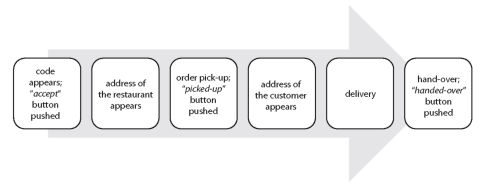
Figure 1: Steps of the delivery
Source: compiled by the author.
Gamification
This section summarises my findings about the presence of gamification in the couriers' work. I analysed separately gamification from-above and gamification from-below. The concepts of making out and making do are used to examine whether there was a conflict of interest between the couriers and the management in the different types of games. From this perspective, it is possible to assess whether certain games could be seen as a form of resistance or merely as coping strategies within the boundaries of the system. In addition, the analysis also took into account the group of couriers who are typically involved in a game. Although my interviewees included two "laid-back" couriers, they are generally a distinct minority among the workers.
Gamification from-above
The application and the unpredictability
The most obvious form of gamification from-above is the application itself. Many couriers told me that the workflow (pick-up, route-planning, drop-off etc.) and the interface of the application resembles a (video)game. Due to this, the work feels more stimulating, fun and challenging. Unpredictability is also part of the gamification. Several couriers said that it makes the work similar to gambling, and they pointed out that it can be addictive.
- 200/201 -
"And then it's a bit like gambling. [...] When you come out, you don't know in advance how many deliveries you're going to have, how long they are, how much you're going to get in tips. When they give you a tip, it's like winning something on a scratch card, so it's a big gamble in the end" (O., average).
The ranking system
The couriers can choose their shifts for the following week sometime between Wednesday and Friday. The exact time depends on the position of the courier in the ranking system. The couriers are divided into a total of 10 groups. The higher a courier is ranked, the earlier they can choose their shifts. According to the information provided on the application: "To create the groups, we take into account the performance of the riders and the system automatically assigns them to their respective groups based on their performance." The system reassesses the groups every two weeks, at which time a courier can rise or descend to another group. In the app there is a table showing the criteria of the assessment. For example, if a courier does not show up for her shift (No show), it is weighted at 20% in her ranking. The courier's average number of deliveries per hour (Utilization Rate, UTR) is weighted at 10%. Although there seem to be exact criteria for the classification, the workers' experience suggests otherwise. The riders complained both in the interviews and in the Facebook groups that the ranking is inconsistent and unpredictable.
The ranking system is an accurate model of digital Taylorism.[25] The aim of the ranking is to increase the efficiency of the work through impersonal control over the workers. Punctuality, reliability, and the acceptance of the algorithm's rules have a positive impact on the workers' ranking. Being late for a shift, declining orders and ending a shift early leads to punishment. Through the app, workers are constantly visible, and every aspect of their work can be documented.[26] The algorithm is a sophisticated tool for discipline: it makes couriers objectified and comparable. As a result of the permanent visibility of the workers, the work becomes panoptical.[27] Due to the GPS, the system is always aware of where the courier is, and how fast she is moving. The system is able to store and evaluate all kinds of data. However, the couriers are not aware of how these affect their ranking and how the algorithm gives them orders in the future.
"I'm sure that they know everything, and I'm sure that this ranking system is bullshit, it's not what counts. They must have some sort of a record of every worker. So that when you turn to them let's say with a problem they can tell if you're reliable or not. I'm sure they have some sort of separate record for each courier" (G, experienced and obsessed).
- 201/202 -
In addition to its disciplinary function, the ranking system can also act as a positive incentive for workers. The majority of the interviewed couriers find the ranking system to be unpredictable and unfair. However, according to Otto and Gregory, it is a transparent and fair way of ranking, which takes into consideration one's performance and reliability. Gregory is very positive about the ranking:
"I really need this kind of rigour or strictness, because otherwise I can't really manage my life. [...] It's also fine to pick shifts based on something. Obviously, you could make a lot less money if there were no shifts" (G., experienced and obsessed).
At the time of the research (during the winter), the couriers I interviewed did not particularly care which group they were in. However, they pointed out that the number of available shifts is based on market demand and not on the number of active couriers. As Julius put it: "It's not [Foodpanda's] job to make sure that the couriers make a living, they just want to make sure that there are always enough people" (J., average). Thus, it is important to have a high ranking in the summer, because there is huge amount of competition for the shifts in that period.
All of the couriers said that when they started working, they felt that it was really important to be high up in the ranking. At the time of the research, all the interviewees were in groups 6-8, except for Gregory, the obsessed courier, who was usually in groups 2-4. He explained that when he started working as a courier, being in the highest-ranking group was more important to him than anything. His performance became part of his identity, and his achievement in the game boosted his self-esteem.
"In the beginning it was all about [the ranking]. It's practically how I ruined a relationship. I put everything into this job, I wanted it to work out. [...] I find myself within it, but outside of it I really don't. I think the ranking system is not good because you get addicted to it and it's all structured in such a way that you don't really know what you can do outside of it" (G., experienced and obsessed).
When I asked the couriers if it was prestigious among workers to be in a high-ranking group, the answers surprised me. My interviewees had quite a negative opinion about the riders in the high groups. They referred to them as "maniacs", "lunatics" and "greedy", although in many cases they called them "legends" which does suggest some respect.
"They are maniacs and greedy. They have no life. They'd rather be out there so they can say and boast in the [Facebook] group, 'I've made 59 deliveries today', 'that's nothing, I've made 61', 'I've earned 40k today' 'I've earned 58k'. And they compete on this, and they'd rather have no life and do nothing else" (A., experienced and laid-back).
- 202/203 -
In conclusion, ranking is important among couriers, but differences in ranking positions often result in being viewed with hostility rather than enjoying prestige. In this respect, the ranking system does have an individualising effect, creating a fracture between couriers in different ranking groups. On the other hand, when push comes to shove, it seems that the competition does not necessarily turn the workers against each other.
"The system is based on everyone waiting for the other to make a mistake so that they can get in their place. It's all designed to basically kill each other, to live off each other's mistakes. But my experience so far is that everyone helps each other if they can." (G., experienced and obsessed)
Bonuses
The third form of gamification from-above is the bonus system. Based on the interviews, the most important bonus is the Pandapróba (Panda challenge). During a Pandapróba, ater reaching a certain number of deliveries (10, 20, .50) per day, one receives an extra amount of money. For instance, at the time of the research, after 10 deliveries, one got Ft 2,400 (~ EUR 6), while after 50 deliveries, one received Ft 50,000 (~ EUR 130). The announcement of the Pandapróbas was quite ad hoc. It only happened on certain days and in certain zones, but the company only notified the workers about them the day before they took place. Between 13[th] of December 2021 and 3[rd] of January 2022 it was made permanent, but only in certain zones of the city. The aim of Pandapróba was clear: to overcome the shortage of couriers during bad weather conditions or holidays.
Experience has shown that the Pandapróba is highly addictive. All the interviewees who were actively working during a Pandapróba targeted a number of daily deliveries, many of them 50, often despite the bad weather conditions. "I become really rapacious, I got soaked in the rain, but I was motivated by gaining that 50 000 a day," said Otto (average). By challenging the couriers, Pandapróba makes the job even more play-like, invoking creative approaches. However, the bonus leads to heavy self-exploitation. It normally takes 10-13 hours to deliver 40 orders, while 50 can be delivered in around 12-16 hours. Besides the money, recognition from other couriers also plays a role in the popularity of this bonus. In Archibald's opinion Foodpanda deliberately announces bonuses in an unpredictable way to lure out workers in harsh conditions.
"Everyone says they can't be bought with money. Oh no, everyone has a price and Foodpanda knows what that price is, to get the simple fools out to work. See, yesterday I was out for 14 hours for that 50 000 Ft? [...] Yes, I was out. And not because I'm a greedy idiot. But to outdo a friend of mine, because he did 49 one day, I told him I'd do 52" (A., experienced and laid-back).
- 203/204 -
According to Archibald, bonuses are a powerful weapon in the company's hands to individualise couriers. In November 2021, an open letter was published in the couriers' Facebook group, urging couriers to boycott work on a given day, putting pressure on the company. When I asked Archibald his opinion about the possibility of a strike, he answered:
"If 300 people boycott work, okay, Foodpanda notices, but they throw in a 100 Ft bonus per hour and the couriers start working. If they're bastards, they'll announce a Pandapróba for that day, and then even the riders who didn't want to work that day will go out and do it" (A., experienced and laid-back).
In conclusion, gamification from-above can be considered to be engineered so that the workers' and the management's interest coincide. Participation in these games can all be seen as making do. The games incline workers to produce surplus-value for the company, while making the work challenging and entertaining. Many elements of gamification can lead to addiction and self-exploitation. Successful participation in the game involves more than the financial rewards. It also creates pride, boosts self-esteem, and in some cases, leads to recognition from other workers.
Gamification from-below
Ways to trick the system
The most common form of gamification from-below is strategising. Before choosing a certain shift, every courier considers the hourly wage and the delivery fee of the zone. They also take into account some less obvious aspects. For example, higher tips can be expected in more affluent areas, although in Budapest that can mean more cycling uphill. The zones differ in size and the number and density of restaurants in them. Other considerations can include traffic and bike lanes. Similarly, one can take into account the ranking system:
"You can play a bit, let's say, with how many hours you work, how many orders you complete... then you can guess how much it will affect your ranking if you decline an order" (G., experienced and obsessed).
By strategising, couriers feel that they have some autonomy over organising their work. At the same time, strategising is a form of making do, since it does not harm the interests of the company at all, as couriers can only manoeuvre within the boundaries set by the business logic.
Another common trick is to learn the codes of the restaurants. This allows experienced couriers (interviews suggest that those who work intensively, get the hang of it in 2-3 months) to mitigate information asymmetry. Experienced couriers have also learned the delivery radius of many of the restaurants. Therefore, when a code appears, they can
- 204/205 -
decide to decline the order if it could involve a long delivery. By using this trick, couriers can avoid long deliveries and problematic restaurants, making their job easier. This is a game of making out, which can be seen as an effective form of resistance to the algorithm, since it goes against the intentions of the management.
"Sprinting" is another popular trick. This is used when the algorithm allocates an address to the courier which is on the edge of a zone, where there are only a few restaurants. In such cases, when the courier hands over the food to the customer, she does not push the "handed-over" button. Instead, she starts to cycle as fast as possible in the direction of the city centre, in hope that by the time the system realises that the delivery is completed, she will get a new order from a restaurant at a better location. It is difficult to fit "sprinting" solely in the category of making out or making do. By sprinting, couriers can trick the algorithm, but not to the extent that it causes problems for the company.
The option of "dropping" orders can also be used to trick the system. It is possible to drop an order when a courier has already accepted an order, but for some reason cannot deliver it. He can get in contact with the dispatchers, who remove the order manually from the courier's profile. Most couriers are aware that if they have to wait more than 15 minutes at a restaurant they can request a drop, while still receiving the delivery fee for that order. This is not ideal for the company, but it is an option offered by their rules, therefore it is a clear case of making do on the part of the couriers.
The games mentioned so far are played by the majority of the workers. However, the following ways of making out are only used by the "laid-back" couriers. These types of games can invoke the disapproval of their fellow workers. An unorthodox way of dropping an order is to tell a false excuse to the dispatcher.
"Sure, I'll go up [the hill] to Törökbálinti út [...] I picked up [the order], smoked a cigarette [...] 'Hi, sorry, I've got a flat tire' [- I told the dispatcher], I had four 'flat tires' in one day. I'm not going to do 5 kilometres, give me a break, it's not worth it. By the time I rode the 5 kilometres, I could have completed two deliveries, maybe three" (A., experienced and laid-back).
By using this method of drop-off, the courier is able to overcome the information asymmetry and, knowing the necessary information, in this case the address of the customer, decide whether or not to accept a delivery. At the same time, as the quotation suggests, the motivating force for dropping is often to enable the courier to deliver more orders, which takes less time. Thus, on the one hand, this trick undermines the organisation of work, but on the other hand, the motivation behind it fits into the profit logic. A "flat tire" can also be a good excuse to end a shift early. Laid-back couriers also strategise with the ranking system to some extent. If they know they will not show up for a shift, they will still check-in on the app a few minutes before the end of the shift, because they know that being late will result in a lower penalty than a No show. When closing shifts early and strategising with the ranking, the interests of the courier and the management do not coincide. This behaviour of making out is a form of resistance against the algorithm and the informational asymmetry
- 205/206 -
that it creates. However, considering the high number of active couriers, the company is not significantly affected by one or two of these small tricks, but if used by many workers, it could sabotage its operations more seriously.
Games between each other
Couriers play games among themselves to make their job more interesting. More than half of my interviewees have no lasting relationships with other couriers and are not part of the inner core. However, Benedict, Archibald and Gregory can be described as "integrated" couriers, as they know many other riders and have 4-5 long-term friends among their colleagues. They told me that the bets they place and races they participate in are motivating and "brighten up the day".
"At the beginning of the month, 10ks, 20 ks, trays of beer are just flying around [...] who can take out more orders in a certain amount of time, who can cycle down the road the fastest. Whatever you can bet on, we'll bet on" (A., experienced and laid-back).
The games that workers play with each other provide a way out of the isolation and monotony that comes with the work. From the management's point of view, bets are actually beneficial, as they result in couriers completing more deliveries and faster.
In conclusion, most of the games from-below can be seen as making do, coping mechanisms which remain within the rules set by the company. Couriers criticise the algorithm for giving them deliveries that take too long to complete, but by taking part in the games, they must accept that their work is managed by an algorithm whose logic of operation is obscured to the workers. The couriers gain some leeway by their tricks, some of which have the potential to actually sabotage the system. However, the majority of the games do not significantly hurt the interests of the company.
Consent and resistance
The following section sums up my findings on the issues of consent and resistance. Firstly, I examine how consent is formed, by analysing the role of gamification, the ethos of efficiency and the material vulnerability of the couriers. Secondly, I turn to the question of resistance, presenting the obstacles and the possibilities of fighting the algorithmic form of management.
During the interviews, I asked the couriers how, if they could, they would change the work organisation. Setting a maximum delivery length was mentioned by many of the couriers. In addition, the ad hoc nature of the bonuses and the unpredictability of earnings were criticised, although only by two couriers. One of my interviewees pointed out that there
- 206/207 -
are not enough shifts and the company employs too many workers at the same time. Only one courier out of seven stated that he would change the obscure and highly addictive tendencies of the algorithm:
"Well, on the one hand, I think it would be good if there was a transparent communication about the algorithm and if we could trace back how it makes decisions. I don't know how it could be possible, but obviously it'd be nice to turn off the addictive, overdriving part of it, that it's always beeping loudly and it's so colourful and it's lit up." (E., average).
Neither the ranking system, nor the continuous monitoring and data storage were mentioned by the couriers. Only one person said that he would try to decrease the uncertainty that arises from the fact that the number of shifts and active couriers is adapted to market needs and that the company does not feel obliged to ensure that couriers can live on their earnings. There was one courier who would prefer not to change anything:
"- Do you think it's ok, that you only see a code when you need to decide whether to accept an order or not?
- That's what's good, why should you strategise? Just do your job, that's it.
- Would you change something in the organisation of the work?
- I would somehow make everyone suck the same. Although I suspect that if you divide the average number of kilometres by the delivery lengths, it comes out the same on average. I'm not sure I would change anything. Why should I change it? I think it's obviously organised well" (G., experienced and obsessed).
I left this question until the end of the interviews, to give the couriers space to reflect on the issues raised during the interview. The point was not to test whether they can perceive the problems, because it is clear that they can. My intention was to see what kind of changes they feel could be realistically implemented and to assess which parts of the management seem unchangeable to them.
The role of gamification
Similarly to Burawoy (1982), I conclude that gamification facilitates the development of consent. To participate in the games, one must accept their rules; through participation, the game becomes a natural part of work. Gamification is a positive stimulus during work. Games make the job more fun and be a source of relative satisfaction and pride. In the case of gamification from-above, couriers must remain within the boundaries set by the management, they can only make do. In the case of gamification from-below, the games played by many of the couriers are also a form of making do. The small opportunities for defiance provide a sense of relative freedom. Strategising and tricking the system makes
- 207/208 -
the couriers feel that they are at least partly in control of the labour process. However, these manoeuvres mostly stay between the lines drawn by the company. Nonetheless, small acts of resistance do appear. A common form of making out is learning the codes of the restaurants. Using false excuses and strategising with the ranking system can also be seen as forms of resistance, although they are practiced by very few of the workers.
Table 2: The appearances of making out and making do
| Making do | Making out | |
| Gamification from-above | ||
| All couriers | Game-like interface Ranking system Bonuses | |
| Gamification from-below | ||
| Many couriers | Strategising "Sprinting" "Dropping" (after 15 min) | Learning the codes of restaurants |
| Only laid-back couriers | "Dropping" with a false excuse Ending shits early with a false excuse Strategising with the ranking system | |
| Only experienced couriers | Games among one another | |
Source: compiled by the author.
Although the couriers criticise elements of the game, overall, they consent to the organisation of work. Participation in the game distracts the couriers' attention from their exploitation and obscures the fact that they are producing surplus-value for the company.
"I think the system is made in such a way that you should do what they throw at you. Because if the system wants to fuck with you, it will. It makes sense to me that it's structured so that you do what they put in front of you, and then you pretty much always end up doing fine" (G., experienced and obsessed).
The ethos of efficiency
Consent is strongly influenced by being socialised in an economic system where rationality and productivity are seen as unquestionable, universal values.[28] In almost all the interviews, the topic of productivity came up when the couriers were asked about changing the methods of management. They argued that it would be difficult to alter the organisation of labour without sacrificing efficiency.
- 208/209 -
"- Do you think it's inevitable that we don't know how the algorithm works?
- Well, yes. If everyone could outsmart it, then what would happen? I think it's necessary that we can't see into it" (O, average).
When asked about their opinion of the organisation of work, the couriers showed a tendency to incorporate the company's interests as their own point of view. In their answers, the couriers prioritised efficiency over fairness and sustainability.
"- And all this [...] the ranking and wages and everything... How fair do you think this work organisation is?
- I think it's a firm organised fucking efficiently" (G, experienced and obsessed).
It is an important element of the formation of consent that the workers see the capitalist economic logic as fundamental and unchangeable.[29] Consequently, questioning a system developed by such a logic seems irrational.
Employment vulnerability
Finally, it is worth examining the material aspect of consent. Couriers are in a vulnerable position, as the company bears no responsibility towards them in terms of labour law. They can be replaced or substituted at any time. Moreover, for many people, being a courier is the only job where they can earn the average wage or more.
"B (experienced and laid-back): I'm always motivated by the fact that it's either this or working three shifts in the factory.
A (experienced and laid-back): In my case, you work 24-48 hours in health care, and you don't get a quarter of the money you make here. Okay, it's burdensome here, but you earn it."
Resistance
When it comes to resistance, there are many obstacles to overcome. Firstly, many of the couriers perceive their work as a temporary form of income. This makes the energy which they would put into fighting the management seem wasted, because change is unnecessary for them in the long term. Secondly, there is a constant fluctuation in the workforce, due to the short-term or part-time workers and depending on the season of the year. Thirdly, the
- 209/210 -
isolation of the couriers from one another makes it difficult for workers to organise. Since there is no official community space for them, they usually only meet at the restaurants, while waiting to pick up an order. Finally, one of the main obstacles of resisting algorithmic management is the lack of a central character of power. There is no boss, just a faceless multinational, with whom almost the only physical contact is at the time of contracting. All communication takes place through newsletters and the app, which creates an isolating layer between the management and the workers. If a courier has a question, even reaching somebody from HR is difficult.
"There's no team here, it's not like a workplace where you go in, there's a team and you can really stand up to the boss together. But for us, we would really need to go out on the streets, I don't know how many thousands of us and say enough is enough" (A., experienced and laid-back).
The couriers encounter an impersonal algorithm. The most obvious form of resistance is to confront this algorithm. However, the algorithm per se cannot be confronted, thus the primary method of resistance is confined to finding loopholes.
Nevertheless, by finding these loopholes, the games can become means of resistance. One of the strengths of Burawoy's theory is that it gives agency to workers.[30] Games can transform, spread, and liberate themselves from managerial interests. Although the games I observed are not (yet) capable of sabotaging management significantly, they lead to the development of digital agency.[31] With some organisation, they could be used for resistance against the algorithm.[32] If, for example, the list of the restaurants' codes became known to more workers, this would provide an opportunity to reduce information asymmetry significantly. In this way the game of making out could contribute to undermining an important element of the work organisation at the company. These small practices could also lead the formation of more organised form of resistance. There are examples of successful organisation by platform workers in many European countries,[33] including Italy,[34] the UK[35] and Germany.[36]
- 210/211 -
Conclusion
The research examined the algorithmic management of Foodpanda in the broader context of platform work and digital capitalism. The main concept applied was gamification, which was divided into gamification from-above and gamification from-below during the analysis.
Gamification from-above consists of the gambling-like work process, the ranking system and the bonuses offered for completing "challenges" during work. It was found that playing the games can lead to addiction and self-exploitation among the couriers. By taking part in the games, the couriers must accept the rules and the logic of the work organisation. Furthermore, the games provide some scope for relative satisfaction during one's work. In the games from-above, workers can only make do, which involves consenting to the algorithmic management system. The formation of consent is also heavily influenced by the internalisation of the economic logic of our age. The ethos of efficiency and productivity dictated by contemporary capitalism makes it seem irrational to question such a remarkably rationalised and efficient organisation of labour. The system seems unquestionable and unchangeable, and the workers are forced to accept this type of management.
Gamification from-below consists of games initiated by the couriers. This includes strategising, tricking the algorithm, and the couriers making bets among themselves. Tricking the algorithm gives the couriers room for manoeuvre, which leads to a sense of relative freedom. The games of making do do not harm the interest of the company. The isolating layer created by the platform and the individualised working conditions set up obstacles to other forms of resistance. Nonetheless, gamification can be a double-edged sword. Games of making out have the potential to give the couriers agency to resist the algorithmic management, which can lead to them organising to fight for their interests.
Finally, it should be acknowledged that the research has its limitations. Only seven interviews were conducted, based on a snowball-method, therefore it is difficult to assess the findings' representativity. The focus was solely on bicycle couriers; workers using motorbikes and cars were not included in the sample. Only Budapest, the capital city was examined. Experiences and opinions could vary in different areas of the country. In addition, the research was conducted during winter, which differs greatly from other periods of the year both in its working conditions and in the number of active couriers. Further research is needed in order to draw more general conclusions about the topic.
References
Alasoini, Tuomo - Immonen, Jere - Seppänen, Laura - Känsälä, Marja (2023): Platform Workers and Digital Agency: Making Out on Tree Types of Labor Platforms. Frontiers of Sociology, 8(2023). Online: https://doi.org/10.3389/fsoc.2023.1063613
Bronowicka, Joanna - Ivanova, Mirela (2020): Resisting the Algorithmic Boss: Guessing, Gaming, Reframing and Contesting Rules in App-Based Management. SSRN Electronic Journal. Online: https://doi.org/10.2139/ssrn.3624087
- 211/212 -
Burawoy, Michael (1982): Manufacturing Consent: Changes in the Labor Process under Monopoly Capitalism. Chicago, IL: University of Chicago Press. Online: https://doi.org/10.7208/chicago/9780226217710.001.0001
Cant, Callum (2019): Riding for Deliveroo: Resistance in the New Economy. Cambridge: Polity.
Chesta, Riccardo - Zamponi, Lorenzo - Caciagli, Carlotta (2019): Labour Activism and Social Movement Unionism in the Gig Economy. Food Delivery Workers' Struggles in Italy. PACO, 12(3), 819-844. Online: https://doi.org/10.1285/i20356609v12i3p819
De Stefano, Valerio (2015): The Rise of the Just-in-Time Workforce': On-Demand Work, Crowd Work and Labour Protection in the 'Gig-Economy'. SSRN Electronic Journal. Online: https://doi.org/10.2139/ssrn.2682602
Della Porta, Donatella - Chesta, Riccardo Emilio - Cini, Lorenzo (2022): Mobilizing against the Odds. Solidarity in Action in the Platform Economy. Berliner Journal Für Soziologie, 32(2), 213-241. Online: https://doi.org/10.1007/s11609-022-00471-z
Drahokoupil, Jan - Kahancová, Marta - Meszmann, Tibor T. (2022): Falling through the Cracks - Gig Economy and Platform Work in Central and Eastern Europe. In Ness, Immanuel (ed.): The Routledge Handbook of the Gig Economy. London: Routledge, 309-323. Online: https://doi.org/10.4324/9781003161875-25
Englert, Sai - Graham, Mark - Fredman, Sandra - du Toit, Darcy - Badger, Adam - Heeks, Richard - Van Belle, Jean-Paul (2021): Workers, Platforms and the State: The Struggle over Digital Labour Platform Regulation. In Drahokoupil, Jan (ed.): A Modern Guide To Labour and the Platform Economy. Cheltenham: Edward Elgar, 162-176. Online: https://doi.org/10.4337/9781788975100.00020
Galière, Sophia (2020): When Food-Delivery Platform Workers Consent to Algorithmic Management: A Foucauldian Perspective. New Technology, Work and Employment, 35(3), 357-370. Online: https://doi.org/10.1111/ntwe.12177
Kahancová, Marta, Meszmann, Tibor T. - Sedláková, Mária (2020): Precarization via Digitalization? Work Arrangements in the On-Demand Platform Economy in Hungary and Slovakia. Frontiers in Sociology, 5. Online: https://doi.org/10.3389/fsoc.2020.00003
Makó, Csaba - Illéssy, Miklós - Nosratabadi, Saeed (2020): Emerging Platform Work in Europe: Hungary in Cross-country Comparison. European Journal of Workplace Innovation, 5(2), 147-172. Online: https://doi.org/10.46364/EJWI.V5I2.759
Makó, Csaba - Illéssy, Miklós - Pap, József (2021a): National Context: Hungary. In Moniz, A. B. - Boavida, N. - Makó, Cs. - Krings, B. J. - de Miguel, P. S. (eds.): Digital Labour Platforms: Representing Workers in Europe. Vila Nova de Famalicão: Edições Húmus - CICS.NOVA, 23-28. Online: https://doi.org/10.34619/rwrm-3uun
Makó, Csaba - Illéssy, Miklós - Pap, József (2021b): Wolt: A High Growth Platform in the Delivery Economy in Hungary. In Moniz, A. B. - Boavida, N. - Makó, Csaba - Krings, B. J. - de Miguel, P. S. (eds.): Digital Labour Platforms: Representing Workers in Europe. Vila Nova de Famalicão: Edições Húmus - CICS.NOVA, 95-110. Online: https://doi.org/10.34619/rwrm-3uun
- 212/213 -
Makó, Csaba - Illéssy, Miklós - Pap, József and Nosratabadi, Saeed (2022): Emerging Platform Work in the Context of the Regulatory Loophole (The Uber Fiasco in Hungary). Journal of Labor and Society, 1(aop), 1-22. Online: https://doi.org/10.1163/24714607-bja10054
Marcuse, Herbert (1991): One-Dimensional Man: Studies in the Ideology of Advanced Industrial Society. 2[nd] Edition. Boston: Beacon Press.
Mueller, Gavin (2021): Breaking Things at Work: The Luddites Are Right About Why You Hate Your Job. London: Verso.
Nagy, Klára (2024): Body and Mind. Reframing Labour Exploitation and Risk as a Sport among Platform Workers. (The Case of the Food Delivery Sector in Budapest). Pro Publico Bono, 12(1), 207-228. Online: https://doi.org/10.32575/ppb.2024.1.10
Perrig, Luca (2021): Manufacturing Consent in the Gig Economy. In Moore, Phoebe V. - Woodcock, Jamie (eds.): Augmented Exploitation. London: Pluto Press, 75-86. Online: https://doi.org/10.2307/j.ctv1h0nv3d.12
Purcell, Christina - Brook, Paul (2020): At Least I'm My Own Boss! Explaining Consent, Coercion and Resistance in Platform Work. Work, Employment and Society, 36(3), 391-406. Online: https://doi.org/10.1177/0950017020952661
Rácz-Antal, Ildikó (2022): A digitalizáció hatása a munkajog egyes alapintézményeire. Jog és Állam, 40. Budapest: Károli Gáspár Református Egyetem Állam-és Jogtudományi Kar Online: https://ajk.kre.hu/images/doc2022/pr/A_digitalizacio_hatasa_a_munkajog_egyes_alapintezmenyeire.pdf
Rosenblat, Alex - Stark, Luke (2016): Algorithmic Labor and Information Asymmetries: A Case Study of Uber's Drivers. International Journal of Communication, 10, 3758-3784. Online: https://doi.org/10.2139/ssrn.2686227
Staab, Philipp - Nachtwey, Oliver (2016) Market and Labour Control in Digital Capitalism. tripleC: Communication, Capitalism & Critique. Open Access Journal for a Global Sustainable Information Society, 14(2), 457-474. Online: https://doi.org/10.31269/triplec.v14i2.755
Standing, Guy (2011): The Precariat. London: Bloomsbury. Online: https://doi.org/10.5040/9781849664554
Szépe, András (2012): Prekariátus: Miért Pont Most És Miért Pont Itt? Fordulat, 19, 10-27.
Tassinari, Arianna - Maccarrone, Vincenzo (2020): Riders on the Storm: Workplace Solidarity among Gig Economy Couriers in Italy and the UK. Work, Employment and Society, 34(1), 35-54. Online: https://doi.org/10.1177/0950017019862954
Van Doorn, Niels - Chen, Julie Yujie (2021): Odds Stacked against Workers: Datafied Gamification on Chinese and American Food Delivery Platforms. Socio-Economic Review, 19(4), 1345-1367. Online: https://doi.org/10.1093/ser/mwab028
Vandaele, Kurt (2021): Collective Resistance and Organizational Creativity amongst Europe's Platform Workers: A New Power in the Labour Movement? In Haidar, Julieta - Keune, Maarten (eds.): Work and Labour Relations in Global Platform Capitalism. Cheltenham: Edward Elgar, 206-235. Online: https://doi.org/10.4337/9781802205138.00019
- 213/214 -
Veen, Alex - Barratt, Tom - Goods, Caleb (2020): Platform-Capital's 'App-Etite' for Control: A Labour Process Analysis of Food-Delivery Work in Australia. Work, Employment and Society, 34(3), 388-406. Online: https://doi.org/10.1177/0950017019836911
Woodcock, Jamie (2021): Understanding Platform Resistance. In The Fight against Platform Capitalism: An Inquiry into the Global Struggles of the Gig Economy. Westminster: University of Westminster Press, 67-83. Online: https://doi.org/10.16997/book51.e
Woodcock, Jamie - Johnson, Mark R. (2018): Gamification: What It Is, and How to Fight It. The Sociological Review, 66(3), 542-558. Online: https://doi.org/10.1177/0038026117728620
Anna Ürmössy studied at the Eötvös Loránd University, Sociology BA between 2019 and 2022. She was a member of the College of Advanced Studies in Social Theory from 2019 to 2023. In 2022, she was a research assistant at the Hungarian Research Network's Centre for Social Sciences. She is currently doing her masters in Sociology and Social Anthropology at the Central European University. For the academic year of 2021/22, she was awarded the National Higher Education Scholarship. In the same year she carried out her research presented in the following study, as part of the New National Excellence Program. In 2023, the research was awarded first place at the National Conference of Scientific Students' Associations. ■
NOTES
[1] E.g. Drahokoupil et al. 2022; Kahancová et al. 2020; Makó et al. 2021a.
[2] E.g. Makó et al. 2021b; Nagy 2024.
[3] De Stefano 2015.
[4] De Stefano 2015.
[5] Kahancová et al. 2020; Standing 2011; Szépe 2012.
[6] De Stefano 2015; Drahokoupil et al. 2022; Rácz-Antal 2022: 62-100.
[7] Englert et al. 2021; Makó et al. 2022; Makó et al. 2020.
[8] Mueller 2021.
[9] Staab-Nachtwey 2016.
[10] Van Doorn - Chen 2021.
[11] Rosenblat-Stark 2016.
[12] Rosenblat-Stark 2016.
[13] Rosenblat-Stark 2016.
[14] Burawoy 1982:46-94.
[15] Perrig 2021.
[16] Alasoini et al. 2023.
[17] Alasoini et al. 2023.
[18] Burawoy 1982: 81.
[19] Burawoy 1982: 93.
[20] Burawoy 1982: 93.
[21] Burawoy 1982: 85-92.
[22] Alasoini et al. 2023.
[23] Bronowicka-Ivanova 2020; Woodcock-Johnson 2018.
[24] See: https://futar.foodora.hu/
[25] Staab-Nachtwey 2016.
[26] Veen et al. 2020.
[27] Galière 2020.
[28] Marcuse 1991.
[29] Purcell-Brook 2020.
[30] Burawoy 1982.
[31] Alasoini et al. 2023.
[32] Bronowicka-Ivanova 2020; Woodcock 2021.
[33] Vandaele 2021.
[34] della Porta et al. 2022; Tassinari-Maccarrone 2020.
[35] Cant 2019; Chesta et al. 2019.
[36] Bronowicka-Ivanova 2020.
Lábjegyzetek:
[1] The author is student, Central European University, anna.urmossy@gmail.com