

Polonca Kovač[1] - Klavdija Košec[2]: The Constitutionality of Tax and Social Legislation: An Analysis of Recent Slovenian Empirical Data* (ELTE Law, 2025/2., 35-54. o.)
https://doi.org/10.54148/ELTELJ.2025.2.35
Abstract
The concept of the rule of law encompasses the regulation of rights and obligations, as well as their enforcement as materia legis. This is particularly relevant in administrative relations, where public and private legal interests often come into conflict. Laws create legal norms, which are constitutionally consistent only if they do not infringe upon human rights and fundamental freedoms. In the Republic of Slovenia, the Constitutional Court, acting as a negative legislator, is responsible for assessing the constitutionality of laws, particularly in the administrative field, most often through a combination of constitutional review and constitutional complaints in administrative cases. This study analyses cases of constitutional complaints arising from original administrative procedures over a ten-year period, from 2014 to 2024, in Slovenian constitutional case law. The research addresses especially the tax and social field, as constitutional unconformity is established most frequently in these areas. Special emphasis is dedicated to procedural safeguards that tackle constitutional rights, such as the right to be heard and the right to appeal. The main findings endorse the role of the Constitutional Court as a negative legislator, being crucial in limiting the tendency of the Executive to conduct administrative proceedings efficiently at the expense of constitutional guarantees. The findings aim to provide lessons not only for Slovenian
- 35/36 -
regulators but also for those in other countries and comparative analyses across the region.
Keywords: rule of law, constitutionality of tax and social legislation, administrative procedures, constitutional guarantees, Slovenian Constitutional Court
I. Introduction
In Europe and beyond, social relations are necessarily shaped and structured by legal frameworks. This is particularly true of administrative relations, which imply authorities' intervention in the private sphere - or legal rules enabling such intervention - at various levels of public governance, defining relations and resolving societal challenges. Central to this are the relations between the state and other social subsystems, such as the economy and civil society.
Since its foundation in 1991, the Republic of Slovenia has evolved into an increasingly regulatory state,[1] a trend that has continued since its accession to the European Union (EU) in 2004. In 1991, laws accounted for 41 per cent of all regulations, while in 2024 they accounted for only around 4 per cent, which means approximately 770 laws compared to some 22,000 implementing regulations. Nevertheless, laws continue to play a critical role: they protect the rights of individuals under the principle of the rule of law,[2] enable the effectiveness and efficiency of the policies they regulate and foster the progress of society. This is achieved through elements such as the alignment of policies with the actual needs of society, stakeholder involvement in the law-making process, policy coherence, a justified balance between benefits and burdens, and maintaining equilibrium between legal flexibility and predictability.
Administrative matters are especially important because rights and obligations vis-à-vis public authorities are regulated through a vast and heterogeneous body of administrative procedures - spanning areas such as tax assessment, social assistance, construction, the environment, agriculture, and internal affairs. In Slovenia, a country with a population of just two million, up to ten million administrative procedures are conducted annually at the first instance[3] alone. Administrative procedures thus represent a core mechanism of public governance and play a crucial role in upholding and implementing the protection
- 36/37 -
of fundamental human rights, constitutional guarantees, and international standards.[4] Where these are not upheld, the legal system must provide adequate judicial review to prevent - through the system of checks and balances - the excessive power of the executive and legislative branches, both in rule-making and enforcement.[5] This oversight is provided through a structured system of judicial protection in individual administrative cases.
Although in continental legal systems - including in Slovenia - the classical regulators are the legislative and executive branches, the context described above also includes the involvement of the Judiciary.[6] If the Executive and Parliament are the 'positive legislators', directly and indirectly generating general legal norms with the force of law, the courts also play a regulatory role by interpreting such. In particular, the Constitutional Court, with its power to abrogate a law, declare it unconstitutional, or provisionally regulate a situation by itself, functions both as a negative and a positive legislator simultaneously.[7] This leads to the research question about the Constitutional Court's impact on better regulations, particularly regarding the system of checks and balances among state authorities and the enhanced protection of constitutional guarantees in administrative matters. Expectedly, the tax and social fields are thus those most subject to the tendency of the Executive to pursue administrative efficiency, sometimes also at the expense of constitutional guarantees, such as rights to be heard and to appeal.
In this context, the paper analyses the legal and empirical aspects of the work of the Constitutional Court over the period 2014-2024, seeking to demonstrate its impact on better regulations in the administrative field. The analysis focuses on procedural rules that safeguard constitutional guarantees or the rights of good administration. This is especially pertinent to the area of taxes and social rights, which appear in Slovenian case law to be the most problematic across all administrative domains. Thus, the article creates new insights about the importance of checks-and-balances principles intended to ensure the rule of law in administrative matters, particularly through procedural guarantees.
The paper is structured as follows: the second section presents the theoretical and general societal framework of the legal regulation of administrative relations, while the third section sets out the results of the analysis of Constitutional Court case law over the past ten years, employing both statistical analysis and selected case highlights. This is followed by a discussion and final conclusions.
- 37/38 -
II. Conceptualisation of the legal regulation of administrative relations
1. Legal regulation of administrative relations and the separation of powers
The rule of law is a foundational concept of modern democratic states, built on the principles of human rights, social justice, and economic freedom. It is grounded in non-arbitrary decision-making by public authorities, respect for the principle of legal equality, and the provision of legal certainty.[8] For example, within political theory, the rule of law primarily concerns the separation and balance among the various branches of state power.[9]
Regulation, like any form of public intervention in society or the market, encompasses a variety of mechanisms designed to steer the relations within a system towards specific goals and according to defined procedures; in the public sphere, this occurs primarily through the law.[10] Legislation is the principal form of regulation in administrative relations, whereby competent rule-makers at various levels of public administration regulate interactions among community stakeholders through legally binding measures.
Certain substantive matters are reserved to specific types of regulations as general legal acts; thus, for example, individual rights and obligations are determined by laws and constitute materia legis.[11] Laws are thus intended to regulate existentially important and potentially conflicting relations, where human behaviour can be controlled and, consequently, the rights and obligations of legal entities must be precisely defined.[12] As stipulated in Article 15 of the Slovenian Constitution, the manner in which human rights and fundamental freedoms are exercised may be regulated by law whenever the Constitution so provides or where this is necessary due to the particular nature of an individual right or freedom. Moreover, hierarchically lower regulations must conform to higher ones: for instance, decrees or rules must comply with the law, and laws must comply with the national constitution and applicable EU regulations. These elements are also subject to constitutional review, even though the regulation of legal relations typically begins in the administrative sphere. This holds especially true with administrative matters, where ensuring a proper balance between the Executive and the Judiciary within a system of checks and balances is essential.
- 38/39 -
In democratic republics such as Slovenia, laws are enacted by Parliament, which represents the legislative branch of power.[13] Hence, although law-making is fundamentally a legal activity, it is carried out by Parliament, which is composed not of legal experts but of elected deputies who pursue specific political interests.[14] It is therefore crucial that power be divided among the three branches: the legislative, the executive, and the judiciary. While these branches are separate, they operate according to a system of mutual checks and balances, with each branch influencing and constraining the others. The legislative branch adopts substantive and procedural laws, which are then applied in administrative procedures. These are implemented by administrative authorities, which belong to the executive branch. The Executive collects feedback from practice and proposes amendments or improvements to the law. The third branch, the Judiciary, plays a particularly important role through the work of the Constitutional Court. This court makes a decisive contribution to the implementation and maintenance of the rule of law, acting as a corrective complement to the legislative procedure - for example, by addressing and rectifying constitutional errors arising from adopted laws.
Therefore, upholding the rule of law goes beyond the mere democratic process of lawmaking and centres instead on the content of the law, which must adhere to recognised legal values and principles. When a law is adopted that may potentially conflict with other laws or even the Constitution, it not only jeopardises the rights of individuals and organisations but also undermines the effectiveness and efficiency of the policies it regulates and the progress of society as a whole. To safeguard societal progress, the very process of adopting regulations is crucial. At the same time, mechanisms and institutions must be in place to ensure that the implementation of policies, procedures, and objectives is properly monitored, thereby promoting the quality of regulations.[15] Inevitably, anomalies arise within the legal order that must be detected and corrected, and laws must be amended or supplemented to genuinely serve society and its legal system. However, such changes should not be rapid or overly frequent, as they may compromise the stability of the law and the legal system and erode legal predictability and certainty. Laws should be stable and predictable; otherwise, they risk hindering individuals and organisations in the exercise of their rights and obligations.[16]
- 39/40 -
2. Legal regulation of the protection of rights in administrative matters in Slovenia
Rights, obligations, and legal benefits can be acquired by or imposed on individuals and organisations through administrative procedures. On the one hand, individuals and organisations enter administrative procedures through the operation of the law; on the other hand, their rights, obligations, and legal benefits are determined by designated (administrative) authorities. This creates an administrative relation, which differs from other legal relations in that the rights, obligations, and legal benefits of individuals and organisations are decided unilaterally and authoritatively by public (administrative) authorities to protect the public interest.[17]
Given the significant impact of authorities on the legal status of the parties involved, the administrative procedure is highly formalised and complex. Despite being regulated differently across countries, a common feature of administrative law is that it aims to protect the public interest while establishing regulatory procedural principles and rules.[18] Most European countries, including Slovenia, have an umbrella or general law on administrative procedure that applies subsidiarily to sector-specific laws. Within the EU, a comparable framework applies across Member States thanks to the adoption of the Law of Administrative Procedure in 2023, covering all countries except Belgium and Ireland.[19] In Slovenia, this purpose is served by the General Administrative Procedure Act (GAPA) adopted in 1999.[20]
The GAPA, particularly through its fundamental principles, contains a set of procedural guarantees and standards already enshrined in the Slovenian Constitution or the EU Charter of Fundamental Rights[21] - for example, the right to be heard (Articles 9, 82, 146 and related), the language of procedure (Article 62 and related), the duty to state the reasons for a decision (Article 214), the right to legal remedies (Article 237 and related). Thus, for example, the right to appeal or its non-suspensive effect - as set out in the GAPA in light of
- 40/41 -
Article 25 of the Constitution on the right to an effective remedy - may be limited only by a special act and only in exceptional cases, if so permitted by law.
In addition to its instrumental role in achieving the objectives of substantive law in administrative procedures, the GAPA also serves as a guarantee of constitutional rights, allowing for flexible special regulation where appropriate. Thus, constitutional provisions on the rule of law, legal protection, dignity, and related rights are undeniably implemented through the application of the GAPA and relevant sector-specific legislation. Administrative procedural law, therefore, also encompasses special procedural provisions found in sector-specific (primarily substantive) laws. Systemic laws typically do not allow for deviations, particularly from the GAPA's fundamental principles. However, where the particularities of a field require specific regulation - such as in cases concerning taxes or social security -a special law may supersede, modify, or complement the provisions of the GAPA, based on reasonable grounds.[22] Moreover, in specialised areas, the procedure can only be regulated by law, not by subordinate regulations, and any deviations can only address specific procedural issues, not the entire framework of a procedural institution.[23]
- 41/42 -
Table 1: Protection of core administrative procedural guarantees by legal source
| International guarantees and sources | Guarantees under the Slovenian Constitution | Protection under the Slovenian GAPA | Protection under special laws |
| Art. 2 of the Treaty on European Union: The Union is founded on the values of respect for human dignity, freedom, democracy, equality, the rule of law and respect for human rights, etc. | Rule of law - Art. 2: Slovenia is a state governed by the rule of law and a social state. | Basic principles (Art. 6-14): legality, protection of the rights of parties and public benefits, right to be heard, right to appeal, etc. Procedural grounds of appeal - Art. 237, violations concerning, eg, the right to be heard. | For example, the Tax Procedure Act regulates certain GAPA principles slightly differently, such as making tax assessment contingent not only on regulations but also on advance agreements or guarantee deeds. |
| Art. 1 of the Universal Declaration of Human Rights: All human beings are born free and equal in dignity and rights. | Protection of human personality and dignity - Art. 21; Equal protection of rights - Art. 22: Everyone shall be guaranteed equal protection of rights in any proceeding. | Principle of hearing the party - Art. 9: Before a decision is issued, the party shall be given the possibility to be heard on all facts and circumstances relevant to the decision, except in summary procedure (Art. 144). | Sector-specific laws often provide for summary administrative procedures that exempt the authority from the obligation to give a party the right to be heard (eg in cases concerning taxes or social security).[24] |
| Art. 8 of the EU Charter on Fundamental Rights - Protection of personal data. | According to Art. 38 on the protection of personal data, the processing of personal data is provided by law. | Access to file and participation in procedure is allowed only to persons with legal interest (Art. 34, 82, 142 and related). | According to the Constitution, a special law must determine which data can be processed and for what purpose. |
- 42/43 -
| International guarantees and sources | Guarantees under the Slovenian Constitution | Protection under the Slovenian GAPA | Protection under special laws |
| Art. 41 and 47 of the EU Charter on Fundamental Rights on the rights to good administration (eg, the right to be heard, to have access to one's file, to be given reasons for decisions) and the right to an effective remedy and to a fair trial. | Right to judicial protection and constitutional review - Art. 23, 156 and 157; Right to legal remedies - Art. 25; Art. 158: final decisions may be challenged only through legally provided extraordinary remedies. | Right to appeal - Art. 13, 229, etc.: A party has the right to appeal against a first-instance decision, normally with suspensive effect, within 15 days of being served the decision. Only a law may provide that no appeal is permitted in certain individual administrative cases. The GAPA also provides five extraordinary remedies, Art. 260-279. | In tax and inspection cases, appeals are non-suspensive; appeal periods may be shorter or longer (30 days under the Tax Procedure Act). Special laws may also regulate as special remedy or adjust the grounds for its application: eg, the Tax Procedure Act (Art. 88-90). |
Source: author's construction based on the cited literature.
In this context, it is crucial that the administrative procedure also provides for adequate remedies. This offers an additional safeguard, ensuring that lawful and sound decisions are reached during administrative procedures.
In Slovenia, a party has the right to appeal against a decision issued at the first instance (Art. 229 of the GAPA). An appeal may be lodged if, in issuing the decision, a substantive regulation has been incorrectly applied or not applied at all; if the facts of the case have been incompletely or incorrectly established; or if violations of procedural provisions have occurred (Art. 237 of the GAPA). Extraordinary legal remedies may also be sought against final and administratively final decisions in cases of serious violations. Judicial review of administrative actions in Slovenia is conducted through administrative disputes under the Administrative Dispute Act,[25] followed by constitutional complaints under the Constitutional Court Act.[26] Judicial review in administrative matters thus aligns with the protection of international legal guarantees, the EU Charter of Fundamental Rights, and the Slovenian Constitution.[27]
An individual administrative act that has become final may also be challenged through a constitutional complaint to the Constitutional Court, provided the party has previously exhausted all available legal remedies. A constitutional complaint may be lodged when
- 43/44 -
a party believes that their human rights or fundamental freedoms have been violated by a specific administrative act issued by a state body, a bearer of public authority, or a local community authority (Art. 50 of the Constitutional Court Act). Although violations of human rights or fundamental freedoms could have occurred through administrative decisions or lower court rulings, the Constitutional Court assesses whether these violations have been remedied.[28] If the Court establishes a serious violation of human rights or fundamental freedoms in an individual act based on a regulation or a general act issued to exercise public authority, it may initiate the proceedings to assess the constitutionality or legality of such general act or regulation (Art. 59 of the Constitutional Court Act).
In the process of reviewing constitutionality, the Constitutional Court may abrogate, in part or in whole, a law that has been found unconstitutional. In this case, the abrogated provisions may no longer be applied after the expiration of the specified time limit, which creates a legal gap that must be filled. The parliament must thus adopt a new law or amend the original law to provide an alternative regulatory solution for the social issue at hand, ensuring respect for constitutional guarantees.[29]
III. Analysis of Slovenian Constitutional Court case law
1. Methodological Outline
Given the theoretical and normative framework outlined above, the case law of the Slovenian Constitutional Court over the past decade was examined to address the research problem identified in the introduction - namely, the impact of the Court on the improvement of laws on procedural safeguards in administrative cases. The research employed a combination of normative, doctrinal, historical, statistical, case study, and axiological-deontological evaluation methods. Based on a preliminary analysis of cases drawn from the Court's annual reports and data available on its official website,[30] it became evident that the greatest concentration of cases concerning the determination of rights and obligations in administrative relations is found in taxes and social security. Accordingly, these two areas were selected for focused examination. Two central research questions were formulated:
- 44/45 -
1. How does the identification of violations by the Constitutional Court influence the amendment of laws concerning taxes and social security?
2. According to the recent Constitutional Court case law, which constitutional guarantees are most frequently violated in special laws concerning taxes and social security?
First, a comprehensive review of the changes affecting all laws governing administration in Slovenia during the period 2014-2024 was conducted. This initial step allowed us to identify which laws underwent the most frequent amendments over the past decade and to further examine whether, and to what extent, the Constitutional Court influenced these changes, as well as what the underlying reasons for such were.
The period of the last decade was chosen for the exploration of the most recent empirical data in the field, but this still represents a rather long period regarding the goal of achieving the most legitimate results possible. Namely, the Constitutional Court of the Republic of Slovenia has acted in the manner described since 1991, when Slovenia gained its independence, but its activities in the first decades were more dedicated to the new societal system and harmonisation with EU law. On the other hand, examination of the recent period allows for an analysis of various dimensions in a more stable environment and subject not only to the national constitution but also to EU legal requirements. The analysis of the laws concerning social security and taxes amended in 2014-2024 was carried out using the Legislative Supervisor[31] - a specialised tool that, inter alia, provides data on the dynamics and frequency of legislative changes in Slovenia on a monthly basis. Also, the official website of the National Assembly of the Republic of Slovenia was consulted,[32] which offers public access to records of all amendments to national legislation. The analysis involved identifying all legislative acts titled 'Act Amending the Act on 'Act Amending and Supplementing the Act on or 'Act Supplementing the Act on When doing so, the official publication date of each amendment was considered, as - in accordance with established legal theory -a law acquires legal force upon its publication in the Official Gazette.
Then, the advanced search engine for case law available on the official website of the Constitutional Court[33] was used to identify relevant decisions issued between 1 January 2014 and 31 December 2024. Given the broad scope of administrative law, only constitutional complaints were taken into account. This focus enabled the examination of cases arising directly from administrative procedures, where all ordinary legal remedies had been exhausted, but where the complainant claimed a violation of human rights protected under the Constitution or relevant international treaties. The survey included cases in which individuals or organisations alleged that the violation stemmed from sector-specific laws governing rights, obligations, or legal benefits. Additionally, a shorter analysis of cases
- 45/46 -
involving requests for constitutional review submitted alongside a constitutional complaint was conducted. In such cases, a lower court identifies a potential inconsistency between a legal provision and the Constitution, suspends its decision-making process, and submits a request for constitutional review to the Constitutional Court. This provides important control data to validate the previously obtained results.
To gain deeper insight into the specific legal provisions that were contested in terms of individual procedural rights, a case study approach was employed as well. Through the detailed analysis of selected Constitutional Court decisions, it was examined how particular constitutional guarantees or party rights were addressed during constitutional review.
2. Results of the Analysis of Amendments to Administrative Laws, 2014-2024
Taking into account the dimensions and criteria outlined above, the analysis shows that over the past decades, laws pertaining to the administrative field were amended 182 times. This figure does not include certain laws - isolated cases concerning organisation rather than constitutional guarantees or procedural rights - which were excluded because of their limited representativeness. When these excluded laws are taken into account, the total number of amendments across all administrative areas exceeds 200, averaging roughly 20 amendments per year (see Chart 1). An overview reveals that the most frequently amended laws concerned social security, taxes, and customs. Over the examined period, social security laws were amended 44 times, while taxes and customs laws were amended 34 times. The highest number of amendments to social security laws occurred in 2015 and 2017, and in taxes in 2019.
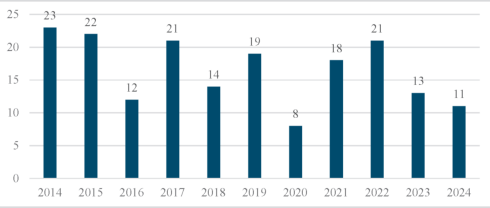
Chart 1: Amendments to administrative laws per year (2014-2024)
Source: author's construction
- 46/47 -
The most frequently amended law in the administrative areas under consideration is the Pension and Disability Insurance Act,[34] which was amended 13 times during the review period, with the peak in 2017 when it was amended three times in a single year. The Parental Protection and Family Benefits Act[35] and the Health Care and Health Insurance Act[36] were each amended six times. Taxation is also represented prominently. The following laws were adopted in 2006[37] and amended repeatedly over the period 2014-2024: the Personal Income Tax Act (amended ten times), the Corporate Income Tax Act (nine times), and the Value Added Tax Act and the Tax Procedure Act (seven times each).
These are not just random cases. The above laws concern key public budget inflows and outflows, reflecting significant macroeconomic issues at the national, EU, and even global competitiveness levels. However, a detailed examination of all amendments to the Pension and Disability Insurance Act and the Tax Procedure Act, the two most frequently amended administrative laws, shows that the reasons behind these changes vary. The Pension and Disability Insurance Act was amended multiple times to align minimum and guaranteed pensions with evolving EU-level economic conditions, to remove unconstitutional provisions, to improve the status of insured persons, and to transpose EU directives into Slovenian law. On the other hand, the Tax Procedure Act was most frequently amended to transpose EU directives, aiming to streamline tax procedures and enhance the enforcement of taxpayers' rights.
One notable example is the 2021 amendment[38] to the Pension and Disability Insurance Act, which aimed to eliminate inequality between insured persons eligible for disability benefits due to occupational diseases or injuries and those who, after 1 January 2008, were no longer eligible for disability benefits because their disability or disease had occurred outside work. Equality before the law is, in fact, a fundamental constitutional guarantee (Article 14), while Article 50 of the Constitution further ensures the right to social security. The said amendment also addressed disparities between those injured before and after 1 January 2013. Interestingly, this inequality had been the subject of a constitutional review petition, but the Constitutional Court rejected it by Decision U-I-129/17 (9 October 2017) because the petitioner had not exhausted all legal remedies. Thus, the legislator acted preventively to eliminate potential discriminatory provisions and prevent unconstitutionality. This example demonstrates that the role of the Constitutional Court as a 'negative legislator' can also have a deterrent effect.
- 47/48 -
3. Study of violations based on constitutional complaints 2014-2024
To identify administrative laws that were recently found inconsistent with the Constitution, a review of Constitutional Court decisions using the advanced search engine available on the Court's website regarding constitutional complaints was conducted. All cases with the following outcomes in constitutional complaints proceedings were included: rejection; establishment of a human rights violation; annulment or annulment ab initio; annulment with a suspensive time limit; establishment of invalidity of a regulation; establishment - not inconsistent with the Constitution/statute; establishment - inconsistent with the Constitution/statute; and other resolutions. Applying these parameters, the advanced search retrieved 101 decisions.[39] Of these, cases concerning purely organisational laws or ancillary administrative relations, such as the payment of administrative fees, were excluded. After this refinement, 84 relevant cases remained, all concerning laws amended as a result of the Constitutional Court's establishment of interference with constitutional guarantees, either primarily or including the procedural rights of the parties. Focusing on social security and taxes, a detailed case study analysis of twenty-one constitutional complaints specifically regarding these areas was conducted. The majority were taxation cases, with the highest concentration of cases concerning the Tax Procedure Act. In most constitutional complaints, complainants also submitted a parallel petition for review of the constitutionality of specific legal provisions.
The analysis revealed that the majority of cases resulted only in a review of the constitutional complaint, with relatively few accepted on the grounds of minor importance or a clear absence of constitutional rights violations. Likewise, most petitions for review of constitutionality were dismissed because they failed to raise significant legal issues or were rejected because the petitioner lacked legal standing. Ultimately, the Court established violations of constitutional guarantees in only three cases in the fields of social security and taxes/customs: two involved the Pension and Disability Insurance Act, and one involved the Tax Procedure Act, as examined in detail below.

Figure 1: Overview of constitutional cases considered in the study
Source: author's construction.
- 48/49 -
An analysis of case U-I-239/14, Up-1169/12 (26 March 2015) shows that the Pension and Disability Insurance Act was found inconsistent with Article 14 of the Constitution, which guarantees equality before the law, particularly in connection with the absence of legal protection. In this case, the applicant was denied a request to have her pension reassessed by including part of her salary that had been used to purchase internal shares in 1992. The Pension and Disability Insurance Institute rejected her application, arguing that the special law did not provide for pension reassessment under such circumstances, and that the applicant's right had already been decided with finality under Article 129 of the GAPA. The central issue here was the lack of a procedural rule - specifically, the absence of an extraordinary legal remedy within the Pension and Disability Insurance Act itself. With this decision, the Constitutional Court made it clear that the absence of extraordinary remedies in a law can lead to inconsistency with the Constitution, as it undermines equal treatment for all affected individuals. This decision has broader implications, highlighting the importance of ensuring that all administrative laws - not just the pension law -adequately regulate extraordinary remedies.
A similar finding arose in Up-195/13, U-I-67/16 (26 January 2017), where the Constitutional Court again identified the Pension and Disability Insurance Act as inconsistent with the Constitution due to the absence of extraordinary remedies. During the review, the Court pointed out that the procedure for pension assessments - and thus the determination of the facts of the case underpinning pension rights under the Pension and Disability Insurance Act (version in force from 1 January 2000 to 31 December 2012) - was governed by the provisions of the GAPA. The procedure and application of extraordinary remedies were not adapted to the specific requirements of pension assessment, meaning that the Act lacked a mechanism to correct potential errors that might affect pension entitlements. The Court questioned why the legislator assumed the general administrative framework was sufficient to protect pension rights.
The final case that was analysed, U-I-106/19, Up-190/17 (10 March 2022), involved the Tax Procedure Act and its inconsistency with Article 38 of the Constitution on personal data protection. The inconsistency lay in Article 20(5) of the Act, which defined the actual owner to be 'a natural person that is indirectly or directly a holder of shares which represent more than 25% in the initial capital of the legal person'. Although the National Assembly argued that this was a proportionate measure serving a legitimate public interest, the Constitutional Court abrogated the provision, reasoning that the public disclosure of such personal data could result in the stigmatisation of individuals as tax evaders.
In addition, cases of constitutional complaints dating back to 2004 were reviewed to compare findings over the years. In this period, the Constitutional Court identified a violation in only one case concerning social security. Case U-I-214/09, Up-2988/08 of 8 July 2010 shows that Article 3(3) of the Social Security Contributions Act[40] was inconsistent
- 49/50 -
with Article 14 of the Constitution. Article 3 of the Act, in fact, provided that severance payments paid upon termination of employment due to incompetence were subject to social security contributions, whereas this was not the case for severance payments paid upon termination of employment due to business reasons. The Court found a violation of Article 14 of the Constitution, as the provision in question led to the unequal treatment of workers, and no reasonable grounds were shown for the different treatments.
IV. Discussion
Law - particularly its constitutional and administrative aspects - and public administration as the set of actors carrying out public tasks most frequently intersect at the national level, where administrative relations are defined by law and implemented through individual administrative procedures. It is therefore essential that laws governing administrative relations include adequate constitutional guarantees to ensure good administration, including rights such as the right to be heard, to have access to one's own file, reasoning, and legal protection.[41] Regulations play a critical role in reinforcing confidence in the legal order and thereby ensuring the protection and respect of human rights and freedoms - but only if they are of high quality, enforceable, and durable. The process by which regulations are adopted is thus crucial, and it must be complemented by mechanisms and institutions that monitor policies, procedures, and objectives to promote the quality of regulation. This includes identifying and correcting anomalies in the legal order and amending or supplementing laws in ways that serve society and its institutional system.[42]
Analyses show that over the past decade, Slovenia has seen approximately 200 amendments to laws regulating administrative relations or providing the basis for administrative procedures. Laws were most frequently amended in areas such as social security (44 amendments) and taxes and customs (34 amendments). Contrary to expectations, there were no cases in which the Constitutional Court directly intervened and triggered an amendment solely on the grounds that a law was unconstitutional in terms of constitutional guarantees, particularly procedural rights, requiring correction by the executive or legislative branches. The present analysis shows that in most cases, the Constitutional Court dismisses constitutional complaints at the preparatory stage, often because the matter is deemed minor or no apparent violation of constitutional rights is found. However, violations of constitutional guarantees primarily appear in substantive rules, relating to specific conditions and rights or obligations within each administrative domain, as revealed through the Court's practice.[43]
- 50/51 -
This leads to an assumption that the level of awareness regarding the importance of constitutional rights in Slovenia is high. This can be attributed to several factors, including the country's longstanding tradition of the rule of law and administrative procedural rights,[44] as well as the established and proactive role of the Judiciary, particularly the Constitutional Court.[45] The Court's preventive function is especially evident in the law on pension and disability insurance, where legislative amendments are often motivated by presumed unconstitutionality of certain norms identified by the Court in other, analogous cases.[46]
Furthermore, the number of constitutional complaints lodged specifically in the administrative field - approximately ten per year - suggests that this avenue of judicial review is already effective per se, even though complainants only gain access to the Constitutional Court after first exhausting the available remedies, namely administrative appeal and administrative dispute. While the total number of constitutional complaints, particularly those challenging the constitutionality of laws underlying administrative decisions, is not insignificant, the number of successful complaints is extremely low. Over the past decade, only three cases were upheld by the Constitutional Court in the two administrative areas most commonly at issue (tax assessment and social transfers/insurance). Of the three cases, two concerned the same law on pension and disability insurance, where procedural shortcomings were identified, particularly the lack of available legal remedies, raising concerns under the principle of equality outlined in Articles 14 and 22 of the Constitution and the provisions of the GAPA.
The GAPA is a key regulation in Slovenia that establishes minimum standards of procedural safeguards, thereby operationalising the principle of good administration. It applies universally, regardless of the administrative area or type of administrative authority involved, functioning as an anti-fragmentation mechanism that gives concrete effect to Article 22 of the Constitution on the equal protection of rights.[47] In provisions where the GAPA directly establishes rights already defined by the Constitution - particularly within its fundamental principles - the principle of lex specialis derogat legi generali does not apply, as the Constitution always takes precedence over special laws. The Constitutional Court has consistently held that where special regulations exist, the legislature must ensure that any derogation from the GAPA is supported by a reasonable ground for deviation from the
- 51/52 -
general framework. This is especially important in matters related to participation rights, privacy, and legal protection.[48]
Respective analysis further revealed that the Pension and Disability Insurance Act, as a sector-specific law, failed to adequately regulate procedural rules. The mere reference to the application of GAPA provisions was insufficient to guarantee effective social protection, especially in cases involving the unsuccessful or delayed exercise of rights to public funds through extraordinary legal remedies. Here, the Constitutional Court played a significant role in shaping the interpretation of procedural rules across the broader administrative field, emphasising that the specificities of sector-specific laws must be implemented fully, not only through the partial application of general rules. The Constitutional Court also stressed the prohibition on using personal data contrary to the purpose of their collection, which has had a substantial influence on the legislator. The Court made it clear that the legislator cannot pursue its objectives - such as reducing tax debt - if doing so infringes upon privacy and information security. This decision is relevant not only for the Tax Procedure Act but also for all other sector-specific laws where the conflict between public and private interests is particularly pronounced, as is often the case in administrative relations.
Despite the fact that very few constitutional complaints succeed - both in absolute and percentage terms - it is notable that in recent years the Constitutional Court has repeatedly recognised the inconsistency of specific administrative laws with the Constitution. All such violations critically affect constitutional guarantees - concerning the legal protection and protection of personal data - that are also provided under international law and instruments such as the EU Charter of Fundamental Rights and the doctrine of good administration reflected in the case law of the Court of Justice of the EU.[49] The review of requests for constitutional review filed by the Administrative Court and the Supreme Court further shows that the most frequently challenged and infringed laws pertain to social security and taxes.
While it cannot be established that there is a systematic trend whereby laws are consistently amended as a direct result of the Constitutional Court's decisions, it is undeniable that the Court does exert influence on legislative changes. Notably, there is no higher body that can review or amend the Constitutional Court's decisions, and the legislator is obliged to follow and implement them. However, a persistent challenge remains: the legislator often does not immediately comply with the Court's decisions, and the Court has no sanctioning power or enforcement mechanism to compel the parliament to act more swiftly. Nevertheless, the Court can define a date for the implementation of its decisions, and its decisions carry the force of law, underscoring the significant authority of the Court's decision-making. In this respect, the Constitutional Court can rightfully be described as the guardian of fundamental human rights, striking down unconstitutional legal norms
- 52/53 -
and effectively shaping new legal standards. Its role in the system of checks and balances among the branches of power is crucial. As a negative legislator, it corrects constitutional deficiencies arising from the adoption of laws.[50]
In sum, replies to the initial research questions can be provided. Regarding the impact of the Constitutional Court's identification of constitutional violations on amendments to administrative law - particularly in the areas of social security and taxes - the survey results indicate that this impact is crucial for the rule of law, regardless of the rather rare breaches established in the given period. Nevertheless, a higher number of constitutional complaints, even in cases where proceedings are not initiated on the merits or end with the Court's rejection (ie, unconstitutionality is not established), influences the adaptation of the legal framework in line with the Court's decisions. This analysis of selected cases involving constitutional review - including constitutional complaints and petitions and requests for constitutional review - shows that violations of constitutional guarantees in administrative laws do indeed occur. Although successful constitutional complaints remain rare, occurring only approximately once every three years over the past decade, these cases consistently highlight recurring guarantees at risk, in particular, the equal protection of rights, the right to be heard, personal data protection, and the use of legal remedies. These findings address the second research question, identifying which constitutional guarantees - according to the Court's case law - are most frequently violated in special laws.
The study of the situation in Slovenia reveals the existence of a feedback loop between the adoption of legislation, its enforcement, and the subsequent need to improve or adjust the originally adopted laws. Similar studies conducted in comparable countries - such as Croatia or Hungary - would also be highly valuable, as they could help identify good practices, problematic patterns, and lessons learned within a region that is closely connected in terms of legal tradition, historical development, and EU membership. Such comparative insights would provide a stronger foundation for making better-informed decisions, both at the legislative level and within public administration, particularly regarding the implementation of laws and judicial review.
In conclusion, it is difficult to pinpoint exactly what improvements could be made to the legislative process itself to reduce the need for frequent amendments or abrogation. These are required by societal changes at the EU level and beyond, while mistakes are inevitable, and a corrective mechanism should always be in place. However, the legislator could enhance the quality of law-making by improving the process of drafting laws and amendments, ensuring the higher quality of regulations and reducing the need for constant revisions.
- 53/54 -
V. Conclusions
Law plays a crucial role in (administrative) legal systems belonging to the Germanic Rechtsstaat tradition, as is historically the case in Slovenia. Whenever public authorities exercise supremacy in intervening in the affairs of individuals (citizens, companies, etc.), even when granting rights or delivering public services, if this is done in an authoritarian manner, the legal structuring of administrative relations becomes a fundamental postulate of the rule of law, grounded in principles of equality and legal certainty or predictability.
In public administration, law - or normative rules and regulations - is often seen merely as an obstacle or as bureaucracy. However, under certain assumptions of better or smarter regulation, these norms are usually essential not only for ensuring legal certainty and coexistence within society but also for fostering administrative development. Legal aspects are relevant both at the methodological-procedural level - in the adoption, harmonisation, and re-regulation of regulations - as well as in their substantive orientation according to the field being regulated. Importantly, law should not be an end in itself; rather, it should contribute, through its certainty and its orientation towards justice, to predictable and aligned interests within a participatory democracy, thereby supporting better relations and reducing conflict in society. This dynamic explains why laws are constantly changing.
According to the study, Slovenian laws in general - and particularly in the fields of taxes and social security - have been evolving mainly due to recent societal changes. However, no systematic trend of amending laws specifically as a result of decisions of the Constitutional Court, as was initially assumed, was established. Still, it is undeniable that the Constitutional Court does influence legislative amendments. The study also shows that the Court's decisions have a significant preventive effect, by analogy to previous or related cases. On the other hand, ministries, as drafters and law-makers, often fail to comply with the decisions of the Court, or do not do so within the given time limits, and there is no instrument for the Court to exert more direct influence on parliament. This reflects the characteristics of a balanced system of separation of powers. ■
NOTES
* This contribution is based on the analysis presented at the ICON-S Central and Eastern European Chapter conference held at ELTE, Faculty of Law, Budapest, 29-30 May 2025, titled 'Individual Autonomy, Fundamental Rights, and Institutional Safeguards'. This article is a result of the basic research programme 'Development of an Efficient and Effective Public Administration System' (P5-0093). The authors acknowledge the financial support of the Slovenian Research and Innovation Agency.
[1] Ulrich Karpen, Helen Xanthaki (eds), Legislation in Europe: A Country by Country Guide (Hart 2020, Oxford, Portland, Oregon) 437.
[2] Christopher May, Adam Winchester, Handbook on the Rule of Law (Edward Elgar 2018, Cheltenham, Northampton).
[3] Polonca Kovač, Tone Jerovšek, Upravni postopek in upravni spor [Administrative Procedure and Administrative Dispute] (Faculty of Public Administration 2023, Ljubljana).
[4] Diana-Urania Galetta, Jacques Ziller, EU Administrative Law (Edward Elgar 2024, Cheltenham, Northampton) 205.
[5] Albin Igličar, Zakonodajna politika [Legislative Policy] (GV Publishing House 2021, Ljubljana).
[6] Jacob J. Meagher, 'Common Law Courts: The Judiciary as a Regulatory Mechanism' (2017) 12 (1) Journal of Comparative Law 108-147.
[7] Sebastian Nerad, 'Ustavno sodišče kot (pozitivni) normodajalec' ['Constitutional Court as a (Positive) Rules Maker'] in Ciril Ribičič (ed), Izzivi ustavnega prava v 21. stoletju [Challenges of Constitutional Law in 21. Century] (Faculty of Law 2017, Ljubljana).
[8] More in Albert Venn Dicey, Introduction to the Study of the Law of the Constitution (Macmillan 1885, London); Jeremy Waldron, 'The Rule of Law' in Edvard N. Zalta, Uri Nodelman (eds), The Stanford Encyclopedia of Philosophy (Metaphysics Research Lab, Stanford University 2023, Stanford CA).
[9] May, Winchester.
[10] Claudio M. Radaelli, Fabrizio De Francesco, Regulatory Quality in Europe (Manchester University Press 2007, Manchester).
[11] Karpen, Xanthaki. Cf. Matej Avbelj (ed), Komentar Ustave Republike Slovenije [Commentary of the Constitution of the RS] (New University, European Faculty of Law 2019, Ljubljana).
[12] More in Igličar.
[13] Franc Grad, Igor Kaučíč, Saša Zagore, Ustavno pravo [Constitutional Law] (Faculty of Law 2018, Ljubljana).
[14] Igličar.
[15] OECD, Regulatory Policy in Slovenia: Oversight Matters, OECD Reviews of Regulatory Reform (OECD Publishing 2018, Paris).
[16] See Stefanie A. Lindquist, Frank C. Cross, 'Stability, Predictability and the Rule of Law: Stare Decisis as Reciprocity Norm' in Charles Gardner Geyh, What's Law Got to Do With It? (Stanford University Press 2020, Stanford CA) 173-192.
[17] Council of Europe, The administration and you: Principles of administrative law concerning the relations between administrative authorities and private persons (Council of Europe Publishing 1996, Germany). Cf. Jean Bernard Auby (ed), Codification of Administrative Procedure (Bruylant 2013, Brussels).
[18] Benedict Kingsbury, 'The Concept of Law' (2009) 20 (1) The European Journal of International Law 23-57.
[19] Giacinto Della Cananea, Leonardo Parona. 'Administrative procedure acts in Europe: An emerging "common core"?' (2024) 16 (20) The American Journal of Comparative Law 1-56.
[20] Official Gazette of RS, No. 80/99. The GAPA has been amended multiple times. On these amendments and their critical consideration, see Polonca Kovač, 'Changing the general administrative procedure codification in Slovenia: between Austrian tradition, EU convergence and future social challenges' in Paolo Duret, Giovanna Ligugnana (eds), New Challenges for Administrative Procedure in Europe: A comparative Perspective (Edizioni Scientifiche Italiane 2021, Napoli) 175-208.
[21] Diana-Urania Galetta et al., The General Principles of EU Administrative Procedural Law (European Parliament 2015, Brussels).
[22] See, for example, Constitutional Court Decision U-I-6/13, Up-24/13 of 11. 2. 2016.
[23] See Kovač, Jerovšek; Avbelj.
[24] In this context, case law suggests that although sector-specific laws may not explicitly include the provisions and guarantees derived from Articles 138-146 of the GAPA, the GAPA nevertheless applies subsidiarily by virtue of the fundamental principles set out in Articles 8 and 9. For example, in its judgment X Ips 17/2023 of 30 November 2023, the Supreme Court of the Republic of Slovenia held that, under a constitutionally consistent interpretation, lex specialis - which provides that the competent authority shall decide in a summary procedure without hearing the parties - only regulates the extended procedural possibility for the authority to decide in a summary fact-finding procedure and does not prohibit the authority from conducting a special fact-finding procedure and hearing the parties. Accordingly, even in such cases, the authority is obliged to carry out a special fact-finding procedure under the GAPA and to hear the parties on the established facts if, within the context of summary fact-finding, omitting the hearing would result in an impermissible interference with the constitutionally guaranteed right under Article 22 of the Constitution.
[25] Official Gazette of RS, No. 105/06 et seq., adopted based on Art. 157 of the Constitution.
[26] Official Gazette of RS, No. 15/94 et seq., adopted based on Art. 153-156 of the Constitution.
[27] Kovač.
[28] Sebastian Nerad, 'Nepristojnost za presojo medsebojne skladnosti predpisov enakega ranga' ['Lack of competence to assess the mutual consistency of regulations of equal rank') in Komentar Ustave RS (2011), <https://e-kurs.si/komentar/nepristojnost-za-presojo-medsebojne-skladnosti-predpisov-enakega-ranga/> accessed 31 October 2025; cf. Avbelj.
[29] See more in Grad et al.; Nerad.
[30] See 'Republika Slovenija, Ustavno sodišče' <https://www.us-rs.si/sl> accessed 31 October 2025.
[31] See portal Tax-Fin-Lex, <https://www.tax-fin-lex.si/Supervizor/Arhiv> accessed 31 October 2025.
[32] National Assembly, Republic of Slovenia, <https://www.dz-rs.si/> accessed 31 October 2025.
[33] Searching by Constitutional Court case law may be undertaken at <https://www.us-rs.si/sl/zadeve-in-odlocitve/odlocitve> accessed 31 October 2025.
[34] Official Gazette of RS, No. 96/12 et seq.
[35] Official Gazette of RS, No. 26/14 et seq.
[36] Official Gazette of RS, No. 9/92 et seq.
[37] Official Gazette of RS, No. 117/06 et seq.
[38] Official Gazette of RS, No. 121/21.
[39] This total also includes multiple cases relating to the same law, eg the rights of war disabled persons; notably, 41 of the identified violations stem from the same year and revolve around the same issue, specifically the rights claimed by disabled beneficiaries who filed constitutional complaints.
[40] Official Gazette of RS, No. 5/96, 34/96, 3/98, 81/2000 in 97/01.
[41] Galetta; Ziller.
[42] Karpen, Xanthaki; Grad et al.
[43] Cases worth mentioning include asylum - see Decisions U-I-309/13, Up-981/13, of 14 January 2015, U-I-189/14-13, Up-663/14, of 15 October 2015, and U-I-68/16-8, Up-213/15, of 16 June 2016.
[44] In the territory of today's Slovenia, the codification of administrative procedure has been in force for over a century. What is known as the Steskov postupnik was introduced in 1923, followed in 1925 by the application of the Austrian GAPA. This was replaced by the Yugoslav GAPA in 1956 and the Slovenian GAPA in 1999. See Kovač 180ff.
[45] Nerad; Grad et al.; Avbelj.
[46] Beyond the analysis presented here, many additional examples from the legislative practice of the Republic of Slovenia can be cited - for instance, issues under the Construction Act concerning the determination of parties to procedures; the Enforcement of Criminal Sanctions Act, addressing the limits of ex lege determination in the summary fact-finding procedure; and the Real Estate Tax Act, raising constitutional concerns regarding the exclusion of the right to appeal.
[47] More in Avbelj.
[48] Galetta; Ziller.
[49] Galetta.
[50] Igličar; cf. Karpen, Xanthaki.
Lábjegyzetek:
[1] The author is (PhD), Professor at University of Ljubljana, Faculty of Public Administration, Ljubljana, Slovenia, https://orcid.org/0000-0002-7743-0514 (e-mail: polonca.kovac@fu.uni-lj.si).
[2] The author is (MSc), Researcher at Institute of Public-Private Partnership, Ljubljana, Slovenia (e-mail: kosecklavdija0@gmail.com).