

Branka Andjelkovic[1] - Tanja Jakobi[2] - Ljubivoje Radonjic[3]: Right Before Your Eyes, Yet Unnoticed - A Comparison of the Growth of Online Labour in Various Countries in Southeast Europe (Publico, 2024/1., 145-172. o.)
https://doi.org/10.32575/ppb.2024.1.7
Abstract
This paper focuses on the increasing prominence of digital labour platforms in the labour markets of Southeast Europe, and compares the supply of online labour from nine selected countries: Serbia, Romania, Hungary, Croatia, Bosnia and Herzegovina, Montenegro, Albania, North Macedonia, and Bulgaria. Digital labour platforms, as an innovative business model, play an important role in today's labour markets by linking the demand and supply of digital work. Southeast Europe is no exception to this trend, and has become an important supplier of online labour. With the impact of the Covid-19 pandemic, this and other new forms of employment further increased both globally and in Southeast Europe. Despite this trend, online labour often remains invisible and under the radar of national policymakers and regulators, as well as national statistical agencies, due to the globalised nature of online platforms.
This paper aims to shed light on the development of online labour in the countries studied, based on publicly available data collected through Gigmetar, a web scraping tool designed to monitor trends on the number, gender, incomes, and occupations of online workers.[1] The paper compares online labour from nine countries active on the most significant general digital labour platforms (Upwork, Freelancer, and Guru) from February 2022 to October 2022. The criteria
- 145/146 -
for the comparison include occupations,[2] gender and income. The analysis is based on the data of approximately 80% of the total number of active digital workers on the platforms under investigation.
The paper points out the similarities and differences in online labour between the countries of Southeast Europe. For example, the number of online workers increased in all the countries, with creative services and multimedia and software development comprising the most dominant occupations in each country. Moreover, men are more commonly represented in these digital markets than women. However, these generalities hide remarkable differences between the countries in terms of the number of online workers per capita, the comparative advantages of each country based on the composition of the online labour force in terms of professions, variations in the gender gap in income distribution, and the average hourly labour price demanded by workers.
The results of our analysis may provide useful information to national policy makers as they work to address the challenges in the labour market brought by technological advancements. This information can also be used to develop policies in areas such as labour rights, education and training, and gender equality.
Keywords: digital labour platforms, online labour, labour markets, Southeast Europe, Gigmetar
Introduction
Digital platforms can be understood as gigantic machines for organisationally and spatially reshaping the space of economic activity by connecting massive numbers of users/customers with service providers, advertisers, or other users.[3] Among the expanding array of digital platforms, digital labour platforms stand out as those that are primarily responsible for linking workers with businesses and clients to provide a diverse range of services by matching labour demand and supply. This feature distinguishes them from other digital platforms operating in various sectors of the economy.[4]
The literature typically identifies two types of digital labour platforms. The first type is referred to as "online web-based" platforms, which facilitate digitally transferable services like writing, editing, translating, and programming tasks through digital labour platforms.[5] The second type is known as "location-based" platforms, where workers perform various duties such as food delivery, taxi services, and home cleaning at a specific physical location.[6] As a result, workers who perform tasks through these platforms are usually categorised into
- 146/147 -
two groups: "online web-based" or digital online workers[7] with specialised skills (such as Upwork freelancers) and location-based online workers (such as Uber drivers). Piasna (2020) and other authors refer to these types of workers as "online" and "offline" online workers.[8]
The concept of platform work, regardless of whether it is performed online of offline, often involves the completion of limited and independent units of work. These units are known by various terms such as piecemeal, task-based, gig, or project-based work, as opposed to the continuous work typical of traditional employment contracts.[9] Furthermore, this type of work is characterised by a limitless career perspective, where individuals are responsible for developing their own careers and skills, rather than relying on employers to provide training and career advancement opportunities.[10]
The use of digital labour platforms is projected to grow significantly in the coming years, potentially challenging what is traditionally regarded as a " job".[11] As a result, digital platform work has garnered attention not only from academic researchers, but also from policy makers and the general public, who are concerned about its implications for individuals, and the social dynamics of work. Questions have been raised about the prevalence of digital platform work, its level of informality and the complexity of skills required, gender distribution, and income, among other issues.[12]
While many studies and legislative initiatives have focused on the location-based platform work which is prevalent in Western Europe,[13] this paper aims to shed light on online platform work,[14] which is more common in Southeast Europe.[15] Indeed, in terms of the proportion of their online platform workforce relative to their total population and workforce, Serbia and North Macedonia are continuously among the top-ranking countries in Europe and the world.[16] Furthermore, earlier studies such as that by Kuek et al. (2015) revealed that as early as 2013, Serbia and Romania were among the countries with the highest proportion of the workforce engaged in this type of work. Moreover, neighbouring countries have also begun to bolster their online digital workforce, albeit from a more modest starting point, as evidenced by Andjelkovic et al.'s (2022) research.[17]
This paper examines the growing significance of web-based digital labour platforms in the labour markets of Southeast Europe, and compares the supply of online platform work across nine selected countries, including Serbia, Romania, Hungary, Croatia, Bosnia and Herzegovina, Montenegro, Albania, North Macedonia, and Bulgaria.
- 147/148 -
To analyse the online platform labour in these countries, we focus on three criteria: occupations, gender, and income. Our aim is to provide national policymakers with valuable data to address various challenges posed by online platform work, such as labour rights, education and training, and gender equality. The paper is structured as follows: first, we provide a description of the methodology used; then, we present an analysis of the country data, highlighting similarities and differences between the countries; and finally, we present our conclusions. In this paper, we use the term online labour/workers to denote online freelancing performed on digital labour platforms.
Methodology
This paper interprets the results from Gigmetar, an instrument developed by the Public Policy Research Centre (PPRC) in 2019 with the aim of monitoring the number, gender, incomes, and occupations of online workers. Applying web scraping as a data collection method, which takes place at regular six month intervals, Gigmetar screens online workers at Upwork, one of the most popular digital labour platforms globally. Upwork is also the most prevalent platform in Serbia and in the majority of the neighbouring countries: Romania, Hungary, Croatia, Bosnia and Herzegovina, Montenegro, Albania, North Macedonia, and Bulgaria, i.e. the region of Southeast Europe.
The data collected in each period represent a relevant sample, comprising approximately 80% of the total number of active online workers on the platform studied in nine Southeast European countries.[18] The number of workers per capita by country takes into account the whole population of workers on Upwork as a sample.
This paper focuses on four cycles of Gigmetar findings, based on data collected in February 2021, August 2021, February 2022, and August 2022.
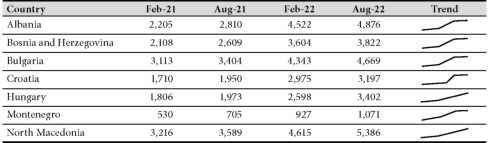
Table 1: The number of workers included in the measurements (by country and in total)
- 148/149 -

Source: Anđelković et al. 2021a; Anđelković et al. 2021b; Anđelković et al. 2022a; Anđelković et al. 2022b.
The first measurement (February 2021) comprised the data of 29,038 online workers in nine countries. The sizes of the samples per country were as follows: Albania - 2,205, Bosnia and Herzegovina - 2,108, Bulgaria - 3,113, Montenegro - 530, Croatia - 1,710, Hungary - 1,806, Romania - 5,881, North Macedonia - 3,216, and Serbia - 8,469 of online workers.
The second measurement (August 2021) collected the data for 32,546 online workers in nine countries. The samples per countries included: Albania - 2,810, Bosnia and Herzegovina - 2,609, Bulgaria - 3,404, Montenegro - 705, Croatia - 1,950, Hungary - 1,973, Romania - 6,769, North Macedonia - 3,589, and Serbia - 8,737 online workers.
The third measurement (August 2021) comprised the data of 42,748 online workers in nine countries. The samples per country were the following: Albania - 4,522, Bosnia and Herzegovina - 3,604, Bulgaria - 4,343, Montenegro - 927, Croatia - 2,975, Hungary - 2,598, Romania - 9,038, North Macedonia - 4,615, and Serbia - 10,126 of online workers.
The fourth measurement (August 2021) collected the data for 47,710 online workers in nine countries. The samples per countries included: Albania - 4,876, Bosnia and Herzegovina - 3,822, Bulgaria - 4,669, Montenegro - 1,071, Croatia - 3,197, Hungary - 3,402, Romania - 9,691, North Macedonia - 5,386, and Serbia - 11,596 online workers.
Findings
This chapter first presents the total population of online workers and the average number of online workers per 100,000 inhabitants, followed by a breakdown by gender. Finally, results on occupations,[19] average hourly rates[20] demanded, and earnings[21] broken down by gender are presented.
- 149/150 -
Population of online workers
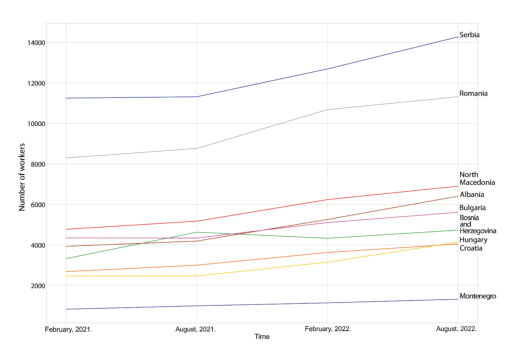
Figure 1: Number of online workers per country
Source: Anđelković et al. 2021a; Anđelković et al. 2021b; Anđelković et al. 2022a; Anđelković et al. 2022b.
Figure 1 shows the total online labour force of each country and their trends over two years. Serbia has by far the largest population of online workers in the region, and is followed only by Romania. North Macedonia and Albania are in the third and fourth place, respectively, and have almost the same number of online workers. Bulgaria, Bosnia and Herzegovina, Hungary and Croatia have more modest online labour forces. Montenegro has the smallest population of online workers, with the equivalent of only one-tenth of Serbia's online labour force.
Almost all the countries recorded an increase in the number of workers during the four periods measured, except for Bosnia and Herzegovina, which saw a slight decrease in its number of online workers between the second half of 2021 and the first half of 2022, and Bulgaria, which experienced a slight decrease in the number of online workers during the second half of 2021. In four out of the nine observed countries, the number of online workers doubled between the first (February 2021) and last measurement (February 2022) - in Hungary (+68.5%), Albania (+63.1%), Montenegro (+60.5%), and Croatia (+51.2%). In contrast, Bulgaria (+29.2%) and Serbia (+26.9%) saw a smaller increase in the online labour population between the two periods.
- 150/151 -
- 151/152 -
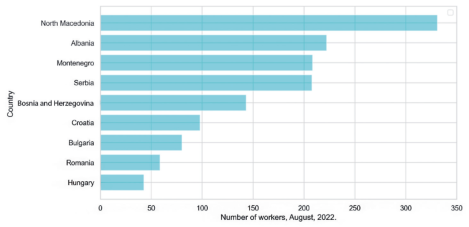
Figure 2: Number of online workers per 100,000 inhabitants per country
Source: Anđelković et al. 2021a; Anđelković et al. 2021b; Anđelković et al. 2022a; Anđelković et al. 2022b.
In summary, Serbia boasts the largest population of online workers in the region, while Montenegro has the smallest. With the exception of Bosnia and Herzegovina and Bulgaria, most countries have experienced an increase in the number of citizens doing online labour. These findings point to a growing trend of online work in the region, which could have significant implications for labour markets and policies. However, further research is necessary to fully understand its impact on national markets.
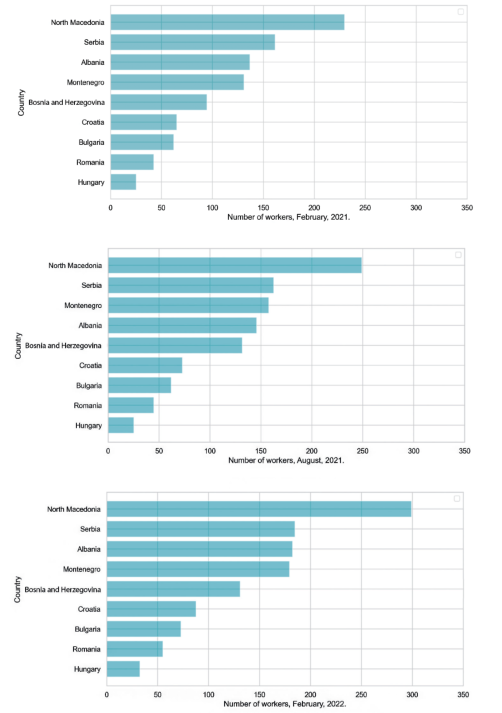
Differences in the total number of online workers between the countries can primarily be attributed to differences in population size and the overall labour market of the observed countries. As such, a more accurate representation of gig work in the region can be obtained by calculating the average number of online workers per 100,000 inhabitants and better reflects the relative share and importance of platform work in a country's economy. As Figure 2 (above) shows, Hungary, Romania, Bulgaria, and Croatia consistently reported the lowest proportion of online workers per capita, despite an increase in the number of online workers over the course of the four measurements. In contrast, North Macedonia had the highest number of online workers per capita, with approximately 230 online workers per 100,000 inhabitants in February 2021 and 331 workers per capita in August 2022. In the first three measurements, Serbia ranked second after North Macedonia, but during the last measurement in August 2022, Albania recorded the second largest population of online workers per 100,000 inhabitants with approximately 222 online workers per capita.
- 152/153 -
Montenegro ranked third with approximately 208 online workers per capita, while Serbia fell to fourth place with approximately 207 online workers per capita. The findings are corroborated by similar research carried out by the OLI (2022) and the European Training Foundation (2022).
The data presented in this paper suggest that platform work is more popular in less developed countries, as evidenced by the highest number of online workers per capita being recorded in these countries. In contrast, the more developed countries in the observed group, such as Hungary, Croatia, Romania, and Bulgaria, have the lowest number of online workers per capita. However, it is important to exercise caution in drawing conclusions in this regard, since the labour markets in countries such as Hungary, Romania, and Bulgaria are known to have a higher penetration by other general platforms than Upwork.
The significant number of workers per capita in the less developed countries of Southeast Europe suggests that platform work still represents a viable alternative to jobs offered in the traditional labour market.
Gender representation
One of the common features of online platform work in all countries is the overrepresentation of men compared to women in the sector, as Figure 3 shows. Indeed, in some countries, such as Bosnia and Herzegovina, men dominate the online labour to a significant extent. Despite a slight decrease in the proportion of men on the Upwork platform since the first measurement, when men made up about 74.4% of the total workforce, men still represented around 68.3% of the online labour population in Bosnia and Herzegovina in August 2022. Similarly, relatively high participation rates of men can be observed in Serbia (67.2%), Hungary (67.1%), and Croatia (65.8%) based on the latest measurement.
Conversely, Albania is a country where there is a smaller gender gap in the participation of men and women in online gig work. According to the latest measurement (August 2022), women represented 41.4% of the gig worker population in this country. In February 2022, the participation of women in Albania was even higher at 43.1%. Considering that Albania stands out as a country with a significant number of online workers per capita and a relatively higher level of participation of women in the market, it appears that platform work in this country is becoming more attractive for women. This might be related to the World Bank intervention in this country entitled "Digital Jobs Albania" promoting digital entrepreneurship among women.
- 153/154 -
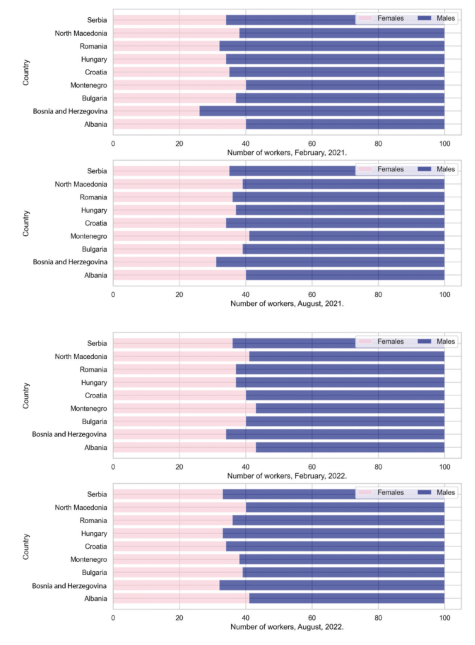
Figure 3: Share of women and men in the "gig worker" population by country
Source: Anđelković et al. 2021a; Anđelković et al. 2021b; Anđelković et al. 2022a; Anđelković et al. 2022b.
- 154/155 -
Occupations
Based on the data in Figure 4 below, it can be concluded that two groups of professions were dominant in the online labour sector throughout the observed period of time in all of the countries. These professions are software development and creative services and multimedia. However, the distribution of certain occupations varies significantly by country, with some countries showing greater proportions in certain fields.
For example, Albania, Montenegro, Hungary, Romania and North Macedonia have comparatively higher proportions of online workers in the field of professional services, which has been maintained throughout the observed period. In the domain of clerical and data entry occupation, Albania, North Macedonia, and Serbia stand out compared to the regional average.
With regards to the highly valued occupations represented in the creative services and multimedia, and software development, workers from Bosnia and Herzegovina, Montenegro, Croatia and Serbia are the forerunners. In the field of sales and marketing, online workers in Albania, Bulgaria, Croatia, Hungary, and Romania comprise a greater proportion than elsewhere. Finally, workers from Bosnia and Herzegovina, Bulgaria, Montenegro, Croatia, Hungary, and Romania stand out in the field of writing and translation.
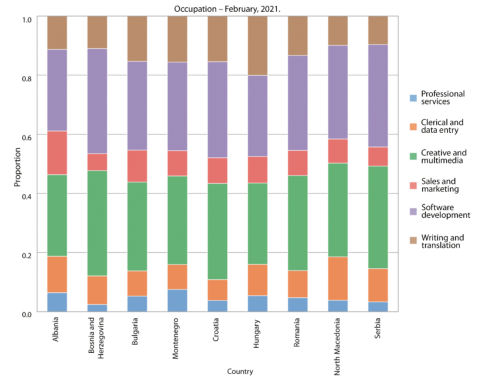
- 155/156 -
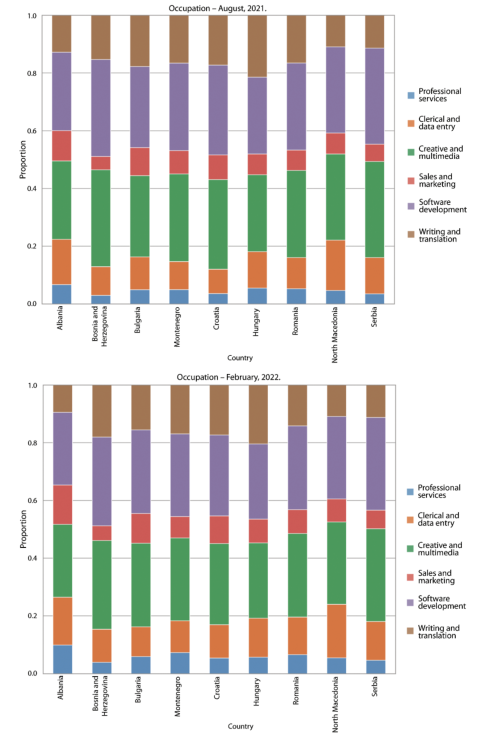
- 156/157 -
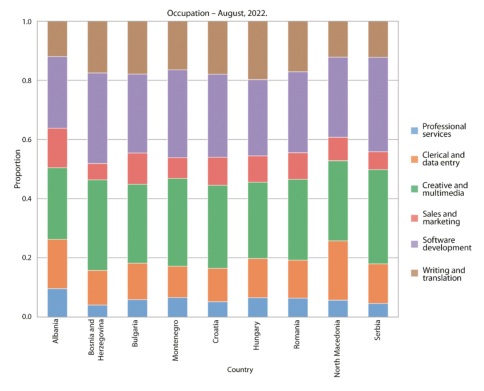
Figure 4: Share of OLI occupation in online workforce, by country
Source: Anđelković et al. 2021a; Anđelković et al. 2021b; Anđelković et al. 2022a; Anđelković et al. 2022b.
Overall, the data indicate that certain countries are better represented in specific fields or occupations in terms of online labour than others. These differences may reflect the varying strengths and skills of their workforce, as well as their economic and political environment. Generally speaking, software development, creative services and multimedia, and professional services are considered higher-paid occupations, whereas writing and translation, sales and marketing, and clerical and data entry are regarded as lower-paid professions.[22]
Therefore, having a comparative advantage in lower-paid professions implies more of a disadvantage than an advantage for the labour force in the given country.
- 157/158 -
Average hourly rates
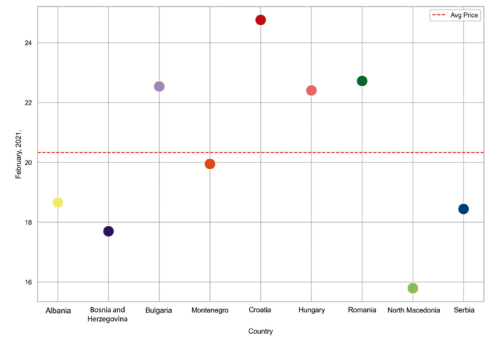
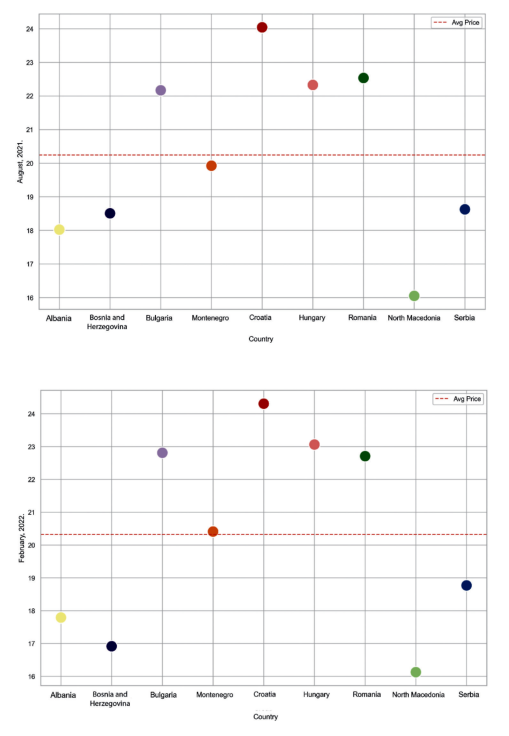
Figure 5 displays the discrepancy in the average hourly rates demanded by online workers across the different countries surveyed. On average, Croatia is recognised as having the most expensive workforce, with one exception recorded in the latest measurement when Hungary's average demanded hourly rates were slightly higher. Namely, the web-based platform economy in Hungary experienced an increase in average hourly rates from February 2021 to August 2022. Aside from Croatia and Hungary, two other countries - Bulgaria and Romania - had relatively higher average hourly rates of pay compared to the regional average in all four measurements. There was also indicative growth in Montenegro, with online workers potentially earning higher hourly rates compared to the regional average in the last two measurements. For the first two measurements, the average hourly rates in Montenegro were lower than the regional average.
In contrast, online workers in Serbia, Albania, Bosnia and Herzegovina, and North Macedonia demanded on average lower hourly rates than the regional average during each of the four measurements. Northern Macedonia was found to be the country with the lowest demanded hourly rates for online workers. Hypothetically, if a Hungarian freelancer worked 176 hours in August 2022 (the number of possible work hours in regular employment) and earned an average online worker income, he/she would have earned approximately $1,373 more than his/her counterpart in North Macedonia, assuming both worked on the same task and for the same number of hours.
- 158/159 -
- 159/160 -
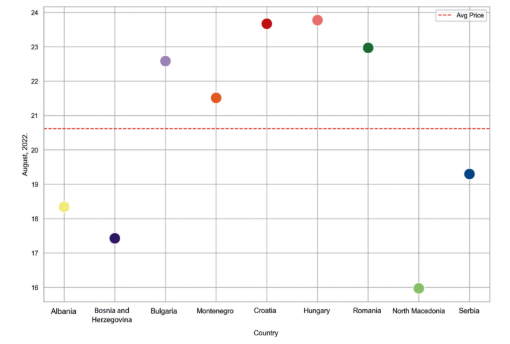
Figure 5: The average hourly rates by country
Source: Anđelković et al. 2021a; Anđelković et al. 2021b; Anđelković et al. 2022a; Anđelković et al. 2022b.
Generally speaking, this sharp division between the two groups of countries reflects their position within or outside of the European Union, and suggests that online workers living in countries with higher living standards demand higher average hourly rates. However, it is important to note that requesting a higher hourly rate does not necessarily mean that these rates are actually paid.
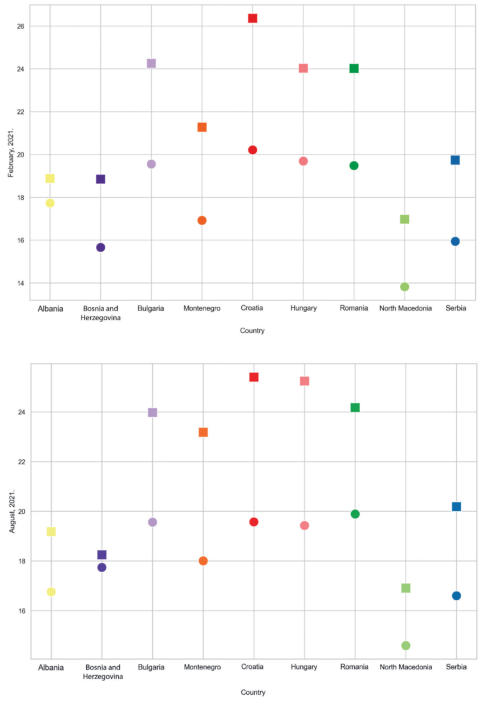
Figure 6 illustrates the disparity in average hourly rates between men and women across the observed countries. The largest differences in average hourly rates demanded by men and women are observed in the countries with relatively higher total average hourly rates, including Croatia, Hungary, Bulgaria, Romania, and Montenegro. In contrast, countries such as Albania, North Macedonia, Bosnia and Herzegovina, and Serbia exhibited slightly smaller differences. The greatest convergence in average hourly rates demanded by male and female online workers is observed in Albania, which could be a result of the relatively higher participation of women in the gig economy of that country.
- 160/161 -
- 161/162 -
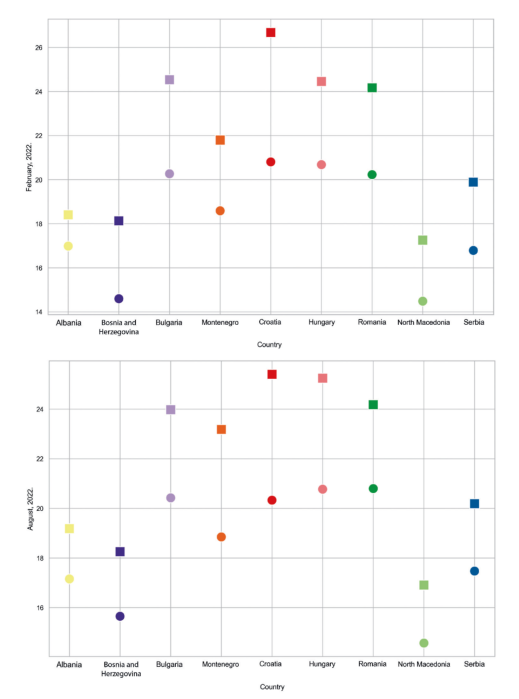
Figure 6: The average hourly rates between women and men, by country
Source: Anđelković et al. 2021a; Anđelković et al. 2021b; Anđelković et al. 2022a; Anđelković et al. 2022b.
- 162/163 -
Earnings
Figure 7 depicts the earnings of online workers across the observed countries for each of the four measurement periods. The level of earnings differs significantly by country. Notably, the largest proportion of income on the platform is generated by online workers from Serbia and Romania, primarily due to the larger numbers of online workers in those countries. Conversely, workers from Montenegro earn the smallest share of earnings on platforms compared to the other countries. To compare the differences between countries, it is worth noting that the incomes obtained by online workers from Montenegro in August 2022 were only around 10% of the earnings achieved by online workers from Serbia in the same period.
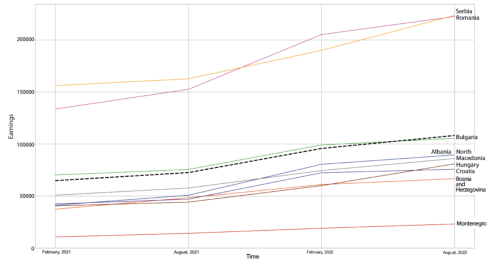
Figure 7: Average earnings of online workers, by country
Source: Anđelković et al. 2021a; Anđelković et al. 2021b; Anđelković et al. 2022a; Anđelković et al. 2022b.
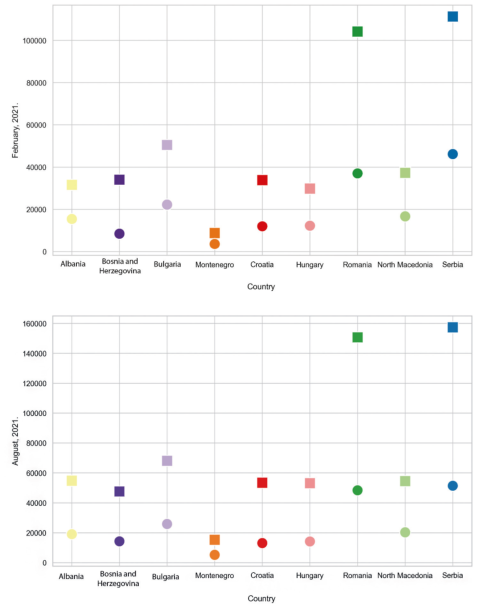
One similarity across all nine countries is that men earn higher incomes than women for performing online labour, as Figure 8 shows. However, the income gaps between men and women vary between these countries. The results over the four periods indicate that the greatest absolute difference in realised incomes between men and women is observed in Serbia and Romania. This difference may be attributed to the greater representation of men in higher-paying professions, such as software development, which have higher average hourly rates. In all the countries surveyed, men were able to earn higher incomes by working on the platform due to the higher average hourly rates they demanded.
Comparing the latest measurement from August 2022 with the first measurement from February 2021, there was an overall increase in the income gap between men and women in
- 163/164 -
all countries. Data from August 2022 indicate that in five out of the nine countries studied (Bosnia and Herzegovina, Croatia, Hungary, Romania, and Serbia), women cannot earn even half of the income earned by men. According to the latest measurement, women in Montenegro achieved 50.8%, in Bulgaria 54.9%, and in North Macedonia 57.6% of the total income achieved by men. Only in Albania did women earn more than 60% of the income earned by men. It is also important to note that the greatest convergence in average hourly rates between men and women was recorded in Albania, which may significantly affect income distribution.
- 164/165 -
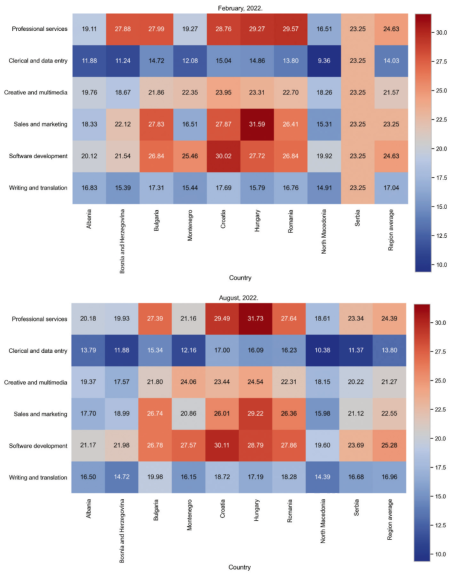
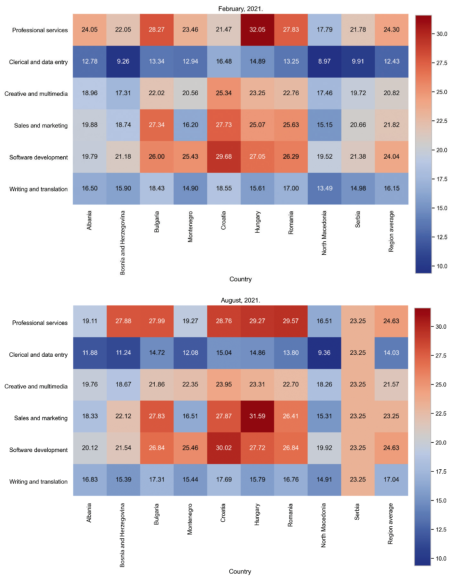
Figure 8: Average earnings of online workers by occupations (by country and regional average)
Source: Anđelković et al. 2021a; Anđelković et al. 2021b; Anđelković et al. 2022a; Anđelković et al. 2022b.
When considering average hourly rates by occupation, workers within certain groups of occupations typically have higher rates regardless of their countries of origin. Indicatively, workers in professional services and software development generally demand
- 165/166 -
higher hourly rates for their services than workers in other fields. In contrast, the lowest average hourly rates are sought by workers in the fields of writing and translation and in clerical and data entry. From the country perspective, Figure 8 shows that in almost all the observed groups of occupations, workers from Hungary, Croatia, Bulgaria, and Romania have the potential to gain the highest hourly rates for their work on the platform.
- 166/167 -
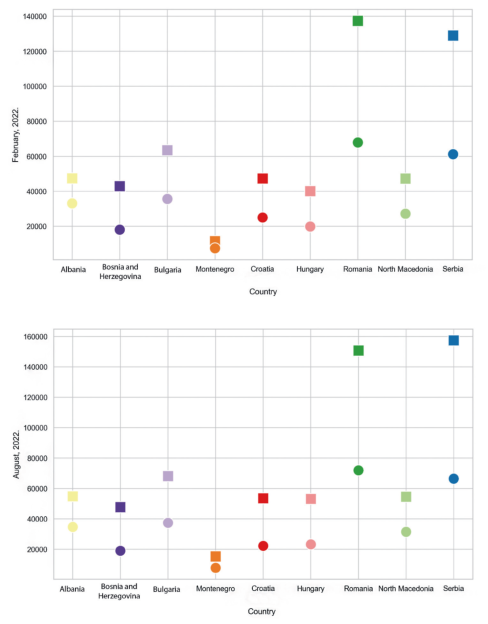
Figure 9: Earnings by women and men in observed countries
Source: Anđelković et al. 2021a; Anđelković et al. 2021b; Anđelković et al. 2022a; Anđelković et al. 2022b.
- 167/168 -
To summarise, the biggest earning gap between women and men was recorded in Bosnia and Herzegovina, where women made only 38.9% of men's earnings. The greatest convergence was observed in Albania, where women were able to earn 63.8% of the total income achieved by men.
Conclusion
The article discusses the trends of online work in 9 Southeast European countries (Albania, Bosnia and Herzegovina, Bulgaria, Croatia, Hungary, Montenegro, North Macedonia, Romania, and Serbia) over the period of 2021/2022. The data presented in this paper indicate a general increase in the number of online workers in most of the countries studied, with some countries doubling their online labour force in two years. There is also a higher number of online workers per capita in the less developed countries of the region, suggesting that platform work is more popular in these environments. The overrepresentation of men in the online labour workforce is also observed in all countries, with some countries having a larger gender pay gap than others. The article also highlights the dominant fields of professions in all the countries, indicating those that have comparative "advantages" in certain fields.
The results echo findings from other studies that suggest the majority of workers on digital labour platforms are from low- and middle-income countries.[23] It is important to note that the ability of online workers from less developed countries to enter the global labour market through online labour platforms is neither positive nor negative, as other factors such as occupation, average hourly rates, and earnings must also be considered. Furthermore, while studies show that the digital market operates globally, with workers with similar skills and experience considered good substitutes for each other, regardless of location,[24] this paper reveals that earnings for performing similar tasks vary significantly even among the countries within the same geographic region. These differences cannot be explained solely by purchasing power parity and suggest that other economic and political factors also play a role.
The gender pay gap is also clearly demonstrated in the results of this paper. Even in countries like Albania, where there is a smaller difference in earnings between the genders, the divide between men and women is considerable. This indicates that a broad array of factors influence this divide. Improving the level of digital skills among women is only part of the solution to enhancing their representation in the labour market in general.
The observed differences in the nature of online platform work in the region highlight the need for tailored policies that consider the unique characteristics of each country. To do so, and as a next step, there is a need to better understand the interplay between the online and traditional labour markets in these countries. Based on these and similar insights,
- 168/169 -
policymakers can craft targeted interventions and initiatives aimed at fostering inclusivity and levelling the playing field for all members of the labour force.
Finally, it should be acknowledged that this article is not without limitations. The study provided insights into the supply of the online platforms' labour force but it did not investigate the demand for online workers. Future research should find ways to include the demand for workers to compare both the supply and demand of labour on online digital platforms. Additionally, although the analysis is based on data from the most popular online platform in the observed countries, it does not fairly represent other popular platforms that could provide a more detailed picture of online gig work in these markets. Furthermore, the study covers the period of 2021/2022, providing a snapshot of the online labour markets during that time. In this regard, continuous analysis is essential to capture long-term trends in online work, which is highly dynamic and is influenced by factors such as economic conditions, technological advancements, and regulatory changes.
References
Aleksynska, Mariya (2021): Digital Work in Eastern Europe: Overview of Trends, Outcomes and Policy Responses. ILO Working Paper 32. Geneva: ILO.
Anđelković, Branka - Jakobi, Tanja (2022): Embracing the Digital Age: The Future of Work in the Western Balkans - Serbia. European Training Foundation. Online: https://www.etf.europa.eu/en/document-attachments/embracing-digital-age-future-work-western-balkans-serbia
Anđelković, Branka - Jakobi, Tanja - Ivanović, Vladan - Kalinić, Zoran - Radonjić, Ljubivoje (2021a): Gigmetar Region. Public Policy Research Center. Online: http://gigmetar.publicpolicy.rs/en/region4-2/
Anđelković, Branka - Jakobi, Tanja - Ivanović, Vladan - Kalinić, Zoran - Radonjić, Ljubivoje (2021b): Gigmetar Region. Public Policy Research Center. Online: http://gigmetar.publicpolicy.rs/en/region5-2/
Anđelković, Branka - Jakobi, Tanja - Ivanović, Vladan - Kalinić, Zoran - Radonjić, Ljubivoje (2022a): Gigmetar Region. Public Policy Research Center. Online: http://gigmetar.publicpolicy.rs/en/region-en-2022-1/.
Andelković, Branka - Jakobi, Tanja - Ivanović, Vladan - Kalinić, Zoran - Radonjić, Ljubivoje (2022b): Gigmetar Region. Public Policy Research Center. Online: http://gigmetar.publicpolicy.rs/en/region-en-2022-1/.
Cedefop (2020): Developing and Matching Skills in the Online Platform Economy: Findings on New Forms of Digital Work and Learning from Cedefop's CrowdLearn Study. Luxembourg: Publications Office of the European Union. Online: https://doi.org/10.2801/588297
- 169/170 -
Čoloyić, Petar - Anđelkoyić, Branka - Jakobi, Tanja (2021): How Many Online Workers Are There in Serbia? First National Assessment of the Number of the Online Workers on Global Digital Platforms. Belgrade: Public Policy Research Center. Online: https://publicpolicy.rs/publikacije/bac4e207bba2e8a9fa84e063c954710e02b375ce.pdf
Forrier, Anneleen - Sels, Luc - Stynen, Dave (2010): Career Mobility at the Intersection between Agent and Structure: A Conceptual Model. Journal of Occupational and Organizational Psychology, 82, 739-759. Online: https://doi.org/10.1348/096317909X470933
Graham, Mark - Anwar, Mohammad (2019): The Global Gig Economy: Towards a Planetary Labour Market? First Monday, 24(4). Online: https://doi.org/10.5210/fm.v24i4.9913
ILO (2021): World Employment and Social Outlook 2021: The Role of Digital Labour Platforms in Transforming the World of Work. Geneva: International Labour Office. Online: https://www.ilo.org/global/research/global-reports/weso/2021/WCMS_771749/lang-en/index.htm
Kenney, Martin - Zysman, John (2019): The Platform Economy and Geography: Restructuring the Space of Capitalist Accumulation. Online: https://papers.ssrn.com/sol3/papers.cfm?abstract_id=3497978
Kenney, Martin - Zysman, John - Bearson, Dafna - Carlton, Camille (2023): 13. Spatial Implications of the Platform Economy: Cases and Questions. In Bianchi, Patrizio - Labory, Sandrine - Tomlison, Philip R. (eds.): Handbook of Industrial Development. [s. l.]: Edward Elgar, 215-231. Online: https://doi.org/10.4337/9781800379091.00023
Kuek, Siou C. - Paradi-Guilford, Cecilia - Fayomi, Toks - Imaizumi, Saori - Ipeirotis, Panos - Pina, Patricia - Singh, Manpreet (2015): The Global Opportunity in Online Outsourcing. The World Bank Group. Online: https://econpapers.repec.org/paper/wbkwboper/22284.htm
Lehdonyirta, Vili - Kässi, Otto - Hjorth, Isis - Barnard, Helena - Graham, Mark (2019): The Global Platform Economy: A New Offshoring Institution Enabling Emerging-Economy Microproviders. Journal of Management, 45(2), 567-599. Online: https://doi.org/10.1177/0149206318786781
Mandl, Irene - Kilhoffer, Zachary - Lenaerts, Karolien - De Groen, Willem P. (2018): Employment and Working Conditions of Selected Types of Platform Work. Eurofound Research Report. Luxembourg: Publications Office of the European Union. Online: https://doi.org/10.2806/42948
McDonnell, A. - Carbery, R. - Burgess, J. - Sherman, U. (2021): Technologically Mediated Human Resource Management in the Gig Economy. The International Journal of Human Resource Management, 32(19), 3995-4015. Online: https://doi.org/10.1080/09585192.2021.1986109
Miles, Raymond E. - Snow, Charles C. (1996): Twenty-First-Century Careers. In Arthur, Michael B. - Rousseau, Dennis M. (eds.): The Boundaryless Career: A New
- 170/171 -
Employment Principle for a New Organizational Era. New York: Oxford University Press, 97-115. Online: https://doi.org/10.1093/oso/9780195100143.003.0006
Moniz, António B. - Boayida, Nuno - Makó, Csaba - Krings, Bettina J. - Miguel, Pablo S. D. (2021): Digital Labour Platforms: Representing Workers in Europe. Vila Nova de Famalicão: Húmus'CICS.NOVA. Online: https://doi.org/10.34619/rwrm-3uun
OLI (2018): Online Labour Index. Online: http://onlinelabourobservatory.org/oli-supply/
Pajarinen, Mika - Rouyinen, Petri - Claussen, Jörg - Hakanen, Jari - Koyalainen, Anne - Kretschmer, Tobias - Poutanen, Seppo - Seifried, Mareike - Seppänen, Laura (2018): Upworkers in Finland: Survey Results (ETLA Reports No. 85). The Research Institute of the Finnish Economy. Online: https://econpapers.repec.org/paper/rifreport/85.htm
Piasna, Agnieszka (2020): Counting Gigs: How Can We Measure the Scale of Online Platform Work? ETUI Working Paper. Brussels: ETUI. Online: https://doi.org/10.2139/ssrn.3699350
Piasna, Agnieszka - Zwysen, Wouter - Drahokoupil, Jan (2022): The Platform Economy in Europe: Results from the Second ETUI Internet and Platform Work Survey (IPWS). (SSRN Scholarly Paper No. 4042629). Online: https://doi.org/10.2139/ssrn.4042629
Schor, Juliet B. - Vallas, Steven P. (2023): Labour and the Platform Economy. In Heydari, Babak - Ergun, Ozlem - Dyal-Chand, Rashmi - Bart, Jakov (eds.): Reengineering the Sharing Economy: Design, Policy, and Regulation. Cambridge: Cambridge University Press, 83.
Branka Andjelkovic is the Co-founder and Programme Director of a reputable think tank, the Public Policy Research Centre based in Belgrade, Serbia. Her research interests encompass labour market institutions, employment relations, and the economy of innovation in the context of digital transformation and Industry 5.0. Branka is the lead author and editor of several pioneering studies about the platform economy and the future of work in Serbia and Southeast Europe. In 2020 she joined the Fairwork project, and has acted as the Principal Investigator for Serbia since then. With extensive experience, Branka has participated as a researcher in various international projects and has also worked as a senior expert in international development for the EU and UN. She holds an MA in public administration from Harvard University (USA), and a BA in the theory of literature from the University of Belgrade (Serbia).
Tanja Jakobi is the Executive Director of the Public Policy Research Center, and a researcher specialising in labour markets, workplace discrimination, and the intersection of technology with work. Her research spans transitioning economies, poverty reduction, and labour market access for marginalised groups. Currently,
- 171/172 -
her research delves into the impact of new technologies on labour markets, shifts in employment contracts, and the rise of new forms of work. This includes investigating online and on-location platform-based work, remote work arrangements, and addressing concerns related to data privacy in the era of artificial intelligence, as well as the use of workplace monitoring technology. Tanja Jakobi holds an MA in business journalism from Baruch College (US) and a BA in philosophy from the University of Belgrade (Serbia).
Ljubivoje Radonjic is a Teaching Associate at the State University of Novi Pazar. He is also a Research Assistant at the Faculty of Economics of the University of Kragujevac where he is currently doing a doctoral dissertation. In his thesis, he writes on the interrelationship between innovations and economic growth in the European region's context. His research interests are primarily focused on innovation economics and regional inequalities but also span labour economics, platform economy, and platform work. As an author and co-author, he has written on the field of the digital economy, platform work, institutional economics, and economic theory and growth. He has been a research coordinator in numerous national and international projects. He holds an MSc in economics from the Faculty of Economics, University of Kragujevac, Serbia. ■
NOTES
[1] See: https://gigmetar.publicpolicy.rs/en/1538-2/
[2] Occupations are defined according to the Online Labour Index (OLI) classification, allowing the comparison between the selected countries and others.
[3] Kenney et al. 2023; Kenney-Zysman 2019.
[4] ILO 2021: 43.
[5] Graham-Anwar 2019.
[6] Pajarinen et al. 2018; Mandl et al. 2018: 3; ILO 2021: 31.
[7] Aleksynska 2021.
[8] Piasna 2020.
[9] McDonnell et al. 2021.
[10] Forrier et al. 2009; Miles-Snow 1996.
[11] Schor-Vallas 2023: 83.
[12] Piasna 2020; McDonnell et al. 2021; Moniz et al. 2021; Andjelkovic-Jakobi 2022.
[13] Piasna-Zwysen-Drahokoupil 2022.
[14] In this paper, we use the term online web-based work and online platform work interchangeably.
[15] Čolović-Andjelkovic-Jakobi 2021.
[16] See: http://onlinelabourobservatory.org/oli-supply/
[17] Kuek et al. 2015; See: https://gigmetar.publicpolicy.rs/en/region-en-2022-2/
[18] The analysis of the characteristics of gig work in these countries is based on the sample composed of 80% of the total number of active digital workers on the Upwork in nine Southeast European countries. The data are collected by the web scraping of publicly available information at worker profiles on the selected platform. Around 20% of the workers remain invisible since their profiles are locked for the public.
[19] The occupations of the workers are classified according to the Online Labour Index methodology comprising 6 groups of occupations: 1 - Professional services, 2 - Clerical and data entry, 3 - Creative and multimedia, 4 - Sales and marketing, 5 - Software development and technology, 6 - Writing and translation.
[20] The average hourly rate represents a starting value of the price demanded per hour by a freelancer for his/her work on the platform.
[21] Earnings represent the income that online workers have gained during the observed period. The earnings presented are lifetime earnings encompassing the total income that workers have generated from the moment they opened their profile on the platform until the moment of data retrieval. The calculation of average earnings includes workers who had not generated any income at the time of measurement.
[22] Cedefop 2020.
[23] Lehdonvirta et al. 2019.
[24] Lehdonvirta et al. 2019.
Lábjegyzetek:
[1] The author is Co-Founder and Programme Director, Public Policy Research Centre, Belgrade, Serbia, b.andjelkovic@publicpolicy.rs
[2] The author is Executive Director, Public Policy Research Centre, Belgrade, Serbia, t.jakobi@publicpolicy.rs
[3] The author is Teaching Associate, State University of Novi Pazar, Novi Pazar, Serbia, ljradonjic@np.ac.rs