

Melinda Pintér[1]: Measuring the Implementation of Deliberative Practices in Decision-Making (Publico, 2024/2., 147-172. o.)
https://doi.org/10.32575/ppb.2024.2.8
Abstract
According to deliberative democracy theories, decisions taken by citizens through deliberation have greater legitimacy for those concerned. It may therefore be worth examining to what extent and at what level the decisions and recommendations of deliberative bodies are taken into account in the decision-making process of a given country. The paper presents a metric which, based on the analysis of specific aspects - the embeddedness of already implemented practices in decision-making, their deliberative level and the scope of the practices - indicates the extent to which a given country applies the results of deliberative bodies' deliberations to the decision-making process. The metric was tested on a sample of 27 EU Member States and four groups were identified in terms of the embeddedness of deliberative practices in decision-making: Laggards, Emergers, Aspirers and Exemplaries.
Keywords: decision-making, deliberative democracy, deliberative practices, international comparison, metrics
Introduction
The main purpose of involving citizens in decision-making in representative systems is to cure the ills of democracy, real or perceived, through more democracy. Recent decades have seen the emergence of a number of democratic innovations, i.e. practices or methods aimed at deepening citizens' involvement in political decision-making, most of which emphasise the role of deliberation as a central element of deliberative democracy. This is no coincidence, since deliberative democratic theory is based on the idea that a collective decision taken by citizens on the basis of rational argumentation has greater legitimacy; it is therefore not surprising that more and more countries are channelling the results of
- 147/148 -
deliberation into the decision-making process, or are using deliberation directly at multiple levels of decision-making. Not only has the European Union articulated the importance of deliberative practices in a Recommendation,[1] but the OECD has also published a report[2] on how deliberative practices can be implemented into existing decision-making structures.
The central question of this paper, therefore, is whether it is possible to create a metric that can measure the extent to which the results of deliberative bodies are incorporated into decision-making, since the methodological measurement of democracy or of certain aspects of it can be very difficult to carry out. The purpose of this paper is to present a metric that measures the level of employment of deliberative democratic practices in decision-making in a particular country, based on the extent to which the deliberative practices already used by the given country are embedded in decision-making, the deliberative level of these practices, and their scope of practice. The main purpose of the metric is to make it possible to compare the degree to which different countries have incorporated deliberative practices into their decision-making processes.
The paper first introduces the theoretical and interpretative framework of the topic: the reasons for and objectives of citizens' involvement in decision-making in representative democracies, democratic innovations and the paradigm of deliberative democracy, followed by a discussion of deliberative practices in decision-making and the methodological difficulties of measuring democratic processes. This is followed by a detailed description of the methodology associated with the metric and the process of applying the metric in practice. In relation to this, the paper presents the results of an analysis of a sample of the 27 EU Member States to illustrate the practical application of the metric in the field of deliberative democratic practices in decision-making, allowing conclusions to be drawn on the applicability and validity of the metric in practice. The paper also discusses and attempts to answer the main methodological questions that arose during the testing of the metric. Finally, the paper summarises the results of the testing of the metric and the most important insights gained from its use in practice, and briefly discusses the potential for further development of the metric.
Theoretical framework
Deliberative democracy theory emerged from the tradition of two main theories, Rawlsian liberal theory and Habermasian critical theory, and the debate between these two schools can be traced in the Journal of Philosophy.[3] However, several generations of deliberative democracy writers have now developed the theory further within the framework of both John Rawls and Jürgen Habermas. It is not the purpose of this paper to present in detail the theoretical starting points and different approaches of deliberative democracy,
- 148/149 -
except insofar as they need to be explained in relation to the adoption and adaptation of deliberative practices.
Citizen participation in decision-making in the representative system
In complex mass societies, direct decision-making by citizens is unfeasible in practice, so modern democracies operate on a representative basis, with representatives elected by citizens making decisions about public affairs. In recent decades, however, increasing attention has been paid to the crisis of representative democracies: the fact that this form does not necessarily ensure that citizens' voices are sufficiently reflected in decision-making processes and outcomes.
Thinking about the crisis of the representative system is closely linked to thinking about the crisis of democracy itself. In the 1930s and 1940s, the threats to democracies were embodied in totalitarian ideologies. However, since the 1970s, the crisis of Western democracies has been more of an existential and systemic crisis. This was described in more detail, for example, in the 1975 report of the Trilateral Commission,[4] which identified the main signs of the crisis of democracy as the increasing delegitimisation of power and the loss of confidence in governments and leaders. During this period, some authors began to reflect on the content of democracy: for example, whether too much democracy can be a problem for the functioning of a state, whether a state can be democratic if a large part of society cannot participate effectively in the functioning of democracy, or whether representative democracy is the only viable way to institutionalise democracy at the level of the nation state.[5] Subsequently, in the early 2000s, thinking about the crisis of democracy resurfaced in academic discourse and since then attention has turned to the crisis of representative democracies.
Almond and Verba pointed out in their work on "The Civic Culture"[6] that citizens' trust in democratic governance and the institutions of governance plays a major role in the practical functioning of democracy. However, processes of depoliticisation can be observed in representative democracies in recent decades, such as the general dissatisfaction with the political system and the lack of trust of citizens in politics or in political actors, representatives and governments. These are accompanied by an increasing lack of political literacy[7] and a decline in political party membership.[8] At the same time the power of unelected actors, such as transnational institutions, banks or other bodies, such
- 149/150 -
as regulatory bodies which lack political accountability is growing.[9] All these trends that have led to an overall erosion of the robustness of democracy in many countries.[10]
The importance of citizen participation has been emphasised in several contemporary democratic theories, such as participatory democracy,[11] deliberative democracy,[12] direct democracy,[13] or difference democracy.[14] These approaches all focus on how to increase or deepen citizens' participation in decision-making.
- Modern theorists of participatory democracy argue that by involving citizens in decisions that affect them, they will feel more responsibility for the decisions they make, and thus view them as more legitimate. Public participation plays a major role in creating rules that are acceptable to all.[15] Furthermore, participatory democrats see the importance of increased citizen participation not only in political decision-making, but also at the level of smaller communities or workplaces.[16]
- The starting point of deliberative democracy, which will be discussed in more detail below, is that citizens' deliberation should be decisive when decisions are being taken that affect everyone. This allows rational decisions to be taken, based on public reasoning and with greater legitimacy, as the views of individual citizens can be heard and taken into account in the deliberation.
- Like participatory democracy, direct democracy focuses on the involvement of citizens in decision-making about public affairs, but differs from it in that it places more emphasis on institutional aspects such as referendums or popular initiatives.[17]
- According to difference democrats, it is also important that the views of oppressed groups in society are taken into account when decisions are made, thus legitimising those decisions.[18]
These approaches, which bring citizens' views to the forefront of decision-making, are clearly important because they reflect the very nature of democracy itself by bringing together a range of perspectives and interpreting positions from different angles.[19] There is a growing belief that "the cure for the ills of democracies is democracy',[20] i.e. the adoption of practices that propagate more democracy and more effective forms of citizen participation in decision-making, such as democratic innovations.
- 150/151 -
Democratic innovations
Recent decades have therefore seen a growing number of democratic innovations that call for democratic practices that broaden and deepen citizens' participation in political decision-making. All of this is designed both to increase the legitimacy of decision-making and to 'lure' disenchanted citizens back into politics.
Democratic innovations are "institutions that have been specifically designed to increase and deepen citizen participation in the political decision-making process".[21] Another approach defines democratic innovations as "processes or institutions that are new to a policy issue, policy role or level of governance and are designed to rethink and deepen the role of citizens in governance processes by increasing opportunities for participation, deliberation and influence".[22] The concept of democratic innovation can also be defined as "the successful implementation of a new idea that is intended to change the structures or processes of democratic government and politics in order to improve them".[23]
Innovations aimed at involving citizens in decision-making and changing political institutions to make them more participatory were grouped by Smith into the following categories:[24] electoral innovations, consultation innovations, deliberative innovations, co-governance innovations, direct democracy innovations and e-democracy innovations. Based on this categorisation, Newton distinguishes between so-called top-down and bottom-up democratic innovations:
- In the top-down approach, innovation should focus on political structures and processes to make the instruments of representative governance work even better and to improve their performance either horizontally, in terms of regulation and oversight of government and public institutions, i.e. improving checks and balances, or vertically, in terms of their accountability to citizens and responsiveness to public opinion.[25]
- Meanwhile, bottom-up innovations are primarily aimed at enabling citizens interested in political participation to become more proactive in public affairs on the one hand, and at improving the political knowledge and skills of less active citizens on the other, thereby encouraging their participation. These forms of innovation therefore seek to improve the quality and quantity of participation and to emphasise the direct nature of participation.[26]
- 151/152 -
Five main types of practices can be identified among these democratic innovations:[27]
- Mini-publics: These are forums where citizens, selected to participate, decide on issues in various different policy areas (e.g. health, environment, social policy, constitutional reform) and at different stages of the policy process (from policy formulation to monitoring), as well as at local, regional, national and transnational levels of governance, based on deliberation and possibly complemented by decision-making through aggregation of preferences.
- Participatory budgeting: Typically operating at a local level and usually open to all citizens in the community concerned, in this approach it is up to the people to decide how public spending is allocated. While there may be a role for deliberation, decisions are usually made by aggregating opinions.
- Referenda and citizen initiatives: These are perhaps the most widely known forms of public participation, where decisions - which may be either advisory or binding - are made by aggregating votes.
- Collaborative governance: This category includes a number of practices that are varied in terms of the interaction between citizens and government, but which all include as an important element a participatory mode based on discussion and decision-making which aims at consensus building, which can be based either on negotiation or deliberation. Examples of these practices can be found in a wide range of policy areas and at various stages of policy-making, and at local, regional, national and transnational levels.
- Digital participation: In the digital space, it is possible for forms of democratic innovation to emerge with characteristics of any or all of these categories. However, it is still worth considering digital participation as a separate category of democratic innovation, as online platforms allow participants to observe, listen, deliberate and vote, even simultaneously during the same process and much more easily than is possible in "offline" spaces.
As can be seen, deliberation is a dominant element in most democratic innovations,[28] and the term 'democratic innovation' itself was closely associated with deliberative democracy when it first appeared in the literature.[29] It is therefore worth briefly reviewing the main theorems of deliberative democracy.
The deliberative paradigm
The deliberative democracy paradigm proposes several different approaches to increasing the level of deliberation in democracies, and various ways in which deliberative practices
- 152/153 -
can be implemented. However, all these different approaches share a number of elements that make the deliberative paradigm not only a theory of democracy in its own right, but also distinguish it from other theories that promote citizen participation in various forms.
The starting point of deliberative democracy is that decision-making should be based on a decision taken by citizens in a process of deliberation, not by voting,[30] and that the legitimacy of the decision derives from the fact that it is taken collectively by citizens - the people affected by the decision - in collective deliberation.[31]
In this context, deliberation involves a debate or exchange of arguments between citizens in which the participants discuss the problem at the heart of the deliberation and their proposed solutions. An ideal deliberation must fulfil a number of conditions: equality is a basic requirement, i.e. the opinions of all participants have the same 'value'; there must be open and free expression of opinion; each position must be supported by arguments; the common good must be taken into account; the interests of all participants must be considered and mutual respect must be shown.[32] Other important elements of deliberation are reflection and seeking mutual understanding, so that participants are willing to change their preferences during the process.[33] For all these reasons, and because the deliberative process allows both minority and individual voices to be heard, and because everyone has the opportunity to persuade others of the validity of their views, deliberative democrats believe that the outcome of deliberation should be a rational decision.[34] In fact, deliberative democracy puts communication at the heart of decisions that affect everyone.
Deliberative forums for deliberation can also be examined on the basis of micro and macro divisions:[35] approaches that examine the level of already institutionalised practices interpret the location and institutionalisation of deliberative forums, ranging from local citizens' bodies and expert forums to parliament.[36] What these different approaches have in common, however, is deliberation: in all of them, the confrontation of arguments and interests, their consideration and reflection, in short, communication, play important roles.
Several criticisms of the practical application of deliberative democracy have been made, which are also worth mentioning briefly. Critics of the immanent features of deliberative democracy argue, for example, that deliberation does not work optimally in all cultural contexts, and therefore the deliberative process cannot be sufficiently inclusive even if all the ideal conditions for deliberation are met.[37] This is because, despite its best efforts, deliberative democracy "systematically excludes a variety of voices from effective participation in democratic politics".[38] Moreover, critics argue that citizens, the building blocks
- 153/154 -
of the deliberative approach, do not have the skills to make deliberative democracy work anyway.[39] Parkinson points out shortcomings in the concept of legitimacy in deliberative theory.[40] Another criticism is that deliberative forums can delegitimise traditional democratic processes, such as elections,[41] because deliberative approaches are often presented as more 'democratic' than traditional institutions of democratic decision-making. Some critics, however, have also questioned the point of institutionalising deliberative democracy or the possibility of adapting these practices more widely, because support for deliberative democracy is not universal.[42] However, despite these criticisms, in practice more and more countries are implementing deliberative democratic practices in their decision-making.
Deliberative practices in decision-making
The reason for the increasing adoption of deliberative practices around the world is that public participation is perceived as having a positive impact on the quality of democracy: it involves citizens in decision-making who can influence it, it encourages the exercise of civic skills, such as communication skills, knowledge of the political system and the ability to think critically about political life, and, thanks to deliberation, it leads to rational decisions based on public reasoning, thus increasing the legitimacy of decisions.[43] The direct involvement of citizens in complex decision-making processes is one of the most important innovations of the "third wave" of democratisation.[44]
Furthermore, the changes listed above have measurable benefits in practical terms: not only can deliberation legitimise government decisions, but also the exchange of information between citizens and decision-makers prior to the implementation process of government policies can have an impact on the effectiveness of policy implementation, because listening to citizens' views and experiences can lead to optimal outcomes when deciding between conflicting alternatives.[45]
Not surprisingly, not only local, regional or national decision-making, but also supranational decision-making is increasingly open to deliberative solutions. A European Union recommendation in 2022[46] stresses the need for citizens to participate in the EU's deliberative process through consultations, citizens' assemblies and online platforms. Another recommendation made in the same year[47] also emphasises the need to make the EU more democratic, proposing the creation of a consultative mechanism of randomly
- 154/155 -
selected citizens to scrutinise proposals from other channels of participation or from the EU institutions themselves. Years before these recommendations, another study[48] examined whether, for example, the European Commission's consultation system could be effectively replaced by a citizens' jury of randomly selected citizens from different Member States. Another OECD report considered how deliberative practices could be incorporated into existing decision-making institutions to give citizens a direct and sustained role in the decisions that affect their lives.[49]
Measuring democratic processes and the relationship between concepts of democracy
Based on the above, it is not unreasonable to conclude that the participation of citizens in decision-making, and in particular the implementation of this participation through deliberative practices, has a positive impact on democratic processes. It may therefore be worth measuring the extent to which a country has incorporated deliberative democratic practices into its decision-making structure.
A number of indices or other metrics attempt to measure the quality of democracies or of different democratic practices:
- The Economist's Democracy Index measures the electoral process and the degree of pluralism, the functioning of government, political participation, democratic political culture and civil liberties.[50]
- V-Dem uses indices of electoral democracy, liberal democracy, participatory democracy, deliberative democracy and egalitarian democracy to measure the state of democracies.[51]
- Freedom House's 'Freedom in the World' report investigates political rights in each country - specifically the electoral process, political pluralism and participation, and the functioning of government. It also examines civil liberties: freedom of expression, freedom of association, the rule of law, and individual liberty in each country.[52]
- Another initiative worth mentioning is the Hungarian Good State and Governance Report (Jó Állam Jelentés), which examined changes and developments in government effectiveness in terms of security and trust in government, community well-being, financial stability and economic competitiveness, sustainability, democracy and effective public administration.[53]
- 155/156 -
A number of other indices or indicators have been devised that seek to measure democracy in various ways.[54] It is important to note that these indicators tend to focus on specific aspects of democracy - such as the enjoyment of freedoms, the rule of law or political pluralism, or on the democratic institutional structure, which may clearly determine the quality or level of democracy - but do not take into account all of them. In order to really measure the quality of a democracy or democratic processes, it may be more useful to consider some broader concepts of democracy.
The Schumpeterian minimalist approach to democracy essentially only requires democracy to account for the procedural dimension of democratic competition, such as the existence of open, free and unrestricted competition in elections and the selection of leaders in this way.[55] The "average" concept of democracy expects more than this, however: it considers a democratic institutional structure and a democratic procedural framework for gaining and retaining power to be necessary but not sufficient in themselves. In contrast, the broad or maximalist notion of democracy emphasises the horizontal and vertical accountability of power, and also interprets the role and nature of participation much more broadly and accords greater importance to citizen participation and deliberation in decision-making.[56]
In another interpretative framework, Coppedge introduces "thick" and "thin" approaches to democracy,[57] while Bühlmann et al. present a threefold typology based on the multi-level concept of democracy outlined by Lincoln in his Gettysburg Address: the minimalist or "elitist" concept means effective governance ("Government of the people"), the medium or participatory dimension means intensive and qualitative participation and representation ("Government of and by the people"), while the maximalist or social concept emphasises social justice and a high level of citizen participation and the most complete form of representation ("Government of, by, and for the people").[58] In Campbell's understanding, the minimalist approach to democracy is a more narrowly focused theory of democracy that defines democracy as a characteristic (property) of the political system, while the maximalist concept is a comprehensive understanding of democracy that refers to society, the economy and the environment and seeks to contextualise the political system within society.[59]
Broader conceptions of democracy, therefore, also take into account factors such as deliberative processes, which, as we have seen above, are particularly relevant to the quality of democracy. In the age of complex modern democracies, it may be essential to consider such factors as the extent to which citizens' views are sought and taken into account in decision-making when defining and measuring the quality or performance of democracies.
- 156/157 -
Of the metrics presented earlier in this sub-section, only the V-Dem indices examine the existence of deliberative processes: the extent to which decisions are made with people's interests in mind, focusing on the quality of discourse on the one hand, and public policies on the other. This involves, for example, the extent to which the political elite publicly and reasonably justifies its position in general and in terms of the common good before making important policy changes, whether there is any level of consultation on this and, if so, the extent to which the political elite acknowledges and respects the arguments against its position, and the extent to which welfare programmes are broadly based.[60]
While the approach taken by the V-Dem to measure deliberative processes is very important, measuring democratic quality should also include an assessment of the deliberative capacity of nation states[61] and the extent to which democratic innovation practices based fundamentally on deliberation are emerging in a given country. The following sections will attempt to determine how the incorporation of deliberative practices in decision-making can be measured in a country, and which variables need to be taken into account.
Methodology
Theoretical background and detailed presentation of the metric
A precise method for measuring the deliberative dimension of democratic systems has not yet been developed, which would provide a valid basis for scaling up existing measures and integrating them into existing indices of democracy.[62] The aim of this paper, therefore, was to create a metric that could approximate the extent to which deliberative practices have been incorporated into the decision-making processes in a given country.
The paper does not claim that the metric it proposes addresses all questions related to measuring the level of deliberation in democracies. It may, however allow the adoption of deliberative practices in decision-making to be measured in terms of some of the most relevant factors involved. It may also allow the creation of a measurement method that can be used for making international comparisons and serve as a starting point for other, more complex measurement tools.
In order to measure the level of deliberative practices in decision-making in a country, the following factors may be useful to consider.
- The level of embeddedness in decision-making, i.e. the extent to which the decision or opinion of a deliberative body is binding on the democratic institution deciding on a given issue or topic: the deliberative forum can make a proposal or a recommendation, or the decision it takes may be binding on the decision-maker or not. The higher the level, the more embedded the practice is in the decision-making process.
- 157/158 -
The metric distinguishes between low, medium and high levels of embeddedness in decision-making:
• Low-level practices are those that do not lead to a concrete outcome at the end of the deliberative process, i.e. they do not formulate a concrete recommendation or proposal that the decision-maker can take into account.
• Intermediate level practices are those that formulate recommendations or suggestions but these do not need to be taken into account by the relevant decision-making body, and/or where the deliberative forum conducts its activities independently of the decision-making body and/or where the recommendation or suggestion emerging at the end of the deliberative process is not transmitted to the relevant decision-makers.
• High-level practices are those that formulate proposals or recommendations on a particular issue that are specifically communicated to the decision-making body, and/or where the deliberative process is initiated by the decision-making body, and/or the decision of the deliberative forum is binding on the decision-making body.
- The deliberative level of the method, i.e. whether the deliberative exercise is more "problem-focused" or "deliberation-focused". This categorisation is based on the distinction between the "external-collective" and "internal-reflexive" aspects of deliberation.[63] The former reflects the fact that democracy is essentially a form of collective decision-making, i.e. a shared decision by equal citizens (participants) (this is the basis of the "problem-focused" approach), while the latter focuses on the nature of deliberation, which emphasises its discursive character (this is the basis of the group of "deliberation-focused" methods). As will be shown below, this aspect of the metric "rewards" deliberation-focused exercises more than problem-focused exercises.
• In problem-focused practices, deliberation is present, but the emphasis is on the need to produce an outcome of the deliberative process, i.e. a report or a recommendation.
• In deliberation-focused practices, the focus is on deliberation, debate, and the clash of arguments, and there is not necessarily a product of the deliberative process, or no decision at all.
- The scope of the method, i.e. the level at which the deliberative process takes place and/or the level to which the decision or proposal (if any) it makes applies.
• Local level practices are deliberative methods at the level of a town or small local community, for example.
• Regional level practices include deliberative processes at the level of a county, a region, a province or even a federal state.
- 158/159 -
• National level practices are those conducted by deliberative bodies on issues that affect the whole country, all citizens.
- Population: the population of the country (in millions of people). The purpose of this element of the metric is to make comparisons between countries more rational and proportionate, as it is assumed that countries with larger populations may in practice have more deliberative practices, although using population as a proportionality factor avoids giving disproportionately high scores by the metric to countries with large populations and many (or presumably more) deliberative practices.
The metric can determine the value of adapting and applying deliberative democratic practices to decision-making in a given country.
Using the metric in practice
The first step in applying this method of measurement is the collection of data, i.e. the collection of deliberative practices from the countries to be studied and compared, the listing of all deliberative practices and their venues (bodies, forums, meetings, methods, institutions, etc.) where deliberation is at the heart of the method. The metric measures each aspect separately and assigns a score to each (Table 1).
Table 1: Breakdown of the metric measuring the adaptation of deliberative practices in decision-making
| Name of the component | Name of the aspects of the component | Description | |
| (A) The level of embed- dedness in decision- making | a) Low-level | At the end of the deliberative process, the deliberative body does not make any spe- cific recommendations or proposals. | 1 |
| b) Intermediate level | The deliberative process makes a recommendation or suggestion, but it does not need to be taken into account by the decision-making body responsible for the case and/or the deliberation was carried out independently of the decision-making body. | 2 | |
| c) High-level | The deliberative process formulates a proposal or recommendation that is specif- ically addressed to the decision-making body, and/or the deliberative process is initiated by the decision-making body, and/or the decision of the deliberative pro- cess is binding on the decision-making body. | 3 | |
| (B) The deliber- ative level of the method | a) Problem- focused | Deliberation is present, but the emphasis is on the end product of the deliberative process (a recommendation, proposal, etc.). | 1 |
| b) Deliberation- focused | The focus is on the deliberation of the participants, not necessarily on the results from the deliberative process (a decision, recommendation, proposal, etc.). | 2 | |
| (C) The scope of the method | a) Local level | A deliberative process at the level of a city or small local community. | 1 |
| b) Regional level | A deliberative process at the level of a county, region, province or even a federal state. | 2 | |
| c) National level | A deliberative process on issues that affect the whole country, and/or all its citizens. | 3 | |
| (D) Population | - | The population of the country (in millions). | x |
Source: compiled by the author
- 159/160 -
The value of a country in terms of the application of deliberative practices in decision-making can be determined by assessing components A, B and C of each practice implemented by that country separately - i.e. for each practice, the level of embeddedness in decision-making, the deliberative level of the method and the scope of the method - and determining the values associated with these components.
EXAMPLE: A deliberative process with a high level of
embeddedness in decision-making, which is problem-focused
and is implemented at national level will score
(3 + 1 + 3) = 7 for components A, B and C.
The D value for the country is then determined, which is the country's population in millions.
EXAMPLE: For a country with a population of 9 million
600 thousand, the D value will be 9.6.
The metric is derived from the components described above as follows:

In other words, the value (A + B + C) is determined for each deliberative process, and then the values determined for each process for that country are added together. The final value of the metric for each country is obtained by dividing this aggregate value by the country's population in millions.
The metric is therefore an aggregate indicator that can determine the value of a country's employment of deliberative democratic practices in decision-making in terms of three main components: the degree of embeddedness of the deliberative practice(s) in decision-making in that country, the level of deliberation of the practice(s), and the scope of the method(s); the final value is given by a proportionality divisor based on the country's population in millions.
Results of testing the metric
Testing of the metric, and thus the first study using the metric, was carried out on a sample of the 27 EU Member States. The study corpus included practices with a focus on deliberation that were listed on the Participedia platform and/or in the POLITICIZE
- 160/161 -
database up to the time of the study, i.e. June 2023. Participedia[64] is a platform listing democratic innovations and diferent practices of public participation, while POLITICIZE is the most systematic and comprehensive database of its kind, collecting the minideliberative public opinion exercises carried out in Europe since 2000.[65] Only those practices where deliberation is present and where this method is at the heart of the practice were included in the corpus of the study.
Unfortunately, a degree of subjectivity was inevitably present in deciding which practices to include in the study corpus. As there is no comprehensive database of deliberative processes of all forms and levels in all countries, compiled on the basis of objective criteria, which would fully include all the practices, there may have been cases that were not included in the study because neither Participedia nor POLITICIZE included them.
Raw data
The study found a total of 342 deliberative democratic processes in the 27 EU Member States that met the study criteria (Table 2).
Table 2: Components of the metric measuring the level of adaptation of deliberative processes in decision-making, and the associated item numbers and values for each country
| Country | Total number of deliberative practices | Component A | Component B | Component C | Component D | |||||
| a | b | c | a | b | a | b | c | |||
| Austria | 28 | - | 26 | 2 | 28 | - | 12 | 13 | 3 | 9.10 |
| Belgium | 25 | 24 | 1 | - | 24 | 1 | 6 | 11 | 8 | 11.75 |
| Bulgaria | 2 | 2 | - | - | - | 2 | - | - | 2 | 6.45 |
| Croatia | 1 | - | 1 | - | 1 | - | - | - | 1 | 3.85 |
| Cyprus | 0 | - | - | - | - | - | - | - | - | 0.92 |
| Czech Republic | 0 | - | - | - | - | - | - | - | - | 10.83 |
| Denmark | 32 | 5 | 12 | 15 | 27 | 5 | 4 | 3 | 25 | 5.93 |
| Estonia | 2 | - | - | 2 | 2 | - | - | - | 2 | 1.37 |
| Finland | 7 | - | 7 | - | 7 | - | 2 | 1 | 4 | 5.56 |
| France | 37 | - | 34 | 3 | 37 | - | 9 | 15 | 13 | 68.07 |
| Germany | 76 | - | 75 | 1 | 76 | - | 47 | 17 | 12 | 84.36 |
| Greece | 1 | 1 | - | - | - | 1 | - | - | 1 | 10.39 |
| Hungary | 2 | 1 | 1 | - | 1 | 1 | 2 | - | - | 9.60 |
| Ireland | 6 | 1 | 1 | 4 | 5 | 1 | 2 | 3 | 1 | 5.19 |
- 161/162 -
| Country | Total number of deliberative practices | Component A | Component B | Component C | Component D | |||||
| a | b | c | a | b | a | b | c | |||
| Italy | 59 | 2 | 57 | - | 57 | 2 | 42 | 16 | 1 | 58.85 |
| Latvia | 1 | - | 1 | - | 1 | - | - | - | 1 | 1.88 |
| Lithuania | 0 | - | - | - | - | - | - | - | - | 2.86 |
| Luxemburg | 4 | - | 4 | - | 4 | - | - | - | 4 | 0.66 |
| Malta | 0 | - | - | - | - | - | - | - | - | 0.54 |
| The Netherlands | 18 | - | 18 | - | 18 | - | 16 | 1 | 1 | 17.81 |
| Poland | 9 | 1 | 8 | - | 8 | 1 | 9 | - | - | 36.75 |
| Portugal | 7 | - | 6 | 1 | 7 | - | 7 | - | - | 10.47 |
| Romania | 2 | - | 1 | 1 | 2 | - | - | - | 3 | 19.05 |
| Slovakia | 1 | - | 1 | - | 1 | - | - | - | 1 | 5.43 |
| Slovenia | 1 | - | 1 | - | 1 | - | 1 | - | - | 2.12 |
| Spain | 18 | - | 18 | - | 18 | - | 14 | 3 | 1 | 48.06 |
| Sweden | 3 | - | 3 | - | 3 | - | 3 | - | - | 10.52 |
Note: data of component D is based on Eurostat 2023. The results are derived from the practical application of the metric using the data of Participedia and POLITICIZE databases.
Source: compiled by the author
It can be seen that large differences exist between the countries studied. I believe that one explanation for this could be the size of the population: in countries with a larger population, the promotion of deliberation can take place not only at the regional and/or national level, but also at the local level, simply because more citizens feel the need to have a direct say in decisions through democratic innovations; on the other hand, it can also be explained by the development of a democratic culture in the sense that some countries, regardless of their population size, wish to focus more on the practical application of deliberative methods and thus on the direct involvement of citizens in decision-making, while others do not. In any case, simply comparing absolute levels of deliberative practices in decision-making does not give a complete and undistorted picture of the ranking of EU Member States in this respect.
It is therefore necessary to examine the practices listed in Table 2 using the methodology described in Section 3 of this paper. For each deliberative democratic practice used, the level of deliberation, the degree to which it is embedded in decision-making, and the scope of the method were determined on the basis of the information available on the practice. By aggregating them for each country and then dividing this value by the population in millions, it is possible to determine the values given by the metric for each country and to establish a ranking of the application of deliberative practices in decision-making in the sample under investigation, in this case the EU Member States (Figure 1).
- 162/163 -
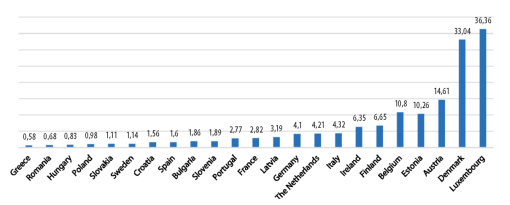
Figure 1: Ranking of the 27 EU Member States according to a metric of their use of deliberative practices in decision-making (countries for which no deliberative democratic practices were found to meet the criteria are not shown)
Note: The values of indicators A, B and C presented above were aggregated and then these aggregated values were divided by the country's population of one million (D). This gave the score for each country, which was then ranked. Source: compiled by the author
The above dataset was compiled using the methodology detailed above: for each practice, the degree of embeddedness in decision-making, the level of deliberation and the scope of the practice were determined, then the A, B, C values for each practice were aggregated, and then these aggregated values were divided by the population of the country in millions. This gave the scores for each country, which were then sorted.
Examining the data, a clear divide can be seen between the lower and higher scoring countries, as well as a clear "lagging behind" of some countries compared to others. The resulting order is worth interpreting in the light of some important observations.
- A higher number of cases, i.e. a higher number of deliberative democratic practices used, does not necessarily imply a higher value, as the measure relates the practices under scrutiny to the population. For example, although Germany has by far the largest number of deliberative practices (76) and is the EU country with the largest population (over 84 million), because of its scores across the metric, it is in the middle of the range.
- However, the number of cases can also increase the value produced by the metric, but this is closely related to the size of the population: in the case of Luxembourg, only 4 deliberative practices in decision-making were identified, but given the population of the country (around 660,000), these 4 practices, which obtained essentially high scores for the inner aspects of the measure, also gave the country a high value.
- The component of the metric marked A, i.e. the level of embeddedness in the decision-making process, can "highlight" the value of a country if there are many practices where legally binding decisions are taken, in other words, if the decision-making
- 163/164 -
body or even the executive in a given case is obliged to take the decision of the deliberative body into account in practice, or if the decision-making body itself initiated the deliberative process in order to obtain the views of citizens. This is precisely what explains the high score given by the metric in Denmark for the so-called consensus conferences, which are deliberative forums of citizens that also formulate concrete recommendations for political decision-making or legislation. However, if the purpose of the deliberative forum is only deliberation and no proposal or recommendation results at the end of the cooperation, it carries less weight.
- Component B of the metric, i.e. the deliberative level of the given process, is intended to compensate for this aforementioned lower weighting and to "reward" exercises that emphasise deliberation. As can be seen in the case of Bulgaria, with only two practices at the national level, which do not have a great direct influence on decision-making but which focus on deliberation, and with a relatively small population (although it is not a mini-state), it scored higher than some countries where more deliberative processes were identified.
- The value of component C, i.e. the scope of the practice(s), also influences the score a country receives. As this analysis now examines the extent to which citizens are consulted and the extent to which their decisions are incorporated into decision-making at the end of a deliberative process based chiefly on representative systems, it is perhaps simplistic, but in the case of the metric it 'rewards' deliberative practices at the national level, i.e. the higher the level at which the method is implemented, the higher the metric. Therefore fewer, but national level practices may score higher than a greater number of practices that are largely at the level of local deliberative bodies. The latter can be seen, for example, in the case of Italy: three quarters of the 59 practices in the corpus were local, which had a strong impact on the value given by the metric.
The following section will examine the systematisation of the data from a different perspective, in order to enable a more structured interpretation of the data.
Systemised data
Looking at deliberative democratic practices in decision-making in the Member States of the European Union and assessing them with the help of the metric, the following categories can be distinguished:
1. Laggards. This group includes countries that have not yet been affected by the trend of more deliberative practices,[66] i.e. the increased use of deliberative practices and their implementation in decision-making at various levels since the 1990s, and are thus falling further and further behind countries that are already at the forefront. The
- 164/165 -
countries included in this group are those that either did not use deliberative practices at all in their decision-making processes, or which used them very rarely (in relation to their population) and at a low level, or those which used them several times at a high (national) level, but the decision taken by the deliberative body was not legally binding. The countries included in this group in the current study are those at the bottom of the list based on the scores assigned to each country by the metric: Malta, Cyprus, the Czech Republic, Lithuania, Greece, Romania, Hungary, Poland and Slovakia.
2. Emergers. In the present study, this group includes countries where there is either a visible will to incorporate deliberative practices into decision-making at a high level, or where there is a small but high level of deliberation on important issues, even those affecting society as a whole, or where the number of deliberative practices implemented is in proportion to the country's population. The countries in this group performed better than those in the first group in terms of the metric's measures of adoption of deliberative practices and comprise Sweden, Croatia, Spain, Bulgaria and Slovenia.
3. Aspirers. This group includes countries where citizens' deliberation is already an active part of the decision-making process, i.e. decisions taken by deliberative bodies often have a real impact and are taken into account by the legislator. However, it is possible that some countries have used even fewer deliberative practices in decision-making relative to their population size, and are therefore 'penalised' by the proportional nature of the metric. The countries in this group are Portugal, France, Latvia, Germany, Italy, Ireland, the Netherlands, Ireland and Finland.
4. Exemplars. These "elite" countries are pioneers and role models in incorporating deliberative practices into decision-making: Belgium with its large number of deliberative practices at all levels of decision-making; Estonia with its first digital People's Assembly enabling online deliberation; Austria with its many deliberative bodies at local level; Denmark with its consensus conferences going back decades; and the mini-state of Luxembourg with its deliberative practices on a small number of highprofile issues compared to the others.
Doubts about the metric and answers
A metric such as the one presented above raises a number of questions. The most important questions are, of course, those of validity and reliability, the two basic requirements of scientific research: that is, whether the method really measures what it is intended to measure, and whether the measurement will produce similar results if repeated several times. Just as no social science model that attempts to explain reality using different methods can be perfect - since it can only ever approximate the object of its study - so no measure of the application of deliberative practices to decision-making can be perfect. Nevertheless, I would argue that the metric presented above provides a good approximation of a valid value for a given country in terms of the employment of deliberative practices in decisionmaking, which becomes meaningful when compared with other countries. The following
- 165/166 -
section of the paper attempts to respond to the most controversial points and arguments concerning the metric, its aspects, purpose or methodology.
As mentioned above, the main difficulty was that there is no comprehensive database listing and detailing deliberative practices in all (European) countries, so it is possible that not all cases were included in the study corpus - it is assumed that the latency is particularly high for deliberative initiatives at the local level. Related to this was the problem of incomplete data: i.e. even if an exercise was listed either on the Participedia platform or in the POLITICIZE database, it was not always possible to determine with sufficient certainty how it was embedded in decision-making, its scope or its level of deliberation. Moreover, in several cases there were duplicates or even merged cases - for example, if a deliberative exercise was repeated or regular. In all cases, an 'expert estimate' was made to determine these practices for the components of the metric. Problems also arose in relation to incomplete data, where precise details of a practice going back several decades could not be found in the databases used to build the corpus, neither in the literature nor on the internet. These practices, found by mention or only by name, were ultimately not included in the corpus as there were essentially a small number of such cases, which presumably did not significantly bias the analysis.
In addition to the more general difficulties, the practical testing of the measure also revealed potential problems with its content. Since these external difficulties outlined above may also represent fundamental internal validity and reliability problems for the metric, the following part of this section will attempt to refute and answer the most important doubts and questions, thus demonstrating the integrity of the metric.
1. The metric does not distinguish between offline and online practices. Indeed, no distinction is made between the offline and online deliberative methods found in the study corpus. The reason for this is that this metric does not examine the (qualitative) differences between online and offline deliberation, but rather the existence of deliberation and its impact on decision-making. In this respect, there is no meaningful difference between online and offline practices.
2. The metric does not take into account either interregional/international cooperation nor supranational (EU) deliberative initiatives. The main purpose of this metric is to measure and compare the extent to which different countries apply the results of deliberative democratic practices in decision-making. That is why the units of analysis in this respect are countries, whereas including deliberative multi-country cooperation in the metric would require the introduction of additional dimensions that would not provide added value.
3. The metric could also take into account other aspects, such as the acceptance of deliberative practices in a given country, the diversity of deliberative practices, etc. While the metric could be extended to include many other important aspects, the aim was to provide a basis for measuring with a high degree of certainty the level of deliberative processes adopted by each country in decision-making, and thus to allow for comparison. An extended metric can of course include other relevant aspects.
- 166/167 -
4. The metric is too simplistic in measuring deliberative practices (scores 1, 2, 3). Again, the aim was simplicity and clarity to create a metric that works well. In the future, it may be worth considering using a scale rather than a dedicated score to measure the aspects under consideration, but for the time being this simplified approach was intended to show that the metric is usable and works.
5. The metric overestimates practices at national level. Starting from the premise of practical ways to make representative systems more 'democratic', the present study aimed to examine and measure the embeddedness of the results of deliberative processes in decision-making as a kind of remedy for the failures of the representative system. In this sense, since the representative system is the focus and level of analysis of the metric presented here, the metric in this instance "rewards" practices at the national level more. However, the metric also has the advantage that the values 1, 2, 3 associated with each component can be reversed or swapped if, for example, the aim is to 'reward' practices at local level - and the same is true for the other components.
Conclusion
At this point it may be possible to answer the central question of the paper formulated in the introduction: is it possible to construct a metric that can measure the level of embeddedness of the results of deliberative practices in decision-making in a given country? When the metric was tested on a sample of EU Member States, the results showed that it is.
The measure was tested on a sample of 27 EU Member States. The corpus of the study consisted of deliberative practices already implemented by the EU27, collected from the Participedia and POLITICIZE databases. For each country studied, the value given by the metric was determined and then, using these values, a ranking was established and four groups were identified in terms of the embeddedness of deliberative practices in decision-making: Laggards, Emergers, Aspirers and Exemplars.
However, the metric presented in this paper is only a starting point: in order to measure with even greater validity the embeddedness of the deliberative practices, whether in decision-making or in other policy areas, it may be necessary to include other factors in the measurement. For example:
- the variety of deliberative practices implemented, i.e. how many different deliberative practices are used in a particular country, as different practices can be used for different purposes and have different outcomes, and therefore the use of a variety of deliberative practices can also show a high level of adoption of deliberative democracy
- opinions about deliberation or the acceptance of deliberation in a given country may be considered because if, for example, there is a strong resistance in a society to implementing deliberative decisions in legislation or policy-making, there are likely to be fewer practices, and this will obviously influence the level of deliberative practices adopted
- 167/168 -
- it may also be worthwhile to include the number of diferent forms of direct democracy, such as referendums, which also seek in different ways to channel citizens' opinions into decision-making, and to look at how deliberative or direct democratic practices are manifested in a given country - for example, whether all are present, none are present, or one or the other is predominant - and to assess deliberative democratic trends in this light.
One might also ask why it is necessary to quantify a process such as the embedding of the results of deliberative practices in decision-making, and why it is necessary to measure these trends in this way. The related literature and research show that decisions made through deliberation have greater legitimacy, allow individual interests and opinions to be heard and reflected, and are perceived as more "owned" by citizens. In short, they make democracy more democratic. Therefore, it may be necessary to measure the extent to which a particular country has incorporated deliberative practices to "complement" the representative system in order to channel citizens' opinions into decision-making. The metric presented in this paper will not only allow this, but also the impact of the results of deliberative practices on decision-making to be tracked, measured and monitored for change from time to time, and the democratic impact and consequences of this to be examined.
References
Abdullah, Nabaz Nawzad - Rahman, Mohd Fitri Abdul (2015): The Use of Deliberative Democracy in Public Policy Making Process. Public Policy and Administration Research, 5(3), 221-229. Online: https://doi.org/10.2139/ssrn.2769105
Alemanno, Alberto (2022): Towards a Permanent Citizens' Participatory Mechanism in the EU. European Parliament - Policy Department for Citizens' Rights and Constitutional Afairs, Directorate-General for Internal Policies, PE 735.927, Brussels. Online: http://www.europarl.europa.eu/RegData/etudes/STUD/2022/735927/IPOL_STU(2022)735927_EN.pdf
Almond, Gabriel Abraham - Verba, Sidney (1963): Political Culture: Political Attitudes and Democracy in Five Nations. Princeton: Princeton University Press.
Antal, Attila (2009): A környezeti demokrácia elmélete és gyakorlata. Politikatudományi Szemle, 18(4), 82-101.
Asenbaum, Hans (2022): Rethinking Democratic Innovations: A Look Through the Kaleidoscope of Democratic Theory. Political Studies Review, 20(4), 680-690. Online: https://doi.org/10.1177/14789299211052890
Bächtiger, André - Dryzek, John S. - Mansbridge, Jane - Warren, Mark E. (2018): Deliberative Democracy: An Introduction. In Bächtiger, André - Dryzek, John S. - Mansbridge, Jane - Warren, Mark E. (eds.): The Oxford Handbook of Deliberative Democracy. Oxford: Oxford University Press, 1-31. Online: https://doi.org/10.1093/oxfordhb/9780198747369.013.50
- 168/169 -
Barber, Benjamin (1984): Strong Democracy: Participatory Politics for a New Age. Berkeley: University of California Press.
Benhabib, Seyla (1996): Four Toward a Deliberative Model of Democratic Legitimacy. In Benhabib, Seyla (ed.): Democracy and Difference: Contesting the Boundaries of the Political. Princeton University Press, 67-94. Online: https://doi.org/10.1515/9780691234168-005
Bohman, James (1998): Survey Article: The Coming of Age of Deliberative Democracy. Journal of Political Philosophy, 6(4), 400-425. Online: https://doi.org/10.1111/1467-9760.00061
Bühlmann, Marc - Merkel, Wolfgang - Wessels, Bernhard (2008): The Quality of Democracy: Democracy Barometer for Established Democracies. Hertie School of Governance - Working papers, No. 22. Online: https://edoc.vifapol.de/opus/volltexte/2013/4240/pdf/22.pdf
Campbell, David F. J. (2008): The Basic Concept for the Democracy Ranking of the Quality of Democracy. Vienna: Democracy Ranking. Online: http://democracyranking.org/downloads/basic_concept_democracy_ranking_2008_A4.pdf
Cengiz, Firat (2018): Bringing the Citizen Back into EU Democracy: Against the Input-Output Model and Why Deliberative Democracy Might Be the Answer. European Politics and Society, 19(5), 577-594. Online: https://doi.org/10.1080/23745118.2018.1469236
Chappell, Zsuzsanna (2010): A Tension between Ideal and Practice: Re-evaluation of Micro and Macro Models of Deliberation. Representation, 46(3), 295-308. Online: https://doi.org/10.1080/00344893.2010.499697
Chwalisz, Claudia (2019): A New Wave of Deliberative Democracy. Carnegie Europe. Online: https://carnegieendowment.org/files/10-17-19_Chwalisz_Deliberative.pdf
Coppedge, Michael (2012): Democratization and research methods. Cambridge: Cambridge University Press. Online: https://doi.org/10.1017/CBO9781139016179
Coppedge, Michael - Gerring, John - Knutsen, Carl Henrik - Lindberg, Staffan I. -Teorell, Jan - Altman, David - Bernhard, Michael - Cornell, Agnes - Fish, M. Steven - Gastaldi, Lisa - Gterl0w, Haakon - Glynn, Adam et al. (2021): "V-Dem Codebook v11.1." Varieties of Democracy (V-Dem) Project. Online: www.v-dem.net/static/website/img/refs/codebookv111.pdf
Crozier, Michel Z. - Huntington, Samuel P. - Watanuki, Joji (1975): The Crisis of Democracy. New York: New York University Press.
Dalton, Russel J. - Cain, Bruce - Scarrow, Susan (2003): Democratic Publics and Democratic Institutions. In Cain, Bruce - Dalton, Russel J. - Scarrow, Susan (eds.): Democracy Transformed? Expanding Political Opportunities in Advanced Industrial Democracies. Oxford: Oxford University Press, 250-275. Online: https://doi.org/10.1093/0199264996.003.0011
Dean, Rikki - Gagnon, Jean-Paul - Asenbaum, Hans (2019): What is Democratic Theory? Democratic Theory, 6(2), v-xx. Online: https://doi.org/10.3167/dt.2019.060201
- 169/170 -
Dryzek, John S. (2000): Deliberative Democracy and Beyond: Liberals, Critics, Contestations. Oxford: Oxford University Press.
Dryzek, John S. (2001): Legitimacy and Economy in Deliberative Democracy. Political Theory, 29(5), 651-669. Online: https://doi.org/10.1177/0090591701029005003
Dryzek, John S. (2012): Foundations and Frontiers of Deliberative Governance. Oxford: Oxford University Press.
Dryzek, John S. - List, Christian (2003): Social Choice Theory and Deliberative Democracy: A Reconciliation. British Journal of Political Science, 33(1), 1-28. Online: https://doi.org/10.1017/S000712340300001
Economist Intelligence Unit (2022): EIU Report - Democracy Index 2022. Online: www.eiu.com/n/campaigns/democracy-index-2022/
Elster, Jon ed. (1998): Deliberative Democracy. Cambridge: Cambridge University Press. Online: https://doi.org/10.1017/CBO9781139175005
Elstub, Stephen - Escobar, Oliver eds. (2019): Handbook of Democratic Innovation and Governance. Cheltenham: Edward Elgar Publishing. Online: https://doi.org/10.4337/9781786433862
Ercan, Selen Ayirtman - Gagnon, Jean-Paul (2014): The Crisis of Democracy: Which Crisis? Which Democracy? Democratic Theory, 1(2), 1-10. Online: https://doi.org/10.3167/dt.2014.010201
Eurostat (2023): Population on 1 January. [Data set]. Online: https://ec.europa.eu/eurostat/databrowser/view/tps00001/default/table?lang=en
Fejes, Zsuzsanna - Kiszelly, Zoltán - Pál, Gábor - Szentpéteri Nagy, Richárd (2014): Demokrácia. In Báger, Gusztáv - Bukovics, István - Csath, Magdolna - Cserny, Ákos - Fejes, Zsuzsanna - Gárdos-Orosz, Fruzsina - Kaiser, Tamás - Kádár, Krisztián - Kis, Norbert - Szente, Zoltán: A Jó Állam mérhetősége. Budapest: NKE Szolgáltató Kft., 167-231.
Fleuss, Dannica - Helbig, Karoline (2021): Measuring Nation States' Deliberativeness: Systematic Challenges, Methodological Pitfalls, and Strategies for Upscaling the Measurement of Deliberation. Political Studies, 69(2), 307-325. Online: https://doi.org/10.1177/0032321719890817
Freedom House [s. a.]: Freedom in the World. Online: https://freedomhouse.org/report/freedom-world
Goodin, Robert E. (2000): Democratic Deliberation Within. Philosophy & Public Affairs, 29(1), 81-109. Online: https://doi.org/10.1111/j.1088-4963.2000.00081.x
Gutmann, Amy - Thompson, Dennis (1996): Democracy and Disagreement. Cambridge: Harvard University Press.
Gutmann, Amy - Thompson, Dennis F. (2004): Why Deliberative Democracy? Princeton: Princeton University Press. Online: https://doi.org/10.1515/9781400826339
Habermas, Jürgen (1995): Reconciliation Through the Public Use of Reason: Remarks on John Rawls's Political Liberalism. Journal of Philosophy, 92(3), 109-131. Online: https://doi.org/10.5840/jphil199592335
- 170/171 -
Hendriks, Carolyn M. (2006): Integrated Deliberation: Reconciling Civil Society's Dual Role in Deliberative Democracy. Political Studies, 54(3), 486-508. Online: https://doi.org/10.1111/j.1467-9248.2006.00612.x
Jó Állam Jelentés [s. a.]: Jó Állam Jelentés. Online: https://joallamjelentes.uni-nke.hu/
Kotanidis, Silvia - del Monte, Micaela (2022): Strengthening Citizens' Participation: How the European Parliament is Responding to Citizens' Expectations. European Parliamentary Research Service - Briefing - Members' Research Service, PE 729.363. Online: http://www.europarl.europa.eu/RegData/etudes/BRIE/2022/729363/EPRS_BRI(2022)729363_EN.pdf
Krieger, Tommy (2022): Measuring Democracy. ZEW - Centre for European Economic Research Discussion Paper No. 22-063. Online: https://doi.org/10.2139/ssrn.4321429
Lafont, Cristina (2017): Can Democracy be Deliberative & Participatory? The Democratic Case for Political Uses of Mini-Publics. Daedalus, 146(3), 85-105. Online: https://doi.org/10.1162/DAED_a_00449
Levine, Peter - Fung, Archon - Gastil, John (2005): Future Directions for Public Deliberation. Journal of Deliberative Democracy, 1(1). Online: https://doi.org/10.16997/jdd.24
Mair, Peter (2013): Ruling the Void: The Hollowing of Western Democracy. New York: Verso Books.
Michels, Ank (2011): Innovations in Democratic Governance: How Does Citizen Participation Contribute to a Better Democracy? International Review of Administrative Sciences, 77(2), 275-293. Online: https://doi.org/10.1177/0020852311399851
Newton, Ken (2012): Introduction: Curing the Democratic Malaise with Democratic Innovations. In Newton, Kenneth and Geissel, Brigitte: Evaluating Democratic Innovations Curing the Democratic Malaise? Routledge, 3-20. Online: https://doi.org/10.4324/9780203155196
OECD (2020): Innovative Citizen Participation and New Democratic Institutions: Catching the Deliberative Wave. Paris: OECD Publishing. Online: https://doi.org/10.1787/339306da-en
Parkinson, John (2003): Legitimacy Problems in Deliberative Democracy. Political Studies, 51(1), 180-196. Online: https://doi.org/10.1111/1467-9248.00419
Parkinson, John - Mansbridge, Jane eds. (2012): Deliberative Systems: Deliberative Democracy at the Large Scale. Cambridge: Cambridge University Press. Online: https://doi.org/10.1017/CBO9781139178914
Participedia [s. a.]: Participedia. Online: https://participedia.net/
Pateman, Carole (1970): Participation and Democratic Theory. Cambridge: Cambridge University Press. Online: https://doi.org/10.1017/CBO9780511720444
Paulis, Emilien - Pilet, Jean-Benoit - Panel, Sophie - Vittori, Davide - Close, Caroline (2021): The POLITICIZE Dataset: An Inventory of Deliberative Mini-Publics (DMPs) in Europe. European Political Science, 20, 521-542. Online: https://doi.org/10.1057/s41304-020-00284-9
Pilet, Jean-Benoit - Bol, Damien - Vittori, Davide - Paulis, Emilien (2022): Public Support for Deliberative Citizens' Assemblies Selected through Sortition: Evidence
- 171/172 -
from 15 Countries. European Journal of Political Research, 62, 873-902. Online: https://doi.org/10.1111/1475-6765.12541
Rapeli, Lauri (2013): The Conception of Citizen Knowledge in Democratic Theory. London: Palgrave Macmillan.
Rawls, John (1995): Political Liberalism: Reply to Habermas. Journal of Philosophy, 92(3), 132-180. Online: https://doi.org/10.2307/2940843
Rose, Jeremy - Sæbø, Øystein (2010): Designing Deliberation Systems. The Information Society, 26(3), 228-240. Online: https://doi.org/10.1080/01972241003712298
Sanders, Lynn M. (1997): Against Deliberation. Political Theory, 25(3), 347-376. Online: https://doi.org/10.1177/0090591797025003002
Saward, Michael (1998): Terms of Democracy. Cambridge: Polity Press.
Saward, Michael (2000): Democratic Innovation. In Saward, Michael (ed.): Democratic Innovation: Deliberation, Representation and Association. London: Routledge, 3-16.
Schumpeter, Joseph A. (1942): Capitalism, Socialism, and Democracy. New York: Harper & Brothers.
Smith, Graham (2005): Beyond the Ballot: 57 Democratic Innovations from around the World. London: Power Inquiry.
Smith, Graham (2009): Democratic Innovations: Designing Institutions for Citizen Participation. Cambridge: Cambridge University Press. Online: https://doi.org/10.1017/CBO9780511609848
Somin, Ilya (2010): Deliberative Democracy and Political Ignorance. Critical Review, 22(2-3), 253-279. Online: https://doi.org/10.1080/08913811.2010.508635
Steiner, Jürg (2012): The Foundations of Deliberative Democracy: Empirical Research and Normative Implications. Cambridge: Cambridge University Press. Online: https://doi.org/10.1017/CBO9781139057486
V-Dem [s. a.]: Varieties of Democracy. Online: www.v-dem.net/
Vibert, Frank (2007): The Rise of the Unelected. Cambridge: Cambridge University Press. Online: https://doi.org/10.1017/CBO9780511491160
Wampler, Brian (2012): Participation, Representation, and Social Justice: Using Participatory Governance to Transform Representative Democracy. Polity, 44(4), 666-682. Online: https://doi.org/10.1057/pol.2012.21
Whiteley, Paul (2009): Where Have All the Party Members Gone? The Dynamics of Party Membership in Britain. Parliamentary Affairs, 62(2), 242-257. Online: https://doi.org/10.1093/pa/gsn054
Young, Iris Marion (1990): Justice and the Politics of Difference. Princeton: Princeton University Press. Online: https://doi.org/10.2307/jJ.ctvcm4g4q
Melinda Pintér is a PhD student at the Doctoral School of Public Administration Sciences at the Ludovika University of Public Service. She focuses on deliberative democracy and its practical implementation, especially its application in the digital space. ■
NOTES
[1] See Kotanidis - del Monte 2022 and Alemanno 2022.
[2] OECD 2020.
[3] See Habermas 1995 and Rawls 1995.
[4] Crozier et al. 1975.
[5] Ercan-Gagnon 2014: 4.
[6] Almond-Verba 1963.
[7] Rapeli 2013.
[8] Whiteley 2009.
[9] Vibert 2007.
[10] Mair 2013.
[11] Pateman 1970.
[12] Bohman 1998.
[13] Saward 1998.
[14] Young 1990.
[15] Michels 2011: 278.
[16] Barber 1984.
[17] Antal 2009: 84.
[18] Dryzek 2000: 57.
[19] Dean et al. 2019.
[20] Dalton et al. 2003: 251.
[21] Smith 2009: 1.
[22] Elstub-Escobar 2019: 14.
[23] Newton 2012:4.
[24] Smith 2005.
[25] Newton 2012: 6-7.
[26] Newton 2012: 8-9.
[27] Elstub-Escobar 2019: 24-27.
[28] Asenbaum 2022: 682.
[29] Saward 2000.
[30] See Elster 1998; Gutmann-Thompson 2004.
[31] See Gutmann-Thompson 1996: 41-42; Dryzek-List 2003; Levine et al. 2005.
[32] See Steiner 2012; Bächtiger et al. 2018.
[33] Dryzek 2001.
[34] Benhabib 1996.
[35] See Hendriks 2006; Chappell 2010.
[36] See RosE-Sæbø 2010; Parkinson-Mansbridge 2012; Dryzek 2012; Chwalisz 2019.
[37] Sanders 1997.
[38] Dryzek 2000: 58.
[39] Somin 2010.
[40] Parkinson 2003.
[41] Lafont 2017.
[42] Pilet et al. 2022.
[43] Michels 2011.
[44] Wampler 2012: 667.
[45] Abdullah-Rahman 2015.
[46] Kotanidis - del Monte 2022.
[47] Alemanno 2022.
[48] Cengiz 2018.
[49] OECD 2020.
[50] Economist Intelligence Unit 2022.
[51] V-Dem [s. a.].
[52] Freedom House [s. a.].
[53] Jó Állam Jelentés [s. a.].
[54] See Krieger 2022: 5.
[55] Schumpeter 1942.
[56] Fejes et al. 2014: 176-177.
[57] Coppedge 2012.
[58] Bühlman et al. 2008: 3-6.
[59] Campbell 2008: 20-21.
[60] Coppedge et al. 2021: 159-162.
[61] Fleuss-Helbig 2021: 321.
[62] Fleuss-Helbig 2021: 321.
[63] Goodin 2000: 81.
[64] Participedia [s. a.].
[65] Paulis et al. 2021.
[66] Dryzek 2000: 1.
Lábjegyzetek:
[1] The author is PhD student, Ludovika University of Public Service, Doctoral School of Public Administration Sciences, melinda.pinter87@gmail.com