

Gyula Bándi[1]: From Sustainability to Circular Economy - Development of EU Strategies and Its Legal Consequences (Fontes, 2016. Különszám, 20-29. o.)
One of the great novelties in the field of environmental protection proved to be the Encyclical Letter of Pope Francis[1]. Pope Francis underlined the responsibility of mankind, among others, as follows: "6. My predecessor Benedict XVI likewise proposed "eliminating the structural causes of the dysfunctions of the world economy and correcting models of growth which have proved incapable of ensuring respect for the environment (...)". We have forgotten that "man is not only a freedom which he creates for himself. Man does not create himself. He is spirit and will, but also nature"[2]. A clear consequence of the malfunctions of human economy is the need to turn much more towards sustainable development or its synonyms, emerged in the last few years: green economy, circular economy. The Pope emphasized: "13. The urgent challenge to protect our common home includes a concern to bring the whole human family together to seek a sustainable and integral development, for we know that things can change (...)".
From Sustainable Development to Green Economy
Sustainable development is a great challenge in itself. As one Hungarian ecologist indicated, there are many different uses of sustainability or sustainable development, while no one claims to hold the holy grail of the perfect definition.[3] It would therefore be rational to start any examination regarding sustainable development with some scepticism, as for example, Fitzmaurice describes sustainable development as an elusive category,[4] while Lowe observes that sustainable development as a legal category is characterized by obscurity and confusion.[5]
One of the most eminent authors of sustainable development law tries to provide a balanced interpretation: "In this way, a principle of sustainable development, in accordance with the Bruntland Report and other global 'soft law' processes, could be argued to have a fundamentally normative character that is binding on the State, though it is a double-edged sword. It would not forbid development as such. Rather, it would require States not to prevent from or frustrate each other promoting sustainable development, and "where development may cause significant harm to the environment", it would require states to take steps to address a duty "to prevent, or at least mitigate, such harm."[6]
Of course, not all authors define the components of sustainability along the same lines, but most of the descriptions use similar interpretations: "It is by now well established that this definition is widely considered to encompass three main strands. These are: (i) economic development; (ii) environmental protection and conservation;
- 20/21 -
and (iii) human equity."[7] Equity in this respect is connected to social issues, listed usually as the third component of sustainable development.
If we wish to have a clear picture why it is so difficult to take hold of sustainable development, there are several arguments: "Sustainability is about visions, but the law as applied is not. The law is about how we can resolve specific disputes in specific circumstances. Because sustainability is about creating places and communities, and thus primarily about purpose and implementing visions, specific-resource-focused legal regimes are too narrow - or more appropriately, operate on the wrong scale - to effectuate any comprehensive vision of a sustainable community."[8] Thus the key to the enigma of the law of sustainable development is to determine how far and with what methods we wish to regulate the subject legally or whether is this really necessary. This is equally important in law, public and economic/financial administration and in virtually any field of management.
It would be impossible today to meet the general requirements of a clear definition as required, among others, by the case law of ECJ/CJEU[9] on the need to have a clear conceptual basis. The case cited here regards environmental impact assessment, but is of much greater importance, referring to the need for an unambiguous and clear wording, serving as a basis for laying down obligations for national legislation: "43. The need for uniform application of Community law and the principle of equality require that the terms of a provision of Community law which makes no express reference to the law of the Member States for the purpose of determining its meaning and scope, must normally be given an autonomous and uniform interpretation throughout the Community; that interpretation must take into account the context of the provision and the purpose of the legislation in question (Case 327/82 Ekro v Produktschap voor Vee en Vlees [1984] E.C.R. 107, paragraph 11)."
The complexity of the concept of sustainable development, consisting of several factors of development, such as poverty, social security, public health, indigenous peoples' rights, natural resources, environmental protection, water, etc. makes it impossible to set up a consistent system. "Sustainable development is not a static concept ... hence inherently varies ratione temporis... The contents of sustainable development thus vary ratione personae. They also vary ratione materiae"[10] It is my firm belief that we must also add that besides the different factors listed above, at least two further elements must be identified, namely the variations according to geographical area (ratione territorii) and the variations related to the level of development (ratione progressionis). Contextual changes and the variations of the extent, scope or coverage of the problem are constant, and this may also be considered the differentia specifica of the subject.
Embarking upon the assessment of the content of the term, several authors share a similar understanding, claiming[11] that there are at least four elements of sustainable development: environmental integration, intergenerational and intragenerational equity and sustainable use - although the latter is much rather a tautology than a particular element. If we try to provide a selection of those components, which may actually have legal consequences and at the same time also serve sustainable development most likely, the following elements constitute the immanent essentials of the concept:
• The rights of future generations or intergenerational equity. It would be expedient to attach to it the right to environment or, in other words, to translate this equity into the language of environmental human rights.
• This is coupled with intragenerational equity, i.e. the rights of current generations, with a clear link to the right to the environment issue and the right to development. The International Court of Justice in its judgment in the Gabčikovo-Nagymaros Case[12] has discussed the concept of sustainable development in paragraph 140 of the judgment (see the quotation below). Judge Weeramantry's opinion attached to the judgment is even more widely known than the judgment itself[13].
• Public participation[14] is also fundamental, together with all of its three major pillars (access to information, participation in decision-making and access to justice). Stemming from the idea of environmental democracy, this principle also covers environmental justice and provides a better chance for the implementation of generational equity. For some more details see for example Article 1 of the Aarhus Convention[15].
- 21/22 -
• Cooperation or cooperative instruments play a primary role in all levels, for example, the IUCN Draft[16] has an entire Part (Part VIII) dedicated to implementation and cooperation. Indeed, most obligations related to the achievement of sustainable development necessitate cooperation - suffice it to mention the common heritage of mankind, shared natural resources, common and differentiated responsibilities, eradicating poverty, etc.
• Integration is a summary and the institutionalization of sustainability, providing a simplified or handy version of the major legal contents of sustainable development. Its main objective is to manage social, material, financial and environmental interests in one system, instead of considering them as separate issues. In the referred judgment[17], the ICJ emphasized: "140. ... Throughout the ages, mankind has, for economic and other reasons, constantly interfered with nature. In the past, this was often done without consideration of the effects upon the environment. Owing to new scientific insights and to a growing awareness of the risks for mankind - for present and future generations - of pursuit of such interventions at an unconsidered and unabated pace, new norms and standards have been developed, set forth in a great number of instruments during the last two decades. Such new norms have to be taken into consideration, and such new standards given proper weight, not only when States contemplate new activities but also when continuing with activities begun in the past. This need to reconcile economic development with protection of the environment is aptly expressed in the concept of sustainable development." There are many well-known legal instruments serving integration, among others the environmental impact assessment, strategic environmental assessment, or the work of the different sustainable development councils or committees operating in most countries.
Integration and sustainable development are the two sides of the same coin. From the point of view of sustainable development, integration is a real challenge for legislation, as clearly stated in the above judgment and related assessments[18]. Integration may be considered a practical path to implement sustainable development.
• The precautionary principle covers, among others, prevention and risk assessment. It has a substantial moral content, covering an extended responsibility for different conducts. Principle 15 of the Rio Declaration[19] provides the principle with a global character: "In order to protect the environment, the precautionary approach shall be widely applied by States according to their capabilities. Where there are threats of serious or irreversible damage, lack of full scientific certainty shall not be used as a reason for postponing cost-effective measures to prevent environmental degradation." The CJEU (ECJ) rendered several important judgments[20] in order to clarify the content of the principle, among others introducing the concept of 'scientific uncertainty'.
• Finally, we must mention subsidiarity, which covers not only the effective distribution of competences and duties, but also the involvement of different institutional systems - state and local governments, social organs, NGOs, businesses, churches, small communities, etc. "Subsidiarity is therefore a somewhat paradoxical principle. It limits the state, yet empowers and justifies it. It limits intervention, yet requires it. It expresses both a positive and a negative vision of the role of the state with respect to society and the individual."[21]
Instead of going into the UNCED (1992) language, we refer to the Academies of Sciences of the World, which in 2000 also adopted a statement on sustainability[22] as a concise summary of current trends, that is at the same time emblematic of the available definitions: "Sustainability implies meeting current human needs while preserving the environment and natural resources needed by future generations."
The Rio+20 Summit mostly repeated what had already been stated before, albeit with one exception: the green economy. If one looks at the official outcome of the Conference - The future we want[23] - the most characteristic statement is part II ('Renewing political commitment'), containing the following : "15. We reaffirm all the principles of the Rio Declaration on Environment and Development... "
Green economy is an additional or seemingly new element, but it does not lead us closer to the matter, but rather seeks to invite businesses to work for sustainable development. The declarations in connection with green
- 22/23 -
economy do not add to the original concept. For example: "60. We acknowledge that green economy in the context of sustainable development and poverty eradication will enhance our ability to manage natural resources sustainably and with lower negative environmental impacts, increase resource efficiency and reduce waste." Green economy is not a novelty, but much rather a different expression of the same vague concept. According to some, this lack of reforms means the crisis of global management and also a moral crisis, endangering our well-being.[24]
The European Integration on Sustainable Development
I first consider the European environment action programs, having their origin at the Paris meeting[25]. The Fifth Environmental Action Programme[26] had two important bases: the UNCED process on sustainable development - look at the title of the Programme: 'Towards Sustainability' - and the Maastricht Treaty[27]. There are several new approaches listed in the Programme, such as the interests of present and future generations; the need to build on shared responsibilities in a way of involving all sectors of society, from public administration to the private sphere; partnership; to implement a broad range of regulatory and other instruments; to further develop integration, etc. The whole shall be based on subsidiarity, connected with shared responsibility. The revision of this Programme in 1998[28] links integration and sustainability in a wider context, as presented in the preamble: "(20) Whereas the further integration of environmental protection requirements into other policy areas is regarded as a key means of achieving sustainable development; (...)".
The implementation of sustainable development has been the key concept of the Sixth Community Environment Action Programme[29], covering material and social issues, linking living standards with sustainable development.
The Programme is clear in defining the major elements of sustainability: "(6) A prudent use of natural resources and the protection of the global eco-system together with economic prosperity and a balanced social development are a condition for sustainable development. (...) (13) The Programme should promote the process of integration of environmental concerns into all Community policies and activities in line with Article 6 of the Treaty in order to reduce the pressures on the environment from various sources."
If we look at Art.2 on principles and overall aims, the close correlation between integration and sustainability becomes self-evident. We may come to the conclusion that sustainability and integration requires a bidirectional process:
-> integrating environmental concerns into all Community policies - Par.(1);
<- environmental measures should be coherent with material and social dimensions of sustainable development - Par.(4).
The revision of this Programme took place in 2007 claiming, among others, that "However, the EU is not yet on the path of sustainable environmental development."[30] Anyhow, there is a need for further integration of environmental policy considerations into the EU policies. Of the 10 key messages of the SOER report[31] formulated at the end of 2010 there are several which are directly related to sustainable development, such as
• " Implementing environmental policies and strengthening environmental governance will continue to provide benefits (...)",
• " Transformation towards a greener European economy will ensure the long-term environmental sustainability (...)."
The Seventh Environment Action Programme - lasting till 2020, with some additional elements and a vision of the Union by 2050 - "Living well, within the limits of our planet"[32] - adopted in 2013[33] describes the details of the
- 23/24 -
nine priority objectives listed in Art. 2[34]. As an example of the general attitude of the whole proposal, the fourth priority objective may be mentioned, relating to environmental legislation, covering five items and from among which three out of the five are somehow connected with public participation (access to information, citizens' trust in institutions, and access to justice). One may have the impression that the drafters have greater confidence in civil institutions and partnership with them and the EU institutions, than in the implementation systems of the Member States.
One of the many accompanying documents, issued together with the proposal must be mentioned, which is Annex 2 of the impact assessment[35] - 'Linkages of environment policy issues' -with a special focus on green economy, as a special answer to the debate related to the general problem of weak or strong sustainability. Green economy, according to Annex 2 means: "The concept of a green economy recognises that ecosystems, the economy [business] and human wellbeing (and the respective types of natural, produced, social and human capital) are intrinsically linked (Figure 1)[36]." This is again not questionable, but the main issue here, how this link is presented.
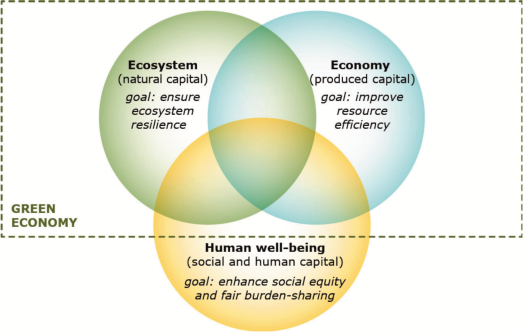
Figure 1.
- 24/25 -
The origin of the above figure is the general or weaker concept of sustainability with an interesting modification. First, we may notice the three major constituents with some specific explanations:
• ecosystem or natural capital must reach resilience (which is usually the immanent quality of the ecosystem);
• economy must be resource efficient;
• human well-being - originally society - must focus on equity and fair burden-sharing. These may mean intergenerational and intragenerational equity in genuine terms.
In case of weak sustainability, sustainable development is meant to be limited to the intersection of three circles, representing the three constituents of sustainable development. In the above outline green economy embraces most of the three constituents, only a part of human well-being is left out. This is partly acceptable, knowing that there are many elements of human well-being which may not be linked with material development and financial interest or business. On the other hand, even the non-material items of well-being may be connected with the ecosystem, thus the other side of the same coin is less satisfactory.
In order to better understand green economy, the Rio+20 documents need to be referred to again[37]: "56. ... we consider green economy in the context of sustainable development and poverty eradication as one of the important tools available for achieving sustainable development and that it could provide options for policymaking but should not be a rigid set of rules..." These words are somewhat different than the EU proposal. Rio takes green economy as a tool for sustainable development, while the Seventh Action Programme suggests that green economy is somehow a replacement of sustainable development. Nevertheless, we face an important terminological change, innovation in terms of sustainable development.
Sustainability had become part of the environmental policy long before an overall strategy could be developed. Soon the need to have a complex, integrated, uniform strategy became vital. The first step was the Gothenburg Strategy, but let us begin with its predecessor, the Cardiff process which proved to be the launch of a more uniform approach, based on environment protection, but getting a wider vision. The 1998 'Cardiff process' was not a success story[38]. The aim was to implement sustainability in practice, via integrating the environmental objectives into the implementation of other EU policies. Integration here may
be understood as a counterpart or even synonym of the principle of sustainable development, meaning the procedure, which helps the different aspects of the protection of environmental interests to take part in the decision making practices outside environmental protection - external integration. The whole problem of integration was clearly summarized in the mid-term review process of the Sixth Environment Action Programme[39], under the heading '2.3.1. Poor integration of policies'[40]. The Communication[41], based upon the impact assessment is a bit more direct: "However, the integration of environmental concerns into other areas has been less successful. The Cardiff process - which was set up in 1998 in order to in institutionalise this type of integration - has not lived up to expectations."
The next step was the EU Strategy for Sustainable Development[42], emphasizing the primary role of developing an effective policy, which must be coherent, within which prices correspond with real costs, science and technology are improved, together with proper communication. Soon after the adoption of the Sustainable Development Strategy (SDS), the concept of 'global partnership'[43] could also appear within EU policy, positioning the EU as an active and leading partner in international cooperation. Sustainable management of natural and environmental resources should form an integral part of all policies, having the condition of the coherence of EU policies, also of better governance.
In 2005 the SDS was revised[44], emphasizing: "(... ) Europeans value quality of life. They want to enjoy prosperity, a clean environment, good health, social protection and equity. (... ) The challenge is to maintain a momentum that mutually reinforces economic growth, social welfare and environment protection." The most important principles of SDS were listed, embracing a wide range of aspects: protection of fundamental rights, inter- and
- 25/26 -
intragenerational equity, open and democratic society, public involvement, involvement of business companies and social partners, coherent policy and governance, policy integration, the precautionary principle, the polluter pays principle.
Based on the revision, the Council adopted a new SDS in 2006[45], which underlined that the Lisbon Strategy and SDS must be harmonized to complement each other. This SDS also emphasizes the role of material development in the process of creating a sustainable society and generally speaking material expansion is taken as a need. It is clear that the EU does not want to depart from growth as such. There were two more revisions[46], within which the second revision in 2009(?)[47] classified some major policy tools of the EU:
• the EU Better Regulation Agenda,
• the renewed Social Agenda,
• the Employment guidelines
• Corporate Social Responsibility
• the task to put the SDS agenda into the external policies, and finally
• good examples in Member States[48].
Parallel with SD strategy, there are essential economic strategies, the most important one in 2000 the Lisbon Strategy[49]: "5. The Union has today set itself a new strategic goal for the next decade: to become the most competitive and dynamic knowledge-based economy in the world capable of sustainable economic growth with more and better jobs and greater social cohesion. (.)" The original strategy proved to be a too complex set of ideas, with a diffuse system of responsibilities, therefore it was relaunched in 2005. The first implementation report[50] was very optimistic, listing results, such as the new package of climate change and energy resources, and the action plan of sustainable production and consumption.
As a result of economic crisis, the new concept of development till 2020 had to be made. First, a Commission proposal[51] has been adopted and later the Council Recommendation[52]. The proposal basically deviated from the original harmonised idea of sustainability, providing a narrower vision of sustainability, subject to material aspects:
"(...) Europe 2020 puts forward three mutually reinforcing priorities:
- Smart growth: developing an economy based on knowledge and innovation.
- Sustainable growth: promoting a more resource efficient, greener and more competitive economy.
- Inclusive growth: fostering a high-employment economy delivering social and territorial cohesion. (... )
These targets are interrelated. (.) Such an approach will help the EU to prosper in a low-carbon, resource constrained world while preventing environmental degradation, biodiversity loss and unsustainable use of resources. It will also underpin economic, social and territorial cohesion.[53]"
The 2008 crisis could not facilitate the situation of sustainability, but reorganized the structure and priorities instead. The change of wording from development to growth may cause serious concerns as it is not absolutely clear whether it is only a different phrasing or a really substantial change of attitude. In terms of different phrasing, we may agree with experts like Jans who believes that sustainable growth is a much weaker concept than sustainable development.[54] The Council clarified that the 2020 strategy incorporates the previous strategies, also environmental requirements.[55] In addition to the strategy, there are different, more detailed strategies made, such as the one on transport[56] or another one on Energy 2020[57].
- 26/27 -
Sustainable Development in Primary Legislation
In 1992 sustainability could appear in the Maastricht Treaty[58], first in the preamble as recital 7. The Treaty on European Union also amended the original Treaty of Rome, covering in the new Art.2[59] everything in connection with sustainability, environment, solidarity, social protection, quality of life, etc. Environmental protection in this article is an equally important constituent of sustainability. The Amsterdam Treaty[60] did not change sustainability and environmental elements in a great extent. The Treaty of Nice[61] in 2001 did not have any change in respect of sustainable development.
The Lisbon Treaty[62] made substantial changes in respect of the Treaty on European Union (TEU) and the Treaty on the Functioning of the European Union (TFEU). The Treaty of Lisbon[63] amended the previous Art.2 on the objectives of the EU, providing a much more elaborate and extensive approach, covering a wider context and relationship of sustainability, keeping the previous elements[64], and in Art. 3(5) the global role of the EU in sustainable development has also been covered[65]. The commitment towards sustainability within the international cooperation is clearly articulated, in connection with developing countries, covering the three pillars of sustainability and besides, in connection with environmental protection as a priority and sustainable management of global resources.[66] It is noteworthy that the Lisbon Treaty finally 'legalized' the Charter of Fundamental Rights, this change is found in Art.6 (1) TEU. The Charta, i.e. The Charter Of Fundamental Rights Of The European Union also refers to sustainable development, although its Article 37[67] may clearly not really be considered as a provision on rights to the environment.
The preamble of TFEU focuses more on financial and material development, not mentioning sustainable development again. A good illustration of the different approach is the wording of recitals 4 and 5 of the preamble[68]. The essence is the material, financial expansion and even the harmonious development - which may have some connection with sustainability otherwise - is clearly a problem of regionalism and not sustainability. In any case, this is a relatively great change compared with the previous Treaty.
As integration may be taken as a tool of practical implementation of sustainable development, Art.11 TFEU on environmental integration is imperative, containing a direct reference to sustainable development[69]. Unfortunately, the likely influence of integration has been narrowed here, due to the fact that the principle of environmental integration had been a stand-alone integration principle up till 2009, but afterwards a proliferation of integration principles seriously hampered its original position[70].
- 27/28 -
No wonder why some authors even believe that the Art. 7 TFEU on consistency shall be the only integration principle, making all the others superfluous[71]. Others warn us about the consequences: "The conclusion must therefore be that there is no hierarchy between the various integration principles..."[72] As a consequence, integration as the practical materialization of sustainable development has lost most of its original positions in the Lisbon Treaty. There are no provisions having direct legal consequences on sustainability in the Treaty, there are no direct legal instruments or legal requirements mentioned. Thus the key of the whole is the institutional and organizational structure of the EU and their willingness to implement the principle of sustainable development.
Sustainable development is on the one hand a principle and on the other hand an objective, the content of which has not been defined in the Treaty. The traditional elements of sustainability are present, but there are no innovations. The wording lacks both the legal clarity and also the sense of legal responsibility. The essence is that we should 'aim at' or 'take into account' sustainable development, as a general guidance, but there is no chance to take it as an obligation. Even the EU establishment shall not be obliged to perform any specific actions, which is a rather weak political challenge. The main question could be, how far this general expectation may be implemented in practice and in which regulatory fields, and how it is possible to come to a level of legal certainty.
The 'greening' of EU strategies beside the sustainable development strategy and the environmental actions programmes in the past some years has been turning towards the above mentioned 'green economy' which is coupled with some additional elements. The first in the list is to turn towards green products[73] in 2013. This does not mean any specific type of products; rather the general attitude of production is at the centre of the EU action. The relevant Communication summarizes the essence: "The general objective of the EU action in this area is to contribute to improving the availability of clear, reliable and comparable information on the environmental performance of products and organisations to all relevant stakeholders, including to players along the entire supply chain. (...) The generic concept of green product as the product that has a reduced environmental impact over the life cycle compared to an alternative product will thus be operationalized by two elements: 1) the method to measure life cycle environmental impacts; and 2) the product category-specific rules which will provide the benchmark necessary to define a truly green product. The same approach will also be implemented for organisations." The next steps, presented by the Communication are to focus on three fields of legislation: Eco-Management and Audit Scheme (EMAS), Green Public Procurement (GPP) and the EU Ecolabel. As it is clear from these proposals, the consumers' vision must have a better focus.
In 2014[74] the next call was a follow-up of green economy, i.e. circular economy, directly connected with sustainable growth: "Circular economy systems keep the added value in products for as long as possible and eliminate waste. They keep resources within the economy when a product has reached the end of its life, so that they can be productively used again and again and hence create further value. Transition to a more circular economy requires changes throughout value chains, from product design to new business and market models, from new ways of turning waste into a resource to new modes of consumer behaviour. This implies full systemic change, and innovation not only in technologies, but also in organisation, society, finance methods and policies. (...)"
At the end of 2015 circular economy strategy was reformulated[75], weakened a bit, but several additional concrete steps were also listed. According to its introduction: "The transition to a more circular economy, where the value of products, materials and resources is maintained in the economy for as long as possible, and the generation of waste minimised, is an essential contribution to the EU's efforts to develop a sustainable, low carbon, resource efficient and competitive economy. Such transition is the opportunity to transform our economy and generate new and sustainable competitive advantages for Europe." Circular economy shall have a direct input on growth, job creation This new strategic vision requires a clear regulatory framework, the first signs of which are different proposals for the development of waste legislation focusing or reuse and recycling. This is going to be followed by legislative proposals for example on plastics, food waste, construction, critical raw materials, industrial and mining waste, consumption and public procurement, later on fertilisers and water reuse, but horizontal measures are equally essential, namely horizontal enabling measures in areas such as innovation and investment. And in order to prove the continuity, the first focus area is product design and production process, followed by consumption - among others, public procurement policy shall also be greened. Thus, a wide range of legislative reforms are coming soon.
- 28/29 -
Law may support the implementation of the strategy, no wonder why the above listed documents all pay special attention to the development of legislation. A perfect example is the improvement of waste legislation towards providing better chance for reuse and recycling. The current waste directive[76] in Art. 3 (definitions) and further could successfully widen the approach on this subject, declaring: "15. 'recovery' means any operation the principal result of which is waste serving a useful purpose by replacing other materials which would otherwise have been used to fulfil
a particular function, or waste being prepared to fulfil that function, in the plant or in the wider economy. (...)" This definition has been the consequence of the gradual development of case law of the European Court of Justice (today CJEU), in this respect the ASA decision must have a significant position,[77] due to clarifying the borderline between re-use, recovery and waste disposal[78]. ■
NOTES
[1] Encyclical Letter Laudato Si' of the Holy Father Francis 'On Care For Our Common Home'
[2] Ibid.
[3] Bulla, Miklós: A fenntartható fejlődés fogalmi világa in Vissza vagy hova - Útkeresés a fenntarthatóság felé Magyarországon, Tertia 2002, p. 105.
[4] "Sustainable development as the precautionary principle is one of the concepts of international environmental law, the real nature of which is mysterious and intangible in spite of its frequent or perhaps overly frequent use." See Fitzmaurice, Malgosia: Contemporary Issues in International Environmental Law. Cheltenham: Edward Elgar Publishing, 2009, p. 67.
[5] Lowe, Vaughan: 'Sustainable Development and Unsustainable Practices'. In: Boyle, Alan E.-Freestone, David (eds.): International Law and Sustainable Development - Past Achievements and Future Challenges. Oxford: Oxford University Press, 1999, p. 23.
[6] Cordonier Segger, Marie-Claire: Sustainable Development in International Law, in Sustainable Development in Sustainable Development in International and National Law, ed. by: Hans Christian Bugge and Christina Voigt, Europa Law Publishing, 2008, p. 128.
[7] Pedersen, Ole W.: Environmental Principles and Environmental Justice, Environmental Law Review, 2010, vol. 12, p. 43.
[8] Long, Jerrold A.: Realizing the abstraction: using today's law to reach tomorrow's sustainability, Idaho Law Review 2010, vol. 46, p. 348.
[9] Case C-287/98, preliminary ruling submitted by the Tribunal d'Arrondissement de Luxembourg in the legal dispute between the Grand Duchy of Luxemburg and the Berthe Linster, Aloyse Linster, Yvonne Linster, September 19, 2000. Reports of Cases 2000 I-06917.
[10] Barral, Virginie: Sustainable Development in International Law: Nature and Operation of an Evolutive Legal Norm, The European Journal of International Law, Vol. 23. No. 2, 2012, p. 382.
[11] Durán, Gracia Marin and Morgera, Elisa: Environmental Integration in the EU's External Relations, Hart Publishing, 2012, p. 41-41.
[12] Case concerning the Gabčikovo-Nagymaros Project (Hungary/Slovakia). Judgment, I.C.J. Reports 1997, pp. 7-84.
[13] See the Separate Opinion of Vice-President Weeramantry, p. 92.
[14] See for the details: Gyula Bándi (ed.): Environmental Democracy and Law, Groningen; Amsterdam: Europa Law Publishing, 2014.
[15] Convention on Access to Information, Public Participation in Decision-Making and Access to Justice in Environmental Matters, done at Aarhus, Denmark, on 25 June 1998, available at http://www.unece.org/fileadmin/DAM/env/pp/documents/cep43e.pdf. The given Article reads: "Objective - In order to contribute to the protection of the right of every person of present and future generations to live in an environment adequate to his or her health and well-being, each Party shall guarantee the rights of access to information, public participation in decision-making, and access to justice in environmental matters in accordance with the provisions of this Convention."
[16] Draft International Covenant on Environment and Development, Fourth Edition: Updated Text, 2010 IUCN.
[17] ICJ 25 September, 1997, Official citation: Gabčikovo-Nagymaros Project (Hungary-Slovakia), Judgment, 1.C. J. Reports 1997, p.78, available at http://www.icj-cij.org/docket/files/92/7375.pdf
[18] See, for example Sands, who underlines that the central element of sustainable development is integration - Sands, Philippe: The "Greening" of International Law: Emerging Principles and Rules, Indiana Journal of Global Legal Studies: Vol. 1: Issue 2, 1994, pp. 302-303.
Available at: http://www.repository.law.indiana.edu/ijgls/vol1/iss2/2
[19] UNCED conference, 3-14 June 1992. Rio de Janeiro, http://www.unep.org/documents.multilingual/default.asp?documentid=78&articleid=1163
[20] Case N. 180/96, United Kingdom vs. Commission, which was also supported by the Council, May 5, 1998, Reports of Cases 1998 I-02265 or First Instance Court, T-13/99, Pfizer Animal Health SA vs. The Commission (2002), E.C.R. II-3305, September 11, 2001, or First Instance Court, joint cases T-74, 76, 83-85,132,137 & 141/00, Artegodan GmbH and others vs. The Commission, November 26, 2002. E.C.R. II-4945., etc.
[21] Carozza, Paolo G.: Subsidiarity as a Structural Principle of International Human Rights Law, The American Journal of International Law, vol. 97, 2003, p. 44.
[22] IAP Statement on Transition to Sustainability, 21 May 2000.
[23] RIO+20, United Nations Rio de Janeiro, Brazil, 20-22 June 2012, http://www.uncsd2012.org/thefuturewewant.html
[24] Antypas, Alexios: Rio+20: the future we still have to fight for, Environmental Liability Review, Vol. 20 Issue 3, 2012, p. 92.
[25] Meetings of the Heads of State or Government Paris 19-21 October 1972, The First Summit Conference of the Enlarged Community, Bulletin of the European Communities, No. 10, Brussels, p. 15-16, http://aei.pitt.edu/1919/2/paris_1972_communique.pdf
[26] Resolution of the Council and the Representatives of the Governments of the Member States, meeting within the Council of 1 February 1993 on a Community programme of policy and action in relation to the environment and sustainable development. Official Journal C. 138, 17.5.93.
[27] Treaty on European Union (Maastricht Treaty), entering into force 1.11.1993, OJ C 191 of 29.07.1992
[28] Decision No 2179/98/EC of the European Parliament and of the Council of 24 September 1998 on the review of the European Community programme of policy and action in relation to the environment and sustainable development "Towards sustainability" Official Journal L 275, 10/10/1998 P. 0001 - 0013
[29] Decision No 1600/2002/EC of the European Parliament and of the Council of 22 July 2002 laying down the Sixth Community Environment Action Programme, OJ L 242, 2002. 09. 10.
[30] Communication from the Commission to the European Parliament, the Council, the European Economic and Social Committee and the Committee of the Regions on the Mid-term review of the Sixth Community Environment Action Programme, Brussels, 30.4.2007, COM(2007) 225 final, p. 17
[31] The European Environment State and Outlook 2010 Synthesis, published by the European Environment Agency, published by the European Environment Agency, http://www.eea.europa.eu/soer/synthesis/synthesis,
[32] Proposal for a Decision of the European Parliament and of the Council on a General Union Environment Action Programme to 2020 "Living well, within the limits of our planet"; Brussels, 29.11.2012, COM(2012) 710 final, 2012/0337 (COD)
[33] Decision No 1386/2013/EU of the European Parliament and of the Council of 20 November 2013 on a General Union Environment Action Programme to 2020 'Living well, within the limits of our planet' http://ec.europa.eu/environment/pubs/pdf/factsheets/7eap/en.pdf and http://eur-lex.europa.eu/legal-content/EN/TXT/?uri=CELEX:32013D1386
[34] Art. 2 presents the directory of these objectives:
"(a) to protect, conserve and enhance the Union's natural capital;
(b) to turn the Union into a resource-efficient, green and competitive low-carbon economy;
(c) to safeguard the Union's citizens from environment-related pressures and risks to health and well-being;
(d) to maximise the benefits of Union environment legislation by improving implementation;
(e) to improve the knowledge and evidence base for Union environment policy;
(f) to secure investment for environment and climate policy and address environmental externalities;
(g) to improve environmental integration and policy coherence;
(h) to enhance the sustainability of the Union's cities;
(i) to increase the Union's effectiveness in addressing international environmental and climate-related challenges."
[35] Commission Staff Working Document, Impact Assessment -Accompanying the document Proposal for a Decision of the European Parliament and of the Council on a General Union Environment Action Programme to 2020 "Living well, within the limits of our planet", SWD(2012) 398 final, Brussels, 29.11.2012
[37] The Future We Want, United Nations A/CONF.216/L.1*, Rio de Janeiro, Brazil 20-22 June 2012, Distr.: Limited, 19 June 2012, Agenda item 10, point 56
[38] Communication from the Commission to the European Council of 27 May 1998 on a partnership for integration: a strategy for integrating the environment into EU policies (Cardiff- June 1998) [COM(1998) 333 -Not published in the Official Journal].
[39] Mid-term review of the Sixth Community Environment Action Programme - Impact Assessment, COM(2007)225 final, (SEC(2007)547), p. 18-19
[40] "Environmental integration was given an institutional boost in 1998 with the launch by the European Council of the 'Cardiff process', requiring different Council formations to develop strategies to this underpin integration."
[41] COM(2007) 225 final, Communication from the Commission to the European Parliament, the Council, the European Economic and Social Committee and the Committee of the Regions on the mid-term review of the Sixth Community Environment Action Programme, p. 15 http://eur-lex.europa.eu/legal-content/EN/TXT/?uri=CELEX%3A52007DC0225
[42] Commission Communication of 15 May 2001 'A Sustainable Europe for a Better World: A European Union Strategy for Sustainable Development' (Commission proposal to the Gothenburg European Council) [COM(2001) 264 final - not published in the Official Journal].
[43] Communication from the Commission to the European Parliament, the Council, the Economic and Social Committee and the Committee of the Regions - Towards a global partnership for sustainable development, Brussels, 13.2.2002, COM(2002) 82 final
[44] Communication from the Commission to the Council and the European Parliament: On the review of the Sustainable Development Strategy A platform for action Brussels, 13.12.2005 COm(2005) 658 final
[45] Review of the EU Sustainable Development Strategy (EU SDS) -Renewed Strategy Council of the European Union, Brussels, 26 June 2006 10917/06
[46] The second: COM(2007) 642 final Communication from the Commission to the Council and the European Parliament Progress Report on the Sustainable Development Strategy 2007 (SEC(2007)1416)
[47] Brussels, 24.7.2009, COM(2009) 400 final Communication from the Commission to the European Parliament, the Council, the European Economic and Social Committee and the Committee of the Regions, Mainstreaming sustainable development into EU policies: 2009 Review of the European Union Strategy for Sustainable Development
[48] Such as "France 'Grenelle de l'Environnement' brought together the government, business and civil society into a high-level debate on new measures for sustainable development."
[49] Presidency conclusions Lisbon European Council, 23 and 24 March 2000
[50] Brussels, 16.12.2008 COM(2008) 881 final Communication from the Commission to the European Parliament, the Council, the European Economic and Social Committee and the Committee of the Regions, Implementation Report for the Community Lisbon Programme 2008 - 2010
[51] Brussels, 3.3.2010 COM(2010) 2020 final Communication From The Commission Europe 2020, A strategy for smart, sustainable and inclusive growth
[52] Council Recommendation of 13 July 2010 on broad guidelines for the economic policies of the Member States and of the Union (2010/410/EU) OJ, L 191 23.7.2010 p. 0028 - 0034
[54] Jans, Jan H.: Stop the Integration Principle?, Fordham International Law Journal, Vol 33, 2010, p. 1538.
[55] Improving environmental policy instruments - Council conclusions - Environment Council meeting Brussels, 20 December 2010
[56] Brussels, 28.3.2011 COM(2011) 144 final White Paper Roadmap to a Single European Transport Area - Towards a competitive and resource efficient transport system SEC(2011) 359 final SEC(2011) 358 final SEC(2011) 391 final
[57] Communication from the Commission to the European Parliament, the Council, the European Economic and Social Committee and the Committee of the Regions - Energy 2020 A strategy for competitive, sustainable and secure energy, SEC(2010) 1346, Brussels, 10.11.2010 COM(2010) 639 final
[58] Treaty on European Union (Treaty of Maastricht) OJ C 191 of 29.7.1992
[59] "The Community shall have as its task, by establishing a common market and an economic and monetary union and by implementing the common policies or activities referred to in Articles 3 and 3a, to promote throughout the Community a harmonious and balanced development of economic activities, sustainable and non-inflationary growth respecting the environment, a high degree of convergence of economic performance, a high level of employment and of social protection, the raising of the standard of living and quality of life, and economic and social cohesion and solidarity among Member States."
[60] Treaty of Amsterdam amending the Treaty on European Union, the treaties establishing the European Communities and related acts Official Journal C 340, 10 November, 1997
[61] OJ C 80 of 10.03.2001
[62] Treaty of Lisbon amending the Treaty on European Union and the Treaty establishing the European Community, signed at Lisbon, 13 December 2007 OJ 2007/C 306/01, 17 December 2007
[63] http://eur-lex.europa.eu/legal-content/EN/TXT/PDF/?uri=OJ:C:2007:306:FULL&from=EN
[64] "Art. 3(3). The Union shall establish an internal market. It shall work for the sustainable development of Europe based on balanced economic growth and price stability, a highly competitive social market economy, aiming at full employment and social progress, and a high level of protection and improvement of the quality of the environment. It shall promote scientific and technological advance.
It shall combat social exclusion and discrimination, and shall promote social justice and protection, equality between women and men, solidarity between generations and protection of the rights of the child."
[65] "5. (... ) It shall contribute to peace, security, the sustainable development of the Earth, solidarity and mutual respect among peoples, free and fair trade, eradication of poverty and the protection of human rights, in particular the rights of the child, as well as to the strict observance and the development of international law, including respect for the principles of the United Nations Charter."
[66] Treaty of Lisbon, Art. 21(2) "The Union shall define and pursue common policies and actions, and shall work for a high degree of cooperation in all fields of international relations, in order to:
(...)
(d) foster the sustainable economic, social and environmental development of developing countries, with the primary aim of eradicating poverty;
(... )
(f) help develop international measures to preserve and improve the quality of the environment and the sustainable management of global natural resources, in order to ensure sustainable development;
(...)."
http://eur-lex.europa.eu/legal-content/EN/TXT/HTML/?uri=CELEX:12012M/TXT&from=EN
[67] "A high level of environmental protection and the improvement of the quality of the environment must be integrated into the policies of the Union and ensured in accordance with the principle of sustainable development."
[68] "(.) RECOGNISING that the removal of existing obstacles calls for concerted action in order to guarantee steady expansion, balanced trade and fair competition,
ANXIOUS to strengthen the unity of their economies and to ensure their harmonious development by reducing the differences existing between the various regions and the backwardness of the less favoured regions, (.)"
[69] "Environmental protection requirements must be integrated into the definition and implementation of the Union's policies and activities, in particular with a view to promoting sustainable development."
[70] The TFEU mentions integration in diverse places:
• Art. 8: equality of men and women
• Art. 9: social protection, employment
• Art. 10: different types of discrimination
• Art. 12: consumer protection
• Art. 13: animal protection, or we may also add
• Art. 194 on energy policy, which also contains some references to the integration principle.
[71] McIntyre, Owen: The integration challenge, Integrating environmental concerns into other EU policies in Suzanne Kingston: (Ed.): European Perspectives on Environmental Law and Governance, Routledge, 2013, p. 137
[72] Ibid. p. 11
[73] Communication from the Commission to the European Parliament and the Council: Building the Single Market for Green Products Facilitating better information on the environmental performance of products and organisations /* COM/2013/0196 final */
[74] Communication from the Commission to the European Parliament, the Council, the European Economic and Social Committee and the Committee of the Regions Towards a circular economy: A zero waste programme for Europe /* COM/2014/0398 final/2 */
[75] Communication from the Commission to the European Parliament, the Council, the European Economic and Social Committee and the Committee of the Regions Closing the loop - An EU action plan for the Circular Economy, COM/2015/0614 final
[76] Directive 2008/98/EC of the European Parliament and of the Council of 19 November 2008 on waste and repealing certain Directives
[77] Case N. 6/00, preliminary ruling submitted by the Verwaltungsgerichtshof, Austria in a legal dispute between Abfall Service AG (ASA) and Bundesminister für Umwelt, Jugend und Familie, February 27, 2002, [2002] ECR I-1961.
[78] "69. However, it does follow from Article 3(1)(b) and the fourth recital of the Directive that the essential characteristic of a waste recovery operation is that its principal objective is that the waste serve a useful purpose in replacing other materials which would have had to be used for that purpose, thereby conserving natural resources."
Lábjegyzetek:
[1] The author is Habil., DSc; Professor and Head of Department (Pázmány Péter Catholic University, Faculty of Law and Political Sciences).