

Zádori Iván[1] - Sebők Marianna[2] - Nemeskéri Zsolt[3]: Sustainability, HRM and Public Services (Publico, 2016/2., 42-57. o.)
Abstract
Human resource management could be a strategic field to ensure sustainable and high standard public services that meet the needs of the citizens, deliver public services to local communities and other stakeholders. This paper is focusing on the theoretical background of sustainability, the sustainability questions of public services and the sustainability issues of HRM in order to outline the potential connections between these fields. The authors draw up recommendations for local public service actors.
The sustainability movement started in the 1980s when it became clear that human activities could not be sustained in terms of the planet's resources. Public service organizations - similar to any other organizations, like market actors, governmental and non-governmental organizations all around the world - also have to cope with the present global, regional and local challenges of sustainability. These economic, social and environmental issues and the potential answers for these challenges should be an integral part of the new public management and new public government approach. In this new vision of sustainability.
Keywords: SERVICE-model, OVHR-model, sustainability challenges of HRM, responsibility, Public Service organizations (PSOs)
- 42/43 -
1. Background: sustainability challenges
From the second half of the 20th century humankind has had to face serious sustainability challenges: the negative effects of the intensive economic, social and environmental processes all over the world have resulted in a slow revaluation of the role and impact of human activities in many fields and generated the idea of sustainability and sustainable development.
According to the Brundtland definition, sustainable development is development that meets the needs of the present without compromising the ability of future generations to meet their needs. Within sustainable development, we can identify the three pillars of society, environment, and economy, which can be interpreted in the context of culture. According to some standpoints, the appearance of the idea of sustainability and sustainable development is a cultural phenomenon, a self-reflection for economic, social and environmental challenges and problems generated by human culture. People are born to different cultures and later they live in the framework of symbolic, objectified and institutional structures of those cultures. These cultures are shaped by the permanently changing challenges (similar to earlier periods of human history), so adaptive models and strategies that respond to these challenges are apparently an integral part of human culture.
These sustainability challenges and reactions are not new in the history of human communities but there is a substantial difference between the earlier periods and the present situation: economic, social and environmental challenges have become much more global instead of remaining local in an interdependent, interconnected world. In the earlier periods of human history sustainability depended on geographic situation and natural resources, whereas today economic performance and competitiveness are the main determining factors. In this globalized situation the importance of learning is crucial, because learning processes could help dealing with the problems and in an optimal situation these could also lead to adaptive models and strategies that could help to generate sustainable conditions and methods in the long run for individuals, communities, institutions and organizations as well.
These economic, social and environmental issues and the potential answers for these challenges should become integral parts of the new public management and new public government approach. In this new vision of sustainability HRM could be considered as a strategic field to ensure sustainable and high standard public services that meet the needs of citizens, deliver public services to local communities and to the other stakeholders. This paper is focusing on the theoretical background of sustainability, the sustainability questions of public services and the sustainability issues of HRM in order to outline the potential connections between these fields. While the authors attempt to draw up recommendations for the local public service actors, it is still important to point out that the paper mainly focuses on the conceptual and theoretical background, including some examples about the present challenges of public institutions.
2. Main focus of the study
Sustainability challenges produce more informed and active citizens who are able to solve their problems with creativity, who understand the working mechanisms of nature,
- 43/44 -
environment, society, law and the economy, who understand the connections between these elements and able to make responsible decisions in their individual and public actions. In the last few decades principles and ideas behind sustainability have started to be integrated into education curricula at different levels of education including higher education all over the world. Similar processes could be recognized in the world of business and in the non-profit sector where more and more stakeholders use this way of thinking both at the strategic and at the everyday operational level, which certainly results in a more sustainable world. These changes and challenges affect the governmental/public sector and its institutions as well. One of the main questions of this paper is to identify the possible role, scope of activities and actions of the public service providers in connection with sustainability when improving their services to the public.
Generally speaking, it is important to point out that this new focus in not mandatory or obligatory for public organizations, as well as there is no direct enforcement for PSOs to deal with such challenges: governmental bodies could manage sustainability as a value and the given level and intensity of sustainability they intend to reach. If sustainability is truly a value for the governmental sector in a given country then the local actors who manage public services could have an active role to strengthen these values in the society by giving and teaching good examples and best practice for the public. Of course, in case of negative feedback the above mentioned free choice of the governmental sector could change very fast when local governmental actors are forced to do something (e.g. California Drought and the government/PSO actions).[1] There are situations when a state or a local government is motivated to introduce new models and use PSOs to reach the aims (e.g. GlashusEtt project, Stockholm). It is basically a market oriented approach when a company tries to sell its service to other organizations and its own costumers creating a new focus for the institutions where this knowledge elements and competences are missing or the everyday operation is based on other priorities. On the other hand, it could be an interesting question to raise whether these institutions that provide public services are forced to develop this new strategic orientation or it is simply a voluntary action of the given PSOs, institution or some colleagues of the organization. There are some situations where the mainly state financed organizations are in lack of financial and human resources and they have no capacity to follow up the new orientation, or they have no resources to buy these services from the market. Why is this so important? The permanently changing resources and challenges result in new approaches from time to time. One of these new viewpoints could be sustainability and sustainable development, where PSOs through their basic activities and operational processes should pay more attention to sustainability challenges.
- 44/45 -
3. Challenges of the New Public Management (NPM)
In the last few decades the NPM theory has become popular in many parts of the world and relatively soon other improvements of the basic concept like New Public Administration, New Public Governance as new directions have appeared in the academic literature worldwide. Without examining and comparing the different models that certainly respond to the present economic, social and even environmental challenges of PSOs we make an attempt to collect all basic processes and potential answers of public service organizations.
There have been several conceptual changes in the correlation and the division of activities among the different sectors of the present societies. With the changing role of the state it is inevitable that there are certain functions that could be carried out more effectively and efficiently by the economic or the non-profit sector. This special repositioning strategy could change the traditional activities of the state and often lead to the reduction of its original activities. Of course, these changes are not free from harsh debates: on the one hand in a democratic society there are many interest groups that think very differently about the exact role and functions of the state and on the other hand who is going to be the one who marks out the territorial boundaries of the state correctly? In spite of the different approaches it is a frequently used strategy and popular ideology to cut back the state and reduce the typical former functions of public services in order to produce a smaller but more rational government sector. In this outsourcing logic and lean reform public functions, in most of the cases, remain intact where the market coordination is functioning but the status of the given organization, the content and the methods of services vary according to the new conditions.[2] It is typical to reduce costs of the operation, especially staff costs, by implementing more cost effective services. It is important to point out that reducing staff costs invariably reduces the quality of the service and this weakens the market position of a service organization. Rather, service firms need to invest in staffing to improve the quality of the service delivered, thus strengthening their market position and sustainability.[3]
Another common point of these models is that the managerial approach and management processes appear in public service organizations. In this new approach services that meet the needs of the public become more important; the costumer is not a passive actor any more, and in certain situations has the right and the possibility to choose other services if not satisfied with the quality of the service. On the other hand, in market coordination the 3Es (economy, efficiency, effectiveness) have also an important role; public service organizations manage their financial and human resources in order to produce high level of services, moreover, while realizing organizational objectives they satisfy the needs of the public as well.
- 45/46 -
On the whole, the NPM movement and the related models urging the reconsideration of the framework, role and operations of public services argued for a more managerial and market-oriented framework for public services delivery which did not simply reform the role of citizens and public administrators but which sought to recast them entirely.[4]
4. Sustainable model for public service organizations
For public services to be sustainable, it is important that besides individual activities and sustainable steps of PSOs the public sector and the state have to become committed and involved in connection with sustainability challenges. The state could use the public sector to implement this vision and set examples for the public. Without this strong commitment and new strategic orientation all the activities would become only accidental and would only depend on the commitment of individual employees, leaders or the management of a given organization. Since a relatively large number of grants are available for public organizations concerning sustainability in many countries of the European Union, it happens relatively often that PSOs become involved for a shorter or longer period of time. However, in some cases these initiatives are not enough to result in a real sustainable operation model.
However, it is very important that this new way of thinking replace the organization's survival operation to create new public values that efficiently respond to the economic and social needs. On the other hand there are some characteristics that we have to take into account before examining the sustainable models for PSOs. According to Osborne, there are some special features which are the following:
- Free choice for PSOs is constrained. For example, they can rarely choose their service users, their range of service offerings or their geographic location. These decisions are taken for them and are dictated often by statute and legislation.
- PSOs are also accountable for their business practice in providing public services through democratic mechanisms of accountability rather than through the market alone. These democratic mechanisms have certainly been stretched and eroded by the NPM but accountability to the citizen is nonetheless still a basic element of public, as opposed to private, services.
- Third, and implicit in the above, is that central governments have a role in creating the political and democratic context for PSOs and over which PSOs themselves have little, if any control.[5]
These general challenges determine the framework of dealing with sustainability challenges. According to the previously mentioned characteristics seven dimensions could be identified that could lead to a sustainable model of public service organizations:
- 46/47 -
Figure 1 • The seven-pointed 'SERVICE' star of a sustainable business model for public service organizations[6]
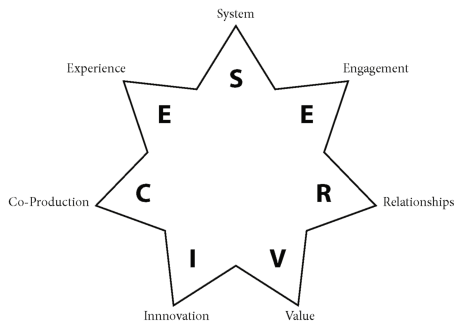
Within the framework of the seven-pointed SERVICE star model the authors draw up the next propositions:
System: public services can be considered as systems and not just 'simple' organizations, hence they need to be governed and managed as such. In this framework beside the given public organizations governmental bodies, other public service organizations, service users, local communities and technologies are also parts of the system where one of the most important tasks of PSOs is to learn how to interact with other actors and how to manage the whole service system in order to satisfy the needs of the public.
Engagement: PSOs need to engage in organizational sustainability. Organizational sustainability has to be an important priority within the institutions where the economic, social and environmental issues of the service process and the human factors of services are crucial.
Relationships: sustainable PSOs depend on long-term relationships across service systems rather than seeking short term transactional value. The importance of the management of existing and potential relationships is an integral part of public services marketing, as 'marketization has become popular in the last few decades and, according to Harker, these activities
- 47/48 -
are focusing on creating, developing, and maintaining committed, interactive and profitable exchanges with selected customers over time.
Value: internal efficiency leads to significant improvements in the efficiency of public services. It is also an important task to design the service processes to produce maximum value for the end-users and rethink the existing organizational culture in order to improve permanently the level of services to satisfy the needs of the end-users.
Innovation: in PSOs innovation could also be inevitable although this kind of innovation does not definitely mean the same competitive advantage which is typical in market coordination and competitive commercial market processes but it is rather about achieving service efficiency and effectiveness. With the available human resources and organizational knowledge in an optimal situation a public services organization could also achieve a certain level of innovation.
Co-production: co-production is an important source of effective performance and innovation by public services. The products of these organizations are designed and produced by public policy makers and service professionals while the consumers, the end-users are relatively passive in this process, although iterative interactions between service staff and service users produce the 'realized' service.
Experience: A key resource for PSOs are the knowledge elements and experiences where the quality and quantity of human resources are emphasized in order to produce sufficient level of services.
The seven-pointed SERVICE star model for public service organizations certainly draw up an ideal framework for those public service organizations which operate in the more developed parts of the world where the above identified key factors could contribute to sustainability, which are definitely priorities for PSOs. However, preferences could be different in the less developed parts of the world and in the transition economies of the Central Eastern European Region. In these regions to reach a more sustainable operation in the public sector, theory and practice have to be more specific and practical reflecting the given challenges of the region forming the basis of tangible activities that could help to obtain a sustainable operation. Therefore, we make an attempt to draw up a revised framework that is much closer to the present economic, social and environmental challenges of the Central Eastern European Region.
5. A new sustainable public service organization model: the OVHR-Model
Our approach, the New Sustainable Public Service Organization Model (OVHR-Model) has four scopes: operation, values, human resources and responsibility. This model is a simplified variant of the seven-pointed SERVICE star of a sustainable business model for public service organizations. The four key areas are the necessary and sufficient conditions that are needed in public institutions to rethink and reorganize their activities to create the foundations of a future sustainable operation. All of the four areas are inevitably needed, if one or more of them are missing from everyday operation, the idea of changing organizational
- 48/49 -
processes to real sustainable ones will remain a fiction. On the other hand, there are certain overlaps and interactions in connection with the four areas that have to be taken into consideration in everyday operation by an organization. After achieving results in these fields, organizations could deal with the other propositions of the seven-pointed SERVICE star model like innovation, co-production or engagement.
Figure 2 • OVHR-Model for public service organizations (figure developed by the authors)
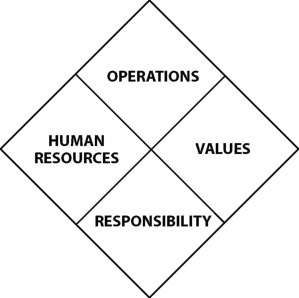
Operations: public service organizations have to manage their financial and human resources in a sustainable way, they have to use sustainable practices in their own operations to improve quality services for the public.
Values: through different activities PSOs could express sustainability values; public PSOs can also serve as models for good practices through a wide range of activities including the management of their resources, decision-making and policy development.
Human resources: PSOs need to employ a labour force with appropriate competencies, knowledge, flexibility and adaptation ability, which is satisfied on the long run.
Responsibility: social and public engagement, CSR, visibility, responsible actions are also substantial in the new sustainable way of thinking within an organization.
6. Four scopes of the OVHR-Model
6.1. Operations
In the everyday operation of a PSO, it is important to reach institutional and financial sustainability in order to provide the required resources for the activities of the institution. This is
- 49/50 -
a rather important challenge as most of the organizations are financed and maintained by the state. Public financing can be unpredictable, which results in permanent adaptation, financial instability and insecurity, and unforseeable situations that could risk the normal operation of the given organization. If the above mentioned stable circumstances are not provided, the institutions have to develop different types of surviving strategies (instead of strategic planning) to ensure normal operation and services. If financing does not change, PSOs should pay much more attention to fund-raising, projects or any other opportunities that could result in extra budget incomes. It remains to be seen if the available human resources, knowledge and competencies are suitable for raising funds from outside. In most of the cases (especially in Hungary) there are many institutions which lack these competencies and the colleagues forced to raise extra budget incomes or forced to participate in projects sometimes do not have the proper knowledge. Moreover, these activities are only manageable at the expense of their normal, everyday work. In an optimal situation the financial background is stable and predictable, the institutions have enough resources to purchase these competencies from the market.
From a sustainability point of view the second most important principle for organizations is sustainable resource management (utilities, waste, renewable resources), which should become a priority for the management and staff. Despite the fact that public service organizations use very different resources, there are significant differences and various approaches in connection with sustainability. The most frequently recommended steps are as follows:
- Starting energy saving programs;
- Renewable energy use;
- Sustainable waste management;
- Using sustainable development strategies;
- Becoming self-sufficient institutions;
- Minimizing environmental impacts of the institution;
- Intensifying public engagement.
It is important to point out that in Central Eastern Europe and in other parts of the less developed world the infrastructural background is simply not appropriate for a more sustainable operation, since buildings are old, the utilities are from the 20th century or even earlier periods. In these situations remodelling, rebuilding is only feasible from outside (mainly governmental) resources. These outside funds are dependent on government preferences and policies, which cannot equally affect all institutions at the same time. In a newly built infrastructure it has to be a priority to create and develop the proper conditions for sustainable resource management while the state has to try to develop strategies to deal with sustainability challenges of the old infrastructural conditions.
6.2. Values
According to the seven-pointed SERVICE star model values are mainly about internal efficiency that leads to significant improvements in the efficiency of public services and designing service processes to produce maximum value for end-users by rethinking the existing organizational culture to satisfy the needs of them. By understanding the importance of the
- 50/51 -
above mentioned fields we presume that public services institutions are appropriate structures for setting examples, best practices, good patterns and precedents for the public.
To achieve this, the first step is to specify and clarify what sustainability means in a given public service organization. It is also substantial to define what kind of tasks could be identified in connection with sustainability, how the outcomes could be presented and communicated to service users in parallel with determining how it could be achieved in practice. The whole process is much easier if there is a central direction and sustainability is a basic priority in the public sector.
It is important to point out if a given organization or public service system is not forced to deal with the challenges of sustainability, similarly to other situations, these issues will be neglected. The situation may change easily, especially if the public sector is forced to respond to these challenges: this is exactly what happened in California in the last years. The serious water problem quickly changed the attitude of the public sector institutions and they did their share to help the adaptation processes of the citizens. If there is no strong negative feedback, public sector organizations can play a proactive role in starting a new way of thinking, and teaching new values of sustainability to other institutions, market actors and to the public.
6.3. Human Resources
Similarly to market actors, public service organizations also depend on certain resources which they have to use efficiently and effectively to reach their aims on a long run. One of the most important resources is human resources within an organization and there are several situations when institutions have to rethink how they use and manage their human resources to maintain high quality services which meet the needs of the public. It is important to point out that the organizational answers for sustainability challenges are not only given at the operational level and must involve more than the simple reduction of the ecological impact of the given institution. It is also about how organizations manage their available human resources and how they pay attention to the social and human aspects of the operational process. According to Ehnert organizations need to focus on the following strategic goals when communicating the importance of sustainability in connection with HRM:
- Attracting and retaining talent and recognizing them as an 'employer of choice';
- Maintaining employee health and safety;
- Investing into the skills of the workforce on a long term basis by developing critical competences and lifelong learning;
- Supporting employees' work-life-balance and work-family-balance;
- Managing ageing workforces;
- Creating employee trust, employer trustworthiness and sustained employment relationships;
- Exhibiting and fostering (corporate) social responsibility towards employees and the communities in which they are operating;
- Maintaining a high quality of life for employees and communities;
- Managing and communicating sustainability values and integrating it into the organizational culture.
- 51/52 -
Although not all of the above mentioned principles are traditionally part of HRM, but they show perfectly the importance of people as a real resource that need to be developed, cherished and sustained instead of the 'hire and fire' attitude.[7] Dealing with these issues could lead to more sustainable and responsible public service organizations that play a crucial role in the state not just expressing and communicating basic values of sustainability but also acting upon them when they manage the human component of the organization responsibly.
On the other hand, understanding human resources as valuable assets that also could become scarce or could be exploited in an organization is also an important sustainability aspect. Organizations will always need highly committed, loyal and motivated workforce to reach the aims of the organization along with the personal goals.
6.4. Responsibility
Corporate social responsibility (CSR) appeared in the academic literature from the 1960s. Although this phenomenon came from the business world where the actors realized that business should not only be concerned with profitability and growth but also with its social and environmental impact, and must pay more attention to the concerns of its stakeholders (employees, shareholders, customers, suppliers, local communities, civil society), the public sector also has to adopt this concept into its operation.
Corporate social responsibility is the duty of a corporation to create wealth in ways that avoid harm to societal assets, while also protecting and enhancing them with market actions, externally mandated and voluntary actions. Organizations of the 21[st] century have been confronted with the difficult challenge of balancing their economic, legal and social responsibility for the variety of stakeholder groups with which they interact. The concept of CSR in Hungary, like in most of the transition economies in Central and Eastern Europe, is still relatively new and not well-known. Before the political changes in 1989 under socialism state owned socialist corporations and organizations had many social and cultural policies which played a major role in the maintenance and development of social and cultural services in the areas where they were located and ran their activities. In the 1990s most of these state owned corporations and organizations were closed, restructured or sold, privatized and the new owners did not care much about the former social and cultural infrastructures. Since the mid-1990s, corporations and public sector organizations have slowly begun to pay more attention to their social responsibilities. The present CSR activities are not coming from the past: most of these activities are imported activities both at business organizations and public institutions.
According to Steiner and Steiner, there are three main actions within organizations in connection with CSR that result in responsibility.[8] The first is market actions, which comes from
- 52/53 -
the logic of market coordination. Generally speaking, the actors who create products or provide services produce things that are useful for the public. If these products were not useful, they would disappear from the market soon, but the presence of these products and services of the market certainly mean a kind of responsibility because these organizations produce what the public needs. The second is mandated actions, where - within the legal framework - organizations have to observe the norms of the law. Legal regulation also come from the working mechanisms of human societies where these social structures create the rules of the game that could secure the sufficient operation of these systems on the long term, that also result in responsibility. The third one is voluntary actions where organizations exceed the first two forms of actions and carry out responsible actions for society and the public.
Since public organizations, in an optimal situation, provide services needed by the public within the legal framework of a given country, responsible policies are mainly focused on voluntary actions and concerned with their reputation and image: they want to project a socially responsible image to their customers and users. The CSR policies are defined under the concept of sustainability and mainly cover economic, social and environmental aspects of sustainable development and/or including policies of specific human rights and charity activities.
7. New challenges, emerging issues
Similarly to other sectors, the public services sector faces permanently changing conditions and challenges. If we examine the present trends, two fields seem to be very crucial: the first is the changing role of the state and the second is the challenge of e-services.
We have already pointed out the importance of the changing role of the state and the governmental sector in connection with sustainability. The state and its policy making role is one of the key actions that could result in a more sustainable service provided to the public. In an optimal situation a new legal background could urge organizations to adapt to the basic elements of the OVHR-model and to make the important steps toward sustainability to show, communicate and teach the citizens the values of sustainability. Along with the role of the state, the role of management is also a major element, because without a strongly committed government the success or failure of steps towards sustainability often depend on the commitment of the leaders and the management of local PSOs so their role is crucial to make PSOs more sustainable.
According to Osborne, most public services used to have a model where service providers and service users interacted in real-time. However, such encounters are becoming more and more virtual giving rise to the challenges of e-services.[9] It is also a challenge from a demand and supply point of view. Older generation of employees can not use digital technology effectively, while younger generations are proficient users. Of course, there is also a generation gap between public services users: the adaptive ability of younger generations is certainly much higher and they use e-services easily while for the older generations these type of services carry
- 53/54 -
certain challenges. Therefore, organizations have to face and have to manage these challenges which means the doubling of the service providing process in certain situations.
The intensive spread of the electronic services is also a critical HR question since some of the public service organizations do not need the competences any more that present employees possess. Although in these situations cutbacks are unavoidable, at the same time the same number of employees with other competences are needed to ensure the background of the electronic services and the operation of the back office as well.
Finally, it is important to pin down the fact that it is probably not very practical to characterize all public services as part of a homogenous whole. Inevitably there are differences between public services in different service sectors or at different points of the public service delivery chain. This is the reason why principles of sustainability could not be identified as universal solutions for every PSO and all public services.
8. Summary
The concept of sustainability has to become a part of public services in the next few years in which PSOs could play an important role. Some public institutions can certainly do more than others to reach these aims, however, the change of mindset is important everywhere. Therefore, every organization can find its role in this new orientation.
Almost 40 years of experience shows that despite several global, regional and local attempts, activities and programs it is impossible to change human mentality from one day to another. Looking back to the history it is clear that these processes usually worked best when negative feedbacks forced people to change their attitudes and way of life. In most of the cases these learning and adapting processes were not very nice and peaceful, although, on the whole, it was a successful story, but not for everyone and not every time. Currently the basic aim could be to solve and control the challenges of humankind without any crisis, which is a common matter so everybody is involved at every stage and level all over the world. In permanently changing environmental and socioeconomic circumstances it is very hard to forecast what we should learn and what is going to be useful in the future. The changes of the world are relatively fast, in most of the cases we are unable to perceive the real changes and situations, and rarely can we establish what and how we should react to work out better solutions. Developing sustainability approach in public service organizations could be one answer for these challenges.
This was one of the main topics of the World Council for Curriculum and Instruction (WCCI) 17th Global Conference, co-organized by the authors.[10] The event was organized around the theme of Educating for Democratic Governance and Global Citizenship. The purpose of this conference was to inspire and engage researchers throughout the world in an exploration of global education focusing on the understanding of the working mechanisms
- 54/55 -
of the world from a global, holistic, multidisciplinary point of view: the economic social and environmental processes, connections, causes and effects of humankind. In this respect educating for democratic governance and global citizenship means that education could produce new types of world citizens who are equally sensitive for the challenges of humanity and the Planet Earth, who understand the democratic values and also have competences, knowledge and skills that enable them to make responsible decisions in their individual and public actions. Educating for democratic governance and global citizenship at every stage of life could be one potential answer for these challenges. In our understanding such scholarly discussions are foundational in bringing about the dynamic educational transformation needed for creating a more peaceful 21st century global society and also creating sustainability of public services.
Public service organizations - similarly to other organizations around the world - also have to cope with the present global, regional and local challenges of sustainability. These economic, social and environmental issues and the potential answers for the challenges should be an integral part of the new public management and new public government approach everywhere in the world. In this new vision of sustainability the four strategic fields of OVHR-Model - the operation, values, human resources and responsibility substantiate those actions that could contribute to a better economic, social and environmental situation parallel with ensuring high standard public services that meet the needs of the citizens.
This study is focusing on the theoretical background of sustainability and the sustainability questions of public services. Our next step is to examine our concept in practice and confirm the theoretical background with empirical data from the Hungarian and the Central Eastern European public organizations in order to draw up a new vision in connection with sustainability for the public service actors of the region.
- 55/56 -
9. Bibliography
1. R. Ashworth, E. Ferlie, G. Hammerschmid, M. Jae Moon, T. Reay: Theorizing Contemporary Public Management: International and Comparative Perspectives, British Journal of Management, 24(2013)/S1, S1-S17.
2. I. Ehnert: Sustainability and human resource management: A conceptual and exploratory analysis from a paradox perspective, Contributions to Management Science, Physica/Springer, Heidelberg, 2009.
3. Ehnert: Sustainability and human resource management: reasoning and applications on corporate websites, EJIM, 3(2009)/4, 419-438.
4. ed. Nemeslaki A.: ICT driven public service innovation: comparative approach focusing on Hungary, National University of Public Service Institute of International Studies, Budapest, Hungary, 2014.
5. Juhász L. M.: Három irányzat a közigazgatás-tudomány fogalomtárából, avagy a New Public Management, a New Governance és az újwéberiánus szemlélet vizsgálata, 2011. Source: jesz.ajk.elte.hu/juhasz47.html (accessed 08.10.2016).
6. eds. D. Morgan, B. Cook: New Public Governance: A Regime-centered Perspective, M. E. Sharp, New York, 2014.
7. Nemeskéri Zs., Zádori I.: A kaliforniai szárazság és kormányzati kommunikációja = Jövőkép és konfliktusok. A Public Relations elmélete és gyakorlata, eds. Sós Péter János, Szécsi Gábor, Alapítvány a Public Relations Fejlesztéséért, Budapest, 2015, 182-199.
8. S. Osborne, Z. Radnor, G. Nasi: A New Theory for Public Services Management? Towards a (Public): Service-dominant Approach, American Review of Public Administration, 43(2013)/2, 135-158.
9. S. Osborne, Z. Radnor, I. Vidal, T. Kinder: A Sustainable Business Model for Public Service Organizations, Public Management Review, 16(2014)/2, 165-172.
10. S. Osborne, Z. Radnor, I. Vidal, T. Kinder: Sustainable Public Service Organizations: A Public Service Dominant Approach, Society and Economy, 36(2014)/3, 313-338.
11. Z. J. Radnor: Review of Business Process Improvement Methodologies in Public Services, Advanced Institute of Management, London, 2010.
12. eds. S. Senses-Ozyurt, S. Klein, S., Nemeskéri Zs.: Educating for Democratic Governance and Global Citizenship, World Council for Curriculum and Instruction, San Diego, 2016.
13. G. A. Steiner, J. F. Steiner: Business, Government and Society. A Managerial Perspective, Text and Cases, McGraw-Hill, New York, 2011.
14. Sustainability and Human Resource Management. Developing Sustainable Business Organizations, eds. I. Ehnert, W. Harry, K. J. Zink, Springer-Verlag, Berlin, Heidelberg, 2014.
15. J. C. Thomas: Citizen, Customer, Partner: Engaging the Public in Public Management, M. E. Sharpe, New York, 2012.
- 56/57 -
Dr. Iván Zádori (zadori.ivan@kpvk.pte.hu): assistant professor and vice dean at the Faculty of Culture, Education and Regional Development, University of Pécs. He has 14 years of experience in higher education (Marketing, Cultural Marketing and Management, Cultural Economics, Nonprofit Organizations and Nonprofit Economics, Sustainability, Sustainable Development). His research activities focus on the development processes and sustainability challenges of islands and other continental areas from social, economic, ecological and cultural perspectives, as well as the learning aspects of sustainability and corporate social responsibility.
Dr. Marianna Sebők (marianna.sebok@uni-corvinus.hu): organizational development expert, human resource manager and assistant professor at the Corvinus Business School, Corvinus University of Budapest, Hungary. She has spent more than 20 years in the market sector as leader and consultant. Her present activies are focusing on knowledge transfer and teaching in higher education. She received her summa cum laude PhD degree from the Doctoral School of Earth Sciences, at the University of Pécs. Her main research field is labour market mobility, she is also committed to changing organizational cultures, applying leadership and innovative HR activities and solutions in practice.
Dr. habil. Zsolt Nemeskéri (nemeskeri.zsolt@kpvk.pte.hu): associate professor at the Faculty of Culture, Education and Regional Development, University of Pécs. The primary topics of his research are the measurement of human resource development and analysing the characteristics of regional development. His scientific area also includes equal opportunities and HRD, in relation with corporate social responsibility (CSR) and employer branding. He is the author of more than a 100 publications in these fields. As a consultant he managed HRD related research projects at McDonald's, AVON Cosmetics, Hungarian Post, Paks Nuclear Power Plant. ■
NOTES
[1] For more details see: Nemeskéri Zs., Zádori I.: A kaliforniai szárazság és kormányzati kommunikációja = Jövőkép és konfliktusok, a Public Relations elmélete és gyakorlata, eds. Sós Péter János, Szécsi Gábor, Alapítvány a Public Relations Fejlesztéséért, Budapest, 2015, 182-199.
[2] Juhász L. M.: Három irányzat a közigazgatás-tudomány fogalomtárából, avagy a New Public Management, a New Governance és az újwéberiánus szemlélet vizsgálata, 2011. Source: www.jesz.ajk.elte.hu/juhasz47.html (accessed 08.10.2016)
[3] S. Osborne, Z. Radnor, I. Vidal, T. Kinder: Sustainable Public Service Organizations: A Public Service Dominant Approach, Society and Economy, 36(2014)/3, 317.
[4] Ibid., 315.
[5] Osborne, Radnor, Vidal, Kinder: A Sustainable Business Model for Public Service Organizations, Public Management Review, 16(2014)/2, 165-172.
[6] Osborne, Radnor, Vidal, Kinder: Sustainable Public Service Organiztations: A Public Service Dominant Approach, Society and Economy, 36(2014)/3, 322.
[7] I. Ehnert: Sustainability and human resource management: reasoning and applications on corporate websites, EJIM, 3(2009)/4, 419-438.
[8] G. A. Steiner, J. F. Steiner: Business, Government and Society. A Managerial Perspective, Text and Cases, McGraw-Hill, New York, 2011.
[9] Osborne, Radnor, Vidal, Kinder: Sustainable Public Service Organizations: A Public Service Dominant Approach, Society and Economy, 36(2014)/3, 332.
[10] The papers of the conference were published in: eds. S. Senses-Ozyurt, S. Klein, Nemeskéri Zs.: Educating for Democratic Governance and Global Citizenship, World Council for Curriculum and Instruction, San Diego, 2016.
Lábjegyzetek:
[1] Faculty of Culture, Education and Regional Development, University of Pécs, zadori.ivan@kpvk.pte.hu.
[2] Corvinus Business School, Corvinus University of Budapest, marianna.sebok@uni-corvinus.hu.
[3] Faculty of Culture, Education and Regional Development, University of Pécs, nemeskeri.zsolt@kpvk.pte.hu.