

Ágoston Restás: Decision Making Method in Emergency (Publico, 2014/3., 126-136. o.)
Abstract
Introduction: In case of emergency we can face a special situation without any warning sign and we can meet the requirements for improvisation making our decision. Improvisation can be at any level of the management (strategic, operational and tactical) but at tactical level the time pressur is certainly the biggest problem. Fire managers have a typical profession, during which making recognition-primed decisions as a symbol of naturalistic decision-making is regularly required. Method: Different tools and methods were used to achieve goals; one of them was the study of the relevant literature, the other one was author's own experience as a firefighting manager. Other results come from two surveys: one of them was an essay analysis, the second one was a word association test; both of theme were specially created for this research by the author. Results: the author created a simple and a complex model for firefighting managers making decisions, taking into account the time pressure, the limited capability of processing information and also a mechanism complementing the recognition-primed decision.
1. Introduction
Disaster managers, especially firefighters, can face a special or emergency situation without any warning sign and even if it was forecast they can meet the requirements of improvisation making their decision. It can be a nuclear accident or its generated problem not just in Hungary but also at international level[1], a chemical accident in the industry or at different transportation lines like road or train . Improvisation can be taken at any level of the management (strategic, operational and tactical) but at tactical level the time pressure is certainly the biggest problem. This article focuses on fire managers as an ideal example to
- 126/127 -
demonstrate a special decision making method in emergency and shows a modellisation of the method for better understanding. Even if regulations for prevention are very important and following its rules can help a lot in many cases e.g. in chemical industry or chemical transportation,[2] preparing the responsible organizations for new challenges are not avoidable. New challenges mean naturally many topics like regulations[3], work of authority, academic or special trainings[4] , activity of voluntary organizations and there are also other issues like climate change or GIS-based decision support systems at tactical level[5]. Military practice can be also adopted in some cases -, but can also raise the problem at a large scale incident or at the method of recovery[6] or cross border cooperation[7]. From the wide range of the problems mentioned above this article focuses on the operational and tactical level of the active intervention where problems converge to one main problem, which is the quick decision, quick response.
An important element of the activities of security managers or emergency responders is that they cannot, or only to a very limited extent can modify the terms of the task, improve them as desired. Despite the differences of environment, indications of the complexity of the situation, the possibility of the radical change in the given situation, uncertainty and ambiguity of the information available can be recognized and well identified. Most of these factors are present; occasionally all of them may be present at a certain level of emergency decisions: including the strategic, operational and tactical levels, but certainly with a different focus or at different times. On strategic and operational levels, in general, not only more time is available, but also human and technical resources are at hand more broadly, and decision support instruments as well to reduce uncertainties occurring. All of them stand implicit at the background of the intervention's safety, which is a priority during the intervention and also a very important and complex question at tactical level[8].
As an example, the extinction of fire in a minor dwelling house requires the implementation of a completely different, simpler scope of tasks than to control fire in a mid-high build-
- 127/128 -
ing[9],[10] or ensuring the preventive rules[11]. Short term disasters require immediate reaction, however slowly developed climate change gives time to create a strategy[12].
The different scopes of tasks exist in different environments and structures, so the solution of similar basic problems also exists in other dimensions. Based on the author's own experience, the more extensive case we are dealing with in time, space and from the aspect of involvement in the incident, the more cumulatively the above factors prevail, but because of the protracted implementation, it is easier to solve them. The most limiting factor from the ones above is time. This provides a framework impossible to burst and a forced drift, a pressurized channel for the decision-maker, entangled in which one can no longer break free. The functional background of decisions made in a short time, their mechanism different from the conventional has been studied recently, and the name recognition-primed decision[13] has been given to this special decision procedure.
2. Decision-making mechanism of a fire manager
Limited time frame allows the processing and management of limited amount of information. We know from Miller's research that the short-term memory of the vast majority of people can only process simultaneously 7±2 units of information[14]. This information, of course, can be quite different, e.g. characteristics of fire, the capacity of the response unit, a number, or even the absence of information searched for. Our memory handles the combinations, "operations" between the information units as information units[15], from which clearly springs forth that the capacity of the short-term memory of a firefighting manager is exhausted very quickly.
The author has proven by essay analysis[16] how complex the tasks of emergency responders are; this shows that in several cases, simultaneously, there is or would be a need to process many more units of information than the capacity of our short-term memory would allow. The maintenance of our decision-making capability, i.e. our short-term memory, based on the above, clearly requires that we should omit analysing and evaluating decision-making processes protracted and use the recognition-primed decision-making procedure, based on previous experience.
- 128/129 -
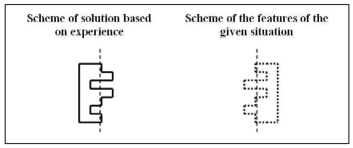
The author wishes to create a model element to demonstrate the decision-making mechanism of firefighting managers, which takes into account the limits of the simultaneous processing of information, that is, it also illustrates Miller's decision-making capacity. Since the information units may be qualitatively independent of each other, the author chooses the simplest graphical representation of the unit-based discrete difference to separate them from each other. A model element must be able to graphically demonstrate the schemes based on earlier experience, the characteristics of different fires, and the interlocking of the former as the application of the scheme, which represents the technically correct solution of the task, i.e. the effective decision. The model refers, at the general model of recognition-primed decisions, mostly to Klein's work[17],[18].
Figure 1. • Graphic representation of the empiric scheme of recognition-primed decisions matching a given situation.
SOURCE: AUTHOR
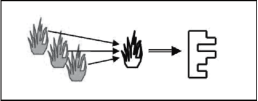
The schemes in figure 1 represent 7 graphical discrete values, which are marked by positive or negative protrusions and their "centre line"; these values indicate the amount of simultaneous decision-making capacity. Therefore, the "negatives" of the schemes can be matched with a given situation and the necessary solution. As an integration of the above processes, decision mechanism functions as follows: an experienced firefighter has performed the elimination of a large number of different fires. Despite the differing parameters of each fire, some characterizing features can be well conceived (figure 2).
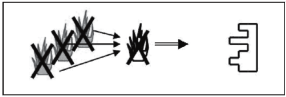
The characterizing features of identical types of fires are crystallized by experience and are fixed in our long-term memory. Similarly, to the characteristics of a fire, the characteristics of successful extinguishing, the facilitating decisions are also fixed (figure 3); just as the mistakes desired to be avoided and the unsuccessful procedures and failures. Experience gained through many years, based on the features of fires, formulate the system of schemes, behind which we can find actions (decisions) efficiently applicable to eliminate them.
- 129/130 -
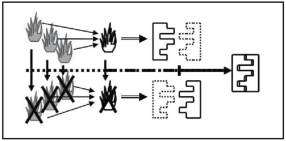
If another incident has almost the same circumstances as one already many times successfully eliminated by an emergency manager previously (model of positive confirmation), he will attempt to use the same techniques in the procedures. Therefore, another fire, quasi bearing the typified properties of previous similar fires, makes a decision-maker involuntarily immediately recall the typified decisions. The properties of a fire and of previous successful extinguishing operations, based on the above, are closely interlinked; they are each other's "reflections" (figures 4). Through the results of association studies the author proved that the above, i.e. the characteristics of a fire and the thoughts directed towards its extinguishing, the schemes of response, are very closely connected in a complex way in the case of firefighters.
Figure 2. • Evolvement of the scheme on fire.
SOURCE: AUTHOR
When a firefighting manager identifies a fire, he imagines what would happen if he applied the usual tactics to fight it. If the scheme of solution matches, he accepts it, if not, he rejects it and thinks of the next most typical action. Thus, it is a recognition-primed, model-matching process, which can be followed by a quick and almost automatic decision.
The long-term memory of a firefighting manager, through practical experience, has the schemes of both different fires and their extinguishing characteristics. During another alert, information available and collected on a fire automatically generates the recollection of the scheme necessary to solve it, based on which a firefighting manager defines the necessary firefighting tactics. However, the results of association studies clearly point in the direction that at a given fire (problem) managers do not focus on the fire as a problem but rather on its immediate solution. From this, the author makes the conclusion that a decision-maker will not follow the change of the characteristics of a fire, but the validity of solution scheme, that is, the dynamics of the implementation of the extinguishing process. This does not mean a contradiction with the previous, but rather a difference in views, the shift of emphasis of the focus of attention.
The difference in views, that is, the shift of emphasis means that a firefighting manager does not focus on the change of characteristics of a fire, but rather on the expected evolvement and dynamics of the scheme selected, i.e. extinguishing tactics. Based on the previous, these are, of course, inseparable from each other, however, the author finds the dominance of the interventions trend so strong in the results of association studies in the case of firefighters that, based on it, the author judges his above conclusion to be justified. The thought sequence fire-charac-
- 130/131 -
teristics-solution is attractively logical, however, the decision capacity of our memory is facilitated if it manages and reduces the necessary information in the simplest possible way. Since the schemes of characteristics relating to a fire exist together with the schemes of solution, there is no real need for it to appear in our short-term memory. Thus, the function appearing is modified to the simplest and shows the format fire-solution.
Figure 3. • Evolvement of the scheme on the lessons learnt from extinguishing a fire.
SOURCE: AUTHOR
The above do not contradict Klein's model, they rather complement it. Klein, in his model, evaluates (imagines what will happen) the results of matching schemes by the decision-maker prior to performing the action version which, based on the author's own experience, is so without doubt, however, the aftermath of the decision, in the author's opinion, is much more significant in the case of firefighting managers.
Figure 4. • Aggregated schemes on fire and the evolvement of the lessons learnt from extinguishing it.
SOURCE: AUTHOR
Since the problem immediately and automatically generates both the direction of the solution and the start of the action version, it is rather the process itself which is important in terms of efficiency, which is caused by the decision. The schemes based on experience certainly contain the information on the dynamics of the process of fire, so if it meets the expectations, we do not have to modify the original firefighting tactics. However, if the dynamics of the process does not suit the expectations, the change is inevitable in the performance of efficiency. Based on the above, the recognition-primed decision is not just an individual act before extinguishing the fire, but it is also the con-
- 131/132 -
tinuous accompaniment as needed. Therefore, the author shares the view that an experienced decision-maker perceives the problem together with its solution; furthermore, the author extends the continuous co-existence of the problem and of the whole process of solution of an emergency.
3. Mechanisms complementing a recognition-primed decision
Different triggers, internal resources ensure the operation of recognition-primed decisions. Klein in his work assumes 5 markedly distinct abilities, these are intuition, imagination, perception of the invisible, the ability to formulate, metaphors and analogies[19]. In the joint work of Cohen, Freeman and Thomson[20], the attention is drawn to the importance and benefits of critical thinking as criticism of actions planned by ourselves.
Despite the fact that one could assume, based on the previous issues, that recognition-primed decision-making is exclusivity on a tactical level, it is absolutely not true. We can compare it with several fires or incidents, still, one of the essential features is that it protracts in time. it allows the decision-maker to think over the situation, collect information, develop action versions and consider them.
3.1. Analytical thinking
Killion sees the combination of recognition-primed decision-making with the analyzing and evaluating procedure in two ways[21]. In both cases, the conditions are that adequate time should be available for analyzing the options. In the first case, prior to recognition-primed decisions, focusing on the given circumstances, we set up options and analyze them. in the second case, a more detailed analysis of the action version of our recognition-primed decision may take place. In the latter case, the spectrum of the task is obviously significantly narrower than in the first case. The two mechanisms, depending on the situation, can be harmonized or one of them may become predominant.
3.2. Critical thinking on a tactical level
Cohen, Freeman and Wolf studied the possible decision support role of critical thinking on a tactical decision-making level[22]. In their work, active naval officers and case reports were stud-
- 132/133 -
ied based on which they state that experienced emergency decision-makers, in new situations, using their previous experience, make decisions with the help of recognition-primed mechanisms. Cohen's model explains in detail the critical analytical strategies that contribute to the operation of recognition-primed thinking. Systematic situation models often based on informal narratives as schemes organize our information in cause and effect relationship in individual cases and underpin the development of recognition-primed thinking.
3.3. Satisfactory procedure mechanism
Previously we have seen that a firefighting manager's time, just as the time of other decision-makers in an emergency to make a decision is limited. Since this time limit precludes the possibility to carry out the necessary analyses of the classic model, objectively the choice of an optimum option is not achievable for a decision-maker. In response to the difficulties of the collection of information and the reduction of the costs in relation, a decision-maker does not strive for optimum results, but, depending on the circumstances, settles for satisfactory solutions.
3.4. Decisions by exceptions
The aim of the application of the method is that the leadership responsibilities of managers should be drastically reducible; its essence is that we should only intervene into processes having permanent characteristics in majority, if they cross the pre-specified lower and upper limits. The method, management by sensitive exception, so derived from the dynamics of the processes, the necessary interventions are now possible even before crossing the borders[23]. The method of management by exceptions, based on the author's experience, is the greatest help for a firefighting manager to continuously maintain his decision capacity. It can appear in different ways, like protocol procedures, individual way of speaking, silence approval, peripheral vision, and information-processing in zones.
3.5. Creativity
Creativity has many definitions. Munteanu, in one of his works, presents 35 ones, which approach creativity in different ways, however, there is no single definition generally accepted or used,[24]. Analyses researching creativity show that there are three general directions of study[25],[26]. The first one concerns the nature of creative thinking, the second one the development of creativity and the third one the characterizing properties of creative people.
- 133/134 -
Amongst the properties, there is practically none, which would not be advantageous for efficient work in a VUCA environment describing the working conditions of a firefighting manager. Based on the above, the author made the conclusion that the creative capabilities of a firefighting manager can be explicitly beneficial for facilitating the technically correct decisions relating to firefighting and technical rescue tasks.
3.6. Heuristics
Heuristics means that certain distortions are not incidental and unarranged errors, but the results of simplifying mechanisms, with which decision-makers make the complicated tasks manageable for themselves, which cut the Gordian knot[27]. Based on research related to the names Tversky and Kahneman, we distinguish 5 basic groups of heuristics[28]. These are representativeness, availability, fixing (imprint) and adjustment heuristics, retrospective distortion, as well as overconfidence and calibration. Studying the activities of firefighting managers, there are many examples of practical heuristics.
Research show that overconfidence means that the division between actual and putative knowledge is around 50%[29]. We are best able to judge the certainty of our decisions around 80% of knowledge, over this value we underestimate our abilities. The above have shown that our actual knowledge does not grow parallel with certainty; the increase of our knowledge does not automatically mean the growth of self-assurance[30]. During firefighting (technical rescue), the characteristic VUCA environment exactly expresses that the actual knowledge of a decision-maker can only be partial, he can only be sure temporarily of the reliability of his knowledge. Aggregating the above, we can see that the risk of overconfidence continuously prevails in the decisions of a firefighting manager.
4. The complex model of decision-making in emergency
If not enough time is available for analysing and evaluating decision-making, recognition-primed procedures receive a greater role. Critical thinking uses recognition procedures, during which the decision-making process can be accelerated or analysed with the help of a quick test and depending on the time available. The quick test, considering the circumstances, hinders recognition-primed decision and prefers critical thinking. However, when the circumstances are inappropriate for critical analysing thinking, the quick test allows an immediate reply.
Despite the limited decision capacity, thanks to recognition-primed mechanisms, in most of the occasions correct decisions are made by firefighting managers. Time limit precludes
- 134/135 -
the possibility for the firefighting manager to carry out analyses necessary for the classic model; therefore, the selection of the optimal possibility is objectively not attainable by the decision-maker. The decision-maker is not striving to achieve ideal results, as a response to the difficulties of collecting information and reducing costs in relation, but depending on the circumstances, he is satisfied with its satisfactory solution.
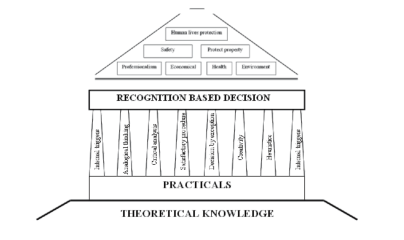
Figure 5. • Complex model of decision-making of firefighting managers in emergencies.
SOURCE: AUTHOR
By reducing the time available for decision-making and for maintaining decision-making capacity, a firefighting manager applies the management (decision-making) method based on exceptions in numerous situations. Its essence is that several moments of interventions proceed protocol-like, thus they need not be controlled all the time; on the other hand, not all the phases of the processes require direct management decision.
During the study of creativity, the author has concluded that there is no feature characteristic of the working circumstances of firefighting managers that would not be advantageous to perform efficient work in a VUCA environment. Therefore, it is sure that the creative capabilities of firefighting managers can be explicitly advantageous to facilitate the professionally correct decisions on firefighting and rescue tasks even if a significant part of the characteristics of innovativeness does not favour the performance of an everyday work free of interventions with respect to firefighting managers.
Heuristics are not random-like errors or specific distortions facilitating our everyday activities. These are the results of simplifying mechanisms, through which decision-makers can make difficult tasks manageable for themselves. Besides the benefits of heuristics, the greatest challenge for a firefighting manager can mean the inherent erroneous distortions, which surely often help, but their uncritical acceptance, in certain cases, can end up in fatal dangers. The declared objective and sense of the decisions of firefighting managers is the efficient implemen-
- 135/136 -
tation of emergency interventions. It is symbolized by the principles of firefighting with structured division, on the top of which we clearly find the saving of human lives.
Firefighting managers certainly have less time to make their decisions compared to the time interval of classic decisions, so their decision mechanism is strongly based on recognition procedures due to the peculiar environment (VUCA), and the limited processing possibility of simultaneous pieces of information. The competence of firefighters is based on the unity of theoretical knowledge and practical experience. Building on practical experience, the different mechanisms like analogical thinking, critical analysis, satisfactory procedure, decisions based on exceptions, creativity and heuristics, together with the internal triggers, hold as pillars and make recognition-primed decision procedure of firefighting managers operational. The author illustrates the above as a complex system of emergency decisionmaking of firefighting managers in figure 5. ■
NOTES
[1] Pátzay, Gy., Weiser L., Feil F., Patek G.: Analysis and Selective Treatment of Radioactive Waste Waters and Sludges in Waste Water, In: Fernando Sabastian Garcia Fernando Sabastian Garcia (ed.) Waste Water- Evaluation and Management. Rijeka: InTech Education and Publishing, 2011. pp. 203-216
[2] Horváth, H., Kátai-Urban L.: Veszély-elhárítási tervezés a vasúti rendező-pályaudvarokon; Katasztrófavédelmi szemle: Védelem 2013. XX. (2) www.vedelem.hu/letoltes/tanulmany/tan436.pdf downloaded: 13.03.2014
[3] Endrődi, I.: A katasztrófavédelem feladat-, és szervezet rendszere, National University of Public Service, Budapest, Vezető- és Továbbképzési Intézet, p. 86 2013
[4] Grósz, Z.: Védelmi igazgatási képzés a Zrínyi Miklós Nemzetvédelmi Egyetemen, VÉDELEM - KATASZTRÓFA- TŰZ- ÉS POLGÁRI VÉDELMI SZEMLE 3: (5) pp. 23-27. ISSN 1218-2958
[5] Kóródi, Gy.: A térinformatika új lehetőségei a háborússérült-ellátásban; KARD ÉS TOLL 2002:(1) pp. 139141.
[6] Ambrusz, J.: A vis maior tartalék felhasználás szabályai, valamint a lakossági kárenyhítés lehetősége, az eddigi országos és helyi tapasztalatok tükrében; Védelem on-line http://vedelem.hu/?pageid=kereses_index, downloaded 26.02.2014, ISSN 1218-2958
[7] Komjáthy, L.: MAGYARORSZÁG TŰZVÉDELME A HATÁRMENTI TELEPÜLÉSEK TŰZVÉDELME, HADMÉRNÖK 8: (1) pp. 99-106. 2013 http://hadmernok.hu/2013_1_komjathyl.pdf downloaded: 28.03.2014, ISSN 1788-1919
[8] Pántya, P.: Hatékonyság és biztonság növelése az osztó vonala mögött, VÉDELEM ONLINE: TŰZ- ÉS KATASZTRÓFAVÉDELMI SZAKKÖNYVTÁR 2011 pp. 1-8. ISSN 1218-2958
[9] Bleszity, J. and Zelenák, M.: Tűzvédelmi ismeretek, Budapest: Szövetkezeti Szervezési Iroda, 272 p. 1990
[10] Pántya, P.: A tűzoltói biztonság növelése zárt téri beavatkozások során, Műszaki Tudomány az Észak Alföldi Régióban 2012. Debrecen: Debreceni Akadémiai Bizottság Műszaki Szakbizottsága, 2012. pp. 393-404.
[11] Horváth, L. A MŰEMLÉK ÉPÜLETEK TŰZVÉDELMI KÉRDÉSEI, 2013. XXII. (3). Tematikus Különszám TŰZVÉDELEM 2013, pp. 109-114. http://uni-nke.hu/downloads/bsz/bszemle2013/3/9.pdf downloaded: 31.03.2014.
[12] Padányi, J.: Éghajlatváltozás és a biztonság összefüggései., HADTUDOMÁNY 1-2: pp. 33-46. 2009, http://mhtt.eu/hadtudomany/2009/1_2/033-046.pdf downloaded: 16.03.2014; ISSN 1788-1919
[13] Klein, G. A.: Strategies of decision making, Military Rewiev, No.5. 1989
[14] Miller, G. A.: The Magic Number 7 Plus or Minus 2; Some Limits on our Capacity for Processing Information, Psychology Review, Vol. 63. 1956
[15] Ribárszki, I.: Döntéspszichológia, Zrínyi Miklós Nemzetvédelmi Egyetem, Jegyzet, Budapest, 1999
[16] Restas, A.: Principles of Decision-Making of Firefighting Managers, Based on Essay Analysis, In: Hervé Chaudet Liliane Pellegrin, Nathalie Bonnardel (Ed.) Proceedings of the 11th International Conference on Naturalistic Decision Making, Marseille, France, 2013. pp. 247-250, ISBN:979 - 10 - 92329 - 00 - 1
[17] Klein, G. A.: Strategies of decision making, Military Review, No.5. 1989
[18] Klein, G. A.: Sources of Power: How People Make Decisions Cambridge, MA: MIT Press 1999 ISBN 0262611465
[19] Klein, G. A.: Sources of Power: How People Make Decisions Cambridge, MA: MIT Press 1999 ISBN 0262611465
[20] Cohen, S. M., Freeman, J.T., Thompson, B.B.: Integrated Critical Thinking Training and Decision Support for Tactical Anti-Air Warfare; Report, Cognitive Technologies, Inc., Naval Air Warfare Center Training System Division, Contract No. N61339-96-R-0046. 1996
[21] Killion,T.H.: Decision Making and the Levels of War; Military Review, United States Army Combined Arms Center, Fort Leavenworth, Kansas, November-December 2000
[22] Cohen, S. M., Freeman, J.T., Thompson, B.B.: Integrated Critical Thinking Training and Decision Support for Tactical Anti-Air Warfare; Report, Cognitive Technologies, Inc., Naval Air Warfare Center Training System Division, Contract No. N61339-96-R-0046. 1996
[23] Hoványi, G.: A menedzsment új horizontjai; Közgazdasági Szemle, XLIX. (3)., pp 251-264, 2002
[24] Munteanu, A.: Incursiune în creatologie. Timişoara, Editura Augusta. 1994
[25] Csíkszentmihályi, M.: Kreativitás - A flow és a felfedezés, avagy a találékonyság pszichológiája; Akadémiai Kiadó, 2008
[26] Zoltayné Paprika, Z. Döntéselmélet; Alinea Kiadó, Budapest, 2002, ISBN 9638630612
[27] Zoltayné Paprika, Z. Döntéselmélet; Alinea Kiadó, Budapest, 2002 ISBN 9638630612
[28] Twersky,A. & Kahneman, D.: Judgment under uncertainity: heuristics and biases,; Science, vol. 185, pp. 1124-1131 (1974)
[29] Lichtenstein, S. & Fischhoff, B.: Do those who know more also know more about how much they know? Organizational Behaviour and Human Performance, Vol. 20. 159-183., 1977
[30] Zoltayné Paprika, Z. Döntéselmélet; Alinea Kiadó, Budapest, 2002, ISBN 9638630612