

Ajmal Waheed[1] - Taqveem Tayyasar Zahra[2]: Impact of Turnover on the Remaining Employee's Organizational Commitment, Job Satisfaction and Job Stress (Publico, 2017/2., 192-208. o.)
The organizations providing services are facing a significant challenge of turnover of their employees. This paper is aimed at to study effects of employee's turnover on remaining organization's employees commitment, job stress and job satisfaction level. To conduct survey the questionnaires are distributed to teachers in three universities in Punjab, Pakistan. 80 teachers from three universities have participated and filled the questionnaires developed for data collection. Convenience sampling technique was adopted to collect data. Findings of the study show that turnover of teacher's affect commitment and job satisfaction of other teachers to some extent but it does not affect their job stress level. Thus, the factors that affect job stress level of teachers are other then turnover of colleagues. This study adds the knowledge to understand the job related issues of academic staff in the context of Pakistan.
Keywords: academic staff, employee turnover, employee commitment, job stress, job satisfaction
- 192/193 -
1. Introduction
The costs associated with the reduced productivity because of labour turnovers account for two third of the total cost of turnover in an organization.[1] In services organizations, frontline employees are their basic competitive edge.[2] As it is a commonly known concept that the delivery of services depends on the employees delivering it. An important issue for services organizations is to retain those service employees; most important is to retain the employees which are very good in providing services to customers. Therefore, managing turnover of organization's employees is important to keep good employees in the organization.[3] Thus it becomes imperative for the organizations to retain their trained employees to avoid such additional costs.
Enormous intangible costs along with tangible dollar cost are associated with labour turnover. These intangible costs depend on the extent to which turnover effect workplace environment.[4] The factors of work place environment are related to the job stress level of employees.[5] As it is commonly known that factors related to workplace affect the employees, even the presence and absence of other employees and their skills affect the flow of work because providing services is usually a step by step procedure in organizations, so performance of an employee often depends on performance of other employees working in an organization. Employee turnover is not an isolated happening in any organization. It is strongly related to organization's employee's behaviours in stipulations of productivity, their plan to leave, decreased loyalty, job stress and job dissatisfaction.[6]
However, the centre of attention in this study is to analyze the impact of employee turnover on the remaining employee's job satisfaction, organizational commitment and job stress. There are total eight sections in this study. First section is about a brief introduction, second section is about the literature review to develop the research framework for arriving at the hypotheses to be tested on the bases of previous researches and third section is about the research framework. In the fourth section the objectives of study are listed, fifth section comprises of hypotheses which are developed from the research framework. he sixth section of this study includes methodology and the section seven is about the statistical tool applied and results generated thereafter. Discussion and conclusion of the study are given in the last section.
- 193/194 -
2. A Review of the Literature
To improve quality of services being provided by an organization, the employees of the organization have central importance. Which means the success of any services organization is the result of act of its employees who have direct interaction with customers.[7] The costs of labour turnover are also related to organizational behaviour and other associated hygiene aspects.[8] It is observed that the intention of employees to leave the organization is a major factor effecting voluntary turnover.[9] Turnover is worse because it results in work force decrease.[10] The increase in turnovers decrease the quality of services being provided by the organizations, it is because of the required time to fill the gap of experienced employees.[11] Employee turnover costs organizations in different ways which includes the costs of identifying, hiring and then training the new staff including the overtime payments to relieve deficiencies, and the cost resulted from the replacement of a trained and skilled employee with an inexperienced new employee.[12]
A major threat in current business field is to keep skilled employees. The employees' turnover costs every organization in a lot of diverse ways like reduced output, decrease moral of employees and lost competitive edge. Cost of turnover of employees can be 1.5 times more
- 194/195 -
than salaries of its employees'.[13] Employees' turnover can cost heavily to an organization.[14] For American companies the cost of employees' turnover is estimated to extent to about $5 trillion per year.[15] The employee's retention can be increased through proper feedback, job clarity; job control and freedom to some extent in their job related decisions.[16] Commitment of an organization's employees is their belief and recognition on its targets and objectives, and their eagerness to put their efforts to support these goals by maintaining membership of the organization.[17] Commitment is of three forms which are affective: continuous and normative commitment.[18] Affective commitment means the employee's faithfulness, loyalty and affection to an organization.[19] Committed employees want to remain part of the organization.[20] However, affective commitment is developed from positive experiences, organizational support and sense of achievement of employees within the organization. Continuous commitment is when employees remain in an organization as the cost of leaving the organization has increased and they cannot get another job easily.[21]
Nevertheless, the cost of leaving may include the lack of employment opportunities or the facilities being provided by the employing organization. Hence continuous commitment varies according to experience and the perceived cost. When workers remain in an organization because of their loyalty with that organization and feeling of doing a right job, it is called normative commitment.[22] Therefore, the normative commitment is developed from the personal and cultural norms. These three types of commitment provide an understandable sense of the reasons because of which the workers of an institute stay with it.
- 195/196 -
However, in Pakistan the more important to be considered is the continuous commitment because of the increased cost of leaving. As far as employees' turnover is concerned it affects the organizational environment and work processes. In many cases the performance of an individual relates to the performance of the other employees working at the same workplace because in organizations there are predefined processes through which required work is to be done. It is commonly known that lack of workers increases the workload on remaining workers resulting in increased jobs tress.
Stress is when workers experience that they are not able to perform their job according to the standards of the organization due to certain happenings in the work environment.[23] Job stress could have different forms depending upon the job requirements of workers. It is defined as a feeling of a worker that his performance is not according to required standards because of some happenings in work place environment.[24] It is required that organizations should eliminate or at least minimize the sources of stress in the work place.[25] Work environment aspects are related to stress, namely lack of control, role uncertainty, work overloads and work disagreements.[26] Work overload is when an employee is not capable of performing his job because of lack of resources, time or capabilities.[27]
Employees' level of satisfaction, their loyalty to the organization and turnover behaviours are linked to their job stress level.[28] Factors of work environment have direct effects on job stress level and employees' job satisfaction.[29] Increased job stress levels result in decreased job
- 196/197 -
satisfaction of employees.[30] Job stress reflects the dissatisfaction of employees which increase the expected rate of turnover.[31] To reduce job stress of an employee, it is significant to increase his commitment towards the organization. Job stress is not only the result of difficulties and overloading of work but there are some personal reasons of employees resulting in job dissatisfactions.[32]
Job satisfaction of employees is a significant characteristic that organizations need for their human resource.[33] Job satisfaction is a sense of achievement developed in an individual as a result of appraisal of job.[34] Job satisfaction affects the rate of turnovers, performance of one's job and level of job stress of an employee.[35] Employee job satisfaction results in increased productivity and decreased turnover while dissatisfaction leads to absenteeism and reduced productivity.[36] Job satisfaction should not be overlooked, but there are small numbers of organizations which consider it seriously.[37]
Based on the literature review above, research framework to study turnover effects on job satisfaction, job stress and organizational commitment of employees is as under:
- 197/198 -
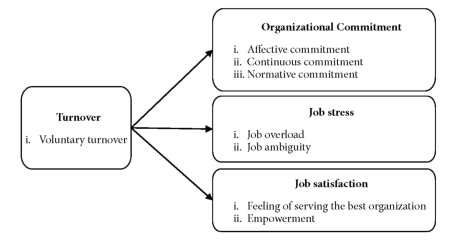
Figure 1 Research Framework
Turnover of employees is the only independent variable and employee's organizational commitment, job stress and job satisfactions are the dependent variables in the above research framework. Turnover is considered as the only one independent variable because it is a study to look at the consequences of employee's turnover in educational institutions on remaining workers commitment to the organization their job stress and job satisfaction level. Turnover is being measured by voluntary turnover, three types of organizational dedication including normative commitment, continuous commitment and affective commitment are considered to measure organizational commitment of employees while job stress is being measured by job overload and job ambiguity. To check the job liking of workers feeling of serving the best organization and empowerment are considered as job satisfaction measures.
3. Objectives of the Study
a. To examine the relationships between employee's turnovers and remaining employee's organizational commitment, job stress and job satisfaction.
b. To study the strength and direction of the effect of an organization's employee's turnover on remaining employee's organizational commitment, job stress and job satisfaction.
4. Hypotheses
The following hypotheses are developed to be tested:
H1[0]: There is no relationship between turnover of employees and remaining employee's organizational commitment.
- 198/199 -
H1: There is a negative relationship between turnover of employees and remaining employee's organizational commitment.
H2[0]: There is no relationship between turnover of employees and remaining employee's job stress level.
H2: There is positive relationship between turnover of employees and remaining employee's job stress level.
H3[0]: There is no relationship between turnover of employees and remaining employee's job satisfaction.
H3: There is negative relationship between turnover of employees and remaining employee's job satisfaction.
5. Methodology
This is a study of employees of services organizations. In this study the population considered is all universities of province of Punjab in Pakistan. The survey covered three universities including Quaid-e-Azam University Islamabad, GC University Faisalabad and University of WAH. The sample to be studied is male and female teachers within the age limit of 25 years to 60 years from different departments of these universities. Teachers at all ranks are considered as sample. In this study the Convenience sampling was adopted to gather the related data. The teachers were contacted personally and 150 questionnaires were circulated to collect data for the study. The response rate was 53.3% as 80 out of 150 teachers returned the questionnaires. The participants were approached after taking permission and they were told that the information being provided by them is used only in this research work and the confidentiality must be ensured to the best possible extent.
The scale being used consists of items to measure four variables being studied in this research. First variable turnover is measured by four items. While organizational commitment is measured by eleven items, job stress is measured by nine items and job satisfaction of employees is measured by six items included in the questionnaire. Thus total 30 items included in the scale. Rating scale (5 point Likert scale) was used to examine how powerfully the subject agrees or opposes the statements, on the five point Likert scale. This is an interval scale and the differences in the responses between any two points on the scale remain the same.
Pre-formulated questionnaire consisting of written set of close ended questions was used to gather information. To maintain the reliability, stability and consistency the data was collected from the entire respondents by using the same questionnaire for all. The scale being used in this research work is to a limited extent adopted from the questionnaires developed by Quinn and Shepard (1974), Pond and Geyer (1991), Mowday, R, T., Steers, R, M., and Porter, L, W. (1979), Weiss, D., Dawis, R., England, G., and Lofquist, L. (1967), Meyer and Allen (1997), Dunham (1994), Cohen (1999), Lvancevich and Matteson (1980), Nelson and Sutton (1990).
It is a field study and the unit of analysis is the individual worker. For this study data is gathered just once in the natural environment with the least interference. The primary data was used and the firsthand information is obtained to study the variables of interest. It is
- 199/200 -
a co-relational study that attempts to establish cause-and-affect relationships through certain type of co-relational or regression analysis.
6. Results and Analysis
Before applying the linear regression to test the hypothesis of this study to arrive at results, some statistical measures are applied on the data of 80 samples, including reliability, descriptive statistics and correlation of the variables. Reliability of the variables is computed to confirm the dependability of the measure being used that should be equal or more than 0.6 when the scale is appropriate.[38] The scale reliability of considered variables for the data of 80 is shown in Table 1. It shows that the scale of 30 items was reliable to collect data for this study. As in Table 1, the reliability for the considered variables is more than 0.6 which shows that all the sub scales are reliable; as all sub scales are reliable; therefore, the total scale is also reliable.
Table 1 Reliability of the Scale for Variables Considered (N=80)
| Sr. # | Scale | Items | Alpha coefficient |
| I | Turnover | 4 | 0.702 |
| II | Commitment | 11 | 0.652 |
| III | Job stress | 9 | 0.746 |
| IV | Job satisfaction | 6 | 0.812 |
As far as descriptive statistics are concerned the mean, standard deviation, minimum and maximum for all variables are given in the Table 2 for 80 respondents. From arithmetic means of the variables it is clear that for turnover, commitment and job satisfaction most of the teachers agree or strongly agree while in the case of job stress most of the teachers disagree or strongly disagree. The standard deviation (SD) is the basic measure of variability. The smaller SD shows that the majority of the values in the gathered data are close to the overall mean of the data and its big value means that information in the data set is widely scattered around the mean of data. As in the Table 2 the highest standard deviation is 0.9093 which shows that the observations in the data set lie within mean ± 1SD. That means the comments in the data are clustered around the mean.
- 200/201 -
Table 2 Descriptive Statistics of the Variables (N=80)
| Scales | N of items | M | SD | Range scores Min - Max |
| Turnover | 4 | 3.0250 | 0.9093 | 1.25-5.00 |
| Commitment | 11 | 3.4216 | 0.4839 | 2.45-4.64 |
| Job stress | 9 | 2.5708 | 0.6242 | 1.33-3.89 |
| Job satisfaction | 6 | 3.7500 | 0.7463 | 2.00-5.00 |
M= mean, SD= standard deviation
Correlation quantifies association among the variables and it shows trend and potency of the linear connection among the variables. Its value varies from +1 to -1 showing the power of association. Its value near to 0 shows weak relationship.
Table 3 Inter Variables Correlation of Scale (N=80)
| Scale | I | II | III | IV |
| Turnover | - | -.243* | -.433** | .211 |
| - | .030 | .000 | .061 | |
| Job satisfaction | - | - | .589** | -.256* |
| - | - | .000 | .022 | |
| Commitment | - | - | - | -.140 |
| - | - | - | .217 | |
| Job stress | - | - | - | - |
*. Correlation is significant at the 0.05 level (2-tailed).
**. Correlation is significant at the 0.01 level (2-tailed).
In Table 3 the correlation among the variables of the study is given. It is clear from the table that turnover is inversely correlated with job satisfaction and commitment at level of significance below 0.05. Turnover is not significantly correlated with job stress. Job satisfaction is significantly correlated with commitment and inversely correlated with job stress. Commitment is also inversely and not significantly correlated with job stress. The inverse and non-significant correlation of variables shows that the assumed relationship among variables is not being laid existing by the outcome of correlation test.
The linear regression is applied on the data collected to test the hypotheses. Linear regression is applied because in this study the one independent variable is predicting three dependent variables. To test H1 the linear regression between turnover and commitment give the results as shown in Table 4. In Table 4, the value of R[2] shows that 18.7% variability in commitment of teachers is explained by variability in turnover of other teachers. Thus value of R[2] shows that some of the teachers are influenced by turnover of their colleagues. (3 shows the strength of relationship. The strength of relationship between turnover and commitment of teachers is 43.3% and is negative as well. Thus showing that turnover negatively affects the commitment
- 201/202 -
of teachers to organization for which they are working up to extent of 43.3%. Standard error of estimate is the typical residual; it is the difference among that is predicted by the model and which is actually observed and the difference is approximately 43.9%. The test is significant as p ≤ 0.000. Thus the data does not provide sufficient evidence to reject H1A, and on the basis of above results of regression, it is clear that turnover of colleague's affect organizational commitment of other employees negatively.
Table 4 Outcome of Linear Regression Taking Turnover as Independent and Commitment as Dependent Variable (N=80)
| Model | b | SE | ß | T | P |
| (Constant) | 4.118 | 0.171 | - | 24.016 | 0.000 |
| Turnover | -0.230 | 0.054 | -0.433 | -4.241 | 0.000 |
| R2 = | 0.187 | ||||
| ΔR2 = | 0.177 |
Note: b= Unstandardized coefficient, SE= standard error, (ß= standardized coefficient, t= test statistic, p= level of significance.
Standard error of estimate = 0.43902
To test the second hypothesis the linear regression between turnover and job stress gives the results as shown in Table 5. In Table 5 R square shows that 4.4% variability in job stress level of teachers is explained by variability in turnover of other teachers. Thus value of R square shows very few teachers feel stressed because of turnover of their colleagues. ( shows the strength of relationship. The strength of the relationship between turnover and job stress level of teachers is 21.1%. This shows that teachers do not feel stressed due to turnover of their colleagues. Standard error of estimate shows the difference of approximately 61.4% between observed and expected. The test is not significant as p>0.05. Thus the data does not provide sufficient evidence to accept H2A, and on the basis of the above results of regression, it is clear that turnover of colleague's dose not effect job stress level of other teachers.
Table 5 Results of Linear Regression Taking Turnover as Independent and Job Stress As Dependent Variable (N=80)
| Model | b | SE | ß | T | p |
| (Constant) | 2.134 | 0.240 | - | 8.894 | 0.000 |
| Turnover | 0.145 | 0.076 | 0.211 | 1.902 | 0.061 |
| R2 = | 0.044 | ||||
| Δ R2 = | 0.032 |
Note: b= Unstandardized coefficient, SE= standard error, (ß= standardized coefficient, t= test statistic, p= level of significance.
Standard error of estimate = 0.61414
- 202/203 -
To test the third hypothesis the linear regression between turnover and job satisfaction gives the results as shown in Table 6. In Table 6 R square shows that 5.9% variability in job satisfaction of teachers is explained by the variability in turnover of other teachers. Thus the value of R square shows that very few teachers feel dissatisfied because of turnover of their colleagues. (ß shows the strength of relationship. Here it is 24.3% which is negative as well, that means the turnover of teachers has very minimal negative effects on remaining teacher's job satisfaction level. This shows that very few teachers feel dissatisfied because of the turnover of their colleagues. Standard error of estimate is the typical residual; it is the difference that amid what is predicted by the model and that actually observed and the difference is approximately 72.8%. The test is significant as p<0.05. Therefore, from the above result, it could be concluded that the data provide weak evidence to accept H3A. It is also obvious that very few teachers feel dissatisfied due to turnover of their colleagues.
Table 6 Results of Linear Regression Taking Turnover as Independent and Job Satisfaction as Dependent Variable (N=80)
| Model | b | SE | ß | T | P |
| (Constant) | 4.354 | 0.285 | 15.300 | 0.000 | |
| Turnover | -0.200 | 0.090 | -0.243 | -2.215 | 0.030 |
| R2 = | 0.059 | ||||
| ΔR2 = | 0.047 | ||||
| Table 6: Linear Regression | |||||
Note: b= Unstandardized coefficient, SE= standard error, (ß= standardized coefficient, t= test statistic, p= level of significance.
Standard error of estimate = 0.72851
7. Discussion and Conclusions
The H1 was that a negative relation exists between turnover of colleagues and organizational commitment of employees that was supported by the results of linear regression performed to test the relationship assumed. It is because when a teacher leaves an institute either for further studies or join another better institute the remaining also think that they should also go for that better opportunity. The approval of the first hypothesis is consistent with the findings of Mowday (1979) as in the literature review. But the second hypothesis of the study was rejected by the results of regression and it becomes clear that turnover of teacher's does not cause job stress to other remaining teachers. It is because the institute hires other teachers to fill their place and the remaining will not have to face work overload or work ambiguity. This would be faced by them if they had to teach that subject in which they are not qualified; but in universities the teaching responsibility is never given to one who does not have sufficient knowledge required so teachers of universities don't have to face the problem of work overload or role ambiguity.
- 203/204 -
The rejection of the second hypothesis is not consistent with the literature and from the results of this research it is understandable that teachers' stress is not increased because of turnover of their colleagues so their productivity is not reduced as a result of increased stress and intangible cost in the form of reduced productivity is not increased. The third hypothesis of the study was weakly supported by the results thus showing teachers job satisfaction is affected to some extent by turnover of their colleagues. Hence, the acceptance of third hypothesis shows that the result is consistent with the previous research by Chen (2007).
This study is useful for the management of academic institutions to boost the job satisfaction and commitment of their teachers by controlling the turnover of workers of the organization. This study helps to understand that in which dimension and to what degree the turnover of teachers affects the organizational commitment and job satisfaction level of other teachers. Employee job satisfaction results in increased productivity and decreased turnover while dissatisfaction leads to absenteeism and reduced productivity (Chen 2006).
The productivity of academic staff is not only related to the lectures delivered by them to the students but it also includes their contribution towards knowledge in the form of research work by them. For research work it is very significant that the researchers' mind is free of thoughts relating useless matters. Thus the findings of this study could help administrators understand how to increase or boost the research contributions of their academic staff by providing them more better work environment through increasing their level of job satisfaction and organizational commitment. The findings show that the job stress level of teachers is not affected by the turnover of their colleagues. This shows that there are factors other than turnover of colleagues which affect the satisfaction level of teachers: these factors could be the performance of their students, their relations with their co-workers etc. Thus future research could include more factors to check the effects of those additional factors on the teachers work stress, to understand the causes of job stress of teachers.
- 204/205 -
References
1. Alexandrov, A. - Babakus, E. - Ugur, Y.: The Effects of Perceived Management Concern for Frontline Employees and Customers on Turnover Intention, Moderating Role of Employment Status, Journal of Service Research, 9(2007)/4, 356-371.
2. Allen, N. J. - Meyer, J. P.: The Measurement and Antecedents of Affective, Continuance and Normative Commitment to the Organization, Journal of Occupational Psychology, 1990/63, 1-18.
3. Amabile, T. M.: Motivational Synergy: Toward a New Conceptualization of Intrinsic and Extrinsic Motivation in the Workplace, Human Resource Management Review, 1993/3, 185-201. Robbins, S. P.: Organizational Behaviour, Prentice-Hall, Englewood Cliffs, NJ, 2005.
4. Andrisani, P.: Job Satisfaction Among Working Women, Signs, 1978/3, 588-607.
5. Cartwright, S. - Cooper, C.: ASSET: An Organizational Stress Screening Tool, The Management Guide, Manchester, RCI Ltd., 2002.
6. Cascio, W. F.: Managing Human Resources: Productivity, Quality of Work life, Profits, McGraw-Hill Irwin, New York, NY, 2006.
7. Chebat, J. C. - Babin, B. - Kollias, P.: What Makes Contact Employees Perform? Reactions to Employee Perceptions of Managerial Practices, International Journal of Bank Marketing, 20(2003)/7, 325-332.
8. Chen, S. H. - Yang, C. C. - Shiau, J. Y. - Wang, H. H.: The Development of an Employee Satisfaction Model for Higher Education, The TQM Magazine, 18(2006)/5, 484-500.
9. Chung, B. G. - Schneider, B.: Serving Multiple Masters: Role Conflict Experienced by Service Employees, Journal of Services Marketing, 16(2002)/1, 70-87.
10. Churchill, G.: A Paradigm for Developing Better Measures of Marketing Constructs, Journal of Marketing Research, 1979/16, 64-73.
11. Coy, J.: Shrinking Labour Force Is Top Challenge for Global Hospitality, Tourism and Service Industries, Cave Creek, AZ: ISHC, 2006.
12. Cummins, R. C.: Job stress and the Buffering Effort of Supervisory Support, Group and Organizational Studies, 15(1990)/1, 92-104.
13. Dalessio, A. - Silverman, W. - Schuck, J.: Paths to Turnover: A Re-Analysis and Review of Existing Data on the Mobley, Horner, and Hollingsworth's Turnover Model, Human Relations, 1986/39, 245-264.
14. Davidson, M. - Manning, M. - Timo, N.: Are Customer Satisfaction and Performance in Hotels Influenced by Organisational Climate? Australian Journal of Hospitality Management, 8(2001)/1, 41-54.
15. Davidson, M. - Manning, M. - Ryder, P. - Timo, N.: Organisational Climate, Perceived Customer Satisfaction and Revenue Per Available Room in Four- to Five-Star Australian Hotels, Tourism Analysis, 6(2001)/2, 123-137.
16. Davidson, M. - Manning, M. - Timo, N. - Ryder, P.: The Dimensions of Organizational Climate in Four- and Five-Star Australian Hotels, Journal of Hospitality and Tourism Research, 25(2001)/4, 444-461.
- 205/206 -
17. Deery, M. - Iverson, R.: Predicting Organizational and Union Commitment: The Effect of Industrial Relations Climate, British Journal of Industrial Relations, 32(1994)/3, 581597.
18. Frank, F. D. - Taylor, C. R.: Trends That Will Shape the Future, Human Resource Planning, 27(2004)/1, 33-41.
19. Griffeth, R. W. - Hom, P. W.: A Comparison of Different Conceptualizations of Perceived Alternatives in Turnover Research, Journal of Organizational Behavior, 1988/9, 103-111.
20. Hartline, M. F. - Ferrell, O. C.: The Management of Customer-Contact Service Employees: An Empirical Investigation, Journal of Marketing, 1996/60, 52-70.
21. Hinkin, T. - Tracey, J.: Contextual factors and cost profiles associated with employee turnover, Cornell Hospitality Quarterly, 49(2008)/1, 12-27.
22. Kirkcaldy, B. - Cooper, C. L. - Furnham, A. F.: The Relationship Between Type A, Internality-Externality, Emotional Distress and Perceived Health, Personality and Individual Differences, 1999/26, 223-235.
23. Landsbergis, P. A.: Occupational Stress Among Healthcare Workers: A Test of the Job Demands-Control Model, Journal of Organizational Behaviour, 1988/9, 217-240.
24. Lashley, C. - Chaplain, A.: Labour turnover: hidden problem - hidden costs, The Hospitality Review, 1(1999)/1, 49-54.
25. Leong, C. S. - Furnham, A. - Cary, L. - Cooper, C. L.: The Moderating Effect of Organizational Commitment on the Occupational Stress Outcome Relationship, Human Relations, 49(1996)/10, 1345-1363.
26. Locke, E. A.: What is Job Satisfaction? Paper presented at the American Psychological Association Convention, San Francisco, California, 1968.
27. Lto, J. K. - Brotherridge, C. M.: Does supporting employees' career adaptability lead to commitment, turnover, or both? Human Resource Management, 2005/44, 5-19.
28. Lyne, K. D. - Barrett, P. T. - Williams, C. - Coaley, K.: A Psychometric Evaluation of the Occupational Stress Indicator, Journal of Occupational and Organizational Psychology, 2000/73, 195-220.
29. Lynn, M.: Turnover's Relationships with Sales, Tips and Service Across Restaurants in a Chain, Hospitality Management, 21(2002)/4, 443-447.
30. Maertz, C. P. - Griffeth, R. W. - Campbell, N. S. - Allen, D.: The Effects of Perceived Organizational Support and Perceived Supervisor Support on Employee Turnover, Journal of Organizational Behavior, 2007/28, 1059-1075.
31. Mathieu, J. - Zajac, D.: A Review and Meta-Analysis of the Antecedents, Correlates, and Consequences of Organizational Commitment, Psychological Bulletin, 1990/108, 171-194.
32. McComb, S. A. - Bourne, K. A. - Barringer, M. W.: Reconciling the paradox of part-time service work, Organizational Dynamics, 2003/32, 342-356.
33. Meyer, J. - Allen, N.: Testing the 'Side-bet' Theory of Organizational Commitment: Some Methodological Considerations, Journal of Applied Psychology, 1984/69, 372-378.
- 206/207 -
34. Meyer, J. P. - Allen, N. J.: A Three-Component Conceptualization of Organizational Commitment, Human Resource Management Review, 1(1991)/1, 61-89.
35. Meyer, J. P. - Allen, N. J.: Commitment in the Workplace: Theory, Research and Application, Thousand Oaks, CA: Sage, 1997.
36. Montgomery, D. C. - Blodgett, J. G., - Barnes, J. H.: A Model of Financial Securities Sales Persons' Job Stress, The Journal of Services Marketing, 10(1996)/3, 21-34.
37. Mottaz, C. J.: Determinants of Organizational Commitment, Human Relations, 41(1988)/1, 467-482.
38. Mowday, R. - Steers, R. - Porter, L.: The Measurement of Organizational Commitment, Journal of Vocational Behavior, 1979/14, 224-247.
39. Mueller, C. W. - Wallace, J. E. - Price, J. L.: Employee Commitment: Resolving Some Issues, Work and Occupations, 19(1992)/3, 211-236.
40. Munhurrun, P. R. - Naidoo, P. - Bhiwajee, S. D. L.: Employee Perceptions of Service Quality in a Call Centre, Managing Service Quality, 19(2009)/5, 541-557.
41. Naumann, E.: Antecedents and Consequences of Satisfaction and Commitment Among Expatriate Managers, Group & Organization Management, 18(1993)/2, 153-187.
42. Nelson, D. L., - Burke, R. J.: Women Executives: Health, Stress, and Success, Academy of Management Executive, 14(2000)/2, 107-121.
43. Nijhof, W. J. - Jong, M. J. D. - Beukhof, G.: Employee Commitment in Changing Organizations: An Exploration, Journal of European Industrial Training, 22(1998)/6, 243-248.
44. O'Connell, M. - Kung, M. C.: The Cost of Employee Turnover, Executive summary, Industrial Management, 49(2007)/1, 14-19.
45. Oshagbemi, T.: Personal Correlates of Job Satisfaction: Empirical Evidence From UK Universities, International Journal of Social Economics, 30(2003)/12, 1210-1232.
46. Pfeffer, J.: Changing mental models: HR's most important task, Human Resource Management, 2005/44, 123-128.
47. Rizzo, J. - House, R. - Lirtzman, S.: Role Conflict and Ambiguity in Complex Organizations, Administrative Science Quarterly, 1970/15, 150-163.
48. Robbins, S. P.: Organizational Behaviour, Prentice-Hall, Englewood Cliffs, NJ, 2005.
49. Singh, J.: Performance Productivity and Quality of Frontline Employees in Service Organizations, Journal of Marketing, 2000/64, 15-34.
50. Sparks, K. - Cooper, C. L.: Occupational differences in the work-strain relationship: towards the use of situation specific models, Journal of Occupational and Organizational Psychology, 1999/72, 219-229.
51. Spector, P. E.: Job Satisfaction: Application, Assessment, Cause, and Consequences, Thousand Oaks, CA, Sage, 1997.
52. Sullivan, S. E. - Bhagat, R. S.: Organizational Stress, Job Satisfaction and Job Performance: Where Do we Go From Here? Journal of Management, 18(1992)/2, 353374.
- 207/208 -
53. Terry, D. J. - Nielsen, M. - Perchard, L.: Effects of Work Stress on Psychological Wellbeing and Job Satisfaction: The Stress-Buffering Role of Social Support, Australian Journal of Psychology, 45(1993)/3, 168-175.
54. Tett, R. P. - Meyer, J. P.: Job Satisfaction, Organizational Commitment, Turnover Intention, and Turnover: Path Analyses Based on Meta-Analytic Findings, Personnel Psychology, 1993/46, 259-293.
55. Williams, L. J. - Hazer, J. T.: Antecedents and Consequences of Satisfaction and Commitment in Turnover Models: A Reanalysis Using Latent Variable Structural Equation Methods, Journal of Applied Psychology, 71(1986)/2, 219-231.
56. Wirtz, J. - Heracleous, L. - Nitin, P.: Managing Human Resources for Service Excellence and Cost-Effectiveness at Singapore Airlines, Managing Service Quality, 18(2008)/1, 4-19.
57. Zaitman-Speiser, I.: On the Relationship Between Performance Level, Organizational Commitment, Career Commitment and Employees' Turnover: Comparison Between High-Tech and Low-Tech Organizations, Unpublished doctoral dissertation, Bar Ilan University, 2005.
Ajmal Waheed (awkhan2@yahoo.com) is an International Chair of Public Management (2016-17 &18) at National University of Public Service, Budapest, Hungary. He is graduated from Punjab University, Pakistan; an MPA (with distinction) from Peshawar University, Pakistan; MS in Public Policy (with merit) from ISS, Netherlands; and PhD from the UM, Malaysia. He enjoys over 30-year experience of teaching, training, and research. Permanently, he is associated as full professor with the School of Management Sciences, Quaid-e-Azam University, Islamabad, Pakistan. He has published many articles in national and international journals. His current research interest activities focus on the fruition of public management i.e., from government to governance: alternate paradigms in public administration and their relevance to developing countries.
Taqveem Tayyasar Zahra (taqveemtz@gmail.com) is a PhD candidate at the School of Management Sciences, Quaid-e-Azam University, Islamabad, Pakistan. ■
NOTES
[1] Hinkin, T. - Tracey, J.: Contextual factors and cost profiles associated with employee turnover, Cornell Hospitality Quarterly, 49(2008)/1, 12-27.
[2] Pfeffer, J.: Changing mental models: HR's most important task, Human Resource Management, 2005/44, 123128.
[3] Lto, J. K. -Brotherridge, C. M.: Does supporting employees' career adaptability lead to commitment, turnover, or both? Human Resource Management, 2005/44, 5-19.
[4] Lashley, C. - Chaplain, A.: Labour turnover: hidden problem - hidden costs, The Hospitality Review, 1(1999)/1, 49-54.
[5] Sparks, K. - Cooper, C. L.: Occupational differences in the work-strain relationship: towards the use of situation specific models, Journal of Occupational and Organizational Psychology, 1999/72, 219-229.
[6] McComb, S. A. - Bourne, K. A. - Barringer, M. W.: Reconciling the paradox of part-time service work, Organizational Dynamics, 2003/32, 342-356.
[7] Chung, B. G. - Schneider, B.: Serving Multiple Masters: Role Conflict Experienced by Service Employees, Journal of Services Marketing, 16(2002)/1, 70-87. Chebat, J. C. - Babin, B. - Kollias, P.: What Makes Contact Employees Perform? Reactions to Employee Perceptions of Managerial Practices, International Journal of Bank Marketing, 20(2003)/7, 325-332. Hartline, M. F. - Ferrell, O. C.: The Management of Customer-Contact Service Employees: An Empirical Investigation, Journal of Marketing, 1996/60, 52-70. Singh, J.: Performance Productivity and Quality of Frontline Employees in Service Organizations, Journal of Marketing, 2000/64, 15-34. Wirtz, J. - Heracleous, L. - Nitin, P.: Managing Human Resources for Service Excellence and Cost-Effectiveness at Singapore Airlines, Managing Service Quality, 18(2008)/1, 4-19.
[8] Deery, M. - Iverson, R.: Predicting Organizational and Union Commitment: The Effect of Industrial Relations Climate, British Journal of Industrial Relations, 32(1994)/3, 581-597. O'Connell, M. - Kung, M. C.: The Cost of Employee Turnover, Executive summary, Industrial Management, 49(2007)/1, 14-19. Davidson, M. - Manning, M. - Timo, N.: Are Customer Satisfaction and Performance in Hotels Influenced by Organisational Climate? Australian Journal of Hospitality Management, 8(2001)/1, 41-54. Davidson, M. - Manning, M. - Ryder, P. - Timo, N.: Organisational Climate, Perceived Customer Satisfaction and Revenue Per Available Room in Four-to Five-Star Australian Hotels, Tourism Analysis, 6(2001)/2, 123-37. Davidson, M. - Manning, M. - Timo, N. - Ryder, P.: The Dimensions of Organizational Climate in Four- and Five-Star Australian Hotels, Journal of Hospitality and Tourism Research, 25(2001)/4, 444-461.
[9] Dalessio, A. - Silverman, W. - Schuck, J.: Paths to Turnover: A Re-Analysis and Review of Existing Data on the Mobley, Horner, and Hollingsworth's Turnover Model, Human Relations, 1986/39, 245-264. Griffeth, R. W. - Hom, P. W.: A Comparison of Different Conceptualizations of Perceived Alternatives in Turnover Research, Journal of Organizational Behavior, 1988/9, 103-111. Mathieu, J. - Zajac, D.: A Review and Meta-Analysis of the Antecedents, Correlates, and Consequences of Organizational Commitment, Psychological Bulletin, 1990/108, 171-194.
[10] Coy, J.: Shrinking Labour Force Is Top Challenge for Global Hospitality, Tourism and Service Industries, Cave Creek, AZ: ISHC, 2006.
[11] Lynn, M.: Turnover's Relationships with Sales, Tips and Service Across Restaurants in a Chain, Hospitality Management, 21(2002)/4, 443-447.
[12] Alexandrov, A. - Babakus, E. - Ugur, Y.: The Effects of Perceived Management Concern for Frontline Employees and Customers on Turnover Intention, Moderating Role of Employment Status, Journal of Service Research, 9(2007)/4, 356-371.
[13] Cascio, W. F.: Managing Human Resources: Productivity, Quality of Work life, Profits, McGraw-Hill Irwin, New York, NY, 2006.
[14] Maertz, C. P. - Griffeth, R. W. - Campbell, N. S. - Allen, D.: The Effects of Perceived Organizational Support and Perceived Supervisor Support on Employee Turnover, Journal of Organizational Behavior, 2007/28, 1059-1075.
[15] Frank, F. D. - Taylor, C. R.: Trends That Will Shape the Future, Human Resource Planning, 27(2004)/1, 33-41.
[16] Amabile, T. M.: Motivational Synergy: Toward a New Conceptualization of Intrinsic and Extrinsic Motivation in the Workplace, Human Resource Management Review, 1993/3, 185-201. Robbins, S. P.: Organizational Behaviour, Prentice-Hall, Englewood Cliffs, NJ, 2005.
[17] Mowday, R. - Steers, R. - Porter, L.: The Measurement of Organizational Commitment, Journal of Vocational Behavior, 1979/14, 224-247.
[18] Meyer, J. P. - Allen, N. J.: A Three-Component Conceptualization of Organizational Commitment, Human Resource Management Review, 1(1991)/1, 61-89.
[19] Mueller, C. W. - Wallace, J. E. - Price, J. L.: Employee Commitment: Resolving Some Issues, Work and Occupations, 19(1992)/3, 211-236.
[20] Meyer, J. P. - Allen, N. J.: A Three-Component Conceptualization of Organizational Commitment, Human Resource Management Review, 1(1991)/1, 61-89.
[21] Zaitman-Speiser, I.: On the Relationship Between Performance Level, Organizational Commitment, Career Commitment and Employees' Turnover: Comparison Between High-Tech and Low-Tech Organizations, Unpublished doctoral dissertation, Bar Ilan University, 2005. Meyer, J. P. - Allen, N. J.: A Three-Component Conceptualization of Organizational Commitment, Human Resource Management Review, 1(1991)/1, 61-89. Meyer, J. - Allen, N.: Testing the 'Side-Bet' Theory of Organizational Commitment: Some Methodological Considerations, Journal of Applied Psychology, 1984/69, 372-378. Mottaz, C. J.: Determinants of Organizational Commitment, Human Relations, 41(1988)/1, 467-482.
[22] Meyer, J. P. - Allen, N. J.: Commitment in the Workplace: Theory, Research and Application, Thousand Oaks, CA: Sage, 1997.
[23] Montgomery, D. c. - Blodgett, J. G. - Barnes, J. H.: A Model of Financial Securities Sales Persons' Job stress, The Journal of Services Marketing, 10(1996)/3, 11-34.
[24] Ibid.
[25] Cartwright, S. - Cooper, C.: ASSET: An Organizational Stress Screening Tool, The Management Guide, Manchester, RCI Ltd., 1001.
[26] Sparks, K. - Cooper, C. L.: Occupational Differences in the Work-Strain Relationship: Towards the Use of Situation Specific Models, Journal of Occupational and Organizational Psychology, 1999/71, 119-119. Nelson, D. L., - Burke, R. J.: Women Executives: Health, Stress, and Success, Academy of Management Executive, 14(1000)/1, 107-111.
[27] Rizzo, J. - House, R. - Lirtzman, S.: Role Conflict and Ambiguity in Complex Organizations, Administrative Science Quarterly, 1970/15, 150-163.
[28] Naumann, E. (1993): Antecedents and Consequences of Satisfaction and Commitment Among Expatriate Managers, Group & Organization Management, 18(1993)/1, 153-187. Sullivan, S. E. - Bhagat, R. S.: Organizational Stress, Job Satisfaction and Job Performance: Where Do we Go From Here? Journal of Management, 18(1991)/1, 353-374. Tett, R. P. - Meyer, J. P.: Job Satisfaction, Organizational Commitment, Turnover Intention, and Turnover: Path Analyses Based on Meta-Analytic Findings, Personnel Psychology, 1993/46, 159-193. Williams, L. J. - Hazer, J. T.: Antecedents and Consequences of Satisfaction and Commitment in Turnover Models: A Reanalysis Using Latent Variable Structural Equation Methods, Journal of Applied Psychology, 71(1986)/1, 119-131.
[29] Kirkcaldy, B. - Cooper, C. L. - Furnham, A. F.: The Relationship Between Type A, Internality-Externality Emotional Distress and Perceived Health, Personality and Individual Differences, 1999/16, 113-135. Leong, C. S. - Furnham, A. - Cary, L. - Cooper, C. L.: The Moderating Effect of Organizational Commitment on the Occupational Stress Outcome Relationship, Human Relations, 49(1996)/10, 1345-1363. Lyne, K. D. - Barrett, P. T. - Williams, C. - Coaley, K.: A Psychometric Evaluation of the Occupational Stress Indicator, Journal of Occupational and Organizational Psychology, 1000/73, 195-110.
[30] Landsbergis, P. A.: Occupational Stress Among Healthcare Workers: A Test of the Job Demands-Control Model, Journal of Organizational Behaviour, 1988/9, 217-240. Terry, D. J. - Nielsen, M. - Perchard, L.: Effects of Work Stress on Psychological Wellbeing and Job Satisfaction: The Stress-Buffering Role of Social Support, Australian Journal of Psychology, 45(1993)/3, 168-175.
[31] Cummins, R. C.: Jobstress and the Buffering Effort of Supervisory Support, Group and Organizational Studies, 15(1990)/1, 92-104.
[32] Nijhof, W. J. - Jong, M. J. D. - Beukhof, G.: Employee Commitment in Changing Organizations: An Exploration, Journal of European Industrial Training, 22(1998)/6, 243-248.
[33] Oshagbemi, T.: Personal Correlates of Job Satisfaction: Empirical Evidence From UK Universities, International Journal of Social Economics, 30(2003)/12, 1210-1232.
[34] Locke, E. A.: What is Job Satisfaction? Paper presented at the American Psychological Association Convention, San Francisco, California, 1968.
[35] Chen, S. H. - Yang, C. C. - Shiau, J. Y. - Wang, H. H.: The Development of an Employee Satisfaction Model for Higher Education, The TQM Magazine, 18(2006)/5, 484-500. Andrisani, P.: Job Satisfaction Among Working Women, Signs, 1978/3, 588-607. Spector, P. E.: Job Satisfaction: Application, Assessment, Cause, and Consequences, Thousand Oaks, CA, Sage, 1997.
[36] Chen, S. H. - Yang, C. C. - Shiau, J. Y. - Wang, H. H.: The Development of an Employee Satisfaction Model for Higher Education, The TQM Magazine, 18(2006)/5, 484-500.
[37] Munhurrun, P. R. - Naidoo, P. - Bhiwajee, S. D. L.: Employee Perceptions of Service Quality in a Call Centre, Managing Service Quality, 19(2009)/5, 541-557.
[38] Churchill, G.: A Paradigm for Developing Better Measures of Marketing Constructs, Journal of Marketing Research, 1979/16, 64-73.
Lábjegyzetek:
[1] The author is PhD, Corresponding Author, Present Position: International Chair of Public Management, Faculty of Science of Public Governance and Administration, National University of Public Service, Budapest, Hungary; Permanent Position: Full Professor, School of Management Sciences, Quaid-e-Azam University, Islamabad, Pakistan, awkhan2@yahoo.com.
[2] The author is PhD Candidate, School of Management Sciences, Quaid-e-Azam University, Islamabad, Pakistan, taqveemtz@gmail.com.