

Soós Edit[1][1]: Challenges of Interregional Cooperation in the Eastern Partnership Countries (Publico, 2016/1., 50-66. o.)
Abstract
The paper examines the implementation of the multilevel governance approach in the Eastern Partnership (EAP) countries. The local and regional administrative reforms must be supported by a continuous exchange of experience, so that the 'good practices' of the local and regional EU authorities can be adopted. The study provides a practical analysis of the local and regional authorities'competences in the field of the Eastern Partnership and INTERREG IVC projects. The research explores the basis for focused policy recommendations.
The paper presents the legal framework of the financial and technical assistance, which is the precondition for progressive economic integration and deeper political cooperation. Experience and 'good practices' from EU Member States present evidence that the EaP countries can benefit from interregional cooperation programmes because these types of cooperation support the basic conditions for improving the regions' competitiveness, help to reinforce the business and investment environment and contribute to improving capacity building, innovation and research.
Keywords: decentralisation, Euroregional Cooperation Grouping, European Neighbourhood Policy, European territorial cooperation, EU law, international regulation, public administration
- 50/51 -
1. Introduction
Successive EU enlargements have brought the countries of Eastern Europe and the Southern Caucasus closer to the European Union. All the countries, to varying degrees, are carrying out political, social and economic reforms, and have stated their wish to come closer to the EU. The European Commission's intension is to develop associate agreements with the Eastern Partnership (EaP) countries. The EaP provides the EU with the means to deepen bilateral and multilateral relations with these countries.
European integration over the past decades has led to a system of multilvel governance in EU member states. In the early 1990s Gary Marks developed the concept of multilevel governance in the context of EU regional policy, but the term is now applied to the EU more generally. The EU regional policy, with all the requirements attached to it for allocating structural funds, has a strong impact on national systems of government. In some cases, especially countries with low levels of regionalisation, it is triggering important reforms, and indirectly promoting decentralisation.[2] However, the decentralisation process has more or less confirmed the three-level structure concept of the EU polity, consisting of the trans-national, national (centralistic) and regional (decentralised) layers. Moreover, new regulations of the Treaty of Lisbon (2009) meant to promote 'good governance' and develop the European public administration, based on different national legal and administrative systems.
The European Union is committed to maintaining good neighbourly relations across the whole Union. Convincing examples of the relevance of multilevel governance can also be found in the regional approach to the European neighbourhood policy (e.g. the Mediterranean Dimension, the Eastern Partnership, the Black Sea Synergy initiative and the Northern Dimension), as well as the European wider neighbourhood policy (incorporating the EU's outermost regions).[3]
The most important obstacles hindering interregional cooperation are the regulatory differences between different states and the different national legal institutions.[4] The EU's main objective in the Eastern Partnership countries is to promote legislative and regulatory approximation towards European standards, stable governance, which can contribute to the development of good governance, share European values and shape institutional and legal operability. Interregional cooperation is a European task and political objective in the region, which makes an essential contribution to the transmission of European values such as
- 51/52 -
democracy, the rule of law, good governance and respect for human rights and decent work on which sustainable development must be built.[5]
The first part of the paper gives an overview of the public authorities of the Eastern partnership (EaP) countries in an interregional context. The different administrative structures, managing principles and mentalities might produce obstacles in the cooperation between the EU Member States and EaP countries. The second part of the study presents the legal framework of the financial and technical assistance, which is the precondition for progressive economic integration and deeper political cooperation. The paper focuses on the international law, based on a 1980 framework convention, to which additional protocols on interregional cooperation were added in 1998 and 2009, and the EU law which has developed incentive and funding mechanisms for interregional cooperation. The paper delivers the argument that greater autonomy for regional and local authorities is an important factor enabling local and regional governments to function effectively and to set up interregional cooperation programmes. Finally, we focus on the regulations in connection with the cooperation programmes and their characteristics in the financial frameworks in 2007-2013 and also on the needs and challenges between 2014 and 2020. We are going to prove that the increased role of local and regional authorities in shaping and implementing EaP policy will give a strong impetus to interregional cooperation.
2. The European Union and the Eastern Partnership countries
The European Union is committed to keeping good relations with its neighbours. This work does not only include cooperation with the central governments and the capitals of the neighbouring states, but there is also an urgent need to speed up cooperation at all levels, building national, regional and local partnerships.
The European Union may support establishing preconditions with a differentiation approach to regionalisation policy and instruments in the Union while taking into account the political, legal and societal reality in each part of Europe. The countries of Eastern Europe and the Southern Caucasus are the core partner countries in the European Neighbourhood Policy (ENP).[6] Since the end of the 1990s, the European Union (EU) has concluded ten Partnership and Cooperation Agreements (PCAs) with the New Independent States of Eastern Europe: Moldova (1994), Ukraine (1998), the Southern Caucasus Armenia (1996), Azerbaijan (1999), and Georgia (1999). The PCAs set the framework within which the ENP is implemented in conjunction with each of the partner countries in Eastern Europe and the Southern Caucasus.
- 52/53 -
The Eastern Partnership (EaP) was launched on 7 May 2009.[7] The last years are characterised by a dynamic development in the relations between the EU and the EaP countries. It has been designed as a tool to enhance bilateral and multilateral cooperation between the European Union and six Eastern European states: Armenia, Azerbaijan, Belarus, Georgia, Moldova and Ukraine. The EaP is based on mutual commitments. The bilateral relations are designed to create a closer relationship between the EU and each of the partner countries through contractual relations towards the Association Agreements.[8] These agreements promote convergence by establishing a closer link to EU legislation and standards. The six countries are highly heterogeneous and the content of the agreements is differentiated according to the partners' objectives and capacities. The implementation of the Association Agreements is facilitated by successor documents to the current ENP Action Plans, incorporating benchmarks and underpinning domestic reform agendas.
The EaP multilateral framework consists of a thematic platform on Democracy, good governance and stability which addresses issues such as fostering approximation to best standards practised in the EU and contributing to increased efficiency of the public administration and policy making process. The EaP multilateral thematic platforms,[9] setting the basis for cooperation with Eastern neighbours of the EU, comprise various domains of action.
In all partner countries the implementation of the EU's objectives has been affected by poor administrative capacities and weak institutional coordination. The comprehensive institution-building programmes foreseen under the Eastern Partnership are undoubtedly much needed.
The local and regional administrative reforms must be supported by a continuous exchange of experience, so that the 'good practices' of EU local and regional authorities can be adopted. Contacts must be stepped up with a view to transferring knowledge through specific cooperation projects between local and regional authorities, boosting the capacity of civil servants by organising specific training courses.
Successfully strengthened interregional cooperation needs an appropriate legislative framework in terms of local and regional governance, local and regional administrative reforms and capacity building. The EU's commitment and assistance need to be matched with the dedication of EaP governments to implement the necessary political and legal reforms and to establish the required administrative capacity. Beyond the European Commission the EU Committee of the Regions (CoR) exerts substantial influence on shaping the competences of the local and regional authorities of EaP countries. The CoR opinion 'Role of Local and
- 53/54 -
Regional Authorities within the Eastern Partnership'[10] underlines the need to add a 'decentralised' approach to the Eastern Partnership.
3. International regulation of interregional cooperation
3.1. The Council of Europe's regulation
The Council of Europe (CoE) has played a significant part in dismantling barriers to regional and international cooperation. Over the years it has encouraged the development of cooperation through the international regulation of cooperation systems.
In order to generally facilitate international cooperation it is necessary to sign the multilateral agreements. An especially important legal document that makes an attempt to regulate cooperation systems, the European Outline Convention on Transfrontier Cooperation between Territorial Communities or Authorities, was passed by the Council of Europe in 1980.[11] The Convention is the key international instrument that enables local and territorial communities or authorities to be involved in interregional cooperation.
The concrete forms of cooperation are derived from the internal legal regulation of each country, therefore the Convention only provides a legal framework that must be filled with specific content by the national legislations of the ratifying countries. (See: Table 1)
Table 1 • Ratification of the international documents
(Source: Council of Europe, Treaty Office)
| COUNTRY | Madrid Convention (1980) | Protocol No. 2 1998 | Protocol No.3 2009 |
| Eastern Europe | |||
| Belarus | - | - | - |
| Republic of Moldova | 2000 | 2001 | - |
| Ukraine | 1993 | 2005 | 2013 |
| Southern Caucasus | |||
| Armenia | 2004 | 2004 | 2010 signed, not ratified |
| Azerbaijan | 2004 | 2004 | - |
| Georgia | 2004 | 2005 signed, not ratified | - |
- 54/55 -
The CoE affirms its assistance in the identification of the obstacles to enhanced interregional cooperation by local and regional authorities and the development of an open attitude in central state administration towards greater interregional cooperation between territorial communities or authorities. The CoE's legal assistance is offered to the countries towards the signature, ratification and the effective European Outline Convention on Transfrontier Co-operation between Territorial Communities or Authorities implementation of the Madrid Convention and its two protocols.
Above all, the Madrid Convention increases the role of local governments and territorial authorities in developing relations across borders. Nevertheless, the actual creation and operation of cooperation systems largely depends on the political attitude and legal system of the relevant Eastern Partnership country.
For creating the preconditions under which local and regional authorities can establish and deepen their cooperation besides the Madrid are its two protocols. The Second Additional Protocol (1998)[12] assists the interregional cooperation of territorial communities and authorities that have no common borders. It recognises the right of territorial communities or authorities within its jurisdiction to draw up, within common fields of responsibility, inter-territorial cooperation agreements in accordance with the procedures laid down in their statutes, in conformity with national law.
The Third Additional Protocol, the Euroregional Co-operation Groupings (ECGs),[13] declares that the ECG shall have the most extensive legal capacity, accorded to legal persons under that state's national law, in which it has the headquarters.[14] The ECG can help strengthen interregional cooperation and foster the exchange of experiences as well as "people-to-people" contacts between local and regional authorities in the EaP countries and the EU Member States. (See: Table 2)
Table 2 • Legal tool for international cooperation of the CoE: Euroregional Cooperation Groupings (ECGs)
(Source: compiled by the authors)
| Members | CoE member states, regional and local authorities |
| Legal status | legal personality, roperty, staff |
| Applicable law | the laws of the CoE member state where the ECG has its headquarters |
| Statute of the grouping | organs, staff, budget |
- 55/56 -
Overcoming obstacles and barriers created by borders due to the national law and the different administrative structures and competences comprise the challenges that need to be addressed to national governments. Strengthening the administrative capacities is prerequisite for signing multilateral agreements in the Eastern Partnership countries.
1. The development of local democracy should be focusing on the strengthening of administrative capacities and good governance in all countries. It is essential for local and regional authorities to have the necessary power to play their role in promoting and managing competitiveness, innovation and cohesion policies.
2. In order to facilitate regional and international cooperation systems, it is important to create a multilevel governmental structure in which local and regional (self)-governance plays a significant part in the arrangement of public policies.
Due to the decentralisation of central assignments in the division of power of states at local and regional levels, the Council of Europe[15] Congress of Local and Regional Authorities (CLRAE) drafted the basic expectations towards the self-governmental minimum for the development of local and regional democracies in two documents. These two documents are the European Charter of Local Self-Government (1985) and the Draft European Charter of Regional Self-Government (1997).
From the point of view of the interregional cooperation, it is the article that defines the right of local governments to unite, and this right is extended to the international level which is of high importance. "Local authorities shall be entitled, under such conditions as may be provided for by the law, to cooperate with their counterparts in other states."[16]
In 2008, the CLRAE passed the Draft European charter of regional democracy, which drafts a system of criteria for establishing a regional self-government, and provides constitutional and legal framework for the rights of regional self-governments, which are necessary to apply in the process of European developments. This document also defines a regional minimum standard of self-governance. An Article referring to cooperation is connected to the international relations of the regions, according to which the Charter announces that "Regional authorities shall be entitled to engage in interregional and transfrontier co-operation with territorial authorities of other countries, within the limits of their competence and in compliance with the law and the international commitments and foreign policy of the state."[17]
For the implementation of the EaP initiative at subnational level the action still needs to be taken at national level with a view to reducing the remaining legal and practical obstacles to interregional cooperation.
- 56/57 -
Table 3. The subnational structure in the Eastern Partnership countries
(Source: Compiled by the authors on the basis of the Committee of the Regions' opinions)
| COUNTRY | Local level | Regional level | Comment |
| Eastern Europe | |||
| Belarus | 1388 municipalities (selsoviet), 97 urban districts (poselok gorodskogo tipa) | 6 regions (voblasts) 118 districts (raions) | the capital city of Minsk with regional status |
| Republic of Moldova | 902 communes 5 city municipalities (municipii) | 32 districts (raioane) | directly elected Heads of District and District Councils two autonomous regions: Gagauzia and Transnistria |
| Ukraine | 10278 villages (sela), 782 towns (selvshcha), 457 cities (mista) | 24 provinces (oblast) 488 districts (raions) | Autonomous Republic of Crimea, 2 municipalities with oblast status: Kiev and Sevastopol |
| Southern Caucasus | |||
| Armenia | 915 communities (hamaynkner) | 10 regions (marzer) | Regional Governors are appointed/dismissed by Government's decision special status for the capital city of Yerevan Local level sorba: Mayor/Head and Councils are elected for four years |
| Azerbaijan | 1607 municipalities (belediyye) 11 cities with district status (charter) | 59 districts (rayonlar) | autonomous region of Nakhchivan |
| Georgia | 64 municipalities (minucipaliteti) 5 self-governing cities tvitmmartveli aalagebi) | 9 regions 69 districts (rayons) | 2 autonomous republics: Abkhazia and Adjara |
Despite the ratification of the European Charter on Local Self-Governement by all EaP countries the provisions are often inconsistent with the Charter and in several countries local executive authorities are not accountable to the elected councils. There is a discrepancy between the competencies and the resources of the local governments and the regional and local self- governments present overlapping competencies.
- 57/58 -
The Council of Europe Reference Framework for Regional Democracy (2009)[18] is serving as a reference point for EaP governments wishing to begin a process of regionalisation or reform of its local and regional structures, without placing its sources in any order of priority.
Concerning the EaP countries in Azerbaijan, despite a law on delegating powers to municipalities signed in 2007, decentralisation still remains limited in practice, while in Armenia Regional Governors are appointed by Government's decision. In Moldova the level of decentralisation is still developing, particularly in fields such as financial and local administrative autonomy, and in Ukraine the subnational level has only limited financial and economic independence. The Constitution establishes that local councils have the exclusive rights to adopt regional programmes on social and economic development, to establish local taxes, and adopt or call for local referenda. However, fiscal decentralisation is not provided for to fulfil those tasks.
3.2. Practical assistance from the European Union. The EGTC and projects
The modernisation of the administrative standards of the local and regional authorities and the upgrade of their administrative capacity with practical assistance from the EU can be achieved through institutional capacity-building and assimilation of 'good practices' by local and regional authorities.
The local and regional administrative reforms must be supported by a continuous exchange of experience, so that the 'good practices' of EU local and regional authorities can be adopted. Cooperation is a tool of the cohesion and regional policy of the European Union. Since 1989 the EU cohesion policy has been encouraging regions and cities in different EU Member States to work together and learn from each other through joint programmes, projects and networks. During the 2007-2013 programming period the INTERREG IVC programme provided funding for interregional cooperation, more than 2,000 public institutions across Europe learned from each other through cooperative policy learning in 204 interregional projects supported by the INTERREG IVC territorial cooperation programme. In the period of 2007-2013 the European Territorial Cooperation objective of the EU cohesion policy covered three types of programmes:
52 cross-border cooperation programmes along the internal EU borders. ERDF contribution: €5.6 billion.
13 transnational cooperation programmes covered larger areas of cooperation such as the Baltic Sea, Alpine and Mediterranean regions. ERDF contribution: €1.8 billion.
- 58/59 -
The interregional cooperation programme (INTERREG IVC) and 3 networking programmes (Urbact II, Interact II and ESPON) covered all 27 Member States of the EU.[19]
INTERREG IVC set out a number of strategic expectations in relation to the interregional exchange of experience process which can be found at various places in the original programming documents.
The regional and international cooperation aims to reinforce the cohesion policy by encouraging the exchange of experience between regions to enhance the design and implementation of operational programmes. The suitable instruments to these aims are: "identification, transfer and dissemination of 'good practices' in the areas of innovation, sustainable urban and rural development and investment for growth and jobs; in addition analysis, development trends of certain regions through studies, data collection, and other measures".[20]
The INTERREG IVC programme primarily supports 'soft' cooperation, but it did not set out any formal requirements how this exchange of experience should take place in practice. These different types of actions for delivering their exchange of experience process should lead to variable forms of policy change. While a successful transfer of a good practice from one partner area to another is considered to achieve mostly immediate and less far-reaching policy effects (short term results), an approaching of these practices in their wider policy context and also the so-called "policy improvements" are supposed to achieve structural changes in the public institutional framework of each participating region and thus a long-term policy impact.
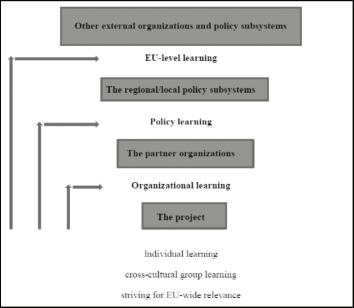
The review of INTERREG IVC allows defining the interregional exchange of experience process as follows: "its very nature is in fact that of a multidimensional and dynamic learning process which is geared towards achieving various forms of policy changes within the partner areas and also beyond. This process should ideally start with learning at the project level, which then stimulates learning within the individual project partner organisations and also learning between them and other organisations of the concerned regional and local policy subsystems in order to achieve policy change in the involved project partner areas as well as learning in an EU-wide perspective."[21] (See: Diagram 1)
Applying the most appropriate model for interregional cooperation, the Regulation (EC) No 1082/2006 of the European Parliament and of the Council on a European grouping of territorial cooperation (EGTC) is a response to the lack of legal and institutional instruments under the EU law. The EGTC signifies decentralised cooperation, and it is an instrument of multilevel governance which contributes to the quality improvement of local and regional cooperation. The EGTC regulation is the first example among EU legal regulations
- 59/60 -
in the course of which a legal instrument grants special rights to local, regional and national public law institutions and civil law organisations of the different member states, in order to develop unified structures that can achieve a more efficient cooperation. The amending 1302/2013/EU Regulation makes changes in response to the weaknesses and areas of potential improvement. These changes concern the membership, the content of the Convention and Statute of an EGTC, its purpose, the process of approval by national authorities, applicable law for employment and for procurement, and finally the approach for EGTCs whose members have different liability for their actions and more transparent procedures for communication. The revised EGTC Regulation[22] shall apply from 22 June 2014. It contains the most important pieces of legislation related to the cohesion policy and most of the programmes funded by the EU in the period 2014-2020.
Diagram 1 • Interregional exchange of experience - a multidimensional process of learning and policy change
(Source: Compiled by the authors on the basis of the Study on Exchange of Experience Process. Final Report, January 2013)
The activities of an EGTC are also carried out at least to some extent outside the territory of the Union. These activities of that EGTC should focus primarily on Union cohesion poli-
- 60/61 -
cy objectives and economic, financial and technical cooperation objectives between a Member State and one or more third countries. In accordance with Article 9 of the revised EGTC Regulation, the cooperation "should be possible where the legislation of a third country, or agreements between at least one participating Member State and a third country, so allows."
"EGTCs are generally established to bring together authorities from different administrative levels, including regions, communities or municipalities to act together as one."[23] Through the creation of this legal framework, partners from different countries and different administrative levels can have one common voice in regional, national or international settings and take joint decisions. (See: Table 4)
Table 4 • Legal framework of interregional cooperation
(Source: compiled by the authors)
| International Law | International regulations of cooperative system European Charter of Local Self-government (1985) Draft European Charter of Regional Democracy (2008) European Outline Convention on Transfrontier Cooperation (1980) Protocol No.2 to the Outline Convention on Transfrontier Co-operation between Territorial Communities or Authorities (1998) Protocol No.3 concerning Euroregional cooperation Groupings (ECGs) (2009) |
| EU Law | EU regulation à INTERREG IVC European grouping of territorial cooperation (2006) |
4. Conclusion
It is necessary to have European cooperation programmes in the EaP countries, because these programmes ensure opportunities for the countries and regions in the EU to reduce their differences, and improve the more underdeveloped. Thanks to the common programmes, the poorer regions can also become beneficiaries of innovation acquisitions, training programmes, infrastructural developments that can support the improvement of these regions. All the three types of European territorial cooperation programmes are very popular. Several projects were implemented in the framework of interregional programmes, which will probably get a bigger emphasis in the fields of innovation, research, development, sustainable growth, competitiveness, lifelong learning, the youth is the future. These terminologies are the key factors of the current cooperation programmes and the programmes in the future that are basic conditions of the improvement of the regions, countries and the European Union.
Supporting the European territorial cooperation remains an important element of the financial package 2014-2020 too, and plays a central role in the implementation of Europe 2020 strategy. The Commission proposed important changes to the way cohesion policy
- 61/62 -
is implemented, for example: reducing the number of priorities, focusing on results and simplification at all levels (beneficiaries, programme authorities, participating EU Member States and third countries, as well as the Commission). In order to provide a more tailored framework for cooperation programmes, a separate regulation for European territorial cooperation programmes are proposed. The regulation contains provisions on thematic concentration and an increased focus on results as well as a number of simplification elements. The Commission's proposal takes better account of multicountry context of the programmes and makes more specific provisions for cooperation programmes and operations.
The European territorial cooperation was supported by the European Regional Development Fund. For 2014-2020 European territorial cooperation is one of the two goals of Cohesion Policy near investment for Growth and Job. In accordance with the new design of the European Cohesion Policy 2014-2020 and the targets set out in Europe 2020, has significantly been reshaped to achieve greater impact and an even more effective use of the investments. According to the Commission's regulation the amount for the territorial cooperation in the timeframe 2014-2020 is €10.1 billion invested in over 100 cooperation programmes between regions and territorial, social and economic partners. This budget also includes the ERDF allocation for Member States to participate in EU external border cooperation programmes supported by other instruments such as the European Neighbourhood Instrument.
In the Eastern Neighbourhood of the European Union the European Neighbourhood Instrument (ENI)[24] finances actions in the various sectors, bringing together public sector expertise from EU member states and beneficiary countries with the aim to create an area of shared values, stability and prosperity. The financial instrument supported the launch of the Eastern Partnership with a total of €2.5 billion for bilateral and regional cooperation (2010-2013).[25]
The role of local and regional authorities could also be strengthened through targeted support, including capacity building, supporting the implementation of the right to good administration, e-administration and access to justice within the competences of subnational authorities. Participants of the Eastern Partnership Summit (2013) highlighted the significant role of local and regional authorities in the implementation of the relevant Eastern Partnership policies and strategies encouraging the representatives of local and regional authorities to enhance their contribution to strengthening multilevel governance.[26]
The need for Public Administration reform, political and fiscal decentralisation and territorial cooperation in the EaP countries make it necessary to take some 'good practices' of the EU Member States. Experience and 'good practices' from EU Member States present ev-
- 62/63 -
idence that the EaP countries can benefit from interregional cooperation programmes because these types of cooperation support the basic conditions for improving the regions' competitiveness, help to reinforce the business investment, contribute to improving capacity building. The participants of the project can gain knowledge and experience abroad and these experiences contributes to the improvement of the quality of their daily work and professional improvement, and also increase their chances as an employee at the labour market.
Inclusion of local and regional authorities in the implementation of the relevant Eastern Partnership policies and strategies needs greater political, administrative and fiscal decentralisation. Greater autonomy for regional and local authorities is an important factor enabling local and regional governments to function effectively and to set up interregional cooperation programmes. Local and regional administrative reforms must be supported by a continuous exchange of experience, so that the 'good practices' of EU local and regional authorities can be adopted. Moreover, the following horizontal political actions and initiatives are offered for consideration:
1. Filling interregional cooperation with substance through
- realising partnerships in the context of the Eastern Partnership, and forming people-to-people contacts among adjacent subnational authorities, taking into account different public laws and the chance for the institutionalisation of relations;
- developing a synergy among different EU policies and measures related to the pre-legislative and evaluation phases;
- involving skilled administrators, public servants and experienced councillors in foreign missions.
2. Increasing cooperation with international organisations
- working with the Council of Europe and EU Committee of the Regions on different thematic issues;
- monitoring human and fundamental rights and discussing further monitoring activities;
- collaborating with professional, civic or academic organisations to exchange information and knowledge, to avoid the duplication of projects and efforts, and upgrade the efficacy of local democratic activities and public service management.
- 63/64 -
5. References
1. European Policy Centre (authors: Claire Dhéret, Andrea Martinovici, Fabian Zuleeg): Division of Powers between the European Union, the Member States and Local and Regional Authorities - Additional Fiscal/Budgetary Elements, European Union, 2012. Source: www.cor.europa.eu/en/documentation/studies/Documents/division-of-powers_ad-ditional-fiscal-budgetary-elements.pdf (accessed 25.12.2015)
2. Verena Hachmann: Promoting learning in transnational networks, disP - The Planning Review, 172(2008)/1, 11-20.
3. Kaiser Tamás: A horizontális európaizáció és a határ menti együttműködések = Hidak vagy sorompók, szerk. Kaiser Tamás, Ágh Attila, Kis-Varga Judit, MTA-MEH Projekt, Stratégiai Kutatások Magyarország 2015, Új Mandátum Könyvkiadó, Budapest, 2007, 7-41.
4. Council of Europe: European Charter of Local Self-government, CETS No.122 Strasbourg, 15. X. 1985. Source: www.rm.coe.int/CoERMPublicCommonSearchServices/Display-DCTMContent?documentId=090000168007a088 (accessed 6.11.2015)
5. Council of Europe: European Outline Convention on Transfrontier Co-operation between Territorial Communities or Authorities, CETS, No. 106., Madrid, 21/5/1980. Source: www.conventions.coe.int/Treaty/Commun/ChercheSig.asp?NT=106&CM=8&D-F=26/01/2013&CL=ENG (accessed 12.10.2015)
6. Council of Europe: Protocol No. 2 to the European Outline Convention on Transfrontier Co-operation between Territorial Communities or Authorities concerning interterritorial co-operation, CETS, No. 169., Strasbourg, 05/05/1998. Source: www.conventions.coe.int/Trea-ty/Commun/QueVoulezVous.asp?NT=169&CM=8&DF=04/04/2015&CL=ENG (accessed 14.10.2015)
7. Council of Europe: Protocol No. 3 to the European Outline Convention on Transfrontier Co-operation between Territorial Communities or Authorities concerning Euroregional Co-operation Groupings (ECGs), CETS, No. 206., Utrecht, 16/11/2009. Source: www.conventions.coe.int/Treaty/Commun/QueVoulezVous.asp?NT=206&CM=8&D-F=04/04/2015&CL=ENG (accessed 11.10.2015)
8. The Congress of Local and Regional Authorities: Recommendation 240 (2008). Draft European charter of regional democracy, 15th Plenary session Strasbourg, 27-29 May 2008. Source: www.regioner.dk/in+english/publications+and+policy+papers/~/media/9BAD3841657F4B9C81C25A2AC2D7E86C.ashx (accessed 8.09.2015)
9. Council of Europe Conference of Ministers responsible for Local and Regional Government. Council of Europe Reference Framework for Regional Democracy,16th Session, Utrecht, 16-17 November 2009. Source: www.wcd.coe.int/ViewDoc.jsp?p=&Ref=M-CL16%282009%2911&Language=lanEnglish&Ver=original&Site=DG1CDLR&Back-ColorInternet=B9BDEE&BackColorIntranet=FFCD4F&BackColorLogged=FFC6-79&direct=true (accessed 11.12.2015)
10. Committee of the Regions: Opinion of the Committee of the Regions on the Role of Local and Regional Authorities within the Eastern Partnership, 79[th] plenary session 21 and 22 April 2009, CdR 78/2009 fin.
- 64/65 -
11. Committee of the Regions: White Paper on Multilevel Governance, Own-Inititative Opinion of the Committee of the Regions, 80[th] plenary session 17 and 18 June 2009. CdR 89/2009 fin.
12. Metis GmbH: EGTC Monitoring Report 2012, European Union, Brussels, April 2013.
13. The Regulation (EU) No 1302/2013 of the European Parliament and of the Council of 17 December 2013 amending Regulation (EC) No 1082/2006 on a European grouping of territorial cooperation (EGTC) as regards the clarification, simplification and improvement of the establishment and functioning of such groupings, 20 December 2013, OJ L 347.
14. Regulation No 232/2014 of the European Parliament and of the Council of 11 March 2014 establishing a European Neighbourhood Instrument, 15 March 2014, OJ L 77.
15. European Commission: European Neighbourhood and Partnership Instrument (20072013). Overview of Activities and Results, European Union, Brussels, 2014.
16. Joint Declaration of the Prague Eastern Partnership Summit Prague, 7 May 2009. Source: www.consilium.europa.eu/uedocs/cms_data/docs/pressdata/en/er/107589.pdf (accessed 23.10.2015)
17. Joint Declaration of the Eastern Partnership Summit, Vilnius, 28-29 November 2013. Source: www.static.eu2013.lt/uploads/documents/Programos_12/131129%20Vilnius%20Summit%20Declaration.pdf (accessed 27.10.2015)
18. European Community: Regional Strategy Paper for Assistance to Central Asia for the period 2007-2013. Source: www.eeas.europa.eu/central_asia/rsp/07_13_en.pdf (accessed 12.11.2015)
19. European Commission: INTERREG IVC, financed by the European Regional Development Fund. Source: www.ec.europa.eu/regional_policy/hu/policy/cooperation/european-ter-ritorial/interregional/ (accessed 12.12.2015)
20. René Kemp, Rifka Weehuizenw: Policy learning, what does it mean and how can we study it? Publin Report, No. D15 (FP5 project PUBLIN on "Innovation in the Public Sector"), NIFU STEP, Oslo, 2005.
21. Pusztai Nora: Cooperation opportunities in the European Union (Leonardo EX-ACT Mobility Program), 31.10.2011-25.11.2011. Source: www.eszakalfold.hu/userfiles/hun/nemzetkozi_kapcsolatok/nemzetkozi_projektek/Leonardo-NEXT/Pusztai_Nora-report.pdf (accessed 12.11.2015)
22. Dányi Olga: How to build a successful partnership. Building and maintaining a partnership in the name of the success, Leonardo da Vinci Mobility Programme Traineeship, 05 Sept - 28 Oct 2011 at la Fundación Comunidad Valenciana-Región Europea, Brussels, 2011.
23. Study on Exchange of Experience Process. Final Report, January 2013. "EureConsult S.A." (Luxembourg) in cooperation with "Spatial Foresight GmbH" (Luxembourg) and "t33 S.r.l" (Italy). Source: www.interreg4c.eu/uploads/media/pdf/exchange_experience_study_full.pdf (accessed 27.10.2015)
- 65/66 -
Dr. habil. Edit Soós (soos.edit@gmail.com): is associate professor at the Department of Political Science, Faculty of Law, University of Szeged. Her research examines the normative effect of the European Union in the wider European neighbourhood and reveals the diverse environment of the European Union's neighbourhood policy in the East Neighbourhood (Eastern Partnership). Her research activities concentrate on the role of local and regional authorities in the system of multilevel governance and the relationship between the different national administrative structures and legal systems which may permit or prevent local and regional authorities from participating directly in interregional cooperation systems. The main theoretical issues of deepening and widening consider public policy in Europe as a whole from the political and legal aspects and examine its practical application in the continual evolution of the European Union. Her present publications refer to decentralised governance and development of public administrations in the EU Member States and effects of Europeanisation on the public administrations in the candidate countries and in the East Neighbourhood. ■
JEGYZETEK
[1] The study is based on the following paper of the 23rd NISPAcee Annual Conference: Sóos Edit: "Practical approaches towards effective interregional cooperation", Co-author: Fejes Zsuzsanna, Tbilisi, Georgia, 21-23 May, 2015.
[2] Claire Dhéret, Andrea Martinovici, Fabian Zuleeg: Division of Powers between the European Union, the Member States and Local and Regional Authorities - Additional Fiscal/Budgetary Elements, European Union, 2012, 10. Source: www.cor.europa.eu/en/documentation/studies/Documents/division-of-powers_additional-fiscal-budgetary-elements.pdf (accessed 25.12.2015)
[3] Committee of the Regions: White Paper on Multilevel Governance, Own-Inititative Opinion of the Committee of the Regions, 80[th] plenary session 17 and 18 June 2009, CdR 89/2009 fin, 13.
[4] Kaiser Tamás: A horizontális európaizáció és a határ menti együttműködések = Hidak vagy sorompók, szerk. Kaiser Tamás, Ágh Attila, Kis-Varga Judit, MTA-MEH Projekt, Stratégiai Kutatások Magyarország 2015, Új Mandátum Könyvkiadó, Budapest, 2007, 9.
[5] European Community: Regional Strategy Paper for Assistance to Central Asia for the period 20072013, 7. Source: www.eeas.europa.eu/central_asia/rsp/07_13_en.pdf (accessed 12.11.2015)
[6] The ENP also covers Belarus, but the EU and Belarus have not yet established a contractual relationship needed to develop their relations further.
[7] The participants of the Prague Summit agree that the Eastern Partnership will be based on commitments to the principles of international law and to fundamental values, including democracy, the rule of law and the respect for human rights and fundamental freedoms, as well as to market economy, sustainable development and good governance. In: Joint Declaration of the Prague Eastern Partnership Summit, Prague, 7 May 2009. Council of the European Union, Brussels, 7 May 2009, 5.
[8] Association Agreements signed in 2014 by Moldova, Georgia and Ukraine.
[9] There are four thematic platforms organised by the European Commission for target-oriented sessions and for open and free discussions, on the basis of the main areas of cooperation: Democracy, good governance and stability; Economic integration and convergence with EU sectoral policies; Energy security; and Contacts between people.
[10] Committee of the Regions: Opinion of the Committee of the Regions on the Role of Local and Regional Authorities within the Eastern Partnership, 79[th] plenary session 21 and 22 April 2009, CdR 78/2009 fin, 5.
[11] Council of Europe: European Outline Convention on Transfrontier Co-operation between Territorial Communities or Authorities, CETS No. 106., Madrid, 21/5/1980. Source: www.conventions.coe.int/Treaty/Commun/ChercheSig.asp?NT=106&CM=8&DF=26/01/2013&CL=ENG (accessed 12.10.2015)
[12] Council of Europe: Protocol No. 2 to the European Outline Convention on Transfrontier Co-operation between Territorial Communities or Authorities concerning interterritorial co-operation, CETS No. 169., Strasbourg, 05/05/1998. Source: www.conventions.coe.int/Treaty/Commun/QueVoulezVous.asp?NT=169&CM=8&D-F=04/04/2015&CL=ENG (accessed 14.10.2015)
[13] Council of Europe: Protocol No. 3 to the European Outline Convention on Transfrontier Co-operation between Territorial Communities or Authorities concerning Euroregional Co-operation Groupings (ECGs), CETS No. 206., Utrecht, 16/11/2009. Source: www.conventions.coe.int/Treaty/Commun/QueVoulezVous.asp?NT=206&C-M=8&DF=04/04/2015&CL=ENG (11.10.2015)
[14] Council of Europe: Protocol No. 3 to the European Outline Convention i. m., Art. 2 (1)-(2).
[15] All Eastern Partnership countries are members of the Council of Europe, except Belarus. Republic of Moldova (1995), Ukraine (1995), Georgia (1999), Armenia (2001), Azerbaijan (2001).
[16] Council of Europe: European Charter of Local Self-government, CETS No.122., Strasbourg, 15. X. 1985. Art. 10 (3). Source: www.rm.coe.int/CoERMPublicCommonSearchServices/DisplayDCTMContent?documentId=090000168007a088 (accessed 6.11.2015)
[17] The Congress of Local and Regional Authorities: Recommendation 240 (2008). Draft European charter of regional democracy, 15th Plenary session, Strasbourg, 27-29 May 2008, Art. 18 (2). Source: www.regioner.dk/in+english/publications+and+policy+papers/~/media/9BAD3841657F4B9C81C25A2AC2D7E86C.ashx (accessed 8.09.2015)
[18] Council of Europe Conference of Ministers responsible for Local and Regional Government. Council of Europe Reference Framework for Regional Democracy, 16th Session, Utrecht, 16-17 November 2009. Source: www.wcd.coe.int/ViewDoc.jsp?p=&Ref=MCL16%282009%2911&Language=lanEnglish&Ver=original&Site=DG1CD LR&BackColorInternet=B9BDEE&BackColorIntranet=FFCD4F&BackColorLogged=FFC679&direct=true (accessed 11.12.2015)
[19] European Commission: INTERREG IVC, financed by the European Regional Development Fund. Source: www.ec.europa.eu/regional_policy/hu/policy/cooperation/european-territorial/interregional (12.12.2015)
[20] Pusztai Nora: Cooperation opportunities in the European Union, Leonardo EX-ACT Mobility Program, 31.10.2011-25.11.2011, 10-11. Source: www.eszakalfold.hu/userfiles/hun/nemzetkozi_kapcsolatok/nemzetkozi_projektek/Leonardo_-_NEXT/Pusztai_Nora-report.pdf (12.11.2015)
[21] Study on Exchange of Experience Process. Final Report, January 2013. "EureConsult S.A." (Luxembourg) in cooperation with "Spatial Foresight GmbH" (Luxembourg) and "t33 S.r.l" (Italy), 11. Source: www.interreg4c.eu/uploads/media/pdf/exchange_experience_study_full.pdf (27.10.2015)
[22] The Regulation (EU) No 1302/2013 of the European Parliament and of the Council of 17 December 2013 amending Regulation (EC) No 1082/2006 on a European grouping of territorial cooperation (EGTC) as regards the clarification, simplification and improvement of the establishment and functioning of such groupings, 20 December 2013, OJ L 347.
[23] Metis GmbH: EGTC Monitoring Report 2012, European Union, Brussels, April 2013, 101.
[24] Regulation No 232/2014 of the European Parliament and of the Council of11 March 2014 establishing a European Neighbourhood Instrument, 15 March 2014, OJ L 77.
[25] European Commission: European Neighbourhood and Partnership Instrument (2007-2013). Overview of Activities and Results, European Union, Brussels, 2014, 11.
[26] See point 50 of the Joint Declaration of the The Eastern Partnership Summit, Vilnius, 28-29 November 2013. Source: www.static.eu2013.lt/uploads/documents/Programos_12/131129%20Vilnius%20Summit%20Declaration.pdf (accessed 27.10.2015)
Lábjegyzetek:
[1] Department of Political Science, Faculty of Law, University of Szeged, soos@polit.u-szeged.hu