

Klára Nagy[1]: Body and Mind - Reframing Labour Exploitation and Risk as a Sport among Platform Workers. The Case of the Food Delivery Sector in Budapest[1] (Publico, 2024/1., 215-236. o.)
https://doi.org/10.32575/ppb.2024.1.10
Abstract
Cycling food couriers in Hungary tend to normalise and justify for themselves the precarious gig working conditions as a sports activity. To understand the blurring between sport and work, I carried out participant observation, conducted semi-structured interviews and discourse analysis. I worked as a bicycle courier in Budapest in July and August 2021. The successful boom of the cycling-based food delivery platforms depends on the extraction of bodily resources. Food delivery companies create new frontiers as they frame labour as challenging cardio activity.
The riders embrace the idea that they get paid for training their body, which activity is otherwise expensive and tiring. The workers utilise their knowledge from their past sporting activities about nutrition and pain relief to increase their workload. Sporting rivalry and boasting of results are active features of the courier community.
Although my interviewees proudly claimed themselves entrepreneurs, the body experiences reveal the cleavage between gig wage labour and idealised entrepreneurship. The pain and dangers of urban cycling work highlight the unequal relationship and make couriers critical of the company.
Keywords: body, exploitation, food delivery, pain, platform economy, sport
Absztrakt
Az ételkiszállítás a platformgazdaság egyik leglátványosabb ágazata, amely az elmúlt években több ezer embert szerződtetett Budapesten. Ez a kutatás azt vizsgálja, hogy a kerékpáros ételkiszállítók hogyan fogadják el, normalizálják és igazolják a bizonytalan munkakörülményeket, a munkaerő kizsákmányolását és a kockázatot. Az ételkiszállítási ágazat kritizálásának és mégis elfogadásának paradoxona aktív jellemzője a magyarországi futárközösségnek. A futárok vezető Facebook-csoportja és az általam készített előzetes interjúk tele vannak a futárcégekkel szembeni kemény kritikákkal. A futárok azonban továbbra is szerződésben állnak ezekkel a cégekkel, és büszkén vállalják a közös futáridentitást. Hogyan fogadják el, normalizálják és igazolják a magyarországi ételfutárok a bizonytalan munkakörülményeket, a munkaerő kizsákmányolását és a kockázatot? A magyarországi kerékpáros ételfutárok hajlamosak sporttevékenységként normalizálni és igazolni maguk számára a bizonytalan munkakörülményeket. A sport és a munka közötti elmosódás megértése érdekében résztvevő megfigyelést végeztem, félig strukturált interjúkat készítettem és diskurzuselemzést végeztem. Kerékpáros futárként dolgoztam Budapesten 2021 júliusában és augusztusában.
A kerékpáros ételkézbesítő platformok sikeres fellendülése a testi erőforrások kitermelésétől függ. Az ételkiszállító cégek új határokat teremtenek, a munkát kihívást jelentő kardiótevékenységként keretezik. A kerékpárosok elfogadják az ideát, hogy fizetést kapnak a testük edzéséért, amely tevékenység egyébként költséges és fárasztó. A munkások a korábbi sporttevékenységekből származó táplálkozási és fájdalomcsillapítási ismereteiket használják fel a munkaterhelés növelésére. A sportversenyzés és az eredményekkel való dicsekvés aktív jellemzője a futóközösségnek.
Bár interjúalanyaim büszkén állították, hogy vállalkozók, testük tapasztalatai a platform munka és az idealizált vállalkozói lét közötti szakadékot mutatják. A városi kerékpáros munka fájdalmai és veszélyei rávilágítanak az egyenlőtlen viszonyra, és kritikussá teszik a futárokat a vállalkozással szemben.
- 215/216 -
Introduction
The food delivery industry is one of the most visible sectors of the platform economy, which has contracted thousands of people in recent years in Budapest. This research explores how Budapest's bike delivery workers accept, normalise, and justify precarious working conditions, labour exploitation, and risk. The paradox of both criticising and embracing the food delivery sector as a positive work choice is an active feature of the courier community in Hungary. The leading Facebook group of these couriers (Futárok - WOLT - Netpincér 2021) and my preliminary interviews are full of harsh critiques of the delivery companies. However, the delivery workers remain contracted by these firms and proudly assume their common identity of riders. How do the food delivery workers in Hungary accept, normalise, and justify the precarious working conditions, labour exploitation, and risk involved in this field?
Bike food couriers in Hungary tend to normalise and justify to themselves the precarious gig working conditions of their occupation as if it were a sports activity. To understand the blurring between sport and work, I carried out participant observation and conducted semi-structured interviews and discourse analysis. I worked as a bicycle courier in Budapest in July and August 2021. The successful boom of bike-based food delivery platforms depends on the extraction of bodily resources. Food delivery companies create new frontiers, framing labour as challenging cardio activity.
The riders embrace the idea that they get paid for training their body, an activity which is otherwise expensive and tiring. The workers utilise their knowledge of nutrition and pain relief from past sporting activities to increase their workload. Sporting rivalry and boasting about results are active features of the courier community.
Although my interviewees proudly claimed to be entrepreneurs, their physical, bodily experiences reveal the cleavage between gig wage labour and an idealised entrepreneurship. The pain and dangers of urban bike work highlight the unequal relationship between the workers and the company, and make couriers critical of the company.
The platform economy
"Earn money whenever you want to", "You can be free and flexible at the same time", "You decide, how much you earn". The website of the Wolt food delivery company displays promises of this kind for potential couriers.[2] "One of the biggest benefits of Wolt's platform is freedom" - states the general introductory email for new couriers. Flexibility, freedom, and control are central elements of recruitment. Harvey (2007) argues that as the condition and mode of production change in every new phase of capitalism, so too does
- 216/217 -
its culture.[3] The transition from Fordism to flexible accumulation changed the form and ideology of production. The acceleration of accumulation has shaped labour to make it as flexible as possible for the employer by mainstreaming new organisational structures, such as subcontracting and outsourcing. A new way of compressing time and space has emerged, fitting flexible production needs. Work volatility has become increasingly prevalent, and short-term plans and temporary contracts have become widespread. The outsourcing of manufacturing from the core countries has increased the importance of the service sector, where on-demand work is particularly normalised. Since employers strive to minimise the risks and responsibilities arising from the unstable economy, it is in their interest to shift to atypical modes of contracting,[4] for example, via temporary work agencies, or as in our case, via platforms. The number of full-time jobs decreases, and with that, certain benefits also disappear.
Food delivery work is part of the platform economy. The platform economy concept covers temporary, freelance, and flexible jobs organised via digital platforms. After the 2008 crisis, the growth of mass and underemployment, the implementation of austerity policies, and increasing inequality made platform work attractive for the impoverished middle class in the core and some semi-peripheral countries.[5]
Despite the remarkable number of competing scholarly views that have emerged about the platform economy, there is a loose consensus about the four principles of the sphere. Workers in the platform economy have irregular, unsocial work schedules depending on the customers' demands. The workers provide most of the means of production. Most work is paid at a piece rate and organised via platforms.[6] In addition, the platform labour force works more hours for the same income as regular workers on average.[7] The platform economy has been severely criticised, and there is an increasing amount of literature on the way its exploitative and precarious working conditions are framed as freedom and flexibility.[8] It is thus important to research the platform gig economy, as it has introduced new production norms, which affect the whole economy.[9] In 2021, an estimated 12 million people worked in the platform economy in the European Union, while 3 million people are "main platform workers", which means they work at least 20 hours per week or earn more than 50% of their income from this sector. 2.5% of the working-age population in Hungary did platform work, and 0.4% were mainly platform workers in the past year.[10]
- 217/218 -
The food delivery sector
The food delivery industry is one of the most visible sectors of the platform economy, which has contracted thousands of people in the past few years in Budapest. The sudden boom in the food delivery platform companies partly stems from the Covid-19 pandemic and Hungary's restrictions on visiting public spaces and direct human contact at that time. The growing interest in food courier jobs cannot be explained simply by the increasing unemployment rate, especially the massive layoffs in the hospitality industry, which forced the workers to participate in the sector. Firstly, since the Covid-19 pandemic, Hungary has had a 2.4% labour shortage.[11] Secondly, the increase in newly contracted couriers continued after the reopening of the hospitality sector.[12]
This article focuses on bicycle food delivery platform workers in Budapest. This research uses the distinction between platform work subcategories made by Vallas and Schor (2020) to describe food delivery platform work. They argue that some types of platform work, such as care work, home repairs, ride-hailing, and courier work form a separate category, as they are organised online, via platforms, but performed offline.[13]
The most widespread method of food delivery is by bicycle. Working as a bike courier requires less capital than being a car or moped courier. However, bike couriers are the most exposed to traffic and the weather. Bicycle delivery represents both the most common mode of couriering and the most extreme working conditions in this sector.
Since the post-socialist transition, and especially since the 2000s, cycling has become a mainstream activity in Budapest, which has thus become a trendy, eco-conscious, middle-class pursuit.[14] The subcultural features of cycling delivery jobs[15] have not disappeared with the transition of cycling into the mainstream and the emergence of platform food delivery companies in Hungary. The cycling subculture was even able to preserve and evolve during the pandemic. Hajtás Pajtás, the oldest cycling delivery company in Hungary, which has existed since 1993, has creatively adapted to the epidemic situation.[16] Additionally, in March 2020, the Gólya Futárszolgálat cycling delivery cooperative was launched.[17]
Food delivery platform scene in Hungary
There are three active food platform delivery companies in Hungary, Wolt, Foodpanda[18] (previously operating under the brand NetPincér), and Bolt Food. These companies contract
- 218/219 -
their workers in two ways, as "partners", to avoid taxation and employment obligations. The first form of employment is that the worker can contract as an "entrepreneur" with the food delivery company. The second form of employment is via cooperatives for students and pensioners. Couriers choose whether to work using bicycles, mopeds, cars, or on foot. The workers bear the cost of the bike, phone, and maintenance.
When I contacted Bence, a manager from one of Hungary's leading food delivery companies, he provided extra information on the workers' statistics, which are publicly unavailable. The income from platform work as a percentage of workers' total income is highly variable.[19] The wages that Wolt couriers receive are calculated on the basis of a combination of base fees and distance fees. In some zones, scheduled hours with hourly shifts are also available.[20] Foodpanda organises shifts for its workers. Within these arrangements, base fees and hourly wages are available.[21] Because of the different fee structures, several couriers work at both Wolt and Foodpanda simultaneously. If a worker cannot book suitable or sufficient shifts at Foodpanda, they can always flexibly work via Wolt.
There are several myths about the income of couriers. "Clickbait" headlines claim that a courier can earn 700-800 thousand HUF (1800-2100 EUR).[22] According to the posts by couriers on private Facebook groups, while such earnings are not impossible, they are not common. Some "legends" can even earn a million HUF per month, but that means working from Monday to Sunday, from 8:00 am to midnight and having a minimal personal life.
Admission happens via an online system. In the company which Bence works for, the management is constantly experimenting with the length of the waiting time. At the beginning of the pandemic, the maximum waiting time was up to four months. However, most applicants had already found other work during this time, so the management reduced the waiting time, and new applicants are now taken first in the application process. A crucial element of the application is the referral system, which speeds up the process of recruitment. In principle, couriers can only recommend candidates for whom they can take full responsibility. Although there are no consequences for recommending an unsuitable candidate in practice, the model works well, with active couriers offering the company a reliable workforce. When there are fewer orders over a more extended period, and the company needs fewer workers, they take on fewer new "partners". The couriers do not have a minimum wage, and their income depends on the number of orders they deliver. When there are fewer orders, couriers try to avoid decreasing their income by recommending fewer acquaintances to be couriers. If there are fewer couriers than orders, the management increases the wages with bonuses.
Labour shortages are an ongoing problem for food delivery companies built on continuous growth. Moreover, couriers turn over quickly, so constant recruitment is needed. Due to the shortage of couriers, the quality of training is deteriorating. Courier
- 219/220 -
informants reported that there used to be an hour-long interactive in-person training session, which switched to an online training session, then to a 25-minute-long recorded video introduction. Although a formal recruitment test has been used in the past half-year, the results of this test are not taken into consideration. As couriers put it, food delivery companies hire anyone with a pulse. Foodpanda even pays its staff for new couriers. If a courier invites a new one, who works 150 hours, the inviting courier receives 50,000 HUF (130 EUR), plus the new courier also gets a voucher of 20,000 HUF (52 EUR).
According to one informant, Bence, more than ten thousand couriers are registered in his company, while there are around twenty-five thousand delivery workers in the country as a whole. Each month, seven to eight thousand couriers are active, and four to five thousand are active per week. Most of the passive workers treat delivery work as a backup plan. They can always work as couriers and bypass the waiting list with their inactive status if anything goes wrong.
Most couriers work part-time. According to Bence, in March 2022, 13% of the couriers worked at least 36 hours per week, and 23% worked between 20 and 36 hours. This means that more than three-quarters of the couriers at this company work less than half-time. Bence estimated that 27% worked between 10 and 20 hours, and 37% worked less than 10 hours in this company. This trend is in line with EU figures. Delivery work tends to coexist and supplement other, not platform-based precarious incomes.[23]
According to Bence, around 80% of couriers are male. This rate is above the EU average, where 59% of delivery platform workers are male.[24] The core of the workers are 30-40 years old men, who are changing their careers, so they need to find temporary jobs quickly. At first sight, it would seem logical for them to apply for unemployment benefits. However, the Hungarian state is not generous with unemployed people, as they receive 60% of their previous income for no longer than 90 days. Hence, if someone is made redundant, dismissed or resigns from their job, they immediately start looking for a new one.
The rapidly fluctuating trend resonates with the EU average in the delivery sector. 48% of the delivery workers started working in the field last year.[25] However, Bence warned about generalising about the workers, since the people who work the most are the most visible, which renders the other couriers invisible. Interestingly, the company does not have data on the gender and age distribution of its contractors.
The population of the couriers is stratified. Beginners can usually be recognised by their orange, substandard quality bikes rented from the Donkey Republic company, which initially specialised in tourists. In line with Piasna's and Drahokoupil's representative
- 220/221 -
online survey research,[26] delivery workers with lower social positions and more economic dependency on the platform enjoy fewer flexible conditions in their work.
Wolt couriers in Budapest do not work fixed shifts. Based on the narrative of the newsletter, this increases their degree of freedom. Couriers can theoretically work any time from 8 am until midnight. Orders are the organising factor of the work, so lunch and dinner times are popular. Wolt motivates its couriers to work during busy periods (such as lunch, dinner times, and in stormy weather) by sending frequent chat messages through the app and offering bonuses if this method does not work. It is common for workers to have to wait hours to receive the first order. Anger about waiting for work is commonly voiced in the courier communities. The waiting, uncompensated work time is a core attribute of platform work, which helps companies to keep wages lower.[27] The food delivery workers at the company which Bence works for spend 20-30% of their online time waiting. At Wolt, in the absence of hourly wages, the couriers do not usually spend time together, as they are rivals. The farther away the other couriers are, the more likely one is to receive an order.
In contrast, online communication is highly active in Facebook groups. The official communication of Wolt by newsletters strengthens the stratification of workers by stating that "hanging out" while waiting jeopardises their chances of getting an order, and that couriers should not believe "rumours" circulating on common Facebook groups. Wolt has stated that they have not contracted too many couriers, so everyone has enough opportunity to work.
Besides newsletters, companies also use other methods to avoid or deflect criticism from their couriers. Foodpanda uses the institution of "captains". In Budapest, there are three captains. Every other city in Hungary has one. Captains are the link and the conflict zone between the couriers and the head office. The couriers are given the captain's phone number and told that they can call them if they have a problem. The captains filter their complaints and discuss them with the management every two weeks. Initially, couriers elected the captains. Since the boom of delivery companies, the "fleet" is no longer a community, and the workers rarely know each other, so now the captains are appointed. The captains receive extra pay, and they are always in the first working group, so they have the privilege of having first choice of the shifts.
Even so, there are problems that neither newsletters, bonuses, nor captains can address. Using a courier application is mentally and physically demanding, as it dictates a breakneck pace. The app shows how much time the food must be delivered within. Usually, this is an unrealistic expectation, as the app sometimes even shows minus minutes. The worker's goal is to complete delivery as quickly as possible, maximise their wages, and adapt to the speed generated by the application. The tempo leads to a high rate
- 221/222 -
of accidents, since it is self-evident that to meet it, it is necessary to disregard the basic rules of Budapest traffic. The companies do not pay attention to how the food is delivered in practice, and couriers do not receive any information or training about the official or unofficial rules of the road. Wolt used to organise optional training for couriers, but it is no longer available.
Besides the entrepreneurial and social features of bicycle food courier work, cycling also brings some pride to the workers. Compared to other types of physical labour, bike delivery endows the workers with the prestige of the urban bicycle culture and visibility, and it is even framed as a leisure activity. The recruitment campaigns employed by food delivery companies are implicitly based on a critique of white-collar jobs and highlight the resistant features of the bicycle subculture. The Facebook and Instagram recruiting advertisements placed by the food delivery companies' position bike delivery work as something advantageous.
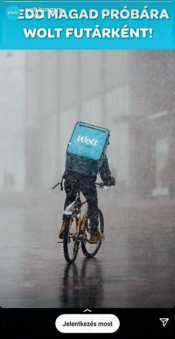
"Test yourself as a courier."
- 222/223 -
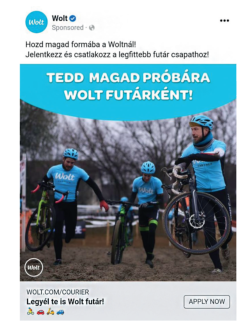
"Get in shape at Wolt! Apply and join the fittest courier team! Test yourself as a courier"
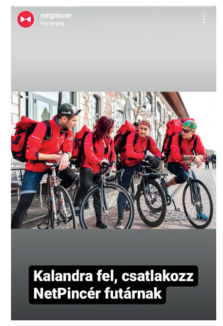
"Go on an adventure, join NetPincér as a courier."
- 223/224 -
Methodology
I divided the research into three approaches: participant observation, discourse analysis, and semi-structured interviews. A significant advantage of participant observation is that I gained insights into the inner logic of "riding", the couriers' working conditions, their dilemmas, and their opinions in detail. I worked as a bicycle courier at Wolt in July and August 2021 in Budapest. Although working as a food delivery courier is mostly a solitary pursuit, there were several situations in which riders had the opportunity to engage in discussions. Joining their conversations while waiting for orders to be prepared or for the algorithm to assign a task, while wearing the company uniform granted me a level of intimacy and access that I would not have otherwise gained.
Like many individuals who want to do a summer job, I fit into the field as a 23-year-old university student. However, I worked in food delivery as a researcher, which is a significant difference. I delivered food out of curiosity, alongside my daily routine, not for money. Hence there were specific layers of the reality of food delivery that I had no access to, even though I did the same job as the others. For instance, I did not gain experience of how a full-time courier creates her work schedule or the physical effects of cycling in Budapest for the entire day. I was able to gain insights into these hidden segments of courier work through the Facebook groups and the interviews.
Communication between couriers happens mostly on social media. While there are open Facebook groups for all the couriers, there are also closed or private groups for the workers of the same food delivery companies. Being an active courier has given me access to these closed forums, which are full of personal experiences, screenshots of texting with support services, advice about riding, opinions, critiques, and debates about food delivery companies. The discourse analysis of these Facebook groups aims to explore the formation of arguments and discussions about working conditions.
The third method I employed is that of semi-structured interviews. I conducted eight online and offline interviews with active and non-active bike couriers, Wolt and Foodpanda, working in Budapest, four women and four men. The youngest was twenty-two years old, and the oldest was thirty-six. I contacted them during my fieldwork, in a bicycle store, via online platforms and through acquaintances. I used these modes to gain access to as heterogeneous a range of interviewees as possible. It was straightforward to find them. The interviewees were keen to share their experiences, as courier work was relatively novel, and a significant experience in their lives.
The interviews lasted between one and two hours. In these interviews, I learned how the couriers position themselves in their work, what their opinion is about the "freedom" and "flexibility" offered by the delivery companies, and how they accept, normalise, and justify for themselves the precarious working conditions. In addition, I conducted two semi-structured interviews with a manager from one of Hungary's leading food delivery companies. I anonymised all my interviews.
- 224/225 -
The authors of the emerging literature on the platform economy primarily draw on policy reviews, interviews, and survey data. This article contributes to the scholarship by extending these methods with participant observation and access to closed online groups.
Table 1: Main socio-demographic characteristics of the interviewees
| Anonymised name | Sex | Age (years) |
| Alexandra | Woman | 25 |
| Anna | Woman | 36 |
| Bela | Man | 26 |
| Bence | Man | 35 |
| Csongor | Man | 30 |
| Flora | Woman | 24 |
| Jamal | Man | 28 |
| Mihaly | Man | 22 |
| Zsanett | Woman | 29 |
Source: compiled by the author.
Embodied labour
Body and pain
As Donna Haraway accurately expresses it, there is no such thing as a natural body "existing outside the self-creating process called human labour",[28] and "the universalized natural body is the gold standard of hegemonic social discourse".[29] Since the 1970s, the body has become a central topic of the social sciences.[30] Scholars do not explore the body as a natural entity but as "an entirely problematic notion"[31] deeply embedded in social relations and particular historical contexts.[32] Alternatively, as Foucault (2012) formulates it, the body is a political object, and technologies of power and social institutions shape it.[33]
Social inequalities are particularly present in sporting bodies since they reproduce and reward traditional physicality and gender norms.[34] During physical exercise, a person objectifies the values associated with these activities and manages her socially disciplined body. Training is a cultural product,[35] and sport is one of the main sites where one masters her habitus.[36]
- 225/226 -
Ignoring pain is an essential part of the ethos of elite sports.[37] However, disregarding pain contradicts its purpose: to warn the person that something harmful is happening to her body. Nevertheless, pain is relative, hence it must be located within class, gender, ethnicity relations, and prior experiences with pain. It "may be totally unrelated to the physical parameters".[38] Pain is a solitary, individual feeling, as an individual cannot share her experience. Hence, handling pain can be more challenging than the pain itself. Sporting pain is even more complex due to hormone production. While doing sports, the body produces endorphins and, under dangerous conditions, adrenalin. These exercise hormones cause happiness and euphoria, and reduce pain.
Considering bicycle courier work as a sport is a part of the industry's discourse. The recruitment advertising, as in the posters presented before, portrays bike delivery as a sports challenge. These ads highlight the advantageous features of delivery work as a form of physical training and hide the exhausting reality. One journalist, Reid (2019) cites Jane Wake, a fitness guru, who argues that delivery work is good for the whole body, improving "agility, speed, upper and lower body strength".[39] Reid (2018) even titled his article about his subjective experiences of delivery work, Confessions of a Deliveroo Rider: Get Fit by Delivering Fast Food.[40] The intentional blurring between sport and work also appears at the management level. The food delivery company, Deliveroo's head of communications, stated that many couriers work this job partly because of the health benefits. However, the physical reality of courier work is more complex than simply idealising it as cardio activity.
Food delivery is physical labour
Before entering the field, I set two rules for myself: to take care of my own and my bike's safety. A couple of hours later, I broke both rules when I cycled between cars on a dangerous road, Rákóczi Street, in order to arrive at Mcdonald's on time. In my ten years of previous cycling experience in Budapest, I had always avoided that street, but riding for Wolt overrode my previous norms. I started my fieldwork on the warmest day of summer 2021, when drinking enough water was an essential task for every courier. The restaurants sometimes helped by offering free water, but sometimes made everything more difficult by not allowing the use of the toilet. Before even starting courier work, my parents had voiced their concern about how the fieldwork would affect my health. The danger of courier work was evident to them. The news reported fatal accidents involving couriers several times that summer. Although these accidents were rare, delivery work had a severe and constant physical effect on me. Permanent tiredness appeared, which lasted even days after work. My body changed, and my legs became more robust. Previously enjoyable physical
- 226/227 -
activities such as going on long walks, boxing training, and recreational cycling became arduous. Cycling became a struggle with my own body to urge myself to better physical performance, even with the help of painkillers.
However, I was still in a privileged position as a researcher. In theory, I could always have stopped working if the circumstances were too dangerous. Why did this not happen very often? Firstly, due to my curiosity, I wanted to experience as much as possible of courier work, not just the version when I am well-rested, and the weather is nice. Secondly, I have become slightly addicted to courier work. This loss of control is not unique to myself. Flora also noted her addiction to delivery work. We both felt that we had to spend every minute of our free time on delivery, and when we could not do it, feelings of guilt appeared. The application constantly sent us motivational messages, which exacerbated the craving to work. It was hard to forget that we were able to work every minute. This feeling resonated with the workaholic culture of the Covid-19 pandemic. Fortunately, despite these circumstances, I never had an accident. However, once I almost fell off my bike while I was checking an address during cycling on slippery paving stones in the rain.
Danger
Bike delivery is inseparable from danger. To make a living, one must cycle for hours in Budapest traffic. In addition, the delivery companies pay riders higher rates when the weather is bad, so working in physically more unsafe conditions is financially more beneficial to the workers.[41] All the interviewees were eager to talk about the dangerous working conditions arising from the harsh weather, the traffic, the light conditions, and the fast tempo dictated by the algorithm. Consequently, many of them had come close to having fatal accidents. Every courier has an internal limit to the amount of risk she is willing to take at work. This is dependent on both their social background and personality factors. Of the interviewees, Alexandra and Anna had the safest rules. When it started to rain, Alexandra went home. However, she was the most privileged, because she did not do this work for financial reasons. Anna also had some economic advantages because she lived in her sibling's flat, so she did not have to pay rent. Moreover, she had worked for a platform delivery company for a longer period of time than the others, and found it the easiest to articulate her views and perceive the limitations in the work. She stated that she does not work when it is raining, or when the temperature is too low. Anna also does not ride too fast since it increases the chance of an accident. "No one's food is worth hurting me or someone else." She also tries to avoid riding at night time when visibility is worse due to the lighting conditions. Although Anna is careful, she has also experienced dangerous situations while doing delivery work.
- 227/228 -
"In the riskiest situation, I avoided an accident by only a few metres. One evening, another courier was driving a car, and since he could not see any headlights, he drove into the intersection without slowing down. Then he braked hard to stop, and we were able to stop simultaneously, just as we were right in front of each other. Another time, I was not sure if a car would stop in front of me or give me the right of way, so I applied the brakes. It was a wet autumn day, and there were leaves on the side of the road. The bike slipped, and I fell on my bag, thank God. I'm fortunate, or maybe I'm a bit more careful, but I haven't had any big crashes or falls."
The others all worked during severe weather, which increases the chance of accidents. Jamal once could not see a red light in the fog. Fortunately, it was a car which collided with his bike, so he fell off before entering the next lane, where a truck would have crushed him. When I talked with Csongor, he had just had an accident, jeopardising his group position at Foodpanda. Fortunately, the company accepted the medical certificate he showed them, so he was able to stay in group three instead of being demoted to a lower level. When I asked Csongor about this accident and his previous experiences, he replied:
"I slipped and fell so badly that I twisted my ankle. I could hardly step on it, it hurt like hell, and I had to keep it wrapped for days. There was such a muddy mess on the road, and I was not paying enough attention. If you pay enough attention, it does not happen, and you develop this routine. How many times have I fallen? A lot. One night during winter, there were big bonuses, and I fell five times. The road was icy. But I fell so often that only the bike fell, and I bounced to my feet and caught the handlebars. Like a stuntman, not because I am skilled, but because I had the routine (i.e. in practice). I was falling on my side, sliding, cursing, but it was nothing. I bounced up, I kept going, but I was falling a lot. The most serious accident was when the handlebars came loose; I lost control. I got scared, and my life flashed before my eyes. I lost control, but then I managed to pull it back. It was the most significant accident I've ever had, and I didn't even fall that time."
When Csongor was telling me these stories, there was a particular macho pride behind his sentences; he was almost bragging about the challenges of the work. This pride resonates with the companies' idealised image of couriers, presenting bike delivery as a challenging and advantageous occupation.
The recruitment advertising, like the posters presented above, depicts bike delivery as a sports challenge. These ads highlight the positive aspects of delivery work's and its training benefits, and hide the exhausting reality.
Bela reported similar dangerous experiences. Bela also told an anecdote about how he often fell off his bike on icy or rainy slippery roads in the traffic while he was not wearing a helmet. Bela bought a strap for his pedal so that it would be less slippery when it was raining. The disadvantage of the strap is that at the beginning when he stopped, he would
- 228/229 -
automatically fall off since he could not pull out his foot. His most significant accident also happened due to this. He had just arrived at a restaurant when a pedestrian looking at her phone bumped into him, so he fell onto the restaurant's terrace. Bela found the winter difficult, which was the first one he had cycled through. In the bicycle subculture, the number of winters cycled is a way of ranking a person. Since the middle of December, his wrist has been hurting. Bela assumed that he had ligament injuries, but he did not go to the doctor and never used his accident insurance because he found it too complicated. He works a lot when the fees are higher due to the severe weather. "The best income I ever had was when I was outside all day in the pouring rain in August. I was soaking wet, and then people tipped me more because they pitied me. I could not put down the phone because new notifications kept popping up."
Bela was resigned to the danger, asserting that. "There is nothing to be done. This job is dangerous. If you're not afraid, it's an excellent thing." He also referred to a "life-threatening" fountain as an inside joke, where every courier falls. In the Facebook groups, people call it the "courier cemetery". For Csongor and Bela, struggling and surviving the unsafe working conditions provided them with a shared identity, which compensated the workers for the clear hierarchy and vulnerability in their work. Both believed that the company does not care about them, for example, by organising training courses for them. There are always enough couriers contracted to deliver. If they do not do it, someone else will. As Bela formulated: "My rival is the other Wolt courier. Anyone who works for Foodpanda is none of my business. I avoid other Wolt couriers when I do not have an order." Competing for tasks is also a central feature of entrepreneurialism.
Mihaly partly quit Wolt because he felt that bike delivery was too dangerous in Budapest. He almost crashed into cars several times. When he was not working, he rode safely in the capital. Alexandra also did not feel safe at work. The people in her milieu warned her about courier work, and when the pride of rebellion passed, she started to agree with them. "There were many times that I did something stupid. I didn't think that I was so careless, and then it turned out that I could get into a dangerous situation, even if I were paying attention, and I'm not driving fast, and not running the red light." When I asked her about the most dangerous situation she had encountered, she mentioned that she had almost hit a pedestrian on the sidewalk. In addition, she lost control of her bike and almost hit a car. After this, she felt that she had caused problems for herself and felt humiliated.
Besides acknowledging the importance of the weather and the other road users, Csongor, Anna and Bela emphasised their skills, which could save them from a (more) serious accident. In Alexandra's case, individualisation was also present, but she internalised the responsibility of the unsafe working conditions as a personal failure.
Even without the dangers of the traffic conditions, bike delivery is severe physical labour, which exhausts the body. Due to the physical burden and monotony, the mind can sometimes "switch off", as the interviewees and I experienced. Csaba explained this feeling in the following way:
- 229/230 -
"When I am exhausted, my brain is sometimes paralysed and automatic. It happens to everyone. The brain gets oxygen, just not enough to think, but my reflexes work the same. I can work, avoid cars, not get into accidents, and pick up food the same way, but I do not know where I am. I arrive at an address, and I have no idea whether I have come to pick up food or drop it off. Of course, if I thought about it, I would know, but I do not need to. Instead, I look at the app. The fastest way to determine where I am going is to cycle and look at the little dot on the map, showing if I am going the right way. Honestly, a well-trained monkey could do this job."
Many couriers listen to music to reduce the monotony, which also increases the level of danger.
Contrary to the international norms, both Wolt and Foodpanda provided accident insurance coverage. I asked Bence about this peculiarity, which goes against the strict market interests. He explained that in December 2020, a company courier died while at work. Then the managers started to push the company to provide accident insurance for the couriers. Besides the moral reasons, the company also profits from it, as it facilitates recruitment and shows the company's social responsibility. Moreover, the workers used this option. The couriers reported that, in the case of Foodpanda, the insurance company cancelled its contract because too many workers were having accidents, so it was not financially beneficial for them. Since the end of 2021, the couriers at Foodpanda have not been covered by accident insurance.
The pain and dangers of urban bicycle work highlight the unequal relationship between the workers and the company. The sporting side of bike delivery is emphasised in the company narrative to make this hierarchical relation palatable. I will explore how delivery work and sport are intertwined in the subsequent paragraphs.
Sport
Experience and knowledge of sport supported my entry into the field, as it has already helped other scholars.[42] Since I have done sports from early childhood, I am familiar with its preparation repertoire, the physical and mental challenges, and the importance of nutrition and recovery, all of which made me a better courier. The interviewees also utilised such knowledge garnered from past sporting activities to enable them to increase their workload. Bike food couriers tend to normalise and justify the disadvantageous circumstances of their jobs by framing it as a sporting activity. All the respondents did sport regularly before working as a courier, especially in childhood. However, they have diverse experiences. Jamal is the most serious about it, as he competes in professional bicycle races in his free time. For Alexandra, sport is part of her family's and her own
- 230/231 -
personal identity, and she was a member of the Hungarian sailing team. Anna attended a high school specialising in sports. Others had done sport as a hobby. Flora and Bela used to go to the gym, and Zsanett sometimes jogged. Csongor used to work out to get "shredded" for the summer. Even so, compared to their former sporting experiences, the physical challenge of courier work came as a shock to them, especially at the beginning. When I asked them about it, they framed their answers as sports challenges. For instance, Jamal compared it to the first time he went to the gym.
Fatigue is not only a characteristic of the beginning of courier work, but also remains part of the delivery work even after a lengthy period. As Csongor noted: "I come home, I sit down, I feel like I'm going to faint, I'm so tired after nine hours of work. I didn't even have a break." Even Jamal, the most professional courier, mentioned the tiredness he feels after a ten-hour shift. To explain and compensate for this physical tiredness, the couriers constantly positioned their work in relation to sports. Csongor noted that there are "real sportsmen" who cycle around fifty hours per week. Boasting about results is a regular feature of Facebook groups. Sporting rivalry also appears in the street, where primarily young male bike couriers sometimes compete by sprinting between traffic lights. Seeing delivery work as a sport gives it an ethos, making it acceptable as a middle-class activity. Zsanett formulated this idea: "It was nice to do some physical work because cycling is not like working in construction. Cycling is a constructive activity, which made me more athletic." Anna was glad that while she had stopped doing regular sport due to office work, it returned to her life when she started working in food delivery. This whole activity was more about the sport than making money for Alexandra. Jamal synchronised his hobby with work. When he prepares for a bicycle competition, he sometimes chooses hilly neighbourhoods to work in, so it counts as training, even if it means that he earns less. "I like it when I go up the mountain because that has a good training factor." Riders adored the idea of being paid to train their body, which is otherwise an expensive and tiring activity. As Jamal said: "I don't go to the gym, just because if I'm going to cycle, I make some money as well." Csongor stated that he would otherwise be too lazy to do cardio activities. Bela bragged that working during summer took off all his body fat. However, both Csongor and Bela admitted that they are too tired to build muscle on their upper body after work even though they would like to. Besides their conscious opinions about the advantages of sports, the riders sometimes felt that the work resembled exercise due to hormonal changes. Anna compared it to the experience of long runs. "It's just hard to get started, but once you're in, it's great." Alexandra also mentioned that the flow of sport and the adrenaline made her forget tiredness and hunger.
There is a significant difference between seeing pain as part of labour or as a part of sport. Bike delivery blurs the border between sport and labour, implying that it incorporates sport's physical and ideological rewards into labour. Accepting delivery work as a sport also helps justify the pain it causes. When I felt pain for the first time during the fieldwork, I decided to take painkillers to be able to cycle. I built on my experiences in competitive sports, where quitting was a rarely chosen option. The interviewees also did not stop working due to pain, and the knowledge and ethos of sport supported this decision. Jamal struggled
- 231/232 -
with pain in his hamstring muscles. He could not stand still and described the pain of the first ten minutes on the bike as torture. However, Jamal continued to work like this until he read about the problem and eliminated it by stretching. Csongor bragged that he never finishes work before the end of his shift. He explained that there is an hour at the most left when he can barely stand, so he always survives somehow. Otherwise, he would have to write to the dispatcher, which is "a lot of time", and he would probably be given a penalty point for it. "It's not worth it." Flora also prioritised work over her health. "Even now, my back hurts like hell, but I want to work." The workers utilise their knowledge from their past sporting activities about pain relief to increase their workload. Zsanett always continued her work even when it was painful or very demanding. If it caused her too much pain, she cured it with a sports cream, which her family had used for decades. Bela's knees and ankles hurt due to cycling, but he never thought about terminating his contract. "I wake up, and oh my God, it hurts. And then I had to sit on my bike the same way and cycle. When I get into it, it is better, and then in the morning, after I rest, it hurts a lot. But I worked the same way then. I knew from my training that the body would get used to it, I just had to give it a little more water and nutrients, and sometimes, when it was very sore, I rested it. But I knew I would get used to it." Another courier recommended collagen protein during this period, widely used for bodybuilding. Bela looked it up online, and after reading good comments about it, he tried it. Collagen tastes terrible, but it worked for him. Just as he persisted through the first work period, he has never stopped during work ever since. "If I get tired, I don't care about it. I work as much as I planned to." Even Alexandra, who had the lowest financial needs but a notable sporting stake in the work, never stopped during lunch periods.
Recovery
Sport does not only teach one how to bear pain. Knowledge about recovery, transferred from a sporting context to the context of food delivery also enables participants to increase their workload. I have divided the topic of recovery into three sections: nutrition, stretching, and rest. With regard to nutrition, although exercise and food delivery seem similar at first sight, they have quite different purposes. While in the field of sport, healthy and balanced diets are emphasised, in bicycle food delivery, the consumption of carbohydrates, especially sugar, is the primary consideration. Sugar has been a rapidly available source of energy since the 19[th] century. It has shifted from being a luxury to a proletarian hunger killer, enabling people to eat fast, high-calorie meals during working time.[43] All the interviewees highlighted the importance of ongoing nutrition as an essential prerequisite of the work. "I don't refuel the car, it won't run, but if it has fuel in it, it goes out of the world" - Jamal noted. The riders' nutrition usually takes the form of junk food during working hours. Jamal ignores food quality, so he usually eats pastries and fast food during the day. In the evenings, he mostly
- 232/233 -
eats canned products or sausages with bread. Csongor usually eats chocolate at work and brings coffee from home, another typical example of a hunger killer.[44] Bela admitted that he does not care about nutrition as long as he has enough energy. He usually buys something from a supermarket or eats a hamburger or a kebab in a restaurant from where he delivers food. The female interviewees were more concerned about their meals. Anna highlighted that she avoids junk food on purpose. She usually brings energy bars and water from home and prepares a warm meal in the evening. Alexandra also preferred energy bars during working hours, along with some fruits and sandwiches. She tried to remember which food smelled the most appealing when she delivered it, and after work, Alexandra goes back to the place and eats there. Hence, she overstepped the burdens of work and turned it into an opportunity for culinary discovery. Flora paid the most attention to the role of nutrition as part of recovery. She tried to make sure she got enough energy. Flora drank BCAA, which is an amino acid used for bodybuilding. However, it also helps the muscle function of people who do physical work regularly. She tried to be aware of proteins, which she had already borne in mind previously as she is a vegetarian. Sometimes Flora consumes protein powders, soy protein, legumes, vegetable butter, and smoothies.
Stretching is another important part of physical recovery after sport, although it is not indispensable. Therefore, it is not a surprise that most workers ignored it. They all knew that it is necessary for recovery, but most of the answers I received were that they always plan to do it, but it rarely happens. The exceptions were Jamal and Anna, probably because of their institutionalised sporting background. The option of resting depends on the individual's financial dependency on the platform. Csongor and Bela, full-time couriers, work regardless of the amount of rest they could get. Flora works less than them, and she states that a half-day is enough for her to recover. This opinion is contradicted by the permanent back pain she complains about during the discussion. She cures it with regular massages, which she bought at a discount. A secondary market reacts to such needs in the Facebook groups. Hence, masseurs, physiotherapists, and chiropractors offer their services at discounts. Alexandra was in the most privileged position, "If I was tired from the previous days, I didn't work."
Conclusion
Based on theories claiming that (sporting) bodies and pain are socially embedded, I argued that bicycle food couriers in Budapest tend to normalise and justify the precarious and dangerous working conditions, labour exploitation, and risk they face in their work by treating it as if it were a sports activity. The riders agree with the claim that they get paid to train their bodies, which is an otherwise expensive and tiring activity. The workers utilise their knowledge from their past sporting activities about nutrition and pain relief to
- 233/234 -
increase their workload. Sporting rivalry and boasting of results are common features of the courier community. Food delivery companies and journalists support this idea, as they frame labour as a challenging cardio activity. Although the workers proudly claimed to be entrepreneurs, their bodily experiences reveal the cleavage between platform labour and an idealised notion of entrepreneurship. The pain and dangers of urban bicycle delivery work highlight the unequal relationship between the workers and the company, the heterogeneity of differently positioned workers, and the lack of workers' freedom.
References
Biró, Attila (2022): 800 ezret is kaszálhat egy Wolt futár: rengeteg embert keresnek a nagyvárosokban. Pénzcentrum, 8 March 2021. Online: https://www.penzcentrum.hu/vallalkozas/20210308/800-ezret-is-kaszalhat-egy-wolt-futar-rengeteg-embert-keresnek-a-nagyvarosokban-1112028
Blake, Andrew (1996): The Body Language: The Meaning of Modern Sport. London: Lawrence & Wishart.
Cant, Callum (2019): Riding for Deliveroo: Resistance in the New Economy. Cambridge: Polity.
Choe, Sang-Hun (2020): Delivery Workers in South Korea Say They're Dying of 'Overwork'. The New York Times, 15 December 2020. Online: https://www.nytimes.com/2020/12/15/world/asia/korea-couriers-dead-overwork.html
Csordas, Thomas (1994): The Body as Representation and Being-in-the-World. In Csordas, Thomas (ed.): Embodiment and Experience. Cambridge: Cambridge University Press, 1-26.
Csordas, Thomas (2002): Body/Meaning/Healing. New York: Palgrave Macmillan. Online: https://doi.org/10.1007/978-1-137-08286-2
DePauw, Karen P. (1997): The (In)visibility of Disability: Cultural Contexts and "Sporting Bodies". Quest, 49(4), 416-430. Online: https://doi.org/10.1080/00336297.1997.10484258
Foucault, Michel (2012): Discipline and Punish: The Birth of the Prison. New York: Vintage Books.
Freytas-Tamura, Kimiko (2020): Food Delivery Apps are Booming. Their Workers are often Struggling. The New York Times, 30 May 2022. Online: https://www.nytimes.com/2020/11/30/nyregion/bike-delivery-workers-covid-pandemic.html?action=click&module=RelatedLinks&pgtype=Article
Gyükeri, Mercédesz (2017): Az éhes vásárlóval nem jó ujjat húzni - a NetPincér-sztori. HVG, 4 April 2017. Online: https://hvg.hu/kkv/20170404_netpincer_cegportre_ekereskedelem_szorad_gabor
Haraway, Donna (1990): Investment Strategies for the Evolving Portfolio of Primate Females. In Jacobus, Mary - Fox Keller, Evelyn - Suttleworth, Sally (eds.): Body/Politics: Women and the Discourses of Science. New York: Routledge, 139-162.
- 234/235 -
Harvey, David (2007): The Condition of Postmodernity: An Inquiry into the Origins of Cultural Change. Cambridge, MA: Blackwell.
Howe, P. David (2011): Sporting Bodies: Sensuous, Lived and Impaired. In Mascia-Lees, Frances E. (ed.): A Companion to the Anthropology of the Body and Embodiment. Wiley-Blackwell, 276-291. Online: https://doi.org/10.1002/9781444340488.ch15
Jackson, Jean E. (2011): Pain and Bodies. In Mascia-Lees, Frances E. (ed.): A Companion to the Anthropology of the Body and Embodiment. Wiley-Blackwell, 370-387. Online: https://doi.org/10.1002/9781444340488.ch21
Kiss, Soma Ábrahám (2021): "Nem vállalkozásod van, hanem egy bringád vagy egy Suzukid" - a kényszervállalkozás valósága. Mérce, 4 May 2021. Online: https://merce.hu/2021/05/04/nem-vallalkozasod-van-hanem-egy-bringad-vagy-egy-suzukid-a-kenyszervallalkozas-valosaga/
Kučinac, Dunja (2021): Gig Work in CEE's Platform Economy: Delivery Drivers in Croatia. Lefteast, 5 May 2021. Online: https://lefteast.org/gig-work-cee-croatian-delivery-drivers
Mintz, Sidney Wilfred (2018): Time, Sugar, and Sweetness. In Counihan, Carole - Van Esterik, Penny - Julier, Alice (eds.): Food and Culture. Routledge, 401-413. Online: https://doi.org/10.4324/9781315680347-28
Pálúr, Krisztina (2020): A világjárvány miatt már az ételrendelés sem lesz ugyanaz. Index, 15 March 2020. Online: https://index.hu/kultur/eletmod/2020/03/15/etelrendeles_hazhozszallitas_karanten/
Piasna, Agnieszka - Drahokoupil, Jan (2021): Flexibility Unbound: Understanding the Heterogeneity of Preferences among Food Delivery Platform Workers. Socio-Economic Review, 19(4), 1397-1419. Online: https://doi.org/10.1093/ser/mwab029
Piasna, Agnieszka - Zwysen, Wouter - Drahokoupil, Jan (2022): The Platform Economy in Europe: Results from the Second ETUI Internet and Platform Work Survey (IPWS). ETUI Research Paper-Working Paper. Online: https://doi.org/10.2139/ssrn.4042629
Popan, Cosmin (2022): The Gig Economy's Corporate Crime Problem. Lefteast, 9 May 2022. Online: https://lefteast.org/gig-economy-corporate-crime-problem/
Pulignano, Valeria - Piasna, Agnieszka (2021): The 'Freedom' to Work for Nothing. Social Europe, 8 December 2021. Online: https://socialeurope.eu/the-freedom-to-work-for-nothing
Rani, Uma - Kumar Dhir, Rishabh - Furrer, Marianne - Gőbel, Nóra - Moraiti, Angeliki - Cooney, Sean - Coddou, Alberto (2021): World Employment and Social Outlook: The Role of Digital Labour Platforms in Transforming the World of Work. Geneva: International Labour Organization. Online: https://www.ilo.org/wcmsp5/groups/public/---dgreports/--dcomm/--publ/documents/publication/wcms_771749.pdf
Reid, Carlton (2018): Confessions of a Deliveroo Rider: Get Fit by Delivering Fast Food. The Guardian, 8 January 2018. Online: https://www.theguardian.com/environment/bike-blog/2018/jan/08/confessions-of-a-deliveroo-rider-get-fit-by-delivering-fast-food
- 235/236 -
Reid, Carlton (2019): Bicycle Courier is the Job that Burns Most Fat, Finds Fitness Guru. Forbes, 14 January 2019. Online: https://www.forbes.com/sites/carltonreid/2019/01/14/bicycle-courier-is-the-job-that-burns-most-fat-finds-fitness-guru/?sh=afb58ef2ee4a
Scholz, Trebor (2017): Uberworked and Underpaid: How Workers are Disrupting the Digital Economy. John Wiley & Sons.
Stewart, Andrew - Stanford, Jim (2017): Regulating Work in the Gig Economy: What are the Options? The Economic and Labour Relations Review, 28(3), 420-437. Online: https://doi.org/10.1177/1035304617722461
Tóth, Katalin (2019): "I love Budapest. I bike Budapest?" Urbaner Radverkehr in der ungarischen Hauptstadt, 1980-2014. Vandenhoeck & Ruprecht. Online: https://doi.org/10.13109/9783666310720
Vallas, Steven - Schor, Juliet (2020): What Do Platforms Do? Understanding the Gig Economy. Annual Review of Sociology, 46, 273-294. Online: https://doi.org/10.1146/annurev-soc-121919-054857
Van Doorn, Niels (2017): Platform Labor: On the Gendered and Racialized Exploitation of Low-Income Service Work in the 'On-Demand' Economy. Information, Communication & Society, 20(6), 898-914. Online: https://doi.org/10.1080/1369118X.2017.1294194
Veres, Dóra (2020): Rengeteg melóst keresnek most országszerte: 700 ezres nettó, diploma nem kell. Pénzcentrum, 7 April 2020. Online: https://www.penzcentrum.hu/egeszseg/20200407/rengeteg-melost-keresnek-most-orszagszerte-700-ezres-netto-diploma-nem-kell-1092314
Wacquant, Loïc (2004): Body & Soul: Notebooks of an Apprentice Boxer. New York: Oxford University Press.
Zhao, Lily (2021): Suicide Attempt by Food Delivery Worker in China Exposes Exploitative Working Conditions. World Socialist Web Site, 21 January 2021. Online: https://www.wsws.org/en/articles/2021/01/22/chin-j22.html
Klára Nagy is a Researcher and Project Coordinator. Graduated from the Sociology and Social Anthropology MA program at the Central European University, and holds a sociology BA from the Eötvös Loránd University. Since 2021 she has been a member of the Solidarity Economy Centre. Since 2022, she is a co-worker at Periféria Policy and Research Center. She was a member of the College for Advanced Studies in Social Theory between 2017 and 2020. Her main research field is flexibilised labour in the platform economy and the electronics manufacturing sector, and social housing approaches. ■
NOTES
[1] I would like to express my deepest gratitude to my supervisors, Professors Claudio Sopranzetti and Violetta Zentai, for their support.
[2] See: https://wolt.com/hu/couriers
[3] Harvey 2007.
[4] Scholz 2017; van Doorn 2017.
[5] Van Doorn 2017: 900.
[6] Stewart-Stanford 2017: 421.
[7] Rani et al. 2021.
[8] Freytas-Tamura 2021; Kučinac 2021; Choe 2020; Zhao 2021.
[9] Cant 2019.
[10] Piasna et al. 2022: 15.
[11] See: https://www.ksh.hu/stadat_files/mun/hu/mun0159.html
[12] Kiss 2021.
[13] Vallas-Schor 2020.
[14] Tóth 2019.
[15] Tóth 2019.
[16] See: https://hajtaspajtas.hu
[17] See: https://www.golyaszovetkezet.hu/golya-futar
[18] Since this research ended, Foodpanda has been operating under the name of Foodora.
[19] Piasna et al. 2022.
[20] See: https://woltfutarok.com/dijazas
[21] See: https://www.foodpanda.hu/en/contents/futardijtabla?r=1
[22] Biró 2021; Veres 2020.
[23] Piasna et al. 2022: 42.
[24] Piasna et al. 2022: 27.
[25] Piasna et al. 2022: 20.
[26] Piasna-Drahokoupil 2021.
[27] Pulignano-Piasna 2021.
[28] Haraway 1990: 10.
[29] Haraway 1990: 146.
[30] Csordas 1994.
[31] Vernant 1989: 10, cited by Csordas 1994.
[32] Csordas 1994.
[33] Foucault 2012.
[34] DePauw 1997: 420.
[35] Howe 2011.
[36] Blake 1996: 23.
[37] Howe 2011.
[38] Tracey 2005 cited by Jackson 2011: 371-372.
[39] Reid 2019.
[40] Reid 2018.
[41] Popan 2022.
[42] Wacquant 2004.
[43] Mintz 2018.
[44] Mintz 2018.
Lábjegyzetek:
[1] Periféria Policy and Research Center, Solidarity Economy Center, nagy. klara@periferiakozpont.hu