

Anikó Edit Szűcs[1]: Judical Review of the Merger Decisions of the European Commission (Publico, 2018/1., 272-289. o.)
Abstract
Decisions of the European Commission which prohibit mergers are significant interventions in the private autonomy of the affected businesses. Therefore, the right of the parties to initiate judicial review of such decisions is of special importance. By reviewing the Court's decisions delivered in such cases, we can see that the Court forces the European Commission to deliver only well-established decisions based on correct legal and factual backgrounds, and to rescind putting obligations on the parties other than those which are inevitable for maintaining the competition. Procedures must be fully transparent, procedural guarantees as the right of defence may only be limited in exceptional cases, and both the Commission and the businesses under investigation are required to actively cooperate with each other.
Keywords: competition law, EU case law, merger control, judicial review, annulled decisions
- 272/273 -
1. Preliminary[1]
The maintenance and the development of an effective competition in the common market is a substantial aim, thus mergers shall be reviewed in order to establish whether concentrations are compatible with the common market.
Council Regulation (EC) No 139/2004 of 20 January 2004 on the control of concentrations between undertakings (hereinafter referred to as Merger Regulation) and Commission Regulation (EC) No 802/2004 on implementing Council Regulation No 139/2004 are the legal basis of the procedures carried out by institutions of the European Union. The Merger Regulation replaced Council Regulation (EEC) No 4064/89 (hereinafter referred to as Former Merger Regulation). In line with the Merger Regulation any concentration, which would significantly impede effective competition in the common market or in a substantial part of it, should be declared incompatible with the common market. The European Commission is not entitled to examine all mergers under the Merger Regulation, only those mergers which have a Community dimension. The European Commission has only competence to examine mergers whether they comply with the rules of the common market and the EU law if certain turnover thresholds are exceeded and none of the firms achieve within one and the same member state more than two thirds of its EU-wide turnover.[2] However, the Merger Regulation contains a referral mechanism, which allows the transfer of a case from the authorities of a Member State to the European Commission, or the other way around, the European Commission may also refer cases to the authorities of the affected Member States. It is of particular importance that in case the above-mentioned criteria are met, the merger has Community dimension even if the undertakings concerned have their seat or their principal fields outside of the Community, provided that the companies involved have substantial operation within the area of the European Union.
The European Commission shall ensure the proper application of all EU rules and the measures, which were adopted by institutions under the EU rules. In line with this, the European Commission has exclusive competence to apply the Merger Regulation, provided that the Court of Justice has power to review. The Court of Justice shall ensure that in the interpretation and application of the Treaties the EU law is observed, where the Court of Justice is acting as court of first instance, and the General Court as review court.
As we will see further on, the number of the notifications submitted to the European Commission increases every year. There was a significant increase since 1997-2000. Given that mergers are often reasonable reactions to economic recessions, as well as opportunities for growth, the actual economic situation supports the further increase of the number of
- 273/274 -
numbers. However, the legal form of mergers may change which shall be always considered when examining a merger.
The European Commission adopted the Guidelines on the assessment of horizontal mergers in 2004, under which "The Commission may decide that an otherwise problematic merger is nevertheless compatible with the common market if one of the merging parties is a failing firm. The basic requirement is that the deterioration of the competitive structure that follows the merger cannot be said to be caused by the merger. This will arise where the competitive structure of the market would deteriorate to at least the same extent in the absence of the merger".[3] According to Article 90 of the Guidelines on the assessment of horizontal mergers three cumulative criteria has essential relevance for the application of the above mentioned clause, these are the followings: 1. the concerned undertaking would be forced out of the market as a result of financial difficulties in the near future; 2. another purchase option is not available with less anti-competitive impact; and 3. without the merger, the assets of the concerned undertaking would necessarily exit the market.
One of the most interesting decision of the European Commission - in my opinion - was the Aegean Airlines and Olympic Air decision in 2013, where the European Commission approved the merger without requiring any commitments on the basis of the failing firm defence, even though the acquisition of the Olympic Air by Aegean Airlines resulted in monopolies on a number of routes.[4] The decision received particular attention, because the European Commission prohibited the same transaction two years before, in 2013.[5]
2. Mergers concerning Europe in numbers
The European Commission regularly publishes excellent summarizing reports, including the annual reports on its webpage. We can also find a summarizing statistical report with all relevant data on merger cases notified to the European Commission between 21 September 1990 and 31 October 2017.[6] The following chart stands for illustrative purposes, and the included data have been selected by the author of this article with the aim to facilitate the understanding of the topic and the importance of the Commission's merger control function.
- 274/275 -
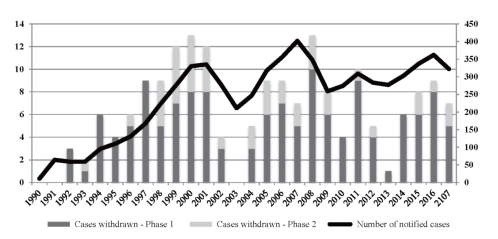
Figure 1 • Summarizing chart on notified and withdrawn cases
(Source: Compiled by the author.)
As we can see, the most cases were notified in 2007. The concerned undertakings have the right to withdraw their notification, in order to be able to change the details of their planned merger or give up their intent. The possible method of the withdrawal has been examined in the case WorldCom, where two American companies having their activity in the communications sector planned to merge their whole businesses. This merger was examined by the U.S. Department of Justice and the European Commission simultaneously. Mario Monti, the European Commissioner for Competition declared at a press conference after a meeting with the representatives of the U.S. Department of Justice, that he will propose the prohibition of the merger of WorldCom and Sprint.[7] The concerned undertakings sent two information letter via fax to the European Commission on the next day in which they informed the European Commission that they withdraw their notification and declared that they do not intend to merge in a way as they presented in the notification to the European Commission. Although the European Commission received these statements, it adopted a decision next day in which the merger was declared incompatible with the common market and the Community law.[8] WorldCom challenged the decision before the Court of First Instance. In the appeal proceeding, several important issues have been examined by the Court. From our point, the most important was that according to the point of the European Commission the concerned undertakings did not cease the merger agreement formally and in line with their media communication they still planned to perform the merger. The European Commission accepted in several former
- 275/276 -
cases the statement of the concerned undertakings about the withdrawal of the notification.[9] The Court of First Instance annulled the decision of the European Commission in view of the fact that the concerned undertakings declared that they abandoned the merger in the form presented in the notification, thus the concerned undertakings were abandoned from the merger agreement, as well. The Court of First Instance laid down that the subjective intention of the undertakings regarding a planned merger cannot be the subject of the European Commission's proceeding.[10]
According to the above, the concerned parties may change the conditions of their merger agreement and notify the European Commission about the merger with changed conditions. The possibility to change the merger agreement and perform the merger in a different form opened the possibility to lodge an appeal. This case underlined the fact that the European Commission has no right to interpret the merger regulation in a different way in different cases, and that without the existence of an effective merger agreement the European Commission has no power to prohibit a possible future merger.
In a significant number of cases, the European Commission declares within the frames of the first phase that the merger is compatible with the common market, thus within 25 working days, following the day of the receipt of the notification by the European Commission, or the receipt of the complete information if the first notification was incomplete.
If the European Commission has serious doubts that the merger is compatible with the common market it shall initiate the second phase. As a result of the second phase proceeding, the European Commission may declare a merger compatible with the common market, or compatible with commitments, or totally prohibit the intended merger. It also has the option to restore the effective competition with other means in line with Section 8.4 of the Merger Regulation. The number of prohibiting decisions adopted by the European Commission are quite low.
Given that a prohibition decision is a serious intervention into the economy, a prohibition decision must have a solid economic and legal basis. However, if we examine the existing case-law of the Court of Justice of the European Union, we can see that the decisions are not uncontroversial. As the annulment decisions have a high importance, we should give a closer look to each.
2.1. Case I - Airtours plc versus Commission of the European Communities[11]
Airtours plc notified the Commission of the European Communities about its intention to acquire all shares in First Choice plc in 1999. The concerned companies were registered in
- 276/277 -
the United Kingdom, and both company's activity concerned significantly the geographical market defined as the United Kingdom and Ireland. Airtours' activity covered: tour operating, travel agencies, charter airlines, hotels and cruise ships, while First Choice' activity covered: tour operating, travel agencies, charter airlines, seat broking and car rental broking.[12] Four companies held 79% of the market share at the time of the investigation of the Commission (Thomson 27%, Airtours 21%, Thomas Cook 20% and First Choice 11%) according to the Commission's data. The remaining 21% was spread between the further actors on the market. The Commission took into consideration that these four big market actors had their own charter airlines and their own travel agencies, while the smaller actors did not have such a capacity.
The Commission initiated an investigation procedure as it had serious doubts regarding the merger's compatibility with the rules of the common market. The Commission of the European Communities sent a statement of objections to the concerned undertakings, which was replied within 16 days by the parties. After it, a hearing was held before the Commission's Hearing Officer, then a set of undertakings was submitted by the parties concerned to allay the identified competition concerns. After a meeting of the Advisory Committee and another between the Commission and the concerned undertakings representatives, Airtours and First Choice modified their undertakings. However, the Commission refused to take into consideration the parties' modification, as the parties delayed, and such undertakings were offered after the third month from the four months' merger investigation. However, the consistency of the Commission is doubtful considering the fact that the Commission accepted delayed concessions just a few weeks later in the Telia/Telenor merger.[13] The Commission declared the merger incompatible with the common market on the ground that as a result of the merger, the merged entity would have a dominant position in the United Kingdom market for short-haul foreign package holidays. The Commission stated that the undertakings proposed by Airtours were eligible to prevent the creation of the dominant position, while the amended undertakings were delayed. This was the first case when the Commission prohibited a merger on the ground of collective dominance with three undertakings remaining in the market following the transaction.[14] The decision created a stir, several journals tackled this issue and stated that this decision created uncertainty as this concentration did not allow the establishment of tacit coordination.[15]
- 277/278 -
Airtours plc appealed to the Court of Justice of the European Union, in which Airtours plc referred to the followings:
1. The definition of the relevant product market relies on manifest errors of the assessment.
2. The definition of the collective dominance; the version of the definition that has been applied first time in this case is incorrect.
3. The infringement of the regulation on appraisal of concentration set out in Article 2 of the Merger Regulation and infringement of Article 253 EC.
4. The infringement of Article 8.2 of the Merger Regulation which sets out that if a concentration is compatible with the common market following the modification of the undertakings, the Commission shall declare the merger compatible with the common market, and breach of the principle of proportionality inasmuch.
The Court of Justice examined the above pleas and concluded the followings. According to the Commission's statement the relevant product market was divided into two parts, the long-haul package holidays and the short-haul package holidays, which definition was accepted by the Court of Justice. The Commission also established that the concentration affects horizontally the travel and leisure sector, while vertically the charter air services and the travel agency services.
The Court of Justice concluded that the second plea was examined within the frames of the third plea. The Court of Justice shall confine itself to the position adopted by the Commission regarding the transaction as notified, i. e. the Court of Justice shall examine the way in which the Commission applied the law to the facts and adjudicated the merits of the Commission statement regarding the effect of the concentration on the competition. According to the third plea of Airtours, the Commission made an assessment error, i.e. the Commission did not prove to the requisite legal standard in its decision establishing that as a result of the merger the merged entity would have a dominant position, which would significantly impede the competition in the United Kingdom market for short-haul foreign package holidays.
The court of Justice declared that three conditions have to be fulfilled in order to establish collective dominance; these are the following:
1. "First, each member of the dominant oligopoly must have the ability to know how the other members are behaving in order to monitor whether or not they are adopting the common policy [...] there must, therefore, be sufficient market transparency for all members of the dominant oligopoly to be aware, sufficiently precisely and quickly, of the way in which the other members' market conduct is evolving,
2. second, the situation of tacit coordination must be sustainable over time, that is to say, there must be an incentive not to depart from the common policy on the market [...] each member of the dominant oligopoly must be aware that highly competitive action on its part designed to increase its market share would provoke identical action by the others, so that it would derive no benefit from its initiative,
- 278/279 -
3. third, to prove the existence of a collective dominant position to the requisite legal standard, the Commission must also establish that the foreseeable reaction of current and future competitors, as well as of consumers, would not jeopardise the results expected from the common policy.[16]
The above cited condition precedents have great importance; however, the Court of Justice lowered the standard of proof in its decision in the Impala case regarding the cases where the undertakings concerned behave in a tacitly coordinated manner.[17] The Court of Justice declared that the above mentioned three conditions may be established indirectly after examining the appropriate circumstances of the present merger, thus if the pricing is synchronic for a long period and the reason of it is unknown may be a sufficient evidence for the existence of the collective dominant position, provided that the other typical factors of the collective dominant position are observed, as well.[18]
Returning to the third plea, the Court of Justice referred to cases Kali & Salz and Waterhouse/Coopers & Lybrand, where it has been laid down, that if the Commission prohibits a merger on the basis that the merger results in a collective dominance, the burden of proof shall lay on the Commission. According to it, the Commission has to - in particular - show evidence of the agents, which make a significant contribution in the assessment that the collective dominance exists, e.g. the lack of effective competition and competitive pressure.
The Commission referred to the following reasons when it prohibited the merger:
1. The remaining three big actors in the market would not compete due to the fact that the market is dependent of capacity decisions and that the degree of the market concentration is high.
2. As a result of the transaction the degree of transparency and interdependence would increase.
3. The market already showed a tendency towards collective dominance.
4. If any of the remaining undertakings would not restrict the capacity, the others could do the same and it would result in a financial loss for all of the remaining undertakings.
5. The smaller agents of the market would be further marginalized.
- 279/280 -
Airtours argued in its claim as follows:
1. The Commission did not prove conclusively, that following the merger, the remaining undertakings would have an incentive to cease competing.
2. No deterrents or adequate means of retaliation exist in the market.
3. The current market players and the potential players would challenge any capacity restrictions and, in parallel, consumers would react.
4. The impact of the merger on competition was incorrectly assessed by the Commission.
The Court of Justice established that the Commission made assessment errors, it underestimated the significance and the power of the smaller undertakings in the market, the potential competitors, the consumers and the hotel-owners, in parallel the Commission has failed to prove that the merger would create a collective dominant position. Given that the third plea was well founded, the decision of the Commission in which the merger was prohibited was annulled by the Court of Justice without examination of the remaining pleas.
This case is widely known, as it was the first prohibition decision, which was annulled by the Court of Justice. This demolition judgment gave proper guidance for the assessment of mergers in oligopolistic markets; it has been analysed by several experts since then and has been applied as a standard for the subsequent mergers in oligopolistic markets.
2.2. Case II - Schneider Electric versus Commission[19]
Schneider Electric and Legrand notified the Commission in 2001 that Schneider Electric planned to acquire the sole control of Legrand by way of a public offer for the exchange of shares.[20] Schneider Electric and Legrand are French limited companies with worldwide activity, where Schneider Electric's activity covers the production and sale of products and systems in the electricity distribution, industrial control and automation sectors, and Legrand's activity covers production and sale of low-voltage switchgear and accessories. The Commission established that the relevant market concerns main switchboards, distribution boards, final panel boards and mains connection circuit breakers.
According to the Commission's decision, the effects of the merger on competition was examined at a level of the group of components necessary for building a particular type of electrical switchboard (accepted by the undertakings concerned), and at a level of the
- 280/281 -
various components to be incorporated into distribution boards and final panel boards.[21] The geographic market has been defined as national markets, which has been approved by the Court of Justice in the judicial proceeding.
The Commission declared the merger incompatible with the common market. According to the conclusion of the Commission, the merged entity would have dominant position in sectoral markets in Denmark, Greece, Spain, Italy, Portugal and the United Kingdom, which would significantly impede the effective competition, and the dominant position of the merged entity on various French sectoral markets would strengthen, as well.[22]
The Commission ordered the separation of Schneider and Legrand within nine months after a second letter of statement. Schneider appealed and asked for expedited procedure, which has been granted by the Court of Justice.
According to the Commission's decision, the relevant industrial sector can be divided into the following segments: 1. main low-voltage switchboards; 2. distribution panel boards; 3. cableways and busbar trunking; 4. final panel boards; 5. electrical equipment downstream from the final panel board; 6. distribution installation accessories; 7. trunking; and 8. transformation and supply products control and signalling accessories.[23] The involved operators can be grouped as 1. manufacturers; 2. wholesalers; 3. switchboard assemblers; 4. installation engineers; 5. project managers and 6. end-users. According to the Commission's decision, the merger would create a dominant position, which would impede the effective competition on the following markets:
1. Italy - moulded case circuit breakers, miniature circuit breakers and cabinets intended for distribution panel-boards
2. Denmark, Italy, Portugal and Spain - miniature circuit breakers, differential circuit breakers and cabinets intended for final panel boards
3. France and Portugal - connector circuit breakers
4. United Kingdom - cableways
5. Greece - sockets and switches
6. Spain - watertight equipment
7. France - fixing and shunting equipment
8. France - electrical transformation products, and
9. France - control and signalling accessories
- 281/282 -
Moreover, the Commission concluded that the merger would strengthen a dominant position, which would also impede the effective competition on the following markets:
1. France - moulded case circuit breakers, miniature circuit breakers and cabinets intended for the distribution of panel boards
2. France - sockets and switches
3. watertight equipment, and
4. security lighting systems or independent emergency lighting units
The above lists show us that the Commission's conclusion was that the transaction would impede the effective competition on several markets. It was a complex case, where even the examination and the definition of the relevant markets were a serious challenge for the Commission. Following the negative decision of the Commission, Schneider brought an action for the annulment of the decision. Schneider's pleas concerned the following issues:
1. procedural irregularity
2. manifest errors regarding the impact of the concentration, the commitments submitted by Schneider in order to render the merger compatible with the common market, and
3. infringement of the right of defence
Regarding the first plea, according to Article 10(3) of the Former Merger Regulation, the Commission had four months from the commencement of the proceeding to find out whether the concentration is compatible with the common market. However, under Article 10(4), such period may be exceptionally suspended if the Commission is obliged to request information pursuant to Article 11(5) due to circumstances for which one of the undertakings involved in the merger is responsible.[24] In this case, the Commission requested the parties to answer 322 questions within five working days. The Court of Justice has taken into account that Schneider answered the Commission 5 days later than the deadline and claimed that it is not in a position to reply on such a short notice, further, the Court of Justice also considered that the information the Commission required was relating to the topics Schneider already examined during the informal stage of the enquiry, thus the Court of Justice rejected the first plea.
Concerning the second plea, the Court of Justice highlighted some conclusions of the Commission. The Commission 1. applied the main features assessed regarding the market to other markets mutatis mutandis; 2. emphasized the low price sensitivity demand for low-voltage electrical equipment; and 3. stated that installation engineers and switchboard assemblers show significant loyalty to manufacturer brands. At the same time, the Commission declared that the brand loyalty is not absolute. These markets are very sensitive to brand, availability of the products and the extent of the product range. The
- 282/283 -
Court of Justice accepted the point of the Commission regarding the loyalty of brands and declared that the access to a national market may be difficult for a new competitor. Given that, the brand may put a manufacturer who is already presented in the market in a better position, the Commission's assessment of the electricians' brand loyalty was accepted, and so the second plea was rejected by the Court of Justice.
In the third plea, Schneider alleged that the Commission overestimated the strength of the merged entity. The Commission defined the markets in national dimensions, but at the same time it estimated the impact of the merger on a European level. The Court of Justice remarked that the Commission failed to show evidence that the transnational effects exist in each market. The Court of Justice concluded that the transaction poses competition problems only in France and on six national markets. The Court of Justice declared that the Commission incorrectly applied Article 2(3) of the Former Merger Regulation and accepted Schneider's third plea.
The Court of Justice established that Schneider's fourth plea was justified as well, in which Schneider alleged inconsistency in the analysis on the structure of competition at wholesaler level. The Court of Justice concluded that the Commission did not sufficiently demonstrate its statement saying that the merged entity would be an unavoidable partner for wholesalers, and the fact that wholesalers would not be able to exercise competitive constraints on the merger entity. The Court of Justice highlighted the lack of country-by-country analysis in this plea, as well.
In the fifth plea, Schneider stated that the Commission failed to analyse the impact of the merger to each national market and applied the results of the Europe-wide analysis. As we can see, this issue was referred to in connection with more pleas by Schneider. Naturally, this plea was also accepted by the Court of Justice.
In the sixth plea Schneider objected that the Commission refused to "include within the market shares of ABB and Siemens (two of the merged entity's leading competitors) the not significant proportion of the sales of panel-board components made by those companies to installation engineers and switchboard assemblers which are vertically integrated within those groups."[25] This issue had high importance, as within the frames of this plea the Court of Justice established that integrated sales shall be accounted when the market shares are calculated.
The seventh and eighth plea concerned only the Danish and the Italian markets, where Schneider referred to an incorrect analysis again regarding the impact of the concentration on the relevant markets. With reference to the lack of proper evidence, the Court of Justice accepted these pleas, as well.
The Court of Justice referred to Article 2(3) of the Former Merger Regulation and concluded that even if the Commission's decision is incomplete, such decision may not be annulled as "A concentration which creates or strengthens a dominant position as a result of which effective competition would be significantly impeded in the common market
- 283/284 -
or in a substantial part of it shall be declared incompatible with the common market."[26] The Commission's conclusion that the merger would create or strengthen a dominant position on the French markets was correct.
The third ground referred by Schneider was decisive, as the Court of Justice annulled the Commission's negative decision as a result of infringement of Schneider's rights of defence when the Commission included in its negative decision a specific objection which was not clearly expressed in the statement of objections.
2.3. Case III - MCI WorldCom versus Commission[27]
As it was already mentioned in this article, this case has relevance as the Court of Justice declared with regard to it, that the subjective intention of the undertakings concerning a planned merger cannot be the subject of the European Commission's proceeding. However, we should take a closer look into this case, as other important conclusions may be drawn from the ruling of the Court of Justice, as well. MCI WorldCom and Sprint Corporation notified the Commission of the European Communities about their intent to merge by way of exchange of shares. The undertakings concerned are global communication companies, where MCI WorldCom's activity covered a wide range of telecommunication services, including facilities-based local, long distance and international Freephone, calling card, debit card and Internet services, while Sprint provided local, long-distance and wireless communications and Internet services. The Commission declared the merger incompatible with the common market in its decision delivered on 28 June 2000.[28]
The undertakings concerned stated that the concentration did not have a community dimension and that Sprint had given MCI WorldCom an undertaking that it would divest itself of its holding in Global One before the transaction takes place, thus Global One's turnover shall not be considered when determining Sprint's turnover in the Community. The Commission informed the undertakings concerned that the transaction had a Community dimension, as the calculation of turnovers has to be made at the time and under the factual circumstances of the merger agreement's signing or, at the latest, when the duty for notification to notify arises. The Commission added that "turnover attached to certain activities may only be excluded when the notified agreement commits irrevocably as a condition precedent to dispose of those activities or if such activities have been divested between the closing of the accounts and the signature of the final merger agreement."[29]
- 284/285 -
As we already know, the undertakings concerned withdrew their notification after Mario Monti, the European Commissioner for Competition declared at a press conference after a meeting with the representatives of the U.S. Department of Justice, that he will propose the prohibition of the merger of WorldCom and Sprint.
To understand the significance of the present decision we must know that an action for annulment is admissible only insofar as the applicant has an interest in the annulment of the contested measure. Such interest is presented if the annulment of the measure is capable to have legal consequence.
MCI WorldCom had to provide a declaration that bringing the proceeding is still in its interest in line with the following judgments. The Court of Justice emphasized in the Gencor case that "the fact that the basis for the transaction has disappeared cannot itself exclude judicial review of the Commission's decision."[30] The annulment of an act may have consequences even if such act has already been carried out or has been repealed. The act can have legal effects and such effects are not necessarily eradicated by its repeal. An annulment request is also admissible if it facilitates to avoid a future repetition of the alleged illegality. In the Kesko case the Court of Justice referred to other cases, such as the Gencor case and Hoogovens Groep v. Commission where it declared that it cannot be deprived of interest seeking if a company merely complies with a Commission's decision as it is obliged to comply with such a decision.[31] To sum it up, the relevance of the Kesko case is the fact that the Court of Justice declared that where the case's circumstances show that the abandonment is a direct consequence of a Commission's decision and not voluntary, the interest of the undertakings concerned for the annulment retains.
MCI WorldCom stated that in accordance with the above, they abandoned the notification as a consequence of the Commission's assessment becoming public, according to which the Commission intends to declare the concentration incompatible with the common market.
The Court of Justice established that the withdrawal of the notification was submitted after the European Commissioner for Competition declared at a press conference, subsequent to a meeting with the representatives of the U.S. Department of Justice, that he will propose the prohibition of the merger of WorldCom and Sprint, and that the aim of the withdrawal was indisputably to prevent the adoption of the negative decision. The Court of Justice considered that these reasons are sufficient in themselves to substantiate the applicant's interest. The Court of Justice added that as long as the negative decision of the Commission is in force, the undertakings may not merge, even if they have an intention again to do so.
- 285/286 -
2.4. Case IV - Tetra Laval versus Commission[32]
The undertakings concerned are Tetra Laval, which is a Swiss-based company acting in carton packaging business and Sidel, which is a French company acting in PET plastic packaging equipment.[33] On 27 March 2001 Tetra Laval announced a public bid for all outstanding shares in Sidel SA, under which Tetra Laval held 95.20% of the shares and 95.93% of the voting right after the closing of the bid. The Commission declared the transaction incompatible with the common market and adopted another decision in which it set out measures in order to restore the conditions of the effective competition.
According to the appeal, Tetra stated that the Commission denied giving them access to several documents on which it relied when concluding its findings. The importance of the right of access to the proceeding's file is designed to ensure the effective exercise of the rights of the defence. However, the right of defence is only infringed if the non-disclosure of the documents in question influences the course of the procedure and the Commission's decision. The Court of Justice examined the documents in question and declared that the Commission did not infringe Tetra's right of defence when it allowed Tetra to access only the non-confidential summaries.
The Court of Justice shall respect the Commission's discretion, especially regarding the assessment of an economic nature. The Court of Justice found that, if the commitments undertaken by the parties concerned are also taken into account, the negative horizontal effects of the merger are minimal, just as the vertical effects, thus the Commission made a manifest error of assessment when it relied on the horizontal and vertical effects when prohibited the merger. Regarding the conglomerate effect, the Court of Justice declared that the Commission's decision does not comply with the requisite legal standard that a transaction may only be prohibited if it gives rise to significant anti-competitive conglomerate effects. Accordingly, the Commission's negative decision was annulled by the Court of Justice.
This was the first case where the Court of Justice addressed theories of competitive harm based on conglomerate concerns, and from this decision it is obvious that the Commission must exhaustively prove its findings if it prohibits a merger on the basis of its expected conglomerate effects.[34]
The Commission appealed and asked the Court of Justice to set aside the judgment of the Court of First Instance. The Court dismissed the appeal. The most important statement in the judgment from the point of view of this article is that the Court of Justice established that "whilst the Court recognises that the Commission has a margin of discretion with regard
- 286/287 -
to economic matters, that does not mean that the Community Courts must refrain from reviewing the Commission's interpretation of information of an economic nature. Not only must the Community Courts, inter alia, establish whether the evidence relied on is factually accurate, reliable and consistent but also whether that evidence contains all the information which must be taken into account in order to assess a complex situation and whether it is capable of substantiating the conclusions drawn from it."[35]
3. Conclusion
The case law shows that substantive judicial review exists in the European Union, as the Court of Justice reviews the Commission's decisions with utmost rigour. Necessarily, the applicants shall be aware of the relevant laws and the numerous precedents which interpret such laws. However, small differences in the factual background may lead to different legal assessments.
Two of the four cases examined above were decided in an expedited procedure. All legal representatives know that the main problem with the judicial review is mostly the fact that the economic interest of the undertakings concerned is to carry out the whole proceeding within a short time. A judicial review may take a long time, even in a non-complex issue and take unacceptably long time in a complex issue, which endangers the effective protection on rights. If we consider that the average time for the Court of Justice to reach a judgment is almost two years and the fact the deciding in a merger case may take even longer - as competition cases are not just complex issues but also require economic analyses - we can imagine how burdensome it is for businesses to keep a merger procedure on hold until the end of a judicial review.[36] The Rules of Procedure of the Court of Justice was amended in 2000 and since then the expedited procedure is available in merger cases. This procedure is not automatically granted, the parties must make a separate application and the Court of Justice makes a decision on a case-by-case basis. The judicial review takes several months, even in expedited procedures.
The development of the merger control and the judicial review is a long process, which continuously adapts itself to the changing legal and economic environment. The constant observation of the EU case law is essential for all lawyers and experts who deal with competition law.
- 287/288 -
References
1. Article 2(3) of the Council Regulation (EEC) No. 4064/89 of 21 December 1989 on the control of concentrations between undertakings. Official Journal L 395, 30/12/1989 P. 0001 - 0012. Available: http://eur-lex.europa.eu/LexUriServ/LexUriServ.do?uri=CELEX:31989R4064:EN:HTML (Downloaded: 01.12.2017.)
2. Case Nr. C-12/03 P - Commission v Tetra Laval, ECLI:EU:C:2005:87.
3. Case Nr. C-440/07 P Commission versus Schneider Electric. Paragraph 20. ECLI:EU:C:2009:459.
4. Case Nr. M.1524 Airtours/First Choice Commission decision of 22 September 1999 declaring a concentration to be incompatible with the common market and the EEA Agreement. Available: http://ec.europa.eu/competition/mergers/cases/decisions/m1524_19990922_610_en.pdf (Downloaded: 29.11.2017.)
5. Case Nr. M.1741 MCI WorldCom/Sprint Commission Decision of 28 June 2000 declaring a concentration to be incompatible with the common market. Available: http://ec.europa.eu/competition/mergers/cases/decisions/m1741_en.pdf (Downloaded: 03.12.2017.)
6. Case Nr. M.2283 Schneider/Legrand Commission Decision of 10 October 2001 declaring a concentration to be incompatible with the common market. Paragraph 177. Available: http://ec.europa.eu/competition/mergers/cases/decisions/m2283_20020130_1240_en.pdf (Downloaded: 29.11.2017.)
7. Case Nr. T-102/96 Gencor versus Commission. Paragraph 45, ECLI:EU:T:1999:65.
8. Case Nr. T-22/97 Kesko versus Commission. Paragraph 59, ECLI:EU:T:1999:327.
9. Case Nr. T-310/00 MCI versus Commission, ECLI:EU:T:2004:275.
10. Case Nr. T-310/00 MCI versus European Commission. ECLI:EU:T:2004:275.
11. Case Nr. T-342/99 Airtours plc versus Commission of the European Communities. ECLI:EU:T:2002:146.
12. Case Nr. T-342/99 Airtours plc versus Commission of the European Communities. Paragraph 62. ECLI:EU:T:2002:146.
13. Case Nr. T-464/04 Impala versus Commission of the European Communities. Paragraph 251-252. ECLI:EU:T:2006:216.
14. Case Nr. T-5/02 Tetra Laval versus Commission, ECLI:EU:T:2002:264.
15. Case Nr. T-77/02 Schneider Electric versus Commission. Paragraph 265. ECLI:EU:T:2002:255.
16. Commission Communication, Guidelines on the assessment of horizontal mergers under the Council Regulation on the control of concentrations between undertakings. Official Journal C 31, 05.02.2004. 5-18. Available: http://ec.europa.eu/competition/mergers/legislation/notices_on_substance.html#hor_guidlines (Downloaded: 18.11.2017.)
17. Council Regulation (EC) No. 139/2014 of 20 January 2004 on the control of concentrations between undertakings.
18. Council Regulation (EEC) No. 4064/89 of 21 December 1989 on the control of concentrations between undertakings. Official Journal L 395, 30/12/1989 P. 0001 - 0012.
- 288/289 -
Available:http://eur-lex.europa.eu/LexUriServ/LexUriServ.do?uri=CELEX:31989R4064:EN:HTML (Downloaded: 01.12.2017.)
19. Court of First Instance Annuls Tetra Laval/Sidel Merger Prohibition. Available: https://docplayer.net/75473089-October-court-of-first-instance-annuls-tetra-laval-sidel-merger-prohibition.html (Downloaded: 04.12.2017.)
20. CRA Competition Memo: The Airtours Case. Available: http://ecp.crai.com/publications/Airtours_Nov1999.pdf (Downloaded: 29.11.2017.)
21. European Commission Press Release Database: The Court of First Instance annuls the Commission decision prohibiting the merger of Worldcom and Sprint. Available: http://europa.eu/rapid/press-release_CJE-04-69_en.htm (Downloaded: 19.11.2017.)
22. European Commission: Commission prohibits acquisition of Sidel by Tetra Laval Group. Available: http://europa.eu/rapid/press-release_IP-01-1516_en.htm (Downloaded: 04.12.2017.)
23. M.6796 Aegen/Olypic II case. Official Journal C 25, 24.01.2015. 7-16. Available: http://eur-lex.europa.eu/legal-content/EN/TXT/?uri=uriserv:OJ.C_.2015.025.01.0007.01.ENG&toc=OJ:C:2015:025:TOC (Downloaded: 18.11.2017.)
24. MoCrum, Anna (1999): Airtours/First Choice. A new precedent on oligopolies. Available: https://uk.practicallaw.thomsonreuters.com/2-101-0747?transitionType=Default&contextData=(sc.Default)&firstPage=true&bhcp=1 (Downloaded: 29.11.2017.)
25. Merger statistics. Available: http://ec.europa.eu/competition/mergers/statistics.pdf (Downloaded: 20.11.2017.)
26. Norton Rose Fulbright LLP (2014): Mergers and acquisitions: the "failing firm" defence - recent merger decisions by the European Commission and UK competition authorities indicate a more sympathetic approach to acquisitions of companies in financial difficulty. Available: www.lexology.com/library/detail.aspx?g=aad22a2a-3b04-4c61-b757-76d6de263edf (Downloaded: 19.11.2017.)
27. Stephanou, Sophia (2009): Collective Dominance Through Tacit Coordination: The Case for Non-Coordination Between Article 82 and Merger Control "Collective Dominance" Concepts. GCP: The Antitrust Chronicle, No. 1. Available: www.competitionpolicyinternational.com/assets/0d358061e11f2708ad9d62634c6c40ad/StefanouOCT-09_1_.pdf (Downloaded: 29.11.2017.)
28. Todorov, Francisco - Valore, Anthony (2006): Judicial Review of Merger Control Decisions in the European Union. Available: https://papers.ssrn.com/sol3/papers.cfm?abstract_id=1795084 (Downloaded: 06.12.2017.) ■
NOTES
[1] The work was created in commission of the National University of Public Service under the priority project PACSDOP-2.1.2-CCHOP-15-2016-00001 entitled "Public Service Development Establishing Good Governance" in the Ludovika Workshop.
[2] Council Regulation (EC) No. 139/2014 of 20 January 2004 on the control of concentrations between undertakings.
[3] Commission Communication, Guidelines on the assessment of horizontal mergers under the Council Regulation on the control of concentrations between undertakings. Official Journal C 31, 05.02.2004. 5-18. Available: http://ec.europa.eu/competition/mergers/legislation/notices_on_substance.html#hor_guidlines (Downloaded: 18.11.2017.)
[4] M.6796 Aegen/Olypic II case. Official Journal C 25, 24.01.2015. 7-16. Available: http://eur-lex.europa.eu/legal-content/EN/TXT/?uri=uriserv:OJ.C_.2015.025.01.0007.01.ENG&toc=OJ:C:2015:025:TOC (Downloaded: 18.11.2017.)
[5] Norton Rose Fulbright LLP (2014): Mergers and acquisitions: the "failing firm" defence - recent merger decisions by the European Commission and UK competition authorities indicate a more sympathetic approach to acquisitions of companies in financial difficulty. Available: www.lexology.com/library/detail.aspx?g=aad22a2a-3b04-4c61-b757-76d6de263edf (Downloaded: 19.11.2017.)
[6] Merger statistics available: http://ec.europa.eu/competition/mergers/statistics.pdf (Downloaded: 20.11.2017.)
[7] European Commission Press Release Database: The Court of First Instance annuls the Commission decision prohibiting the merger of WorldCom and Sprint. Available: http://europa.eu/rapid/press-release_CJE-04-69_en.htm (Downloaded: 19.11.2017.)
[8] Case Nr. T-310/00 MCI versus European Commission. ECLI:EU:T:2004:275.
[9] The judgment refers to the Ferriere Can Carlo versus European Commission case Nr. 344/85, and to the Fingruth case Nr. 14/88.
[10] Case Nr. T-310/00 MCI versus European Commission. ECLI:EU:T:2004:275.
[11] Case Nr. T-342/99 Airtours plc versus Commission of the European Communities. ECLI:EU:T:2002:146.
[12] Case Nr. M.1524 Airtours/First Choice Commission decision of 22 September 1999 declaring a concentration to be incompatible with the common market and the EEA Agreement. Available: http://ec.europa.eu/competition/mergers/cases/decisions/m1524_19990922_610_en.pdf (Downloaded: 29.11.2017.)
[13] McCrum, Anna (1999): Airtours/First Choice. A new precedent on oligopolies. Available: https://uk.practicallaw.thomsonreuters.com/2-101-0747?transitionType=Default&contextData=(sc.Default)&firstPage=true&bhcp=1 (Downloaded: 29.11.2017.)
[14] Ibid.
[15] For further details please see e.g. the following article: CRA Competition Memo: The Airtours Case. Available: http://ecp.crai.com/publications/Airtours_Nov1999.pdf (Downloaded: 29.11.2017.)
[16] Case Nr. T-342/99 Airtours plc versus Commission of the European Communities. Paragraph 62. ECLI:EU:T:2002:146.
[17] Stephanou, Sophia (2009): Collective Dominance Through Tacit Coordination: The Case for Non-Coordination Between Article 82 and Merger Control "Collective Dominance" Concepts. GCP: The Antitrust Chronicle, No. 1. Available: www.competitionpolicyinternational.com/assets/0d358061e11f2708ad9d62634c6c40ad/StefanouOCT-09_1_.pdf (Downloaded: 29.11.2017.)
[18] Case Nr. T-464/04 Impala versus Commission of the European Communities. Paragraph 251-252. ECLI:EU:T:2006:216.
[19] Case Nr. T-77/02 Schneider Electric versus Commission. ECLI:EU:T:2002:255.
[20] Case Nr. M.2283 Schneider/Legrand Commission Decision of 10 October 2001 declaring a concentration to be incompatible with the common market. Available: http://ec.europa.eu/competition/mergers/cases/decisions/m2283_20020130_1240_en.pdf (Downloaded: 29.11.2017.)
[21] Case Nr. M.2283 Schneider/Legrand Commission Decision of 10 October 2001 declaring a concentration to be incompatible with the common market. Paragraph 177. Available: http://ec.europa.eu/competition/mergers/cases/decisions/m2283_20020130_1240_en.pdf (Downloaded: 29.11.2017.)
[22] Case Nr. C-440/07 P Commission versus Schneider Electric. Paragraph 20. ECLI:EU:C:2009:459.
[23] Case Nr. T-77/02 Schneider Electric versus Commission. Paragraph 48. ECLI:EU:T:2002:255.
[24] Council Regulation (EEC) No. 4064/89 of 21 December 1989 on the control of concentrations between undertakings. Official Journal L 395, 30/12/1989 P. 0001 - 0012. Available: http://eur-lex.europa.eu/LexUriServ/LexUriServ.do?uri=CELEX:31989R4064:EN:HTML (Downloaded: 01.12.2017.)
[25] Case Nr. T-77/02 Schneider Electric versus Commission. Paragraph 265. ECLI:EU:T:2002:255.
[26] Article 2(3) of the Council Regulation (EEC) No. 4064/89 of 21 December 1989 on the control of concentrations between undertakings. Official Journal L 395, 30/12/1989 P. 0001 - 0012. Available: http://eur-lex.europa.eu/LexUriServ/LexUriServ.do?uri=CELEX:31989R4064:EN:HTML (Downloaded: 01.12.2017.)
[27] Case Nr. T-310/00 MCI versus Commission, ECLI:EU:T:2004:275.
[28] Case Nr. M.1741 MCI WorldCom/Sprint Commission Decision of 28 June 2000 declaring a concentration to be incompatible with the common market. Available: http://ec.europa.eu/competition/mergers/cases/decisions/m1741_en.pdf (Downloaded: 03.12.2017.)
[29] Case Nr. T-310/00 MCI versus Commission. Paragraph 4, ECLI:EU:T:2004:275.
[30] Case Nr. T-102/96 Gencor versus Commission. Paragraph 45, ECLI:EU:T:1999:65.
[31] Case Nr. T-22/97 Kesko v. Commission. Paragraph 59, ECLI:EU:T:1999:327.
[32] Case Nr. T-5/02 Tetra Laval versus Commission, ECLI:EU:T:2002:264.
[33] European Commission: Commission prohibits acquisition of Sidel by Tetra Laval Group. Available: http://europa.eu/rapid/press-release_IP-01-1516_en.htm (Downloaded: 04.12.2017.)
[34] Court of First Instance Annuls Tetra Laval/Sidel Merger Prohibition. Available: https://docplayer.net/75473089-October-court-of-first-instance-annuls-tetra-laval-sidel-merger-prohibition.html (Downloaded: 04.12.2017.)
[35] Case Nr. C-12/03 P - Commission v. Tetra Laval, ECLI:EU:C:2005:87.
[36] Todorov, Francisco - Valcke, Anthony (2006): Judicial Review of Merger Control Decisions in the European Union. Available: https://papers.ssrn.com/sol3/papers.cfm?abstract_id=1795084 (Downloaded: 06.12.2017.)
Lábjegyzetek:
[1] The author is PhD, jurist, Security Policy Expert, Assistant Professor, National University of Public Service, aniko.edit.szucs@gmail.com