

Neli Kirilova[1]: Control of the Black Sea Straits - The Kerch Incident[1] (Publico, 2023/3., 137-160. o.)
Maritime Security and the Psychology Drama Triangle of Ukraine, Russia and NATO, Türkiye and the EU[2]
https://doi.org/10.32575/ppb.2023.3.7
Abstract
This article addresses regional security in the EU's South-Eastern neighbourhood. The current Russia-Ukraine relations represent a critical point within the historical power competition over the Black Sea straits between Russia-Türkiye and Russia-NATO. The Black Sea has three geopolitically significant straits. Two are controlled by Türkiye - the Dardanelles and the Bosphorus, connecting the Black Sea and the Mediterranean Sea. One is currently controlled by Russia - the Kerch Strait, connecting the Black Sea and the Azov Sea. The unresolved regional security crises include the Kerch Strait incident from 2018, in which Russian vessels implemented military action against Ukrainian vessels.
This study is inductive. It addresses the Kerch Strait incident as a security crisis of two contrasting perspectives - first, that of maritime security and international law, and second, the psychological drama triangle - a model of interpersonal dependency, which I apply to international relations.
- 137/138 -
These two approaches lead to a better understanding of ongoing processes. First, the maritime law perspective shows the inapplicability of international maritime law due to opposing vital security interests of the participants. Second, the psychological perspective suggests an alternative explanation of recurring crises in international relations.
The findings suggest two solutions. First, based on international maritime law, the Kerch incident could be resolved only if Russia and Ukraine agree on the ownership of Crimea and its territorial waters. However, their differing perception of security threats is an obstacle to such resolution. Second, the drama triangle of human interaction examines interpersonal conflict in which the victim has to interrupt the cycle of victimisation. Applying this psychological model to IR suggests that Ukraine, if in the victim role, should aim self-empowerment to minimise dependencies on dominant international actors.
Keywords: Black Sea Kerch Strait, EU, NATO, Russia, Türkiye, Ukraine, maritime security, psychology drama triangle
Introduction
In 2022, Russia and Ukraine entered into a war. From 2021 to 2022, tensions on the land border between Russia and Ukraine were present. Previously, the Kerch Strait incident of November 2018 indicated vulnerability of Ukraine, aggression by Russia, and the role of the West - the EU and NATO - as rescuer. Türkiye abstained from reaction, but unknown for how long. Tensions in close proximity are ongoing - the Israel-Palestine conflict. The geostrategic interest of Türkiye in the Black Sea is to control the Dardanelles and the Bosphorus Straits, providing access to the Mediterranean Sea. The country is a NATO member state and cooperates with Russia.
The strategic importance of the Black Sea Straits - geopolitical competition between Russia, Türkiye and NATO
The Black Sea is an almost landlocked body of water, accessible to the Mediterranean Sea via the Bosphorus and Dardanelles Straits, both controlled by Türkiye. The Black Sea has access to the similarly landlocked Sea of Azov via the Kerch Strait, located between Crimea and Russia. The Black Sea allows warm water access between the North European Russian territory through Kerch and the World Ocean through the Bosphorus and Dardanelles Straits. For these reasons, control over these straits is of strategic importance for the regional powers.
- 138/139 -
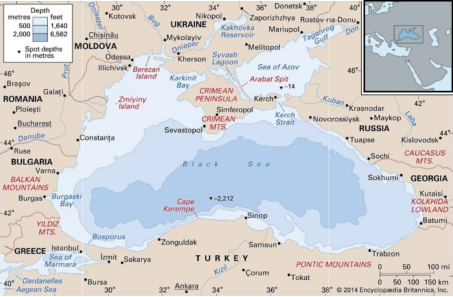
Figure 1: Black Sea
Source: Encyclopedia Britannica 2019
The main regional competitors around the Black Sea are Russia, Türkiye and the West, combining NATO and the EU. The Black Sea is of geopolitical and geostrategic importance for Russia and Türkiye. It provides access to territories for military action, energy security projects, trade, therefore increasing their regional influence. For Russia, it provides access through the Kerch Strait, the Bosphorus and the Dardanelles to the Mediterranean Sea. For Türkiye, it provides access through the Kerch Strait to the Sea of Azov and the inner territory of Russia via the Don River. Also, the Black Sea provides access to the inner territory of Ukraine and Belarus through the Dnieper River. It is a major trade corridor generating wealth, with strategic importance in blocking the enemy in case of a war. The Black Sea is connected to the inner part of the European continent through the Danube River. NATO has access to the Black Sea through the Bosphorus and Dardanelles Straits, controlled by Türkiye, and the Danube River's delta controlled by Romania, but sharing 630km of river border with Bulgaria. Romania and Bulgaria are both EU and NATO members. Türkiye is a NATO member, but with regional interests in the Black Sea, historically competing for influence with Russia. Therefore, the behaviour of Türkiye in NATO is not completely predictable.
- 139/140 -
Contemporary security crises, resulting from the geopolitical competition over the Black Sea Straits
The post-Cold war competition between Russia and NATO continued on the dividing line around the Black Sea. At the beginning of 2022, militarisation on both sides of the Russia - Ukraine border raised concerns in Europe. The tension developed into a war with three focuses, outlined by a Ukrainian security expert: Crimea, Eastern Ukraine and the maritime dimension.[3] The interest of Russia in the Black Sea and the Sea of Azov was not only in relation to Ukraine - it aimed to project power towards NATO collectively and Türkiye individually.[4]
Scenarios of regional developments include either military cooperation of some of the countries without NATO, for example the U.K., U.S., Georgia, Romania, Türkiye; or NATO strategic cooperation in the Black Sea.[5] Türkiye is a historical regional player in the struggle over the Black Sea Straits, competing with Russia. Türkiye controls the Bosphorus and Dardanelles through the Montreux Convention. A scenario of a stronger Türkiye is a precondition for closer relations with Russia and deteriorated relations with NATO.[6] This could block further Western influence, which Türkiye aimed at by creating the BSEC in 1992. A contemporary example-the construction of an Istanbul channel could bypass the Montreux Convention and allow the access of military vessels,[7] avoiding an agreement of the international community.
The Black Sea Maritime Security[8] has increased its importance for the EU since the 2014 geopolitical crisis in Crimea, based on sovereignty dispute between Ukraine and Russia. An oversimplified description of the main facts shows that the approach of Ukraine towards the EU in 2014, was interpreted as a possibility to later NATO membership-both organisations are considered 'West' in the Eastern view. This was unacceptable by Russia due to its own perceived security concerns, and therefore its reaction to annexation of Crimea was not surprising. It was not acceptable, but not unexpected. The EU, based on International Law, declared this act to be illegal. The Crimean conflict led to international disputes over parts of the territory of Ukraine, and the maritime waters around the Crimean Peninsula, particularly in the Kerch Strait. Following Crimea, the Kerch Strait Incident in 2018 and the war in 2022 deepened the conflict.
- 140/141 -
The Kerch Strait Incident
The Kerch Strait Incident in November 2018 is the first confrontation between Russia and Ukraine over the waters of the Sea of Azov and over the land border of Ukraine.[9] The clashes in the Kerch Strait could lead to conflict escalation, following the annexation of Crimea by Russia in 2014.[10] The incident happened after a bridge was built between Crimea and the continental territory of Russia. Specifically, on 25 November 2018 three Ukrainian vessels attempted to cross the Kerch Strait from the Black Sea to the Sea of Azov, aiming to reinforce the Ukrainian naval force at Mariupol and Berdyansk.[11] Russian Coast Guard vessels, supported by helicopters and warplanes, fired on the Ukrainian ships injuring six sailors, after which they detained the vessels and their crew.[12] The Crimean courts detained the 23 sailors for two months before a trial, which demonstrated that the Russian forces were openly engaging with forces from Ukraine, while the previous presence of Russian troops in Crimea and military involvement in Ukraine had not clearly shown open aggression.[13]
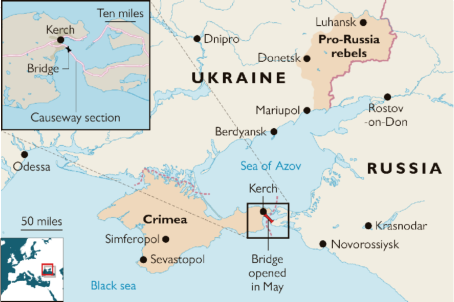
Figure 2: Kerch Strait
Source: Bennetts 2018
- 141/142 -
The challenge was not only the seizure of Ukrainian ships by the Russian military, but the geostrategic importance of the Kerch Strait. The EU's ability to provide security in Ukraine became questionable due to the four-year period between Crimea's annexation in 2014 and the unpreparedness with which it met the Kerch Strait confrontation in 2018.[14] The Ukrainian position, supported by the West, was that Russia attempted to claim rights over the territorial waters around Crimea, thus controlling the Kerch Strait.[15] The Ukrainian President asked for support from NATO, under martial law[16] which allows military control over territories where the civil authority cannot cope with the crisis.[17] Mobilising NATO troops based on the Ukrainian request could have provoked further Russian reaction, developing into a war. This would be neither beneficial to NATO members around the Black Sea, nor to Russia, nor to Ukraine whose territory could have turned into a proxy Russia-NATO conflict. This indeed happened later, in 2022.
The motives of Russia, driven by its continuous confrontation with NATO, and its response to Ukraine's approach towards NATO in this context were not considered. An objective view of the situation requires a clarification of the strategic perspectives of all involved actors. For Russia, the control of Crimea and therefore of the Kerch Strait was a vital security interest. It defined whether or not NATO vessels could be allowed access through the Sea of Azov to the Don River towards internal Russian territory. Crimea was of high strategic importance for Russia. The possibility of Ukraine to gain EU membership, if accompanied by NATO membership, was perceived as a threat to Russia's strategic security, in case that Crimea belongs to Ukraine. This vital security interest from Russia's perspective is underrepresented in the Western literature.
The role of the EU is to create and support international legislation, based on which it judges the situation of Crimea and the Sea of Azov. The EU calls for the implementation of the International Law of the Sea, without engaging in the problematic definition of the ownership of Crimean territories, which it considers occupied by Russia.[18] Nevertheless, the contradictory security concerns of the participating states limit its efficiency.
Research problem
The questionable interpretation of existing maritime security norms in the Black Sea led to an unclear resolution of the Kerch Strait incident in 2018. The international community has agreed on the common Law of the Sea, to which both Ukraine and Russia are members, while the regional powers have agreed on common Black Sea conventions. As both Russia and Ukraine are part of the UNCLOS, this could provide a solution only if the ownership
- 142/143 -
of Crimea is agreed by both. However, agreement has not been reached on this question, which is an obstacle to applying UNCLOS to the Kerch Strait.
The annexation of Crimea by Russia is considered illegal under international law and thus by the EU, while Russia itself considers it a legitimate action. As a result, the waters around Crimea and the Kerch Strait cannot be regulated by mutual international recognition of the existing international law in maritime disputes, namely the UN Convention on the Law of the Sea of 1982, preceded by the Geneva Convention of 1958. The unresolved ownership of the waters under the sovereignty of Crimea allows dual interpretation of the Kerch Strait incident, because the peninsula is part of the territory of Ukraine according to Ukraine and the majority of the international community, while Russia considers it to be part of its own territory. Therefore, it is questionable how the internationally agreed sea conventions are applicable to the Kerch Strait, if both Russia and Ukraine claim ownership.
The current paper clarifies the reasons for inability of the existing international law to solve the situation. An alternative interpretation is suggested through a model from the field of psychology, the application of which I transfer from individuals to international relations actors. Thus, the research questions are: How can the international rules appropriate for the Kerch Strait be defined and how can the psychological model of the drama triangle explain the dependence of the actors?
Methodology: maritime security vs. the drama triangle model
This research aims to reveal what applicable international legislation exists and why a solution to the conflict acceptable to both Russia and Ukraine has not been found yet. It searches for an alternative explanation in the drama triangle model, developed by a psychologist, which clarifies the unhealthy dependencies between people, adapting this model to explain the relations between international actors. Thus, the research explores the relationships between Russia, Ukraine, Türkiye, the EU, and NATO.
The methodology is inductive, considering two separate perspectives - international law as it applies to a particular maritime security crisis, and a psychological approach addressing the persistent conflictual relations within which the crisis happened. It first examines the international norms applicable to the Black Sea Kerch Strait incident. Next, it integrates the outcome in the wider context of psychological dependence theory. It interprets the continuous international conflict through a psychological framework that is typically used for interpersonal conflict assessment. This combined approach might be applied to situations of geopolitical competition between two hegemons, a dependent state and the sea waters between them. It is applicable to maritime regions locked between regional powers in any part of the world.
The first method addresses how the Kerch Strait incident can be understood through regional agreements, international norms and UN Conventions in force. It analyses the existing maritime security conventions, approved by the United Nations, and agreements between Russia, Türkiye and the EU in the context of Black Sea regional power competition.
- 143/144 -
These international conventions and European regional agreements refer to the Law of the Sea, particularly to maritime security in the Black Sea region.
The second method explores the possible application of the drama triangle - a psychological model of interpersonal conflicts, to international conflicts, particularly to the regional actors involved in the Kerch Strait incident. This innovative approach addresses recurring crises in vulnerable states around the Black Sea. Unlike international law, which addresses a particular crisis, the psychological model address the recurrence of crises due to unresolved conflictual dependency. This model suggests an innovative transdisciplinary solution to international conflicts.
The methodological sequence is particularly appropriate to this case. After clarifying the reasons why a legal solution to a single crisis is impossible, it suggests an alternative solution to recurring crises in a longstanding conflict by introducing the drama triangle model of social interaction. Applied to international relations, it suggests an innovative approach to solving a stalemate situation.
First Approach: Black Sea Maritime Security and International Law
The legal approach interprets the Kerch Incident as a single crisis of Black Sea maritime security. The international law concerning the Black Sea in the context of EU Maritime Security includes several international norms - the Geneva Convention of 1958,[19] the UN Convention of 1982 settling the Law of the Sea (UNCLOS),[20] the Montreux Convention of 1936 settling the control over the Bosphorus and the Dardanelles by Türkiye, and International Humanitarian Law in case of armed conflict. However, the applicability of existing international law to this crisis is questionable. Both Russia and Ukraine are parties to UNCLOS, so they are expected to adhere to it, but Türkiye is not.
Control of the straits - Türkiye and the Montreux Convention 1936
In 1857 the signing of the Copenhagen Convention[21] was of geostrategic importance for the Baltic Sea, as it opened access through the Danish Straits for international shipping, allowing free use of the waterways for military and commercial ships. It removed the previously effective Sound Dues agreement, detrimental to the ports and trade of Denmark-full control of the straits was maintained by Denmark, which received fees from the entry to the Baltic Sea of international vessels.[22] Similarly, for the Black Sea, several conventions
- 144/145 -
have opened up the Bosphorus and Dardanelles to international vessels. The latest since 1936, is the Montreux Convention, which regulates the free movement of ships from and to the Black Sea. It grants Türkiye full sovereignty over the Dardanelles, the Marble Sea and the Bosphorus, which enhances the strategic importance of Türkiye in regulating access to the Black Sea from the Mediterranean, and to the Mediterranean from the Black Sea.
According to the Turkish Ministry of Foreign Affairs,[23] the Montreux Convention is closely linked to the Black Sea security and stability, and its state of implementation guarantees balanced relations. In particular, merchant vessels are allowed to pass freely through the Straits, but war vessels are restricted depending on the states to which they belong - those not belonging to riparian states are further restricted according to tonnage and the duration of stay of the vessel in the Black Sea.[24] Regulated by the Montreux Convention of 1936, Türkiye controls the Black Sea Straits Bosphorus and Dardanelles. Thus, Türkiye allows the free entrance of trade vessels and imposes special regulations for military vessels. It is of geostrategic importance, because in case of military action Türkiye decides which military vessels can cross from the Mediterranean to the Black Sea and from the Black Sea to the Mediterranean Sea. The strategic importance of Türkiye as a major player in the Black Sea is guaranteed as long as the Montreux Convention of 1936 is in force. As a key regional actor, Türkiye should be consulted on Black Sea maritime security matters. The Kerch Strait Incident is such an issue, therefore Türkiye could be present in its solution.
The Straits have major geostrategic importance. Türkiye, by maintaining control of the Bosphorus and the Dardanelles, possesses power over the access of ships from Russia and from the Mediterranean to those waters, both for military and trade purposes. Further North, at the Sea of Azov, if Russia controls the Kerch Strait, then only ships to which Russia allows access could sail from the Sea of Azov to the Black Sea. If Russia and Türkiye agree on mutual control over the near-landlocked Black Sea and the Sea of Azov, then no vessels could cross the waters of the Black Sea without their permission. If an agreement exists between Russia and Türkiye, only the ships allowed by them could move between the Mediterranean and the Sea of Azov. However, such an agreement between depends on the willingness of both to share the sovereignty of the Black Sea Straits. This is uncertain, based on their historical competition for regional control.
International Humanitarian Law and the EU
Several international rules regulate maritime security. International Humanitarian Law - jus in bello for armed conflict and jus ad bellum for reasons of war, as well as the San Remo Manual on International Law are applicable to armed conflict at sea. Stahn[25]
- 145/146 -
suggests a third concept - jus post bellum, which would regulate post-conflict relations. Another instrument that regulates armed conflict at sea is the San Remo Manual[26] on International Law, which is applicable to Armed Conflicts at Sea since 1994. Despite the fact that these regulations tackle international conflicts at sea, in the current study they are not applicable to the Kerch Strait incident. The core problem in this conflict is not war at sea, but the intention of the military vessels to cross the waters in question. This paper suggests that the unsettled status of the ownership of the peninsula is narrowly connected to the internal security of Russia.
The EU focuses on cooperation and preserving the principles of international law, including through its Black Sea Synergy,[27] rather than military involvement.[28] The active international agreements are limited in this regard. The Danube Strategy[29] concerns the inland territory and waters of the EU member states up until they drain into the Black Sea. Before the war in 2022, according to the European External Action Service, the EU applies its Maritime Security Strategy Revised Action Plan[30] to the Black Sea, as well as its EU Global Strategy,[31] which has a dedicated section on the increasing geopolitical importance and strategic location of the Black Sea. Neither of these norms provides a solution agreed upon by all participants.
International conventions - UN Law of the Sea of 1982, Geneva Convention on the Law of the Sea of 1958
International security and maritime security are regulated by commonly agreed international law. The currently existing legal framework includes two major UN Conventions - the 1958 Geneva Convention of the Law of the Sea and the 1982 UN Convention of the Law of the Sea (UNCLOS). The Law of the Sea Convention or Law of the Sea Treaty - since its inception in the United Nations Conference on the Law of the Sea between 1973-1982, has been in force since 1994 with 167 participatory countries, including the EU since 2016.[32] UNCLOS members include Russia, Ukraine, Bulgaria and Romania - both EU and NATO members, while Türkiye is not a member. The members agree to follow the principles of international law, while non-members are not expected to follow these principles. The challenge is that two members, Russia and Ukraine, do not follow the same principles of international law on maritime security.
- 146/147 -
The Geneva Convention on the Law of the Sea from 1958 creates several sea zones - the Territorial Sea and Contiguous Zone, the High Seas, Fishing and Conservation of Living Resources of the High Seas, the Continental Shelf, and, additionally, the Compulsory Settlement of Disputes, all agreed by the United Nations. The three basic maritime areas it outlines are: Territorial Sea, Continental Shelf and Exclusive Economic Zones. Based on it, the UN Convention on the Law of the Sea of 1982 distinguishes between different types of territories and waters relevant to regulating the sovereignty of the sea. They are shown in the figure below, comprising six Maritime Zones - internal sea, territorial sea, contiguous zone, continental shelf and exclusive economic zone, and high seas.
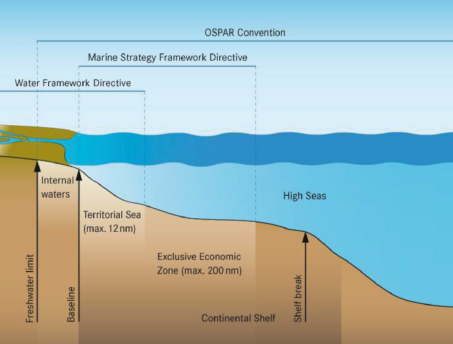
Figure 3: Jurisdictional zones of the UN Convention on the Law of the Sea, 1982
Source: OSPAR Commission 2010.
Each of these maritime zones has specific characteristics, with the aim of defining who is the sovereign of each territory, and how the relations of different coastal states are regulated on the sea. The High Seas, established primarily in the UN Geneva Convention of 1958, comprise "all parts of the sea that are not included in the territorial sea or in
- 147/148 -
the internal waters of a State".[33] The key issue about the High Seas is that "no State may validly purport to subject any part of them to its sovereignty",[34] which is a major reason for disputes between states, if it is not regulated. The UN Law of the Seas in 1982 established internationally recognised norms for governance: "The exclusive economic zone shall not extend beyond 200 nautical miles from the baselines from which the breadth of the territorial sea is measured."[35] Moreover, "in the exclusive economic zone, the coastal State has: (a) sovereign rights for the purpose of exploring and exploiting, conserving and managing the natural resources [...], and with regard to other activities for the economic exploitation and exploration of the zone",[36] which seeks to clarify who is able to implement trade and how to do it, without claiming preferential conditions on an unregulated basis. Furthermore, UNCLOS 1982 regulates the ownership sovereignty of the ships and the applicable jurisdiction. Namely, "warships on the high seas have complete immunity from the jurisdiction of any State other than the flag State".[37] However, "on the high seas, or in any other place outside the jurisdiction of any State, every State may seize a pirate ship or aircraft, or a ship or aircraft taken by piracy and under the control of pirates, and arrest the persons and seize the property on board".[38] This means that in cases of harmful, criminal action, a ship could be judged by any country of the international community. Also, in case of any other action by a ship, the responsibility for its actions is linked to the flag under which it is sailing. This rule creates a precondition for strong international order and discipline regulated by the community even on open waters, the area thus designated as the high seas.[39]
Result of the First Approach: Sovereignty of Crimea, Russia - NATO dynamics
This paper finds that the Law of the Sea does not provide an agreement for all states not to interfere within the territory of another state, because the presumption is that states have defined boundaries. The existing norms only clarify what kind of solutions are needed for the secure passing of sea vehicles without harming the interests of any of the surrounding sea states. However, they fail to provide a normative solution to the crisis under study, which would be applicable to all the involved states.
In the UN Law of the Sea 1982, innocent passage[40] through the territorial waters of another sovereign country means that a ship refrains from engaging in certain prohibited
- 148/149 -
activities, including weapons testing, spying, smuggling, serious pollution, fishing, or scientific research. In the case of the Kerch Strait incident in 2018, Ukrainian vessels with military equipment were trying to pass through the Kerch Strait from the Black Sea, aiming to reinforce the Ukrainian military on the coast of the Sea of Azov. Based on the UN Law of the Sea of 1982, this constitutes innocent passage if the ship refrains from prohibited activities. Therefore, it does not test weapons and does not spy or smuggle goods over the sovereign territory of another state, in this instance Russia. However, two difficulties for interpreting the situation exist.
First, if the Ukrainian vessels passing through the Kerch Strait are not testing any weapons and are passing innocently through waters under the sovereignty of Russia, they could be granted free access. However, if the purpose of their passing is to reinforce Ukrainian military, it is an act against another country-Russia, regardless of whether defensive or offensive[41]. Therefore, despite the clause of innocent passage under the UN Law of the Sea, the Ukrainian military ships would cross the waters against the interest of Russia. From the UN Law of the Sea perspective it is legitimate, but from Russian perspective opposing the action, at least by blocking the Ukrainian ships from reaching their military objective, could be interpreted as a security interest.
Second, the question is more complex, because of the lack of complete international agreement on the sovereignty of Crimea and, therefore, the sovereignty of its sea waters. Western authors sharply criticise Russia for controlling the Kerch Strait, calling for the rule of law to be in force.[42] The Ministry of Foreign Affairs of Russia, however, considers its actions during the Kerch Strait incident in November 2018 legitimate.[43] It judges the actions of Ukraine as unacceptable, and declares that Russia would not allow activities directed against Russia - this narrative is followed until the escalation of a war in 2022. Simultaneously, Russia declares openness for constructive dialogue on the Sea of Azov, inviting[44] Ukraine for a bilateral solution, instead of involving the international community and international law to resolve the situation. Russia warns that escalation of the conflict is possible in the waters of the Kerch Strait, and a reaction could be expected towards Ukraine or any country supporting what Russia deems as 'provocative actions of Ukraine'.[45] From the Western perspective, Russia was acting in a harmful way, as Crimea belongs to Ukraine. From a Russian perspective, it was defending its strategic interests. If Crimea was part of Russia, which Russia claims,[46] then it would be difficult to judge.
Only after the sovereignty of the Crimean Peninsula is clarified can the currently effective UN Law of the Sea of 1982 provide a solution. At the moment, the case of the Kerch Strait
- 149/150 -
does not fall under its 'innocent passing' clause, which states that it is possible for foreign vessels to pass if they do not implement military actions. Either the military vessels of Ukraine crossed the sovereign territory of Ukraine, which means that Russia is violating foreign sovereign waters, or the military vessels of Ukraine crossed the sovereign territory of Russia and this violated the foreign sovereign waters of Russia. In either case, the Kerch Strait incident cannot be solved by the Law of the Sea, but by solving the question of the sovereignty of Crimea.
As long as the status of Crimea is not internationally agreed by all concerned states, particularly Russia and Ukraine, it cannot be established who is the sovereign of the territorial sea waters of the Crimean Peninsula. Even though international law is in favour of Ukraine, the control of the Kerch Strait means allowing NATO access to the Sea of Azov and to the internal Russian territory, which is contrary to the security interests of Russia. As long as Russia and NATO perceive each other as adversaries, unsurprisingly each of the two strives to gain advantage over the other and to protect its territory from the other.
Therefore, the 1982 UN Convention on the Law of the Sea could not show which side was in the right in case of the interrupted attempt by Ukrainian military vessels to cross the Kerch Strait. It was not clearly agreed whether Ukraine was in the right to act, if Crimea was a part of Russia and these military vessels were acting against Russia. Neither was it clear if Russia was trampling on international law, if Kerch waters were within the sovereign of Ukrainian Crimea, and Ukraine was trying to cross its own waters aiming at non-innocent passage to provide military enforcement against Russia, with the potential of NATO assistance. The law might provide a legal answer, but such action would logically be against the vital security interest of a state. Neither state is likely to allow action against its vital security interests. An agreement acceptable to all involved parties does not exist yet. This led the researcher to proposing another point of view to solve the problem - an approach to conflictual situations, known in psychology.
Second Approach: The Lasting Russia - Ukraine Conflict and the Psychology Drama Triangle
In this section I propose an innovative approach to the recurring crises and conflicts in the vulnerable states around the Black Sea region. It structurally addresses the lasting crises of Crimea and Ukraine, including the Kerch Strait incident and its aftermath. I first explore the dependencies studied in a theory of psychology, and then I suggest how these dependencies can be applied to international relations.
In psychology, a situation where three participants are involved in an unhealthy dependence is called drama triangle,[47] which involves a weak victim, a harmful persecutor
- 150/151 -
and a helping rescuer, with possible interchange over time between the three unhealthy roles. Although this concept was created more than 50 years ago, it remains widely referenced in contemporary psychology debates. It relates to the concept of co-dependency,[48] which lies within the core of ontological insecurity[49] embedded in the lack of a secure attachment style. Drawing a parallel to the continuously conflictual relations between some countries in international relations, the core reason is the lack of mutual security guarantees. The original model created by Karpman clearly outlines some of the roles in such unhealthy dynamics. In the Drama Triangle,[50] the victim is weak, harmed, complaining and suffering, while the persecutor is strong, steady and stable, but also harming, bullying and injuring the others and the saviour is strong, steady and stable, but protective, providing support, care and shelter to the victim. Comparing the individual strategies for action of the participants in the Black Sea crisis, I draw parallels with the psychological drama triangle model. The roles in the specific Kerch Strait incident are: Ukraine as the victim, Russia as the persecutor and NATO as the rescuer. However, in history these roles might have been played by different participants at different times. This paper borrows solutions from psychology, which explain the relations between international actors.
Interpersonal conflict analysis - Victim, persecutor, rescuer
The drama triangle[51] describes the model of interpersonal relations between three people playing defined roles in an unhealthy relationship - one is the victim who suffers, one is the persecutor who harms and one is the rescuer who protects the victim. A specific feature of this model is that the victim is unable to take responsibility for itself, while the rescuer helps with unsolicited efforts that sacrifice its own goals, and the persecutor ruins the confidence of the victim in order to hide his own vulnerabilities. All the roles are interchangeable among one another.[52] The drama continues for as long as the participants change roles or engage with other participants.[53] The suggested solution in psychology, for any of the involved actors, is to break the cycle of dependence and to stop repeatedly assuming the same or a different role. However, this remains a challenge for each actor.
- 151/152 -
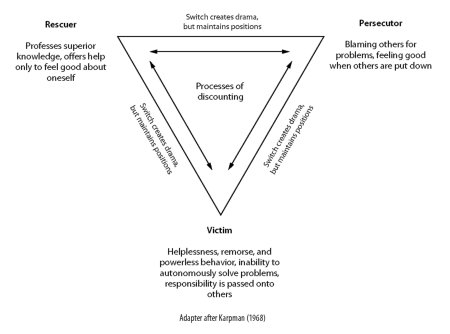
Figure 4: Psychology Drama Triangle
Source: Grigore et al. 2021: 70
In this model, a persecutor is aggressive and blames, oppresses and demeans others.[54] A rescuer is a peacemaker who tries to help the weak others by improving, changing and controlling their behaviour, offering unwanted advice.[55] A victim is powerless, unable to find their own solution, and threatened by uncontrollable situations.[56] A necessary condition for a conflict to exist is to designate a victim.[57] Therefore, if the potential victim succeeds in becoming self-empowered, a conflictual situation cannot continue. Escaping the triangle for each participant starts with the awareness of their own role.[58] The next step is taking responsibility for their own actions,[59] where the victim needs to take responsibility for solving its own problems. Overcoming the role of a victim through finding the outcomes of the victims' own problems is a solution suggested by the 'winner's triangle' model.[60]
- 152/153 -
The applicability of roles - Ukraine, Russia, Türkiye, NATO, and the EU
A brief historical overview reveals the roots of perception of a vulnerable position for Ukraine. According to some scholars, Ukraine became separate from Russia in 1917, but was recognised only by Germany, whose military later required food and coal resources from Ukraine, while the local population was divided between nationalists and communists.[61] In 1922 the Ukrainian SSR was among the founders of the USSR, and according to some sources the Ukrainian language and culture were developed by the Bolsheviks, while Ukrainian politicians took leading positions in the SSR, and as the Secretary General of the Communist party Khrushchev awarded Crimea to Ukraine, an action which was not politically significant during the USSR time and which eased its economic integration.[62] This shows consecutive dependence of Ukraine over time - on Russia, on Germany, on the USSR - and such lasting dependence is a precondition for maintaining its role as a victim.
The history of Crimea, in particular, is marked by the presence of different cultures - Bulgarian, Greek, Roman, Ottoman (14-18[th] century), Russian (1783-1917) and Soviet (1921-1991), with numerous short periods of being declared an independent republic, populated and locally ruled by Tatars.[63] While this shows attempts to interrupt the dependence, it also indicates longer periods of dependence, typical for the role of a victim aiming at self-responsibility. Since the collapse of the USSR, Crimea remained part of Ukraine, with Russia retaining a military base in Sevastopol.[64] In 2014 Russia annexed Crimea and later constructed a bridge to its mainland over the Kerch Strait in May 2018, allowing commercial vessels to call at Ukraine's ports on the Sea of Azov coast, but resulting in a clash between naval ships belonging to Russia and Ukraine in November 2018.[65] After the Kerch Strait incident, which injured Ukrainian sailors, Russia stopped three ships with crew from Ukraine, and closed the Kerch Strait by placing a large cargo ship under the bridge, while the government of Ukraine declared martial law for 30 days.[66] This situation confirms the lasting strategic importance of the Crimean Peninsula, and the specific significance of the Kerch Strait as a passing point between the two seas - the Black Sea and the Sea of Azov, for two opposing post-Cold war actors - Russia and NATO. This immense interest of stronger regional players over the control of Crimea is a serious obstacle for its independent empowerment.
The political elite of Ukraine, despite the resulting long-lasting unfavourable conditions for its people, shows repetitive tendencies to be mentored by a stronger foreign player.[67] If the logic of the psychological drama triangle is applied to the participants in the Black
- 153/154 -
Sea Kerch Strait incident, then the directly involved parties are Ukraine, Russia and NATO, while Türkiye and the EU are indirectly involved. Russia and NATO both change roles between rescuer and intruder over time. It is problematic if Ukraine's own perception perpetually corresponds to the role of a victim, weak and incapable of solving its problems by itself. This is probably due to historical dependence on a changing stronger actor who subordinates the country. As long as Ukraine avoids ownership of its vulnerability and searches for an external rescuer, being it NATO, Russia, or another actor, the unhealthy role model continues and the cycle repeats. In the Kerch incident and the annexation of Crimea, the EU has also switched between roles - partially in the role of a victim asking for international law to be followed, and partially performing the role of a rescuer requiring that international law must be respected otherwise it will threaten the perpetrator with its most important tools, such as sanctions. Türkiye has a triple role in the situation: as a NATO member, as a regional competitor to Russia, but also as an ally of Russia against Western approaches, shown through the establishment of a Black Sea Economic Cooperation Organisation,[68] initiated right after the dissolution of the Soviet Union. This triple role puts Türkiye in a temporary position of an observer. An involvement by Türkiye could switching between the drama triangle roles. However, it is uncertain how long each actor would remain in the same role.
Result of the Second Approach: A psychological solution in IR. Empowering the victim. A consistent political discourse by Ukraine
Applying the psychological drama triangle to Crimea in the Black Sea region reveals three actors playing the roles of a weak and vulnerable victim, a strong and contentious offender (persecutor) and a strong and protective defender (rescuer) implemented by international actors. In the case of the Kerch Strait in Crimea, five participants are involved, switching between the three roles - the EU, Russia, Türkiye, NATO and Ukraine. Over time, Russia and NATO have shown the characteristics of both an offender role, steady and adversarial, and a defender role, steady and protective. Türkiye has played a neutral role, neither supporting nor criticising either side, Russia or NATO. However, it has the potential to be in either position, depending on which side it would take at a given time - that of Russia, of NATO, of Ukraine or, most likely, its own. The EU has a less aggressive role compared to NATO and Russia, but also with potential to develop its role as either a rescuer, or a persecutor. Ukraine remains in the vulnerable role of a victim as long as it hesitates between Russia and NATO, relying on external support. If it chooses a steady internal position, it could build confidence and strength, despite possibly losing some annexed territories. This could be politically arranged later, if Ukraine keeps permanently a stable behaviour towards all external players. Applying the solution from psychology, the most
- 154/155 -
desirable position for Ukraine is to synchronise its internal policies and disputes, which will result in confident external policies regardless of any change of internal leadership or external roles.
The solution of the Kerch Strait incident depends on the correlation between these five actors - the historical leaders Russia and Türkiye, the EU being present via individual cooperation strategies, Türkiye offering economic cooperation for all, but also potentially playing a harmful-beneficial role for either Russia or NATO, while Ukraine suffering any scenario. Several possible developments of the situation exist. First: an optimal solution is an agreement between Russia and NATO, being the two strongest actors, in respect to the needs of Ukraine. However, such an agreement is not likely to be reached soon. Second: Ukraine might remain in a vulnerable position by switching the roles of rescuer-persecutor between Russia and NATO, or by requiring help from other external actors, maintaining its role of dependence. Third: another alternative is if Türkiye provides stronger support for NATO in opposition to Russia, or if, in contrast, Türkiye neglects NATO and cooperates with Russia, diminishing the Western presence in the Black Sea-the original goal of the BSEC organisation, initiated by Türkiye after the Cold War. Neither of these options is beneficial for Türkiye, which decreases its likelihood to happen. Fourth: another option is for the EU to use military force, which is less likely to happen soon due to the position of the EU as a safeguard of international norms and regulations, and its recent development towards strategic compass and strategic autonomy. Fifth: therefore, the only working solution is empowering Ukraine to pursue a constant stable policy, ending its dependence on external actors who switch between persecutor and rescuer role, but instead directing its efforts towards independent political action and permanent geopolitical orientation. Any internal vulnerability brings the country back to the victim role, which equals an invitation for a persecutor and a rescuer to interfere.
Neither Russia nor NATO are likely to break the cycle of dependence, because it proves their powerful actor position. Ukraine remains in the role of a victim until it owns the responsibility for its situation. A steady position would send the right signals to external parties. The significant interest of external actors in its strategic location creates obstacles for its independence. Russia considers a critical security interest not to allow the entry of NATO ships through the Kerch Strait. If Ukraine aims for NATO membership, then from Russia's critical security perspective, Ukraine cannot be allowed to control the Kerch Strait, and therefore Crimea cannot belong to Ukraine. Ukraine cannot ignore these themes of its territorial disagreement with Russia. Therefore, Ukraine can take responsibility by either confirming its Western choice and risking to lose territory, or maintaining close ties with Russia, limiting Western influence. The EU membership of Ukraine is not harmful to Russia's critical security, if not accompanied by NATO membership. Tat interpretation remains valid as long as Russia and NATO perceive each other as opposing actors, competing for influence over the territory of vulnerable countries between them.
- 155/156 -
Conclusion
The strategic importance of the Black Sea creates opportunities for geopolitical cooperation, but also confrontation for leadership in the region. The Kerch Strait incident can be interpreted differently through the perspectives of Russia, NATO, Ukraine, the EU and Türkiye. Russia aims to protect its sovereignty and historical power. NATO aims at expansion and provides Ukraine with the requested support, due to incapability to cope alone. Ukraine aims to protect its territory from military presence of Russia, while giving positive signals towards the EU and NATO. Türkiye avoids involvement on any side with potential negative consequences against its interests. The EU aims to protect international norms and regulations, supporting the principles of international law in global governance. In the Kerch Strait, the EU consistently applies the international law, according to which Crimea was illegally annexed from Ukraine, which is the Western perspective. From a post-Cold War perspective, enhancing the communication between NATO and Russia, by means of EU mediation, is more likely to impact regional crises.
This article has explored some aspects of the geopolitical competition for power in the Black Sea region that resulted in maritime security crises. The case study of the Kerch Strait incident happened in 2018, when Russian military action stopped Ukrainian military vessels from crossing the Kerch Strait, located between Crimea and Russia. The gap in this paper is the incapability of international law to provide solution. There is a lack of common agreement between the involved regional players - not only Russia and Ukraine, but also NATO, the EU and Türkiye, on which rules are applicable to this specific situation. My research question was: How can the international rules appropriate for the Kerch Strait be defined and how can the psychological model of the drama triangle explain the dependence of the actors? My methodological approach was inductive, with the study initially examining the Kerch crisis through the prism of international law, and then explaining the wider context of recurring crises and lasting conflict between the same actors through the drama triangle model, borrowed from the field of psychology.
The first perspective, international law, addressed the particular security crisis. It explored the challenges of the Black Sea maritime security in the framework of UN Law of the Sea Convention of 1982 (UNCLOS) and the Montreux Convention of 1936. The findings showed that the Kerch Strait incident could be explained by international law only if the law is accepted by all involved states. Both Russia and Ukraine are members of UNCLOS, so a common decision is formally possible. However, a major difficulty derives from the security concerns of Russia. Losing control of the Kerch Strait could allow access by NATO to Russia's internal territory through the Sea of Azov, which is not acceptable to Russia. A security priority for Russia is to block potential NATO access, so it aims control of the Kerch Strait. The territorial waters of Crimea are determined in terms of its land, therefore UNCLOS can serve only after the ownership of the Crimean peninsula is agreed. If Ukraine allowed NATO access through the Kerch Strait, then Russia's efforts to claim Crimea as its own territory can be viewed as an attempt to protect the internal Sea of Azov. The existing maritime law does not provide a solution, while political agreement on the
- 156/157 -
ownership of the territory of Crimea is lacking. Alternatively, mutual agreement between Russia and Ukraine on the regulation of entry of military vessels in the Sea of Azov might be a possible solution. A necessary condition before applying international law is that Russia and Ukraine decide which state Crimea belongs to, considering the security threats for both. Inarguably, the EU is on the side of international law, according to which Crimea belongs to Ukraine. However, this only confirms the concerns of Russia, in its post-Cold war competition with NATO.
The second perspective addressed the deeply rooted conflict between the main regional actors. The maritime security crisis is located within a psychology pattern of recurring crises and continuous conflict. The psychological model of the drama triangle, which is usually applied to conflicts between individuals, was innovatively applied to international relations. The international actors involved in the Kerch Strait incident are five, exhibiting mixed characteristics of victim-offender-defender. Transposing the perspectives of psychology to the enduring historical competition over Crimea, the relations between Ukraine, Russia, Türkiye, NATO and the EU were examined within the drama triangle. A solution in the psychological drama triangle is reached if a participant decides to break the cycle of mutual dependence. Brought to the case study of the Black Sea region and the Kerch Strait incident, such participants are Russia, NATO and Ukraine. The core problem is Ukraine's role of a victim, which changes its dependence on different actors over historical time, seeing the others as either rescuers or persecutors. The weak and hesitant victim role constantly requires external support. Surprisingly, in psychology it is the victim which needs to break the cycle, which would be equivalent to Ukraine initiating a stable political discourse of internal unity and independence. Borrowing a conceptual framework from psychology, a possible solution in international relations is Ukraine to be assertive about its own interests. The process of empowerment of Ukraine requires steady political discourse over time and wide internal support. This would diminish dependences on external actors, on the cost of initial responsibility for its own situation. Empowerment of the victim based on the psychology drama triangle is applicable to security aspects of other countries, corresponding to the similar situation of social relations.
Limitations and recommendations
Limitations: This paper discussed a regional maritime security crisis through two perspectives - first, international maritime law addressing the specific crisis, and second, a novel psychological perspective, addressing the lasting conflict. It is limited to maritime security as part of the political and strategic goals of the involved actors. The research is written from the perspective of a political scientist, not that of a lawyer, neither a psychologist. Furthermore, this research is written before the escalation of a war - it is applicable to the period of prevention, as well as to the post-conflict peace-building.
Recommendations: First, the geopolitics of the Black Sea region also involves the Turkish position between NATO and Russia. The Kerch Strait incident and the sovereignty of
- 157/158 -
Crimea could include the perspective of Türkiye, whose strategic interests include both Russia and NATO. Second, the combined research of international relations, maritime security and psychology brings innovative results. Collaboration with psychologists could develop the perspective of empowering the victim to leave the drama triangle, applied to international relations dependencies. Both the interstate relations and the interpersonal models of behaviour might appear with interchangeable common characteristics. This path needs further research.
References
Bennetts, Marc (2018): Ukraine Crisis: Kerch Strait Controls Access to Ukraine's Eastern Ports. The Times, 27 November 2018. Online: www.thetimes.co.uk/article/kerch-strait-controls-access-to-ukraines-eastern-ports-xpqwmqh2z
Black Sea Economic Cooperation (1992): Charter of the Organization of the Black Sea Economic Cooperation. Online: www.bsec-organization.org/UploadedDocuments/StatutoryDocumentsAgreements/CHARTERFourthEdition7July.pdf
Copenhagen Convention (1857). Treaty for the Redemption of the Sound Dues between Austria, Belgium, France, Great Britain, Hanover, the Hansa Towns, Mecklenburg-Schwerin, the Netherlands, Oldenburg, Prussia, Russia, Sweden-Norway and Denmark.
Cornell, William F. (2014): Transactional Analysis: 50 Years Later in Theory and Practice. Transactional Analysis Journal, 44(3), 226-236. Online: https://doi.org/10.1177/0362153714554188 ; DOI: https://doi.org/10.1177/0362153714554188
Doswald-Beck, Louise ed. (1995): San Remo Manual on International Law Applicable to Armed Conflicts at Sea. Cambridge: Cambridge University Press. Online: https://doi.org/10.1017/CBO9780511622052; DOI: https://doi.org/10.1017/CBO9780511622052
Encyclopaedia Britannica (2019): Black Sea. Online: www.britannica.com/place/Black-Sea
Encyclopaedia Britannica (2020): Martial Law. Online: www.britannica.com/topic/martial-law
Encyclopaedia Britannica (2022): History of Crimea. Online: www.britannica.com/place/Crimea/History
European Commission (2011): EU Strategy for the Danube Region. Online: https://ec.europa.eu/regional_policy/en/policy/cooperation/macro-regional-strategies/danube/
European Commission (2016): A Global Strategy for the EU's Foreign and Security Policy. Online: https://eeas.europa.eu/sites/eeas/files/eugs_review_web_0.pdf
European Commission (2018): EU Maritime Security Strategy Revised Action Plan. Online: https://ec.europa.eu/maritimeaffairs/sites/maritimeaffairs/files/eumss-revised-action-plan_en.pdf
- 158/159 -
European External Action Service (EEAS) (2019a): Black Sea Synergy: Review of a Regional Cooperation Initiative - Period 2015-2018. High Representative of the Union for Foreign Affairs and Security Policy, European Commission. Online: https://eeas.europa.eu/sites/eeas/files/swd_2019_100_f1_joint_staff_working_paper_en_v3_p1_1013788-1.pdf
European External Action Service (EEAS) (2019b): EU Supports Better Cooperation in the Black Sea Region. Online: https://eeas.europa.eu/sites/eeas/files/factsheet_blackseasynergy_2019_en_final_digital.pdf
European External Action Service (EEAS) (2019c): The Black Sea: Revised EU Maritime Security Strategy Action Plan. Regional and Global Maritime Affairs. Online: https://eeas.europa.eu/topics/maritime-security/46708/black-sea-revised-eu-maritime-security-strategy-action-plan-regional-and-global-maritime_en
European Security and Defence College (ESDC) (2021): Training Course: Hybrid Threats and Maritime Security.
Grigore, Georgiana - Molesworth, Mike - Vonţea, Andreea - Basnawi, Abdullah H. - Celep, Ogeday - Jesudoss, Sylvian P. (2021): Drama and Discounting in the Relational Dynamics of Corporate Social Responsibility. Journal of Business Ethics, 174(5), 65-88. Online: https://doi.org/10.1007/s10551-020-04591-5; DOI: https://doi.org/10.1007/s10551-020-04591-5
Global Security (2022): Montreux Convention 1936. The Montreux Convention Regarding the Regime of the Black Sea Straits Bosporus and Dardanelles. Multilateral Treaty between Bulgaria, France, Greece, Japan, Romania, Yugoslavia, Türkiye, UK, USSR. Online: www.globalsecurity.org/military/world/naval-arms-control-1936.htm
Hall, Jonathan (2019): From the Azov Sea to the Black Sea: Russia's Maritime Campaign. Center for International Maritime Security, 26 March 2019. Online: http://cimsec.org/from-the-azov-sea-to-the-black-sea-russias-maritime-campaign/39967
Hapon, Nadiya (2021): Educational Prospects of the Practical Solution of Personal Ontological Insecurity. Scientific Journal of Polonia University, 44(1), 33-40. Online: https://doi.org/10.23856/4404; DOI: https://doi.org/10.23856/4404
International Institute for Strategic Studies (IISS) (2018): The Kerch Strait Incident. Strategic Comments, 24(10), 1-2. Online: www.iiss.org/publications/strategic-comments/2018/the-kerch-strait-incident DOI: https://doi.org/10.1080/13567888.2018.1557878
Karpman, Stephen B. (1968): Fairy Tales and Script Drama Analysis. Transactional Analysis Bulletin, 7(26), 39-43.
Lac, Andrew - Donaldson, Candice D. (2020): Development and Validation of the Drama Triangle Scale: Are you a Victim, Rescuer, or Persecutor? Journal of Interpersonal Violence, 37(1), 1-25. Online: https://doi.org/10.1177/0886260520957696; DOI: https://doi.org/10.1177/0886260520957696
- 159/160 -
Maass, Anna-Sophie (2019): From Vilnius to the Kerch Strait: Wide-Ranging Security Risks of the Ukraine Crisis. European Politics and Society, 20(5), 609-623. Online: https://doi.org/10.1080/23745118.2019.1570667; DOI: https://doi.org/10.1080/23745118.2019.1570667
Ministry of Foreign Affairs (MFA) of the Russian Federation (2018): Заявление МИД России [Statement of the Russian Ministry of Foreign Affairs], 21 November 2018. Online: www.mid.ru/home/-/asset_publisher/WNgME5eEYa3x/content/id/3414549
Ministry of Foreign Affairs (MFA) of Türkiye (2019): Implementation of the Montreux Convention. Online: www.mfa.gov.tr/implementation-of-the-montreux-convention.en.mfa
OSPAR Commission (2010): Quality Status Report 2010. Online: https://qsr2010.ospar.org/en/ch01_02.html
Shelest, Hanna (2021): The Maritime Dimension of the Russian-Ukrainian War. Policy Brief. Defence and Security Foresight Group, Department of National Defence of Ukraine and the Canadian Armed Forces.
Stahn, Carsten (2006): 'Jus ad bellum', 'jus in bello'... 'jus post bellum'? - Rethinking the Conception of the Law of Armed Force. European Journal of International Law, 17(5), 921-943. Online: https://doi.org/10.1093/ejil/chl037; DOI: https://doi.org/10.1093/ejil/chl037
UNCLOS (1982): United Nations Convention of the Law of the Sea. Online: www.un.org/depts/los/convention_agreements/texts/unclos/unclos_e.pdf
United Nations (1958a): Geneva Conventions on the Law of the Sea. Audiovisual Library of International Law. Online: http://legal.un.org/avl/ha/gclos/gclos.html
United Nations (1958b): Convention on the High Seas. Geneva: Conference on the Law of the Sea. 79-155. Online: https://treaties.un.org/doc/Treaties/1963/01/19630103%2002-00%20AM/Ch_XXI_01_2_3_4_5p.pdf
Warner, Oliver (1967): Elsinore and the Danish Sound Dues. History Today, 17(9). Online: www.historytoday.com/archive/elsinore-and-danish-sound-dues
Сивилов, Александър (2022): Защо Украйна забрави собственото си минало? "След края на историята" [Why Ukraine Forgot Its Own Past? After the End of History]. Бъгарско национално радио [Bulgarian National Radio], 22 January 2022. Online: https://bnr.bg/horizont/post/101590042
Neli Kirilova's research interests are international relations theory, geopolitical security, crises and conflict prevention, Black Sea region, the European Union, Russia, Türkiye. ■
NOTES
[1] This research does not necessarily reflect the views of the institutions to which the author is affiliated. This paper contains an analysis, objectively conducted in attempt to compare Western and Eastern views. The author possesses a major in Russian, Central and East European Studies by the University of Glasgow, with research experience in Russia, Azerbaijan and Georgia, which makes the expressed viewpoints relying on facts, presenting conflicting perceptions and logical assumptions. The analysis is based on usage of both Western and Russian language sources.
[2] This article was partially inspired by the Conference International Cooperation and Geopolitical Security in the Black, Mediterranean and Baltic Seas - Legal, Economic and Environmental Aspects, organised by the Black Sea Institute, Bulgaria, in 2019. Some aspects of it were discussed during Risks and Stability in the Regions of the Black, Mediterranean and Baltic Seas panel of this conference. The paper is the edited form of the presentation held at the Critical Rethinking of Public Administration 2021 Conference.
[3] Shelest 2021: 3.
[4] Shelest 2021: 3.
[5] Shelest 2021: 7.
[6] Shelest 2021: 6.
[7] Shelest 2021: 6.
[8] European External Action Service (EEAS) 2019c.
[9] Maass 2019: 609.
[10] International Institute for Strategic Studies (IISS) 2018: 1.
[11] International Institute for Strategic Studies (IISS) 2018: 1.
[12] International Institute for Strategic Studies (IISS) 2018: 1.
[13] International Institute for Strategic Studies (IISS) 2018: 1.
[14] Maass 2019: 609.
[15] Shelest 2021:4.
[16] Maass 2019: 609.
[17] Encyclopaedia Britannica 2020.
[18] European External Action Service (EEAS) 2019b.
[19] United Nations 1958a.
[20] UNCLOS 1982.
[21] Copenhagen Convention 1857.
[22] Warner 1967.
[23] Ministry of Foreign Affairs (MFA) of Türkiye 2019.
[24] Global Security 2022.
[25] Stahn 2006: 921.
[26] Doswald-Beck 1995.
[27] European External Action Service (EEAS) 2019a.
[28] Before the Russia-Ukraine war in 2022, when the EU started to provide military, political, financial and humanitarian support to Ukraine.
[29] European Commission 2011.
[30] European Commission 2018.
[31] European Commission 2016.
[32] European Security and Defence College (ESDC) 2021.
[33] United Nations 1958b: Article 1: 81.
[34] United Nations 1958b: Article 2: 81.
[35] UNCLOS 1982: Part V, Article 57: 44.
[36] UNCLOS 1982: Part V, Article 56: 43.
[37] UNCLOS 1982: Article 95: 59.
[38] UNCLOS 1982: Article 105: 61.
[39] UNCLOS 1982: Part VII: 57.
[40] UNCLOS 1982: Section 3: 26-29.
[41] This refers to 2018, much before the escalation of a war.
[42] Hall 2019.
[43] The paper is not about propaganda strategies, so it will not discuss this aspect. However, the scope of propaganda and foreign information manipulation might be a subject of further research.
[44] This refers to the Kerch Strait Incident in 2018, much before the war escalated in 2022.
[45] Ministry of Foreign Affairs (MFA) of the Russian Federation 2018.
[46] In IR, sometimes the claim of a country might not correspond to reality. The more other countries support the untruthful facts, the higher the chances that it turns into a new reality.
[47] Karpman 1968:40.
[48] Cornell 2014: 226.
[49] Hapon 2021: 34.
[50] Karpman 1968:40.
[51] Karpman 1968:40.
[52] Karpman 1968: 39.
[53] Karpman 1968: 39.
[54] Lac-Donaldson 2020: 3.
[55] Lac-Donaldson 2020: 3.
[56] Lac-Donaldson 2020: 3.
[57] Karpman 1968: 39.
[58] Lac-Donaldson 2020: 17.
[59] Burgess 2005 in Lac-Donaldson 2020: 19.
[60] Chloy 1990 in Lac-Donaldson 2020: 19.
[61] Сивилов 2022.
[62] Сивилов 2022.
[63] Encyclopaedia Britannica 2022.
[64] Encyclopaedia Britannica 2022.
[65] Encyclopaedia Britannica 2022.
[66] Encyclopaedia Britannica 2022.
[67] Сивилов 2022.
[68] Black Sea Economic Cooperation 1992.
Lábjegyzetek:
[1] The author is PhD Candidate in International Relations and Security Studies, Corvinus University of Budapest & PhD Fellow, Doctoral School on CSDP/CFSP, European Security and Defence College, neli.v.kirilova@gmail.com, https://orcid.org/0000-0003-3583-6783