

David M. Wineroither - Gilg Seeber: Democratic Linkage Building in Western and Eastern Europe Agenda and Preliminary Results (Publico, 2015/3., 109-123. o.)
Absztrakt
Political parties exert pivotal influence in ensuring democratic accountability. Performing this role is more difficult in Central and Eastern Europe where features of party, party system and voter behaviour still tend to create an environment that weakens the mechanisms of democratic linkage, e.g. as the result of weakly structured party systems coupled with weak partisanship.
In this research paper, we draw an agenda for research on linkage building between parties and voters in the region. We also report on preliminary results of a first paper which focused on parties' party familial propensities as their presence indicates rather high levels of party system institutionalization. Our findings support the concept of party families across linkages for the West while there is mixed evidence for post-socialist countries.
We tentatively conclude that Central and Eastern European countries have not yet developed political landscapes similar to those existing in older Western democracies. Most essential, party competition here is dominated by the antagonism of clientelistic and programmatic parties.
Keywords: clientelism, Eastern/Western Europe, linkage building, party competition - party families, quality of democracy, quantitative methodology
1. Introduction
Most normative models of democratic representation recognize congruence of public policies and preferences of citizens/voters as the essence and bottom line of responsive government.[1] However, parties and candidates competing for votes have to convince their electorates on multiple grounds of political reasoning. Policy does not form the common single currency on the market place established within the framework of democratic polities. Instead the various domains of linkage building at work are of very different nature: rational,
- 109/110 -
instrumental and emotional. Consequently, political accountability in democratic polities encompasses various non-policy modes of linkage building.
The majority of studies at the intersection of patterns of party competition, electoral studies and quality of democracy have hitherto been anchored in the policy dimension of political competition. The general orientation has been towards the responsible partisan (government) model.[2] Hence, other paths of crafting democratic accountability in the long run received much less attention. This applies to (a) clientelism as part of the world of instrumental calculation and (b) electoral strategies representing the sphere of emotional reasoning, consistent party identification, charismatic leadership and ascriptive (formal) representation.[3]
To get a full picture of how representation works in the variety of institutional landscapes and party systemic features in contemporary Europe all of these domains of interaction between consumers and suppliers on the democratic market place have to be considered and analyzed systematically. Keeping this task description in mind, the argument of shortcomings resulting from limited scope carries additional weight in evaluating cross-regional divides along the distinction between older Western (first and second wave) and newer eastern (third and fourth wave) democracies. In this field, comparative political research proved vibrant and has expanded into new domains over the past decades. Renewed interest in regional european disparity has been (a) driven by notions of Europeanization in the enlarged European Union and (b) created by perspectives on democratic (club) convergence trends. Scholars have investigated a wide range of phenomena including varieties of capitalism, party system propensities, distribution of policy preferences at various levels of aggregation, and programmatic convergence of party families.[4] Most of these contributions have resumed convergence taking the shape of catch-up processes in the east. Thus, the revealed
- 110/111 -
trends towards Western European average typically describe beta type convergence at party and country level respectively.[5]
Why should we concern ourselves with aspects of linkage building and political accountability? For sake of conciseness no exhaustive list of arguments is provided. A few selected examples will illustrate the importance of the sketched agenda. First, political actors' promises to serve demands on various linkages and corresponding delivery of electoral pledges impact upon the quality of democracy in much respect. For example, formal representation can be conducive to mobilize marginalized groups for participation in the democratic process (ethnic minorities, the younger generation and elderly people, women, and perhaps the bold and ugly). Second, clientelism, while bearing economic costs at the macro level and violating several principles of good governance, provides an effective tool for ethno-cultural and ethno-regional minorities. Here we may think of the Hungarian minority party RMDSZ in Romania, the Turkish one in Bulgaria (DPS) and SVP representing the German speaking population of South Tyrol in Italy as primary examples. Third, the lasting presence of more or less familiar party families allows for informational shortcuts among voters. It thus reflects upon party system institutionalization, which at lower and medium levels helps to avoid conduct of bad governance (e.g. moral hazard and related rent-seeking strategies).[6] In other words, parties still exert pivotal influence in ensuring democratic accountability across time and space. Performing these roles is more difficult in Central and Eastern Europe where features of party, party system and voter behaviour still tend to create an environment that weakens the mechanisms of democratic linkage, e.g. as the result of weakly structured party systems coupled with weak partisanship. We thus focus on parties' party familial propensities as their presence indicates rather high levels of party system institutionalization. In more practical terms, our analyses should also be of interest for those in the business of political campaigning.
2. Towards a uniform mode of political competition in Europe?
In the present article the focus of analysis is on the structure of supply-side party political competition across Europe at the brink of the international financial crisis in 2008-2009. Demand-side considerations and institutional opportunity structures are dropped for now.
- 111/112 -
In addition, this opener operates at the level of party families and does not touch upon other levels of aggregation (e.g. country and individual party).[7]
Based on the sketched framework this study adds to the literature on - the absence of -convergence trends between older Western European and newer Eastern European democracies the perspective of patterns of accountability. Have party systems in Eastern Europe developed political landscapes highly similar to those existing in Western Europe? Do parties and party families conform in the combinations of linkage mechanisms they utilize and prioritize in their attempt to resonate with voters? Do these profiles reflect shortcomings existing in third-wave democracies? In addressing these questions the analysis relates to the recent wave of meritful contributions investigating the effects of globalization and supranational integration on the operative mode of national party systems.
This article (a) takes up the argument for encompassing all domains of linkage building in order to allow for more comprehensive conclusions and (b) generates hypotheses for the regional profiles of party familial behaviour drawing from established theories in the various fields of research concerned. The next section discusses the data at hand and informs about methodological aspects (case selection, statistical procedures to be employed). In the empirical part a number of bivariate and multivariate analyses will be employed. Finally, the need for more detailed research on determinants of parties' accountability profiles across Europe will be demonstrated.
3. The role of supply side politics
Most studies of party competition dealing with divides between Western and Eastern European sets of countries solely focus on programmatic competition. But neither do all voters focus on policy considerations in their evaluation of a party nor does it seem apt to separate different dimensions of evaluation. For example, there is ample evidence for how closely evaluations of programmatic offers influence perceptions of leaders' character traits. There is a significant net effect of the assessment of the party leaders on vote choice independent from programmatic screening.[8] Also, voters sometimes bridge the two worlds of rational and emotional reasoning as is the case with assignments of issue competence mediated through party identification.[9]
On the supply side, parties of all party families utilize various non-programmatic linkage mechanisms, albeit in a different fashion and to varying degrees as not all types of par-
- 112/113 -
ties are able and willing to serve all linkages.[10] All of these mechanisms influence the reasoning of voters in choosing from the party and candidate menu served. Yet, while some linkage building strategies go hand in hand, other combinations of linkage mechanisms to reach out for potential voters entail sharp trade-offs and even incompatibility, or may simply go beyond the resources of a single party. Clientelism, for instance, tends to lower credibility in delivering policies to boost the national economy.[11] On the other hand, extensive party membership and organization often result in programmatic ossification. In short, parties cannot freely choose among linkage strategies suited to address the needs of a multiple of ever narrower groups of voters.
Bringing together existing theoretical propositions about the relationship between linkage strategies of party families, linkage profiles at the regional level and the spatial configuration of supply-side politics would lead us to predict substantial regional differences in the configuration of supply-side politics. How party choices of utilizing linkages combine into dimensions of accountability should differ significantly, too. Turning to party families, the theories at hand point to a rather congruent setting. In other words, one would expect a different make-up of supply-side politics but a similar line-up of party families within their respective setting.
4. Data and Methodology
Supply side data come from the unique Democratic Accountability and Linkages Project (DALP).[12] Party level variables on the wealth of voter-party linkage mechanisms have been derived from an expert survey and include information on parties' policy positions and mobilization efforts as well as party leaders' operational efforts. Our analyses focus on national parties in European democracies. Countries in the sample had to qualify over two additional criteria. First, the survey only covers countries which had experienced two consecutive (semi)democratic elections and had an overall Freedom House score of four and above in the years before 2008-2009. Second, DALP employs a population size criterion in that it excludes very small polities. Thus, a number of countries had to be dropped from the chosen sample for either one or both reasons, most notable EU member states Luxemburg and Malta, and non-members Iceland and Turkey.
The measurement of parties' operational effort consists of five variables: an index for the procurement of different categories of targeted goods and services, a multiplicative index of
- 113/114 -
party-level cohesion, polarization and salience measures,[13] and three aspects of mobilization efforts, namely presenting a leader's charismatic personality, invoking loyalty, party history or party identification, and claiming the party's competence to govern.
The DALP survey covers parties represented in the lower chamber.[14] The resulting 220 parties from 33 countries (16 West, 17 East) were classified according to their party familial entity. Eleven parties (~5%) could not be classified for various reasons (typically single issue and populist/personalist parties). Seven of these come from Eastern Europe, three alone from Ukraine. Except for major parties in Russia and Ukraine only small and very small parties had to be excluded. As we are interested in both the location of party families in the supply-side political space and their degrees of homogeneity, party families which scarcely populate the European political space and which do not alter the national/regional configuration of that competitive space, such as agrarian and religious parties, have been dropped as well.
There are a number of reasons of conceptual and statistical nature to operate at this rather high level of aggregation.[15] As for classification and ascription of membership, we identify ideology and policy records as the key element and guiding principle for making choices. Right-wing populist (RPP) and radical right parties (RR) have been merged on these grounds. In addition, the largest party family in our data set, Christian democrats and secular conservatives (SC), consists of a number of borderline cases, which (almost) equally qualify as agrarian and religious parties respectively. Please note that the classification refers to parties' attributes as of 2008-2009 when the survey was implemented. Party familial membership, of course, varies over time.[16]
In the end, the performed analysis works with more than 200 parties from eight European party families coming from all countries included in the design of our study (listed in table 1). Most party families enjoy comparable support in both regions. This similarity dates back to the mid 1990s.[17] Except for the category of 'socialist' parties they are all sufficiently represented (in numeric terms) in both regions under examination.
- 114/115 -
Table 1 Number of parties according to regional membership in eight party families
| West | East | West+East | |
| PARTY FAMILY | |||
| COMMUNIST | 4 | 4 | 8 |
| SOCIALIST | 10 | 1 | 11 |
| SOCIAL DEMOCRATIC | 16 | 21 | 37 |
| GREENS | 10 | 3 | 13 |
| LIBERAL | 19 | 18 | 37 |
| ETHNIC (merged with ethnoregionalist) | 5 | 7 | 12 |
| CHRISTIAN DEMOCRATIC (merged with secular conservatives) | 27 | 33 | 60 |
| RIGHT-WING POPULIST (merged with radical right) | 15 | 11 | 26 |
| SUM | 106 | 98 | 204 |
5. Results
We first look at the descriptive statistics of variable and party family scores comparing the two regions. Table 2 presents the relevant summary information. At first glance we notice the very limited differentiation among the three major mainstream party families (SD, CD/SC and Liberals) in both regions. The numbers confirm basic assumptions of prioritization as specified for particular party families operating in Western Europe. For example, with regard to political leadership, we find the expected divide between low-scorers of the united political left and increasing levels towards the right pole. While the line-up of party families reflects ideological orientation (left-right, location in two/three-dimensional policy space) by and large, polarization driven by more extremist parties is entirely absent. In addition, in the West again, we observe that greater emphasis on a certain linkage is associated with higher degrees of homogeneity, e.g. valence issues[18] for mainstream families, charismatic effort for parties of the far right and programmatic effort for the Greens. Here the existence of ideological blueprints is most clearly exemplified. The same pattern was unfolded for policy competition in Western Europe.[19]
- 115/116 -
Table 2 Basic descriptive statistics of party familial linkage scores across Europe
| WEST | Clientelism | Programmaticism | Charisma |
| Social democrats | 9,17 | 0,45 | 2,68 |
| Standard deviation | 2,90 | 0,11 | 0,49 |
| Christian democrats/conservatives | 9,08 | 0,37 | 2,62 |
| 3,06 | 0,15 | 0,70 | |
| Liberals | 7,22 | 0,39 | 2,47 |
| 1,68 | 0,11 | 0,66 | |
| Ethnic/ethnoregionalist | 9,52 | 0,28 | 2,81 |
| 3,04 | 0,08 | 0,37 | |
| Right-wing populists/radical right | 7,71 | 0,40 | 3,32 |
| 2,27 | 0,13 | 0,68 | |
| Greens | 6,26 | 0,48 | 1,85 |
| 0,51 | 0,13 | 0,21 | |
| Socialists | 6,94 | 0,43 | 2,38 |
| 1,15 | 0,18 | 0,64 | |
| Communists | 8,69 | 0,50 | 1,97 |
| 0,89 | 0,04 | 0,81 | |
| EAST | Clientelism | Programmaticism | Charisma |
| Social democrats | 13,01 | 0,32 | 2,87 |
| Standard deviation | 2,85 | 0,12 | 0,60 |
| Christian democrats/conservatives | 12,24 | 0,32 | 2,93 |
| 2,09 | 0,14 | 0,72 | |
| Liberals | 12,2 | 0,34 | 2,96 |
| 1,25 | 0,11 | 0,65 | |
| Ethnic/ethnoregionalist | 13,36 | 0,21 | 2,55 |
| 0,60 | 0,12 | 0,22 | |
| Right-wing populists/radical right | 12,34 | 0,33 | 3,61 |
| 2,16 | 0,14 | 0,73 | |
| Greens | 9,28 | 0,31 | 2,64 |
| 3,25 | 0,12 | 0,75 | |
| Socialists | - | - | - |
| - | - | - | |
| Communists | 11,19 | 0,37 | 2,48 |
| 3,79 | 0,18 | 0,49 |
- 116/117 -
| Party identification | Competence | Factori | Factor2 | |
| 3,19 | 3,74 | 0,72 | -0,06 | |
| 0,38 | 0,32 | 0,64 | 0,59 | |
| 2,89 | 3,51 | 0,46 | -0,08 | |
| 0,38 | 0,32 | 0,64 | 0,59 | |
| 2,45 | 3,36 | -0,17 | -0,14 | |
| 0,57 | 0,53 | 0,62 | 0,96 | |
| 3,24 | 3,02 | 0,68 | 0,13 | |
| 0,48 | 0,96 | 1,01 | 0,60 | |
| 2,33 | 2,10 | -0,44 | 1,14 | |
| 0,72 | 0,77 | 0,96 | 0,90 | |
| 2,10 | 2,47 | -0,92 | -0,83 | |
| 0,26 | 0,36 | 0,28 | 0,30 | |
| 2,40 | 2,24 | -0,59 | -0,16 | |
| 0,52 | 0,66 | 0,61 | 0,93 | |
| 3,82 | 1,79 | 0,41 | -1,01 | |
| 0,22 | 0,45 | 0,27 | 1,09 | |
| Party identification | Competence | Factor1 | Factor2 | |
| 2,73 | 3,39 | 0,35 | 0,06 | |
| 0,50 | 0,68 | 0,77 | 0,84 | |
| 3,17 | 3,29 | 0,22 | -0,15 | |
| 0,46 | 0,82 | 0,56 | 0,96 | |
| 2,69 | 3,31 | 0,24 | -0,19 | |
| 0,58 | 0,52 | 0,60 | 0,97 | |
| 3,28 | 2,56 | -0,76 | 0,68 | |
| 0,28 | 0,43 | 0,30 | 0,32 | |
| 2,66 | 2,58 | -0,65 | 0,23 | |
| 0,64 | 0,76 | 0,90 | 0,99 | |
| 2,15 | 2,31 | -1,31 | -0,55 | |
| 0,10 | 0,84 | 0,79 | 0,88 | |
| - | - | - | - | |
| - | - | - | ||
| 3,82 | 3,15 | 0,03 | -0,58 | |
| 0,86 | 0,94 | 1,43 | 0,65 |
- 117/118 -
In the East, we miss such tendency on the supply side of politics. One of our counterintuitive findings would be that across linkages the standard deviation at party family level is not significantly greater in Eastern Europe compared to the West, and indeed much smaller in the case of clientelism. This prima facie points to equal validity of the concept of party families in both regions, which is surprising given lower degrees of party system institutionalization and much shorter history of democratic party competition in post-communist countries. However, the distinction of party familial linkage profiles is less clear cut in that region for average scores are characterized by much smaller distances between them. This is best illustrated by clientelistic effort. No fewer than five party families score similarly high on this linkage. Overall, the described similarity accounts for fuzziness of the concept of party families in Eastern Europe in this analysis of supply-side components.
Turning to the regional configurational aspect of supply-side competition, we take a closer look at the bivariate correlations of the five variables. The coefficients for the bivariate correlations reveal some intriguing patterns both cross-regional and within the regional set-up. First, the trade-off between clientelistic engagement and programmatic effort is much more accentuated in the East. According to developmental theory, we expected to find such a relationship rather in Western Europe where it is in fact not applicable. Second, we notice the non-relationship between party identification and featuring charismatic leaders for both regions. In the East, party identification effort is characterized by the absence of any distinctive relationship with other ways of linkage building (see the high uniqueness and low communality of this variable in the exploratory factor analysis). Third, the different regional web of relationships provided by 'valence' effort (competence to govern) is particularly noteworthy.
6. The structuration of supply-side space
We perform exploratory factor analyses to gain insight into the configuration of supply-side competitive space in Western and Eastern Europe.[20] In both cases rotated solutions (varimax) suggest sufficiency of two factors which explain 50.3% (West) and 44.6% (East) of the variance, factor loadings thus pointing to the existence of two underlying dimensions. In the West, the first dimension is defined by a demarcation line drawn between establishment and challenger parties (high loadings on clientelism, party identification and valence). The second is almost exclusively based on parties' profile on charismatic effort.[21] As already mentioned, we lack the trade-off between clientelism and programmaticism predicted in the literature for affluent countries.[22]
- 118/119 -
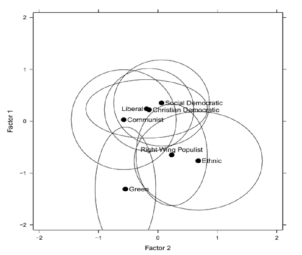
In the East, the setting of both dimensions looks much different. The first factor highlights 'competence to govern' appeal and features clientelism and charismatic effort to moderate degrees. This leaves us with the difficult task to pin down the essence of this background or higher-order variable in a verbal interpretation. We may act with restraint in our assignment and simply call this the 'competence to govern' dimension. The second factor expresses a sharp trade-off between clientelism and programmaticism, properly framed as 'universalism vs. particularism'.
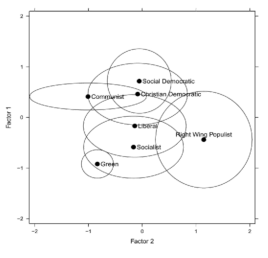
As we can see the make-up of supply-side competitive space across Europe differs markedly. However, the descriptive statistics support the validity of the concept of party family for both regions and indicate a similar positioning of party families relative to each other. Where, then, are party families located in their respective two-dimensional space? Does any (fictional) axis of competition result from the line-ups of party families? The answer to the second question is clearly no for West and East. The location of party families rather constitutes a squared area within which linkage strategies are pursued. As it seems competition over certain linkage mechanisms is more a matter of individual parties and emerges from rather ad hoc dynamics in national party systems. This would be the case for parties' emphasis on contrasting images of their rival's lead candidate, or by ignoring the leadership aspect at all.[23]
Figure 1 The supply-side location and homogeneity of party families in the West
Source: Wineroither, David M. and Seeber, Gilg: Two Worlds of Representation? Party Families and Patterns of Linkage Building Across Europe, Ecpr Joint Sessions, Warsaw, 2 April, 2014.
- 119/120 -
In answering the question of party familial tangibility, the results are ambivalent. First, as we have seen the configuration of supply-side space differs markedly in East and West. Second, the ordering of parties shows moderate resemblance across regions. Third, while the positioning of party families relative to each other reveals their ideological roots in the West, some of them overlap to substantial degree. This characterizes established mainstream party families whereas it least applies to the smaller and more homogenous challenger parties of the far right and Green family. Parties of the left ideological spectrum tend to be more homogenous. In the East, however, the story is much shorter. Here the location of party families simply tells little or nothing about ideological commitment and programmatic identity as a consequence of low homogeneity.
Figure 2 The supply-side location and homogeneity of party families in the East
Source: Wineroither, David M. and Seeber, Gilg: Two Worlds of Representation? Party Families and Patterns of Linkage Building Across Europe, Ecpr Joint Sessions, Warsaw, 2 April, 2014.
We briefly turn to the issue of (groups of) outliers within party families by performing cluster analysis. The shape of dendrograms originating from hierarchical cluster analysis (Euclidean distance) and based on linkage scores suggests classification of parties forming six groups. In Western Europe, cluster 1 is of moderate size almost exclusive consists of SD and CD/SC parties (17 out of 19). Membership in this group seems to be driven by high effort on clientelism and party identification. Cluster 2 has a more diverse setting featuring parties from all other party families (mainstream party families are completely absent!) and strong representation of Greens: seven out of the ten parties of this party family in the sample we find here alone. While the third cluster is dominated by right-wing parties, the large fourth is characterized by the overrepresentation of Liberals, the underrepresentation of Greens and the absence of RPPs. It is primarily CDs to populate cluster
- 120/121 -
5 while all four Communist parties exclusively make up for the final cluster. Green parties are packed in two clusters only. Communist parties form a separate cluster on their own. Ethnic and ethno-regionalist parties are spread over four out of six clusters. Socialist parties are evenly distributed over three clusters (numbers 3-5). Two Scandinavian Green parties join a number of socialist parties from the same region in cluster four. Over two-third of Liberals are amassed in the fourth cluster. Right-wing parties are highly concentrated in clusters 2 and 3 (33% and 53% respectively). The two largest party families, CD/SC and SD, are similarly spread over clusters 1, 4 and 5 with more than half of their members participating in no. 4.
Overall, the membership profile reproduces the image of distinct party familial linkage building. If we exclude the small group of ethnic/ethno-regionalist parties, the share of parties belonging to the same family represented in one cluster only varies from 40% (socialists) to 100% (communists). We find almost all parties of a party family concentrated in two clusters: 100% in the case of Communists and Greens, 94% of SDs, 86% of RPPs, 85% of CD/SCs, 79% of liberals and a low of 70% for socialists. Thus, larger party families in Western Europe are not significantly more heterogeneous in their supply-side strategies at this rather general level. Notions of relative heterogeneity in the case of the centrist party family of Liberals seem to be driven by outliers, which we find scattered over the remaining five linkages.
In the East, the large second cluster is dominated by CD/SC and SDs, the 'twins' of clientelistic engagement, which are typically of larger electoral size. This cluster describes the 'particularistic' pole on the second dimension of linkage building existing in Eastern Europe. Cluster three, similar to no. 1, consists of manifold party families. The smallest cluster (4) exclusively represents far right parties. This group of parties heavily emphasizes charismatic leadership. In contrast, they put little effort in valence appeal. Cluster five comprises centrist parties from three mainstream families: SDs, liberals and CD/SCs. This cluster denotes focus on programmatic effort and competence to govern. Put in a different fashion, it forms the universalistic pole of political accountability. Hence, the party families of SDs and CD/SCs seem to be split over the second dimension of linkage building. The very large final cluster consists of parties from all families with CD/SCs and Liberals being overrepresented.
How much variation in cluster membership do we find across party families? For membership in one cluster, the percentage ranges from 36% (CD/SC) to 75% (communists, in pole position again). We step aside 'Greens' which consists of just three parties in clusters 1, 2 and 6. The percentage for membership in two clusters sees Communists ahead once more (full sample of four parties) followed by RPP/RRs (73%), ethnic parties (71%), CD/SCs (69%), liberals (61%) and SDs (57%). Compared to Western Europe, we see weaker party familial bonds at work here. The gap is most remarkable for Social democratic parties (94 vs. 57%). We are wondering if this remarkable heterogeneity hints at electoral difficulties SDs face in many Eeastern European countries, prompting them to try different and perhaps unknown combinations of linkages to strengthen competitiveness.
- 121/122 -
Table 3 Dispersion vs. concentration of party familias over clusters in each region hip (share of parties within each party family represented in two clusters only)
| Communists | Greens | Social democrats | Right-wing populists/ radical right | Christian democrats/ secular conservatives | Socialists | Liberals | Ethnic | |
| WEST | 100 | 100 | 94 | 86 | 85 | 70 | 70 | |
| EAST | 100 | 57 | 73 | 69 | 61 | 71 |
7. Conclusion
Using the unique DALP data set on the wealth of modes of political accountability, our analyses have unveiled a number of noteworthy patterns of linkage building across Europe. First, basic assumptions regarding a number of crisp relationships between certain linkages and party families are supported by our findings for Western Europe. Second, we see confirmed the expectation of (a) different dimensional make-up between Western and Eastern Europe and (b) similar party familial line-up within the respective space. In short, the concept of party families can be meaningfully applied to some non-programmatic linkage mechanisms, most confidently PID and charismatic effort. This is an important finding as it provides evidence which runs contrary to claims of 'cartelization' of political parties, and predominance of politico-economic constraint hand in hand with electoral dealignment. These challenge the foundations of (responsible) party government, and hence the presence of definable party families.[24]
What ranks high on our to-do list? For sake of limited space we felt unable to address the role of party familial outliers, the significance of country effects and the role of DOES - do everything parties (whose presence might explain the absence of a sharp clientelism-programmaticism trade-off in the West). We are further in need of developing more sophisticated model based cluster solutions assisting to refine our understanding of outlier structures. These more fine-grained analyses would more closely reflect upon historical-institutional pathways to democracy to mention just one aspect. Similar, we put aside the entire topic of imperfections in Central and Eastern European 'third wave' democracies as reflected in linkage building strategies. Do patterns of linkage building imply a trend of conver-
- 122/123 -
gence among old and new democracies? What do these empirical profiles suggest in terms of fostering democratic consolidation and increasing quality of democracy? For instance, are all voters equally represented at indidivual party and party systemic level over various linkage domains? Are we able to connect efforts of linkage building with effects on resonance among sets of voters? After all, functioning democratic competition should result in rather crips relationships between the nature of supply-side offers and demand-profiles of party electorates, e.g. in terms of class appeal in postindustrial societies. The resulting indicators could serve researchers in creating new variables in order to explain democratic underperformance in the described ways.[25] Finally, and perhaps most importantly for some polities in the region, what is the exact nature of conditional effects of political clientelism and executive leadership on erosion of accountability and macro-economic performance? ■
NOTES
[1] Jane Mansbridge: A 'Selection Model' of Political Representation, Journal of Political Philosophy, Vol. 17. No. 4. 2009, 369-398.
[2] For instance Robert Rohrschneider and Stephen Whitefield: The Strain of Representation, How Parties Represent Diverse Voters in Western and Eastern Europe, Oxford University Press, Oxford, 2012.
[3] Herbert Kitschelt: Linkages between Citizens and Politicians in Democratic Polities, Comparative Political Studies, Vol. 33. No. 6. 2000, 845-879.
[4] Dorothee Bohle and Greskovits Béla: Capitalist Diversity on Europe's Periphery, Cornell University Press, Ithaca-London, 2012. Daniele Caramani: The Europeanisation of Politics: The Integration of Electorates and Party Systems in the European Union, Cambridge University Press (forthcoming), Cambridge. Tim Haughton: Party Politics in Central and Eastern Europe. Does EU Membership Matter? Routledge, London, 2011. Peter Mair: The Europeanization dimension, Journal of European Public Policy, Vol. 11. Vol. 2. 2004. 337-348. Eds. Thomas Poguntke, Nicholas Aylott, Robert Ladrech, Carter and Kurt Richard Luther: The Europeanization of National Political Parties: Power and Organizational Adaptation, Routledge, London-New York, 2007. Paul Webb and Stephen White: Party Politics in New Democracies. Oxford University Press, Oxford, 2007. Paul G. Lewis and Radoslaw Markowski: Europeanizing Party Politics? Comparative Perspectives on Central and Eastern Europe, Manchester University Press, Manchester, 2011. Stephen Whitefield and Robert Rohrschneider: The Salience of European Integration to Party Competition: Western and Eastern Europe Compared, East European Politics and Society (forthcoming).
[5] Katharina Holzinger, Helge Jörgens and Christoph Knill: Transfer, Diffusion und Konvergenz: Konzepte und Kausalmechanismen, Politische Vierteljahresschrift, Vol. 7. 2007, 11-35. See also Jan-Erik Lane and Svante Ersson: Party System Instability in Europe. Persistent Differences in Volatility between West and East, Democratization, Vol. 14. No. 1. 2007, 92-110.
[6] Paul G. Lewis: Party System Institutionalisation in East-Central Europe, Empirical Dimensions and Tentative Conclusions, ECPR Joint Sessions, Rennes, 11-16 April, 2008.
[7] Note that a variety of topics related to modes of political linkage building across the global universe of (semi-) competitive polities is covered in the work of the DALP research team at Duke University. Draft papers are available at http://sites.duke.edu/democracylinkage/papers/
[8] Amanda Bittner: Platform or Personality? The Role of Party Leaders in Elections. Oxford University Press, Oxford, 2011.
[9] Rune Stubager and Rune Slothuus: What Are the Sources of Political Parties' Issue Ownership? Testing Four Explanations at the Individual Level, Political Behavior, Vol. 35. No. 3. 2012, 567-588.
[10] Herbert Kitschelt: Party Systems = eds. Carles Boix and Susan Stokes: Oxford Handbook of Comparative Politics, Oxford University Press, Oxford, 2007, 522-554.
[11] Gary W. Cox and Matthew D. McCubbins: The Institutional Determinants of Economic Policy Outcomes = eds. Stephan Haggard and Matthew D. McCubbins: Presidents, Parliaments, and Policy, Cambridge University Press, Cambridge, 2001, 21-63.
[12] For more and detailed information on funding (e.g. World Bank), conceptualization and implementation please consult https://web.duke.edu/democracy/. The team at Duke University employed a wealth of measures to validate the reliability of DALP data.
[13] For their definition see Kitschelt and Freeze: Programmatic Party System Structuration.
[14] There are a few minor exceptions to that rule. Country anchors could propose to deviate from this golden rule in either way (add/drop parties) where they convinced about the respective parties' relevance for the national competitive space.
[15] Caramani operates with nearly two-dozens of party families mainly due to the inclusion of single-issue parties and those of rather particularistic nature. See Daniele Caramani: The Europeanization of Electoral Politics: An Analysis of Converging Voting Distributions in 30 European Party Systems 1970-2008, Party Politics, Vol. 18. No. 6. 2012, 803-823.
[16] For this reason it is not an option to make use of the largely time-invariant classification of political parties in the CPDS data sets (I+II). See Klaus Armingeon, Laura Knöpfel, David Weisstanner and Sarah Engler: Comparative Political Data Set I 1960-2012, Institute of Political Science, University of Berne, Bern, 2014.
[17] Caramani: The Europeanization of Electoral Politics, 813.
[18] Valence topics, contrary to positional issues, are non-divisive among the general electorate. For instance, 'economic prosperity' can be assumed to be (almost) uniformly welcomed by voters. In this view, voters' choice primarily depends upon competence ratings (who is more likely to succeed in the job?) and isssue ownership by parties/candidates (who is more credible in delivering this goal?).
[19] Laurenz Ennser-Jedenastik: The Homogeneity of West European Party Families. The Radical Right in Comparative Perspective, Party Politics, Vol. 8. No. 6. 151-171.
[20] Recall that this analysis is performed at the party level only without weighting them according to party size (vote/mandate share). Also, in the section devoted to party familial profiles, one should take into consideration the possibility of strong country effects.
[21] Compare this to the very similar associations reported by Wineroither and Seeber: The Winning Formula of Portfolio Diversification, and derived from five party families representing 77 parties in ten countries.
[22] Eds. Herbert Kitschelt and Steven I. Wilkinson: Patrons, Clients and Policies. Patterns of Democratic Accountability and Political Competition. Cambridge University Press, Cambridge, 2007.
[23] For the prominence and electoral effectiveness of such strategy see ed. Anthony King: Leaders' Personalities and the Outcomes of Democratic Elections, Oxford University Press, Oxford, 2002.
[24] Kitschelt and Rehm: Party Alignments.
[25] The individual party scores computed and referred to in this study can, of course, be made available upon request.