

Szilvia Vetter[1] - László Ózsvári[2] - Anita Boros[3]: Protection of Animals in the Constitutions of the European Countries (Publico, 2020/1., 170-189. o.)
https://doi.org/10.32575/ppb.2020.1.9
Abstract
The aim of the study is to examine how animal protection, especially that of animal specimens, is included in the European constitutions. San Marino and the United Kingdom have no classical, written constitutions, hence, a total of 42 European constitutions were studied. Animals typically appear in the constitution as species that, as part of nature and the environment, must be conserved in order to preserve biodiversity. There are only a few constitutions in Europe that reflect a narrowly defined approach to animal protection. According to this, animals as individuals must be protected because of their intrinsic value. The research has shown that 14% (6 countries) of the European countries examined contain both species and specimen protection provisions in their constitutions. The vast majority, 69% (29 countries) included only animal species protection provisions in the constitution. 17% (7 countries) of the European constitutions do not contain a provision based on any of the criteria. Only Austria, Germany, Luxembourg, Slovenia, Sweden and Switzerland have provisions for individual protection of animals at constitutional level. In Switzerland, a unique legal institution, the "dignity of animals" was given constitutional protection.
Keywords: animal protection, constitution, biodiversity, animal cruelty
- 170/171 -
Absztrakt - Az állatok védelme az európai országok alkotmányában
A tanulmány célja annak vizsgálata, hogy az állatvédelem - különös tekintettel az állatok egyedeinek védelmére - megjelenik-e az európai országok alkotmányában. San Marino és az Egyesült Királyság nem rendelkezik egyetlen dokumentumból álló írott alkotmánnyal, így rajtuk kívül összesen 42 európai alkotmány került a vizsgálatba. Az állatok az alkotmányokban leginkább a természet, illetve a környezet részét képező állatfajokként jelennek meg, amelyeket a fajgazdagság, biodiverzitás fenntartása érdekében meg kell őrizni. A szűk értelemben vett állatvédelem, vagyis az egyedvédelem csupán néhány európai alkotmányban lelhető fel. Ezek a rendelkezések azon a megközelítésen alapulnak, amely szerint az állatok egyedeit azok önmagában vett, inherens értékei miatt szükséges védeni. A kutatás eredményei alapján a vizsgált európai alkotmányok 14%-a (6 ország) tartalmaz mind fajvédelmi, mind egyedvédelmi rendelkezéseket. Az országok túlnyomó többsége, 69%-a (29 ország) csak az állatfajok védelmére vonatkozó előírásokat tudhatja magáénak alaptörvényi szinten. Az európai alkotmányok 17%-a (7 ország) viszont nem tartalmaz egyik kritériumnak megfelelő rendelkezést sem. Az állatok alkotmányos szintű egyedvédelme Európában csak Ausztriában, Németországban, Luxemburgban, Szlovéniában, Svédországban és Svájcban található meg. Svájcban egy egyedülálló jogi intézmény, az "állatok méltósága" is alkotmányos védelmet kapott.
Kulcsszavak: állatvédelem, alkotmány, biodiverzitás, állatkínzás
- 171/172 -
1. Introduction
Nowadays, there is a growing interest in animals and the human-animal relationship. Their subjective experiences have become morally, socially, politically and - last but not least - legally significant.
A common feature of the world's legal systems is that legislation forms a hierarchical system. Constitutional rules represent the foundation, the theoretical basis, and also the limitations of lower-level legislation. Lower-level legislation may not contain a provision contrary to higher-level legislation. The main argument of those campaigning for the inclusion of animal welfare in the constitution is that it would prevent other rights set out in the constitution (such as the right to artistic freedom, education or scientific activity) undeservedly overruling animal welfare issues. Lifting animal protection into the constitution, therefore, produces "equality of arms" between animal welfare and other constitutional rights.
Different legal regulations make definite differences between animals based on their biological characteristics. It is difficult to formulate a constitutional addition that is sufficiently general, fits into the legal system and is appropriate in all aspects.
The aim of the research is to determine whether European countries with written constitutions made an attempt to raise animal protection to a constitutional level, and if so, in what exact form.
2. Circumstances Determining the Legal Judgment of Animals - The Role of Context
In general, legal approaches are similar in countries that show geographical, historical and political similarities. The attitude towards animals and the legislation originating from these roots largely depend on the ethical sense and traditions of the given country. In order to understand the path that has led - or has not yet led - to the incorporation of animal protection into constitutions in Europe, it is necessary to review the religious and legal basis for judging animals and the attitudes of society.
2.1. Brief history of the legal status of animals
It has accompanied the history of mankind, and with very few exceptions it is still true today: animals have no legal capacity, so only human beings can be subject to fundamental rights and freedoms (such as the right to life or physical integrity).
During the Roman Empire, animals were categorised according to their economic value and were clearly considered a "thing" in legal terms. The ownership of animals suitable for work could be transferred only by a solemn act, the mancipatio. Wild animals, which at that time had no economic value, had a simpler procedure, they changed ownership
- 172/173 -
with traditio: these were placed in the res nec mancipi category. In addition, animals were classified as chattel (res mobiles) and moving thing (res se moventes). The wild animal was a lordless thing (res nullius). The term res derelicta (a deserted thing) was used for animals that had been chased away by their owners.[1]
Medieval animal trials seemed to create the legal personality and litigation capacity of animals, but animals were actors in theatrical performance.[2] Animal trials were about the people, they contained a message to people. They were deterrent and even an opportunity for entertainment, they did not mean any improvement in the legal situation of animals.
The prevailing perception to this day is the lack of legal capacity of animals. Since the 1970s, efforts to shift the legal status of animals to a kind of "pseudo-legal entity" have appeared again and again.[3] There has been no breakthrough in legal categorisation (with the exception of the limited legal personality for apes), but there is a clear change in the mere material status of animals. The special legal nature of animals has been strengthened, based on the recognition of the intrinsic value of living beings.
Although the impact of the triumvirate fighting for animal rights (Singer,[4] Regan,[5] Stone[6]) is unquestionable, legislators and law enforcers generally see the strengthening of animal protection not in the creation and extension of animal rights but rather in the self-limitation of the state.
The views of animal welfare activists are not the same as to whether it would be in the interests of animals to be granted legal personality. One view is that animals should be given rights because state self-restraint is not enough: it merely regulates the exploitation of animals, rather than banning all forms of exploitation. Legal capacity is not necessarily linked to a natural person, as it is an artificial construction: a company, for example, may also have legal personality. A version of the legal personality that could be appropriate for animals could have been created. Overall, it is considered that provisions that do not provide legal personality are merely a symptomatic treatment of problems affecting animals. Another group of animal welfare activists sees benefits, too, in keeping animals "things" in legal terms. Epstein[7] argues directly that for animals, material status has more advantages than disadvantages, as man provides them with food, shelter, veterinary care, and humane death. Garner[8] also believes that animal welfare can be improved by restricting humans and further developing the existing animal welfare legislation.
- 173/174 -
2.2. Religious foundations of legal judgment of animals
Each of the great world religions deals with the living beings with whom we share our Earth. However, religions differ in terms of the specific role of humanity, the limits of its responsibilities, and they also preach different doctrines as to whether animals have souls similar to humans. Religious foundations can determine, but at least influence, both animal treatment and meat-eating habits. According to some experts, the idea of "sacred animals" was born out of necessity. Pigs did not live on the land where the Jews lived, and the sacred animal of the Hindus is the cow, because without oxen they were not be able to work on the land. The Indian constitution states that agriculture and animal husbandry should be organised in a modern way, on a scientific basis, especially with regard to the herd of cattle (the slaughtering of which is partly forbidden by the constitution itself). Action against animal cruelty is also explicitly enshrined in the Indian Constitution: it is included in the list of subjects that may be covered by both federal and state law.[9] And according to Tudge, whichever society needed horses, they were not used for food there, and people also "learned" to be disgusted with the idea of consuming horsemeat.[10]
Kosher rules observed in Jewish traditions and halal slaughter observed in Islam raise fundamental animal welfare issues, as both methods of slaughtering are characterised by the absence of stunning prior to slaughter.[11]
Christianity, which fundamentally defines Europeanness, proclaims the supremacy of man over all other living beings on this earth, but it is not an unlimited or unethical rule. Since God created only man in His own image, the souls of animals can only be inferior. St. Thomas Aquinas states that "the soul of the animal is not part of the inheritance" because animals have only breeding instinct.[12] Jáki claims in his book Evolution for Believers: "Man was born to die... If man were merely an animal, he would receive all this with a monotonous reassurance into the inevitable. But man doesn't act like animals, at least not always. Man can act selflessly... Man can love, wants to love, and loves in a way that elevates love far above the natural instinct."[13]
2.3. Attitudes towards animals
Views on animals have evolved and changed over the course of history.[14] Ideas about animals or human-animal relationship were logically related to the characteristics and prevailing views of the society of the age. Society raises its voice selectively, only in relation
- 174/175 -
to certain cases of animal suffering, and this fundamentally determines the place and role of animal protection in the legal system as well.
2.3.1. The paradox of anthropocentric empathy
Although the attitudes of modern societies towards cruelty to animals have become stricter in recent decades, the majority of people do not question the viability of killing animals for consumption or pharmaceutical animal experiments. The paradox speaks for itself: on the one hand, all forms of cruelty to animals (including acts of negligence) are condemned, but on the other hand, people are reluctant to give up the benefits and goods gained through the use of animals. All this duality can also be discovered in the legislation of individual countries, especially in countries where there are traditions of forms of entertainment associated with animal suffering (e.g. bullfighting, cockfighting).
There is a dissociation between our knowledge of pain and the acceptance of the use of animals. The most important tool for this is language, which allows us to depersonalise and thereby reduce the significance of our actions. Thus, laboratory animals will be "experimental subjects," "devices," or "model systems," in the military, dogs will be "trained biosensors," and so on.[15]
The paradox mentioned above applies mostly to farm animals. In the case of companion animals, there is no contradiction between our moral duty to the animal and its "use". Dogs, cats, hamsters, etc. are often considered family members, they are an emotional resource for people.[16]
2.3.2. Ethical consumerism
Ethical consumer attitudes are also becoming widespread. Animal welfare is one of the quality indicators that is becoming increasingly important to consumers.[17] If we take a closer look at the relevant statistics, we find a contradictory situation. On the one hand, the consumer pays attention to the welfare of farm animals when choosing the brand of a given type of food. 74% of European citizens believe that buying products made with animal-friendly technology can have a positive effect on the protection of farm animals; 55% of citizens do not consider the representation of animal welfare issues in their country's agricultural policy to be sufficient. On the other hand, half of the citizens do not take the above aspects into account when buying food or making a specific purchasing decision (for example, in Poland this proportion is 51%). Of course, there are also countries where
- 175/176 -
we find much larger rates (in Sweden, for example, the conditions under which animals were bred are important to 67% of the consumers).[18]
3. Material and Method
The aim of the study is to examine how the animals, especially the protection of animal specimens is included in the European constitutions. Theoretically, animals can appear in the constitution in two major forms: as species or as individuals. Constitutional powers often regulate certain issues affecting biodiversity at the top of the hierarchy of sources of law, so in most of the cases animals appear in the constitution as species. In the last few decades, provisions recognising the intrinsic value of animal individuals have also appeared in some constitutions.[19]
Fourty-two European constitutions were examined to see if they contained animals and, if so, in what form. If an animal is present only symbolically, i.e. as an element of a coat of arms, for example, it was not taken into account. The countries examined were: Albania, Andorra, Austria, Belarus, Belgium, Bosnia and Herzegovina, Bulgaria, Croatia, Czech Republic, Denmark, Estonia, Finland, France, Germany, Greece, Holy See (Vatican), Hungary, Iceland, Ireland, Italy, Latvia, Liechtenstein, Lithuania, Luxembourg, Malta, Moldova, Monaco, Montenegro, the Netherlands, North Macedonia, Norway, Poland, Portugal, Romania, Russia, Serbia, Slovakia, Slovenia, Spain, Sweden, Switzerland and Ukraine. In the absence of a written constitution consisting of a single document, two countries were left out of the research: San Marino and the United Kingdom.
4. Results and Discussion
4.1. Countries without animals included in the constitution
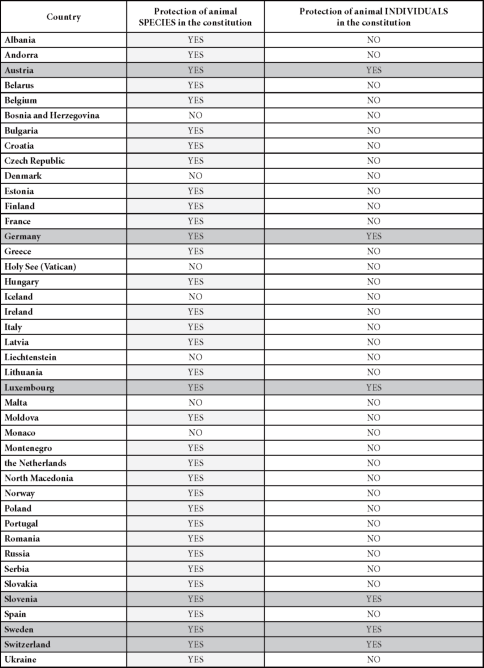
There are European countries whose constitutions make no reference to the protection of animal specimens or species. These are constitutions that do not contain explicit references to the protection of the environment either. The constitutions of Bosnia and Herzegovina, Denmark, Iceland, Liechtenstein, Malta, Monaco and the Vatican do not include animals, or any reference to the protection of animal species or biodiversity.
- 176/177 -
4.2. Protection of animal species in the constitution
The protection of animal species is part of both environmental protection and nature conservation. The aim of environmental protection is to preserve and improve the health of people and animals, to maintain and restore the performance, unique character and diversity of nature and landscape. In the broadest sense, environmental protection includes all human activities aimed at preserving the environment. Nature conservation is part of environmental protection; a set of measures aimed at conserving the natural landscape, rare and endangered plant and animal species and their habitats and ensuring their protection against the damage of civilization. Thus, efforts to maintain animal species and their habitats are also included.[20] In contrast to animal protection in the narrow sense, nature conservation and environmental protection do not provide protection for the value of the animal itself, but seek to protect it as part of nature.[21]
If the protection of the environment, the protection of nature, the protection of biodiversity or, most specifically, the protection of fauna appears in a constitution, it also includes the protection of animal species.
Out of the 42 European countries examined, 35 contain provisions referring to the protection of animal species. These are the following: Albania, Andorra, Austria, Belarus, Belgium, Bulgaria, Croatia, Czech Republic, Estonia, Finland, France, Germany, Greece, Hungary, Ireland, Italy, Latvia, Lithuania, Luxembourg, Moldova, Montenegro, the Netherlands, North Macedonia, Norway, Poland, Portugal, Romania, Russia, Serbia, Slovakia, Slovenia, Spain, Sweden, Switzerland and Ukraine. However, these provisions are mostly indirect and protect animal species through the protection of the environment, nature or biodiversity.
One of the most complete environmental regulation belongs to the French constitution, where the relevant provisions can be found under the heading "Charter for the environment". In addition, the French constitution even contains provisions on education, training, research and innovation related to environmental protection.[22] The Swiss constitutional environmental regulation consists of 10 paragraphs, and it is extremely broad.[23]
4.2.1. Differences in terms
Accordingly, the wording of the provisions and the terms used also vary from country to country. Some countries use the term specifically for animal species: fauna. The Croatian constitution emphasizes: "the sea, seashore, islands, waters, air space, mineral resources, and other natural resources, as well as land, forests, flora and fauna, other components
- 177/178 -
of the natural environment" shall enjoy special protection of the state.[24] The Republic of Serbia shall organise and provide for - among others - "sustainable development; system of protection and improvement of environment; protection and improvement of flora and fauna".[25] The Bulgarian constitution provides for the preservation of "living nature in all its variety".[26] The protection of the "biodiversity, in particular native plant and animal species" is stated in the Hungarian constitution.[27] The Slovakian state "shall care for economical exploitation of natural resources, ecological balance and effective environmental policy, and shall secure protection of determined sorts of wild plants and wild animals".[28] Some countries' constitutions require the "rational use" of natural resources: in Belarus "the State shall supervise the rational utilisation of natural resources to protect and improve living conditions, and to preserve and restore the environment";[29] similar provisions can be found in Andorra[30] and Spain.[31] "Natural resources shall be managed on the basis of comprehensive long-term considerations which will safeguard this right for future generations as well", according to the Constitution of Norway.[32] The term "durable equilibrium" is used in the Luxembourg constitution in the sense that this must be established "between the conservation of nature, in particular its capacity for renewal, and the satisfaction of the needs of present and future generations".[33] The Czech constitution contains provisions on "prudent use" of "natural wealth". The Preamble states: the citizens of the Czech Republic in Bohemia, Moravia, and Silesia are "resolved to guard and develop together the natural and cultural, material and spiritual wealth" handed down to them. "The state shall concern itself with the prudent use of its natural resources and the protection of its natural wealth."[34]
4.2.2. Environment as a right and as an obligation
Differences can also be found when examining whether the environment (of which the fauna is a part) is connected to a right or an obligation.
- 178/179 -
4.2.2.1. Environment as a right
The right to environmental protection appears in the constitutions as so-called third-generation (solidarity) rights. The right related to environmental protection typically has more levels. People have the right to healthy environment, and to be informed about the current state of the environment. In Albania "everyone has the right to be informed about the status of the environment and its protection" according to the constitution.[35] On the other side of this right is the obligation of the state to inform. In Moldova, "the State shall guarantee to every individual the right to free access and dissemination of the trustworthy information regarding the state of the natural environment".[36] "Everyone shall have the right to healthy environment and the right to timely and full information about the state of environment" in Serbia.[37] According to the Constitution of Ukraine, "everyone is guaranteed the right of free access to information about the environmental situation, the quality of food and consumer goods, and also the right to disseminate such information".[38] The Confederation shall compile the necessary statistical data on the status and trends in the environment in Switzerland. No one shall make such information secret.[39] In other cases, people have the right to take an active part in shaping environmental action. In Montenegro "everyone shall have the right to receive timely and full information about the status of the environment, to influence the decision-making regarding the issues of importance for the environment, and to legal protection of these rights".[40] In addition to the right to a healthy environment, environmental issues may also arise in connection with the right to actio popularis. In Portugal, the right of actio popularis may particularly be exercised in order to promote - among others - the preservation of the environment and the cultural heritage.[41]
4.2.2.2. Environment as an obligation
If the protection of the environment or nature is connected to an obligation, it is also different in each country whether the obligations of the individual, the state, or both are highlighted, or the regulation may designate a specific government body responsible.
A general responsibility for the environment is defined in the Finnish constitution when it states: "nature and its biodiversity, the environment and the national heritage are the responsibility of everyone".[42] According to the Constitution of Montenegro, "everyone
- 179/180 -
shall be obliged to preserve natural and cultural heritage of general interest".[43] "Everyone shall have a duty to preserve nature and the environment and to treat natural resources with care" in Russia.[44] In Latvia, it is already stated in the Preamble of the constitution that "each individual takes care of oneself, one's relatives and the common good of society by acting responsibly toward other people, future generations, the environment and nature". Subsequently, the Latvian constitution emphasises the responsibility of the state in both informing people and conserving nature: "the State shall protect the right of everyone to live in a benevolent environment by providing information about environmental conditions and by promoting the preservation and improvement of the environment".[45] In Andorra "the State has the task of ensuring the rational use of the land and of all natural resources, so as [...] to protect the autochthonous flora and fauna".[46] In Moldova the state must ensure - among others - "restoration and protection of the environment, as well as maintenance of ecological balance". Lithuania, for example, emphasises similar state responsibilities. In Portugal, the constitution details the state's environmental responsibilities at length.[47] In Austria, the Federation has powers of legislation and execution in the detailed sections on environmental protection.[48] The Republic of Poland shall - among others - "ensure the protection of the natural environment pursuant to the principles of sustainable development".[49] "It shall be the concern of the authorities to keep the country habitable and to protect and improve the environment", according to the Constitution of the Kingdom of the Netherlands.[50] In Spain, "the public authorities shall watch over a rational use of all natural resources with a view to protecting and improving the quality of life and preserving and restoring the environment, by relying on an indispensable collective solidarity".[51]
There are also examples where the constitution mentions nature conservation in connection with the division of powers. The Italian state has exclusive legislative powers in the protection of the environment, the ecosystem and cultural heritage.[52] The German constitution is a good example of states delegating the regulation of certain issues related to nature protection to a lower level, but leaving the regulation of the protection of animal species to federal competence. "If the Federation has made use of its power to legislate, the Länder may enact laws at variance with this legislation with respect to [...] protection of nature and landscape management (except for the general principles governing the protection of nature, the law on protection of plant and animal species or the law on
- 180/181 -
protection of marine life)."[53] The Swedish constitution sets out in detail the tasks of the Committee on Environment and Agriculture.[54]
The Romanian Constitution also explicitly emphasises the responsibility of legal entities in environmental protection: "natural and legal entities shall be bound to protect and improve the environment".[55]
There is an unusual solution in the Belgian constitution that states: "the Federal State, the Communities and the Regions pursue the objectives of sustainable development in its social, economic and environmental aspects". After that, however, it is only in relation to the rights of the individual that the constitution returns to the environment when it states: everyone has "the right to the protection of a healthy environment".[56]
The constitutional provision applied by the Republic of Macedonia lists environmental protection among the fundamental values of the constitutional order.[57]
4.2.3. Environmental protection as a resctriction of an individual's rights
Environmental protection, i.e. indirectly the protection of animal species, can also appear in the constitution as a restriction of an individual's rights. Environmental issues also appear among the possible cases of property restrictions in the constitutions of some countries. "Free enterprise and proprietary rights may be exceptionally restricted by law for the purposes of protecting the interests and security of the Republic of Croatia, nature and the human environment and human health", states the Croatian constitution.[58] In Romania, "the right of property compels to the observance of duties relating to environmental protection [...] in accordance with the law or custom".[59] "Possession, utilisation and disposal of land and other natural resources shall be exercised by the owners freely provided that this is not detrimental to the environment", according to the Russian constitution.[60]
The constitutions of some countries emphasise that if compliance with environmental regulations would cause damage to property or health, there has to be compensation. For example, in Russia the relevant requirement is: "everyone shall have the right to a favourable environment, reliable information on the state of the environment and compensation for damage caused to his (her) health and property by violations of environmental laws".[61] In Sweden "in the case of limitations on the use of land or buildings on grounds of
- 181/182 -
protection of human health or the environment [...] the rules laid down in law apply in the matter of entitlement to compensation".[62]
The freedom of movement may also be restricted in order to protect the environment. In Estonia the right to freedom of movement may be restricted in the cases prescribed by law to protect the natural environment, among others.[63]
The freedom of entrepreneurship may also be affected by restrictions for environmental reasons. In the Republic of Macedonia, "the freedom of the market and entrepreneurship can be restricted by law only for reasons of the defence of the Republic, protection of the natural and living environment or public health".[64]
4.3. Protection of animal individuals in the constitution
The protection of the individuals of animals appear in some form in 6 out of the 42 examined European countries (Austria, Germany, Luxembourg, Slovenia, Sweden and Switzerland).
The Austrian federal constitution lists the protection of animals in its legislation as a federal responsibility, although execution of this legislation is a state responsibility, unless otherwise provided for in federal legislation.[65]
In Germany, the relevant provision is contained in Article 20a, according to which, in the context of constitutional orders out of a sense of responsibility for future generations, the state protects the natural foundation of life and animals.[66]
The Slovenian constitution, in Article 72 on the right to a healthy environment, prescribes that the protection of animals from cruelty must be regulated in legislation.[67]
The most detailed constitutional regulation of animal welfare is found in Switzerland. Pursuant to Article 80 the state has a legal obligation with regard to animal welfare. This obligation covers animal care, animal testing and procedures performed on live animals, the use of animals, the importation of animals and products of animal origin, trade in animals, the transport of animals, and the slaughter of animals. According to cardinal rule, it is the task of cantons to enforce these regulations. In Switzerland the legislators attempted to introduce the legal concept of animal dignity. In the absence of the legal personality of animals, a reference to their dignity is essentially contextless, although it provides highly indicative guidance from the legislator and expresses a respectful attitude towards animals.[68] In practice, the protection of animal dignity in the Swiss constitution,
- 182/183 -
which is unique globally, means mostly that it is forbidden to humiliate animals, use them as tools, or alter their appearance.[69]
According to the Constitution of Luxembourg, "the State [...] promotes the protection and welfare of the animals". The amendment was incorporated into the Luxembourg constitution in 2007.[70]
Uniquely, the Swedish constitution provides protection against the depiction of violence against animals in the media. Article 11 provides a mandate to enact legislative provisions against video recordings or recordings made using other technical means that depict violent acts or threats against people or animals, and which are aimed at minors.[71] Although this solution still falls short of protecting animals for their intrinsic value alone, and appears to be aimed more at protecting society, it can be considered forward-looking.
4.4. Overall results
The constitutional regulation of the 42 European countries regarding animals vary from country to country concerning whether the protection of animal species and/or animal individuals appear in some way in the constitutions (see Table 1 and Figure 1). In the process of the analysis, the protection of animal species was considered to be a part of nature conservation and environmental protection per definitionem, even if there is no explicit reference to the animal species or the fauna.
- 183/184 -
Table 1 Protection of animal species and animal individuals in the constitutions of 42 European countries
(Source: compiled by the authors).
- 184/185 -
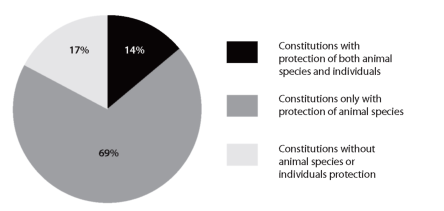
Figure 1 Proportion of the appearance of the protection of animal species and animal individuals in the constitutions of the examined European countries (n = 42)
(Source: compiled by the authors.)
14% of the European countries surveyed contain both animal species and individuals protection provisions in their constitutions. The vast majority, 69%, included only animal species protection provisions in the constitution. 17% of the European constitutions do not contain a provision based on any of the criteria.
5. Conclusions
Although the protection of animal species indirectly includes the protection of animal individuals, the purpose and means of protection of animals in the strict sense can be strongly distinguished from the provisions for the protection of animal species. Animal protection in the strict sense, that is, the protection of individuals based on their inherent value, is more difficult to link to human interests alone, but it rather reflects ethical, moral considerations.
The human interest in conserving biodiversity is less controversial, which makes easier to access species protection by law. It is not surprising, then, that the number of European countries whose constitutions contain provisions on the protection of species (nature protection, environmental protection) is much higher than the number of countries that regulate the protection of individuals of animals at the constitutional level.
Even if animal protection appears in the constitution of a country, it does not mean unlimited protection of animals, it only results in animal protection becoming comparable to other constitutional rights. The constitutional regulation of animal protection is not a basic precondition for the system of animal protection regulation to work well. On the other hand, incorporating animal protection into the constitution is a guiding step that manifests value.
- 185/186 -
References
1. Drewermann, Eugen (1997): Az állatok halhatatlanságáról. Korunk, Vol. 3, No. 8. 35-41.
2. Eisen, Jessica (2017): Animals in the constitutional state. International Journal of Constitutional Law, Vol. 15, No. 4, 909-954. DOI: https://doi.org/10.1093/icon/mox088
3. Evans, Edward P. (1906): The Criminal Prosecution and Capital Punishment of Animal. New York, E. P. Dutton and Company.
4. Farouk, M. M. - Al-Mazeedi, H. M. - Sabow, A. B. - Bekhit, A. E. D. - Adeyemi, K. D. - Sazili, A. Q. - Ghani, A. (2014): Halal and Kosher slaughter methods and meat quality: A review. Meat Science, Vol. 98, No. 3. 505-519. DOI: https://doi.org/10.1016/j.meatsci.2014.05.021
5. Földi András - Hamza Gábor (2010): A római jog története és institúciói. Budapest, Nemzeti Tankönyvkiadó.
6. Garner, Robert (2000): Animal rights, political theory and the liberal tradition. Contemporary Politics, Vol. 8, No. 1, 7-22. DOI: https://doi.org/10.1080/13569770220130095
7. Jáki Szaniszló (2007): Evolúció hívőknek. Budapest, Kairosz Kiadó.
8. Jámbor Adrienn (2016): A kedvtelésből tartott állatok jogi védelme. PhD értekezés, Miskolci Egyetem Állam- és Jogtudományi Kar. DOI: https://doi.org/10.14750/ME.2016.033
9. Regan, Tom (1983): The case for Animal Rights. Berkeley - Los Angeles, University of California Press.
10. Rollin, Bernard E. (2011): Animal Rights as a Mainstream Phenomenon. Animals, Vol. 1, No. 1. 102-115. DOI: https://doi.org/10.3390/ani1010102
11. Sátori Ágnes (2006): Állatokhoz való viszony a társas-társadalmi kapcsolatok rendszerében. Doktori disszertáció, Budapest, ELTE BTK.
12. Serpell, James A. - Paul, Elizabeth S. (1994): Pets and the development of positive attitudes to animals. In Manning, Aubrey - Serpell, James A. eds.: Animals and Human Society. London, Routledge. 127-145.
13. Singer, Peter (1975): Animal Liberation. Harper Collins.
14. Sípos Mihály - Móró Adrienn - Szűcs Endre (2009): Állattenyésztési etika és az állatjóllét fejlődése napjainkig. II. rész: Filozófiai megközelítések. Animal welfare, ethology and housing systems, Vol. 5, No. 2. 108-118.
15. Stone, Christopher D. (2010): Should Trees Have Standing? Law, Morality and the Environment. Oxford, Oxford University Press.
16. Tassy Sándor (1998): Agrárgazdasági Fogalomtár. Budapest, Mezőgazdasági Szaktudás Kiadó.
17. Tudge, Colin (1992): Last animals at the zoo. How mass extinction can be stopped. Washington D.C., Island Press.
18. Vetter Szilvia (2014): Marketingkommunikáció és állatjólét. Animal welfare, ethology and housing systems, Vol. 10, No. 1. 27-31.
- 186/187 -
19. Vetter Szilvia - Vasa László - Ózsvári László (2014): Economic aspects of animal welfare. Acta Polytechnica Hungarica, Vol. 11, No. 7. 119-134. DOI: https://doi.org/10.12700/aph.11.07.2014.07.8
20. Vetter Szilvia - Boros Anita - Ózsvári László (2020): Penal Sanctioning of Zoophilia in Light of the Legal Status of Animals - A Comparative Analysis of Fifteen European Countries. Animals, Vol. 10, No. 6. 1024. DOI: https://doi.org/10.3390/ani10061024
Internet sources
1. Epstein, Richard A. (2004): The Terror of Animal Rights. Capitalism Magazine. Available: www.capitalismmagazine.com/2004/02/the-terror-of-animal-rights-2/ (Downloaded: 05. 09. 2018.)
Legal sources
1. Belgische Grondwet (Constitution of Belgium).
2. Bharatiya Samvidhana (Constitution of India).
3. Bundesverfassung der Schweizerischen Eidgenossenschaft (Constitution of Switzerland).
4. Bundes-Verfassungsgesetz (B-VG) StF: BGBl. Nr. 1/1930 (WV) idF BGBl. I Nr. 194/1999 (DFB) (Constitution of Austria).
5. Bunreacht na hÉireann (Constitution of Ireland).
6. Constitució d'Andorra (Constitution of the Principality of Andorra).
7. Constitución española - Aprobada por Las Cortes en sesiones plenarias del Congreso de los Diputados y del Senado celebradas el 31 de octubre de 1978 (Constitution of Spain).
8. Constituição da República Portuguesa, de 2 de Abril de 1976 (Constitution of Portugal).
9. Constituţia Republicii Moldova (Constitution of the Republic of Moldova).
10. Constituţia României (Constitution of Romania).
11. Constitution de la Principauté (Constitution of Monaco).
12. Constitution de la République française - Constitution du 4 octobre 1958 (Constitution of France).
13. Constitution Le Grand-Duché de Luxembourg du 17 octobre 1868 (Constitution of Luxembourg).
14. Costituzione della Repubblica Italiana (Constitution of Italy).
15. Danmarks Riges Grundlov (Grundloven) (Constitution of Denmark).
16. Eesti Vabariigi põhiseadus (Constitution of Estonia).
17. Grondwet van Nederland (Constitution of the Netherlands).
18. Grundgesetz für die Bundesrepublik Deutschland in der im Bundesgesetzblatt Teil III, Gliederungsnummer 100-1, veröffentlichten bereinigten Fassung, das zuletzt durch Artikel 1 des Gesetzes vom 28. März 2019 (BGBl. I S. 404) geändert worden ist (Basic Law for the Federal Republic of Germany).
19. Kongeriket Norges Grunnlov, gitt i riksforsamlingen på Eidsvoll den 17. mai 1814 (Constitution of Norway).
- 187/188 -
20. Konstytucja Rzeczypospolitej Polskiej z dnia 2 kwietnia 1997 r. (Constitution of Poland).
21. Kostituzzjoni ta' Malta (Constitution of Malta).
22. Kushtetuta e Shqipërisë (Constitution of Albania).
23. Legge fondamentale dello Stato della Città del Vaticano 26 novembre 2000 (Fundamental Law of Vatican City State).
24. Lietuvos Respublikos Konstitucija (Lietuvos Aidas, Nr. 220; 1992, Nr. 33-1014) (Constitution of Lithuania).
25. Magyarország Alaptörvénye (2011. április 25.) (Fundamental Law of Hungary).
26. Satversme (Constitution of Latvia).
27. Stjórnarskrá lýðveldisins Íslands (Constitution of Iceland).
28. Suomen perustuslaki (Constitution of Finland).
29. Sveriges grundlagar (Constitution of Sweden).
30. Ustav Bosne i Hertcegovine (Constitution of Bosnia and Herzegovina).
31. Ustav Crne Gore (Constitution of Montenegro).
32. Ustav Republike Hrvatske (Constitution of the Republic of Croatia).
33. Ústava České republiky ze dne 16. prosince 1992. (Constitution of the Czech Republic).
34. Ustava Republike Slovenije (Constitution of Slovenia).
35. Ústava Slovenskej republiky z 1. septembra 1992 (č. 460/1992 Zb.) (Constitution of Slovakia).
36. Verfassung des Fürstentums Liechtenstein (Constitution of the Principality of Liechtenstein).
37. Σύνταγμα της Ελλάδας (Constitution of Greece).
38. Канстытуцыя Рэспублікі Беларусь (Constitution of Belarus).
39. КОНСТИТУЦИЯ НА РЕПУБЛИКА БЪЛГАРИЯ (Constitution of Bulgaria).
40. Конституция Российской Федерации (Constitution of the Russian Federation).
41. Конституція України (Constitution of Ukraine).
42. Устав Републике Србије (Constitution of the Republic of Serbia).
43. УСТАВОТ НА РЕПУБЛИКА МАКЕДОНИЈА (Constitution of the Republic of North Macedonia).
Dr. Szilvia Vetter is an experienced Director of Communications with a demonstrated career of working in the government relations industry, and Assistant Research Fellow at the University of Veterinary Medicine (Department of Veterinary Forensics and Economics). She is lecturer of Animal Welfare at the University of Veterinary Medicine, Budapest, in Hungarian, English and German languages. She was winner of the "Man of Words 2020" Communication Professional Award. She worked in the Constitutional Court of Hungary, in the Hungarian Tourism Limited and in the Ministry for National Economy as the Director of Communications. She has got a Doctor of Law degree (Eötvös Loránd University) and a Bachelor of Economics, International and Intercultural Communication degree (Budapest Metropolitan University). Her field of research is the legal, economic and communicational aspects of animal welfare.
- 188/189 -
Dr. habil. László Ózsvári is head of the Department of Veterinary Forensics and Economics and Vice Rector for Educational Affairs at the University of Veterinary Medicine, Budapest (UVMB). Earlier, he worked at the Ministry of Agriculture and Rural Development as the Head of the Animal Health Unit, which also dealt with animal welfare regulations. He graduated as a Doctor of Veterinary Medicine at UVMB and received his PhD degree in Management and Business Administration at Szent István University, and his MBA degree from Webster University. He has a wide range of referred publications focused on animal health economics, food chain safety and animal welfare issues.
Dr. habil. Anita Boros, LL.M. graduated at the Budapest University of Economic Sciences and Public Administration as administration manager, and in 2005 she obtained law degree from the Eötvös Loránd University, Budapest. She had completed her bar exam in 2009; meanwhile she acquired her PhD in Political Science and Law at the Graduate School of Károli Gáspár University of the Reformed Church in Hungary. In 2010, she graduated at Andrássy University, Budapest's Comparative Faculty of Law (LL.M.). She habilitated in 2016. She has an intermediate level of knowledge in English and advanced level (paired with professional legal and public administrative knowledge) in German. Currently she has been working at the Faculty of Public Governance and International Studies of the University of Public Service. In addition, she is a Hungarian state secretary for the Ministry of Innovation and Technology. She is the author or co-author of nearly 230 studies and is a lecturer of several independently listed subjects, supervisor for PhD students and has participated in several conferences as organiser and presenter. She has held several significant positions since 2010. Thus, she acts as a member of the Hungarian Academy of Sciences, as editor-in-chief of the journal "Pro Publico Bono - Hungarian Public Administration" (Pro Publico Bono - Magyar Közigazgatás), as member of the editorial board of journals "Codification and Public Administration" (Kodifikáció és Közigazgatás) and "Public Procurement Bulletin Plus" (Közbeszerzési Értesítő Plusz), as president of the editorial board of the "Public Procurement Survey" (Közbeszerzési Szemle) (between 2016 and 2018) and as editorial member of the journal "Judiciary Review" (Bírósági Szemle). In addition, she is a member of the Council of the Public Procurement Authority, the chairperson and member of the basic and professional examination committees, member of habilitation committees, president of the Administrative Procedural Law Association and member of the Hungarian Bar Association. Her fields of research are administrative procedure law, European administrative procedure law and public procurement law, the law of state and municipal property management and the law of state-owned companies. ■
NOTES
[1] Földi-Hamza 2010, 716.
[2] Evans 1906, 384.
[3] Rollin 2011, 102-115.
[4] Singer 1975, 311.
[5] Regan 1983, 474.
[6] Stone 2010, 264.
[7] Epstein 2004.
[8] Garner 2000.
[9] Const. of India, Art. 48.
[10] Tudge 1992, 16-20.
[11] Farouk et al. 2014, 505-519.
[12] Drewermann 1997.
[13] Jáki 2007, 98.
[14] Sípos-Móró-Szűcs 2009, 108-118.
[15] Sátori 2006, 279.
[16] Serpell-Paul 1994, 127-145.
[17] Vetter-Vasa-Ózsvári 2014, 119-134.
[18] Vetter 2014, 27-31.
[19] Eisen 2017, 909-954.
[20] Tassy 1998, 191.
[21] Jámbor 2016, 223.
[22] Const. of France, Art. 8, 9.
[23] Const. of Switzerland, Section 4.
[24] Const. of Croatia, Art. 52.
[25] Const. of the Republic of Serbia, Competences of the Republic of Serbia, Point 9.
[26] Const. of Bulgaria, Art. 15.
[27] Fundamental Law of Hungary, Article P) paragraph (1).
[28] Const. of Slovakia, Art. 44, Point 4.
[29] Const. of Belarus, Art. 46.
[30] Const. of the Principality of Andorra, Art. 31.
[31] Const. of Spain, Art. 45.
[32] Const. of Norway, Art. 112.
[33] Const. of Luxembourg, Art. 11bis.
[34] Const. of the Czech Republic, Preamble, Art. 7.
[35] Const. of Albania, Art. 56.
[36] Const. of Moldova, Art. 37.
[37] Const. of the Republic of Serbia, Art. 74.
[38] Const. of Ukraine, Art. 50.
[39] Const. of Switzerland, Art. 65.
[40] Const. of Montenegro, Art. 23.
[41] Const. of Portugal, Art. 52.
[42] Const. of Finland, Art. 23.
[43] Const. of Montenegro, Art. 78.
[44] Const. of the Russian Federation, Art. 58.
[45] Const. of Latvia, Art. 115.
[46] Const. of the Principality of Andorra, Art. 31.
[47] Const. of Portugal, Art. 66.
[48] Const. of Austria, Art. 10, Point 1.12.
[49] Const. of Poland, Art. 5.
[50] Const. of the Kingdom of the Netherlands, Art. 21.
[51] Const. of Spain, Art. 45, Point 2.
[52] Const. of Italy, Art. 117, Point S.
[53] Basic Law of Germany, Art. 72, Point 3.
[54] Const. of Sweden, Supplementary provision 7.5.1, Point 13.
[55] Const. of Romania, Art. 35 Point 3.
[56] Const. of Belgium, Art. 7bis.
[57] Const. of the Republic of Macedonia, Art. 8.
[58] Const. of Croatia, Art. 50.
[59] Const. of Romania, Art. 44, Point 7.
[60] Const. of the Russian Federation, Art. 36, Point 2.
[61] Const. of the Russian Federation, Art. 42.
[62] Const. of Sweden, Art. 15.
[63] Const. of Estonia, Art. 34.
[64] Const. of Macedonia, Art. 55.
[65] Const. of Austria, Art. 11, Par. 1, Point 8.
[66] Basic Law of Germany, Art. 20a.
[67] Const. of Slovenia, Art. 72.
[68] Vetter-Boros-Ózsvári 2020, 1024.
[69] Const. of Switzerland, Art. 80.
[70] Const. of Luxembourg, Art. 11bis.
[71] Const. of Sweden, Art. 11.
Lábjegyzetek:
[1] The author is assistant research fellow, Department of Veterinary Forensics and Economics, University of Veterinary Medicine, Budapest, vetter.szilvia@univet.hu.
[2] The author is Dr. habil., Vice Rector, Head of Department, Department of Veterinary Forensics and Economics, University of Veterinary Medicine, Budapest, ozsvari.laszlo@univet.hu.
[3] The author is Dr. habil., LL.M. Associate Professor, Lajos Lőrincz Department of Administrative Law, Faculty of Public Governance and International Studies, University of Public Service, Budapest; Globalization Competence Center, Széchenyi István University, Győr; boros.anita@uni-nke.hu.