

Attila Marján[1]: Social Policies - Are "European Models" Viable Models for China? (Publico, 2016/2., 80-103. o.)
Abstract
As regards social policies, the EU is an obvious model for inspiration for China, but the European social models themselves have come under pressure and proved unsustainable lately, therefore China is best advised to look at the more sustainable versions of the European social models, such as the reformed German or some features of the Scandinavian ones. Moreover, Chinese studies on the European social systems have often been ideologically motivated, therefore often produced biased results. The article summarizes the existing research evidence, also highlights the differences between the European and Chinese social systems and explains those areas where European solutions could best be used as models for Chinese reforms. The key issues with the Chinese social security system are underfinancing, insufficient coverage, geographical fragmentation and inefficient institutions. This mix of challenges constitute a significant risk to the sustainability of social order in the long run.
Keywords: EU-China comparative studies, social models, social policy
- 80/81 -
1. Introduction
Research of how European and especially EU policy solutions could serve as models for Chinese practice is not very frequent. One research evidence should be highlighted here, the paper Xinning Song published in 2010.[1] Nevertheless, that paper more or less limits its ambition to catalogue existing research done by Chinese scholars on different EU policy areas. As Xinning Song explains[2] European Studies in China developed very rapidly in the last twenty years. The reason for this is twofold: EU-China relations have been growing wider and deeper and so has economic interdependence, but also Chinese scholars and decision makers acknowledge the "relevance of European models to China's domestic political and social development, as well as China's external relations".[3] He reviews Chinese EU studies in the following areas considered most relevant by Chinese academia and the political class: European party politics and the issue of democratic socialism; the European social policy and social security systems, EU regional policy, European foreign and neighbourhood policy, the European concept of effective multilateralism, Europe as an example of peaceful rise, and finally functionalism i.e.: the step-by-step, sector-by-sector approach to reinforcing cooperation and how it can be applied to East Asian regional integration.[4] Xinning also claims that Chinese would like to learn more from Europe than from the United States, partly because they consider the EU as a "social power" as opposed to the US. In the late nineties, European studies in China got a new impetus when the EU and the Chinese government launched the first EU-China Higher Education Cooperation Programme (1997-2001), as one of the major objectives of the programme was to promote European Studies in China. More than a hundred Chinese and European universities and research institutions, as well as a thousand Chinese and European scholars took part in the programme. Moreover, about twenty new centres of European Studies were established at Chinese universities and research institutes. EU studies (including political science, economics, law sociology, international relations, history) did not only start to flourish but also became deeper, more strategic and better organized.
The present paper, although aims to provide fresh evidence on the different fields it assesses, should in principle be considered as an overview and also as an introduction to a series of more elaborate papers focusing on individual relevant issues. The paper also wants to contribute to better mutual understanding by introducing some of the key political concepts of the two players, therefore it may be interesting for European and Chinese readers alike. Analyses of Sino-European relations are plentiful, as China is getting prominence internationally, research papers on China and China-EU relations (especially with a sectoral focus) are becoming abundant.
- 81/82 -
2. EU-China cooperation and Chinese research on european social policies
Although China obviously cannot afford a European-style welfare state, Chinese decision-makers and scholars have been turning to Europe as the most important reference for reforms. During the last forty years many Chinese scholars have turned to the social models established in EU member states. The most popular model was of the Nordic countries, especially the Swedish. In the 1980s,[5] driven by ideological motives, Chinese scholars considered it the best example to promote social and political reforms in China. Chinese were intrigued by the fact that the Social Democratic Party could sustain its power for such a long time. There were suggestions[6] that the only way to overcome the problems within the Communist Party (such as corruption) and the best way forward for China was democratic socialism - someway in the Swedish sense. The Swedish social security system was also a key reference point. But as the authoritarian ideological grip tightened, these ideas were shelved. Nevertheless, the establishment of the social security system has been an issue for the Chinese government since the 1980s, so research into EU member state practices continued. According to Xining[7] almost all textbooks and academic works, books and articles on social policy and social security systems in China have a reference to European practices. From the 1990s, Chinese studies into the European social models have become more in-depth, more focused on individual policy areas such as medical care, employment, labour market, aging issue, pension system, and started to look at these issues from the perspective of what China could learn from European ways.
From the early 2000s these studies started to boom thanks to the EU-China Higher Education Cooperation Programme. 143 collaborative research projects were funded and 27 of them related to the EU social policies (social security system, welfare state, public health, aging, employment policy, environmental policy, etc.), about 20 per cent of the total. Among the 440 Chinese visiting scholars supported by the programme, 117 did research on social policies and social security systems. According to research by the Institute of European Studies at the Chinese Academy of Social Science, more than one thousand publications, including books, journal articles and policy reports, were published in Chinese on European social policies and social security system by the end of 2002.
In 2002 the Chinese government put forward a new strategy to improve the social standards of the society reducing wealth gaps. Studies on European social policies and social security systems thereby got another impetus.
Chinese scholars generally hold that European social systems - unlike the American one -bring "social justice and harmony into the capitalist market economy", therefore constitute a good example for China to follow. By now the EU and China work closely at technical
- 82/83 -
levels: in 2005 the European Commission and the Chinese Ministry of Labour and Social Security signed a Memorandum of Understanding on EU-China cooperation on Labour, Employment and Social Affairs. This encompasses social protection, social cohesion, labour legislation, labour market issues and social dialogue. The EU-China Social Security Reform Cooperation Project was also kicked off in 2006.[8]
As Zhou Hong explains,[9] unlike other research areas, the European social policy studies in China are multidisciplinary, encompassing demography, sociology, economics, history, law, finance and even philosophy. Most of the time research was driven by domestic needs and direct demand from decision-makers, especially when major labour market reforms were initiated. Therefore many of the research projects have been done with the explicit objective to show how the European example could be helpful in China. The topic of social justice and its implementation via social legislation has been a key research interest for Chinese scholars. Lately the complementarity and sometimes the contradicting nature of social policy planning between the EU and member state levels and the role of the private sector in pension provision have raised the attention of Chinese researchers. Intensive research has also been conducted in the field of social policy reforms. The thematic coverage of research encompassed poverty and family related issues, family subsidies, old age pension, health care insurance, employment rules, youth unemployment, early retirement, parttime employment, but, according to Hong, it excluded important issues like the interaction between social and economic policies in Europe, institutional issues such as the interests and motives of key European social policy actors, social exclusion, social inclusion or social dumping. Hong criticizes the political (ideological) point of view of researchers that often neglected the analysis of contributions, actions and views of policy actors other than the ruling party in the country of study. He also claims that the level of cooperation between Chinese researchers studying social policy from different angles (EU-level, individual member state focus) and also with general EU-experts is insufficient therefore the research evidence is inadequately prepared and used.
3. Introducing the concept of welfare state
The welfare state is the key concept of social policies and has been studied and interpreted abundantly by Chinese scholars as well. The concept is not straightforward as "welfare state" means different things in different countries. In the US generally means nothing more than
- 83/84 -
"welfare provided by the state". In Europe it encompasses a broad system of social protection. In many "welfare states", notably those in Western Europe and Scandinavia social protection is not delivered only by the state, but also by independent, voluntary, and autonomous public services. The "welfare state" in these countries is then a system of social protection rather than a scheme operated by government.
The basic goal of social policy is the promotion of social welfare. After World War II in Western European countries strong state intervention was a la mode, which was true for the designs of social systems as well. Nationwide social policies were put in place including the establishment of massive bureaucratic entities to manage these policies. This gradually changed and over the decades the private sector and voluntary and non-profit organizations gained importance.
Welfare state (as it is understood in Europe) is historically a transnational phenomenon that dates back to the late 19th century when its main function was to respond to the problems caused by the capitalist industrialization, urbanization and demographic shocks.[10]
In Germany the post-war settlement was based on the idea of a 'social state', sometimes called 'social market economy' where economic development was the key driver to achieve social welfare. Social benefits are earnings-related, and those without work are less protected. Public expenditure on welfare should be compatible with the need for economic development and growth. This system developed through a corporatist structure on the basis of decentralized mutual aid associations. Social insurance for health, some social care and much of the income maintenance system, is managed by a system of independent funds.
In France social protection is based on the principle of solidarity: as prescribed by the first article of the French Code of Social Security. Nevertheless, this term is used in different senses. Solidarity is based in societal interdependence and mutual responsibility. This is now applied at national level by extending the scope through the creation of a national regime for health and social security. Since the 1970s this pattern of solidarities has been supplemented by social inclusion, to bring excluded people into the national social net. The current French system of welfare is a very complex and expensive net of services with a lot of special arrangements for different groups and categories of people.
The Swedish social model is often seen as an ideal form of 'welfare state, offering extensive institutional care as a universal minimum to its citizens. It puts an emphasis on social equality, which also entails that Sweden has the highest level of spending on social protection in the OECD, and the lowest proportion of income left to independent households because of high taxes - less than half its national income. This 'institutional-redistributive' model combines the principles of comprehensive social provision with a certain level of egalitarianism that intends to limit societal differences.
According to Anthony Giddens, one of the fathers of the "third way" of the Blairite reformed left in the UK, a social model presupposes the existence of five criteria: i) a developed and interventionist state, where the taxes collected represent a significant part
- 84/85 -
of the national income; ii) a strong welfare system, which serves all citizens, especially the needy; iii) a system guaranteeing the reduction of economic or other disparities; iv) social partners and trade unions, which play a key role in operating the welfare system and protecting workers' rights; v) increased welfare and employment as a key element of all political initiatives. Europe's social policy systems have played an important part in shaping the continent's economy and its unique social model, which has gone through several shifts in emphasis over the decades.[11]
However surprising it may sound, several welfare provisions were introduced in China earlier than in Western Europe. Here not only timing is worth noticing but also the fact that these welfare measures were obviously not connected to democracy or workers' rights like in Europe. Comprehensive provisions of water, food supply, famine relief and education were introduced for the needy as early as the 18th century in China. These provisions had a completely different ideological backing than the social provisions later in Europe. These were hand-outs from the sovereign. According to Confucian political ideology,[12] the emperor was the provider of social order, as a benevolent father of the society. Moreover, Confucianism stresses a moral obligation to help, however, not in a universal sense like in Christianity, rather focusing on the family. Inequality between people is taken absolutely normal and hard workers upholding society should be rewarded for their efforts. This leads to the acceptance of exclusion of poor people and in a certain sense to the aversion to seek government support. In turn, the government has no obligation to grant social security, which is not a right in this culture. The government, as a benevolent authority, provides for moral reasons.[13] As Lin Ka explains, the different understanding of welfare is obvious from the examination of the Western and Chinese meanings of the word "welfare". While "welfare" in Europe comes from the Norse "Velferd" (fare well) and German "Wohlfahrt" (well-being), the Chinese "oruzhi" translates into happiness sent from heaven or a benevolent superior.[14] In the West the welfare state and social care is based on citizenship and related social rights while the Chinese welfare system is more collectivistic, in which local communities and family bonds play important roles.
4. The European social systems
The EU is a union of welfare states, not a welfare union. Social policy is a loosely harmonized area in the EU based on more or less voluntary cooperation between member states. Cross-EU welfare payments are also non-existent. Individual member states retained their sovereignty in this domain. The European Community was founded for political and
- 85/86 -
economic reasons, therefore at the time of its establishment it had no social ambitions. These came later especially after the crises of the 1970s.[15]
The German concept of "social market economy" and the European social model are cognate ideas. The former sets out to guarantee freedoms, fair competition and protection of the weak through division of power, acts of legislation and institutional regulation. It is the task of the state to create the framework of an economic order that eliminates unjustified privileges and promotes social equality. In 1949 the Christian Democratic Union of Germany's three - occupied - western zones set themselves the task of creating a "social market economy", which was based on rejecting a planned economy, defending private property, fair and free competition, prices suitable for the market, independent control of monopolies, ensuring the social security of the vulnerable and negotiated wage agreements. They were opposed to the social command economy as well as the ultra-liberal state's withdrawal from the economy. Justice, the state, traditions and morals, firm standards and values are the foundations of this social market economy, but the model - in order to control economic policy, social policy and market conditions - tries to reconcile interests and "protect the weak, restrain the immoderate, cut down excesses, limit power, set rules of the game and guard their observance. The market economy is a necessary but insufficient condition of a free, happy, just and orderly society" - Wilhelm Röpke, the economist wrote over half a century ago. The concept of the social model has undergone several modifications and has been interpreted in various ways.
In a wider interpretation, the European social model goes beyond social protection (pensions, health care) and includes areas such as benefits, social dialogue, lifelong learning and other active employment policy instruments, as well as the fight against poverty and discrimination. The model acknowledges the role of social dialogue, particularly in areas such as combating unemployment, linking work and training, and introducing new methods of work organisation. In Europe, the state lays down the fundamental rules of employment, and expectations for social protection have come to be deeply embedded in people's minds. The realisation that economic development is a necessary but insufficient pre-condition of society's development and its citizens' welfare is much more embedded in European thinking than in the US. Accordingly, the welfare index - which measures economic development as
- 86/87 -
well as quality of life - is superior to the American value in most European countries, which is an eloquent testimony of the advantages of the European model.[16]
At the Union level, there is no single official definition of the European social model. Building a "European Social Area" through common standards and harmonising national social policies was a novelty of the nineties, although the Union's social policy aspirations have been growing more and more ambitious since its creation. The Treaty of Rome in 1957 only set the objective of improving workers' living and working conditions to help create a common market; today, the objectives range from full employment and a high standard of social protection through gender equality to solidarity between the member states. Even though social policy largely remains a national competence, there is a certain degree of coordination at Community level. The open method of coordination, which was introduced gradually, starting in the late nineties, is based on voluntary cooperation by the member states without any binding rules or trespassing of national competences. The open method rests on soft law mechanisms such as guidelines and indicators, benchmarking and sharing of best practice. Broad common strategic goals are agreed, which are translated into national action plans, the implementation of which is monitored and evaluated in comparative reports. The Community's social policy has taboo areas that it avoids, which typically include wages, salaries, social redistribution and related issues. The Community's social policy is quite limited in its scope: it mostly applies to specific groups and situations and tends to set minimum requirements. The EU has declared to maintain the balance between the liberal market economy and social security, or - in other words - between competitiveness and solidarity, a key priority of its policies.
The European socio-economic model rests on fundamental western values such as democracy, the rule of law, or respect for human rights and national self-determination. According to its self-identity, its economic philosophy is "more social" than the US or Asian models; social equality is more emphatic, and economic performance is viewed together with other goals such as social cohesion, environmental protection or the general welfare of citizens. Accordingly, the state plays a stronger role than in other models. Still, critics say that the European social model is not really a model, and is not truly European. The EU economy functions through the cooperation of different cultures and languages, and we can hardly talk about a European society or European culture, only about the sum of European peoples and cultures. Employment, welfare, health and pension policies vary greatly from one country to another, and these differences only grow with each enlargement of the Union.
- 87/88 -
In general, the European social model brings to mind social justice and solidarity, but the mention of the European social model is often used to stress the difference between EU and US social policy. The welfare system was one of modern Europe's finest achievements.
The EU member states pursue different social policies. The EU may issue guidelines and set targets, but jobs are not created by Brussels. The welfare, healthcare and pension systems also vary enormously from one country to another. Obviously, there is no such thing as a single European minimum wage or an EU healthcare system.
When referring to the European social model, the adjective "European" has another dimension: an institutional one. Common values and principles may be important, but they are of little use without common rules and institutions. As already stated, the EU is rather weak in this sense. One can safely say that the Treaty of Amsterdam in 1997 was a turning point in European cooperation in the fields of employment and social policy. In addition to the open method of coordination, the member states entrusted the Commission with making proposals for legislation combating discrimination at the workplace and outside. In 2009 the Lisbon Treaty made the Charter of Fundamental Rights[17] - which only had the status of a political declaration before - part of the EU's legal system, which among other things enables the Court of Justice to use its rulings to force the member states to harmonise their legislation even in the absence of specific European legal acts.
Even though we cannot define precisely what is meant by "European social model" and the boundaries of the concept are rather blurred, there is a kind of European model, or model-family. When talking about the European social model it should be remembered that the concept covers a wide spectrum of social systems: there are major differences among the welfare, fiscal and transfer systems of the various member states. There are four more or less distinct welfare systems in the EU: the Nordic (or Scandinavian), the liberal Anglo-Saxon, the continental and the Mediterranean one.[18]
The Nordic (or Scandinavian) model, which has become an example to follow lately, is characterised by guaranteeing - widely interpreted - social rights and high redistribution rates. The funding for maintaining the high standard of social protection comes from high taxes. Employment does not appear to be a problem; registered unemployment numbers are generally low, in which both the public and private sectors play their part (in some parts of Scandinavia, the public sector employs 30% of the workforce). There is active state
- 88/89 -
intervention in the labour market, with training programmes and job placement schemes. Trade unions are the strongest in the world. An average 60% of workers are trade union members, but in Scandinavia and Denmark this figure exceeds 75%. Society is consensus-based, 82% of employment contracts are protected by collective agreements. As a result, income disparities are small, and the whole of society enjoys generous social care. The Nordic model is an ideal example of the welfare state and egalitarian society.
The Anglo-Saxon model is selective in providing care to its citizens; social care is not an inherent right. Accordingly, the level of redistribution is low and the state is of moderate size. Systems following this model have managed to cut back public spending through comprehensive reforms, which has led to an increase in the number of low-income families and in social inequalities. The reforms included the privatisation of the pension system and trimming unemployment benefits, which is a guarantee of long-term sustainability. This model is an example of the self-provision approach.[19]
The continental model, which is found in most countries of continental Europe, is a unique mixture of state interventions and family traditions, with a high level of social protection funded by payroll taxes. The system is characterised by high redistribution rates and inequalities in fiscal burdens. In the welfare system of the continental model, the focus is on creating new jobs in the public or private sector. This model, if applied rigidly, tend to yield modest results due to high labour costs and the budgetary burden of unemployment benefits to the many jobless. In its French version the state and other institutions under the national budget play a central role, and sometimes have a protectionist attitude, which makes the continental model expensive and unsustainable in the long run in the face of globalization.
The Mediterranean model is similar to the continental one in many aspects, but differs in some others. The pension system has a more central role, while family takes over some of the functions of the social safety net. This model results in striking inequalities in social benefits and blatant discrimination, which divides workers as well as the jobless (typically women and young people). Women are disadvantaged in these countries as they find their professional career and family life incompatible. The system is wasteful and often encourages early retirement instead of self-training and job-seeking. The worst example for this model is crisis-hit Greece.
- 89/90 -
The social systems of European countries thus show great differences and have gone through transformation in the new member states too in recent years. The state's role is important everywhere, but it is more direct in some countries than in others. One extreme is direct state provision, the other is a state that only regulates private sector service providers. The situation varies considerably in terms of the role of social dialogue, sectoral rules and corporations in protecting workers and shaping social benefits.
It is important to note that considerable challenges[20] have to be faced by the European social systems in the 21[st] century. This is especially true in the case of those national models that bear the characteristics of the (stylized) Mediterranean or Continental types. A more flexible socio-economic environment is needed to respond to global economic and demographic changes. Moreover, the entry of China and India into the global economy has also brought billions of new workers into the global labour market, which has cut the global capital to workforce ratio by half. This dramatic development is causing fundamental social shifts east and west alike.
Due to these demographic[21] and economic constraints welfare states have come under serious pressure in Europe forcing especially southern EU member states to introduce austerity reforms cutting back welfare provisions and toughen pension rules.
5. The Chinese Social Security System - facts, problems, solutions
In China the transition to a market economy is still an unfinished business and this process has social policy effects. The most serious challenge is the care for the elderly. Due to the
- 90/91 -
official one-child-only policy and the closing down of former state-owned enterprises (which used to provide care for their retired workers), more and more Chinese retirees are finding themselves left without any kind of care or provision. While one tenth of the population (131 million people) was over the age of 60 in 2000, this ratio rose to 12.5% by 2010, and will rise to 17% by 2020 and 30% by 2050, when their number will have swollen to 480 million.[22] The country's traditional social care system has been falling apart, and family ties that used to ensure that the elderly were not abandoned have already been ripped asunder. More and more people in China live in nuclear families or migrate to cities on the east coast to earn a living, leaving the elderly and the sick behind in depopulated villages. State-owned firms that used to provide for their former employees disappear. China is a country of vast social disparities, and the gaps are getting wider. The most severe source of income inequality in today's China certainly lies in the striking urban-rural disparities. There are 70 million landless peasants and close to 200 million migrant casual workers wandering in the vast countryside. During the last few decades almost 450 million peasants have left the land and moved into cities. While some 200 million people were lifted from poverty, hundreds of millions are still threatened by it.
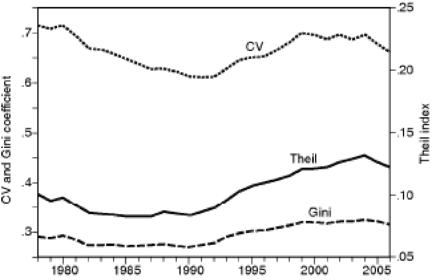
There are significant regional and societal disparities in China. Coefficient of variation (CV), Gini coefficient and Theil index are the three most commonly used and popular measures in the literature of China's regional inequality, which all reveal a similar trajectory of the period from 1978 to 2006.
Figure 1 • Interprovincial inequality in per capita GDP, 1978-2006[23]
- 91/92 -
Table 1 • Comparison[24] of per capita GDP of the four regions[25]
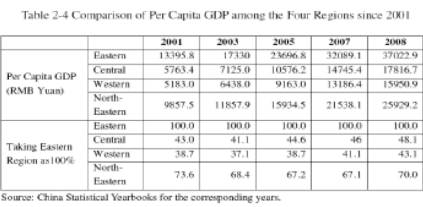
Per capita GDP is another indicator of the overall level of economic development. As presented in Table 1, if we take the per capita GDP of Eastern China as 100%, the ratio between the central, western and north-eastern regions with the former keep increasing in recent years.
If these issues remain uncontrolled and unresolved it might result in significant issues in the slowly ageing China, whose population will start to decrease in the near future.
This situation has indeed been a major issue for the Chinese government for years. As it is understood in the West, social rights guarantee high levels of welfare and they are features of advanced capitalist economies and constituting parts of democracies - as explained by Stepan and Müller.[26] This may put the Chinese government in a somewhat awkward position from a political/ideological point of view, but they applied a rather pragmatic approach: they had to establish a functioning social system anyway in order to avoid social disarray. The comparison of Western and Chinese social systems, including its structure, logic, institutions is nevertheless not easy. This is not only a result of the different political systems, Stepan and Müller argue that there are fundamental cultural differences and even terminology may be elusive to grasp sometimes due to language barriers. Nevertheless it is clear that Western (primarily European) social systems are key references to Chinese decision-makers, and as a result, the Chinese social system has ever more common or similar features with that
- 92/93 -
of the West. Lately this also encompassed the involvement of market based solutions.[27] In 2010 Wen Jiabao argued that "Social programs designed to meet non-basic needs should be handed over to the non-public sector to let the market satisfy the multi-layered and individualized needs of society..."[28]
This is a remarkable shift from the mentality of the pre-80s period when welfare in urban areas was originally guaranteed by the State Owned Enterprises (SOEs), which through their danwei (working units) provided a lifelong social security system. The rural population was provided with a minimum security through the public ownership of land and by the household registration (Hukou) system which also served as the control registry for the rigid rural-urban segregation.[29]
Social security (shehui baozhang) is the umbrella term for all different types of public social policies. Social insurance (shehui baoxian) and social welfare (shehui fuli) are the major strands of public social services. Social insurance programs include pension insurance, medical insurance, work injury insurance, unemployment insurance and maternity insurance. Insured employees and their employers pay contributions to the schemes (civil servants had a privileged situation). Insurance systems are gradually extended to the rural population.
Social welfare in China is defined as social measures to help people in need, including the minimum livelihood guarantee (dibao), other guarantees and medical assistance systems. Dibao is a cash hand-out financed from taxes introduced from the nineties in cities and slowly extended to rural territories as well. There is also a traditional form of mainly community based help system is, the wubao which is delivered in kind (food, clothes, shelter, medical treatment) to needy households or individuals, including orphans and veterans. Families still play an important role in social welfare provision, especially in the countryside (family insurance - jiating baozhang).
During the last thirty years the logic and also the structures of provision of social services underwent major reforms. These were necessary since political and mainly socio-economic changes, such as privatization, and immense migration to cities from rural areas made the traditional work-unit based social security system in urban areas as well as the family based social system in rural areas completely dysfunctional. For decades the policy focus was growth, little attention was paid by the government to creating a nationwide, coherent social security system. This had to be changed: the government realized how dangerous it is to run the country without a properly functioning safety net with sufficient funding and administrative capacities. Major legislative reforms have been launched to counter the rising socio-economic inequalities and to fill the immense gap in the safety net caused by the dismantling of work-units and the massive migration to cities.
- 93/94 -
In 1998, the government established a unified urban health care scheme compulsory for all urban employees, regardless of the type of enterprise. In rural health care the process is much slower, but in 2002 a framework for a renewed Rural Cooperative Medical Scheme was adopted.
After President Hu Jintao's assumption of office in 2003, a considerable change took place as political attention shifted from purely GDP-growth oriented policies towards a more balanced, sustainable and socially equitable approach to development, under the motto a "harmonious society". This refocus from GDP to social also means that the government wants to equalize social services until 2020 nationwide. From 2003 onwards social policy focuses on the inclusion of the large vulnerable groups such as rural residents, unemployed and migrant workers.
A major reform step was taken in 2010 by the adoption of the Social Insurance Law, which specifies the functioning of the following social insurance programs: pension insurance, medical insurance, work injury insurance, unemployment insurance and maternity insurance. Moreover, as a result of a number of institutional mergers and re-assignments of competences the Ministry of Human Resource and Social Security was established to have a single and relatively strong institutional actor in the field of social insurance. Nevertheless, competences for health-related social policies remained scattered.[30] But institutional reorganization seems to be on track and competences on the public social policies are ever more concentrated and the promotion of public welfare is now declared as an independent function and no longer is hidden behind the patchwork of cross-cutting ministerial and other organizational portfolios.
Although the gradual reform of the urban pension system started already in the late 1990s whereby pension coverage was extended from SOE workers to all urban workers irrespective of the company's ownership type, there still is no unified pension system for rural areas, only voluntary, poorly funded, and very fragmented schemes exist with a low popular coverage. According to official estimates, only 7% of rural people aged 60 or older receive any pension benefits.[31]
China's urban pension system is based on three pillars since the late nineties: A social security net (Pillar 0), basic pension insurance (Pillar 1) and supplementary pension insurance (Pillar 2). Under this framework, pension funds are sourced from the government, enterprises and individuals.
According to Hu Yifan[32] the main problems of the Chinese pension system are the increasingly ageing population, the low contribution rate, the low coverage, the fragmented
- 94/95 -
management and the low return on investment.[33] The collection rate[34] has declined from 25.1 percent in 2008 to 17.1 percent in 2010. Compliance is low because the mandatory contribution rates for employers and employees are excessively high (with 28 percent of wages it is almost the highest in the world). Moreover, due to the fragmented nature of the system employees, especially migrant workers, often have to abandon their individual pension accounts when moving to another city.[35]
In 2000, the central government set up the National Social Security Fund (NSSF), to serve as a buffer mechanism to mitigate the pressure stemming from gaps in the pension system -with no success at all in reality.
The government introduced a rural pension plan in 2009 and a new urban pension plan in 2011. Before 2009, only 30% of the population had a pension; with these reforms the coverage grew to 55%, but in reality the pension system was still like a patchwork varying from city to city, from urban to rural areas, and from public to private sectors. Small reform steps are almost continuous and as a result coverage gradually grows, but while the major part of the population is covered by one of several pension schemes in 2015, only about 30 per cent have a coverage that will guarantee a meaningful income. The basic pension is only 55 yuan ($8.75) per month, which cannot guarantee even the minimum subsistence.
Pension reforms are necessary also because of the challenges (both budgetary and social) caused by China's quickly ageing population. The number of people aged over 65 will rise from 132 million in 2015 to 331 million by 2050 (and 480 million people will be over 60), while the number of people aged 15-64 will fall from 1bn to 849m, according to the projections of the UN.[36] The ratio of those aged over 65 to those aged 15-64 will rise from 13 per cent in 2015 to 39 per cent by 2050 in China. (From 2014 to 2050, China's median age will skyrocket, from roughly 35 to 46.) But even with the current low dependency ratio, many provincial pension systems have serious shortfalls that are filled by channelizing current workers' personal retirement accounts (nominative pre-funding mechanism to pay future pensions) to pay benefits to current old age pensioners. Underfunded pensions for non-government workers have been a source of labour unrest and popular outrage for years. According to a report co-authored by Ma Jun the funding shortfall in China's urban pension
- 95/96 -
system between 2012 and 2050 is USD 6.3 trillion in current value terms.[37] By 2010, there was only 204 billion yuan (US$32.37 billion) in the individual accounts, rather than the supposed figure of 2 trillion yuan (US$0.31 trillion), creating a gap of a total of 1.76 trillion yuan (US$0.28 trillion) for the government to fill. Therefore the central government looks into the introduction of a centralized management of the pension funds. As a reaction to this report the government announced plans to again reform its pension system.[38] Part of the government's plan is to raise the retirement age, which at the moment is 60 for men, 55 for women working in white-collar industries, and 50 for blue-collar female workers.[39] In early 2015 the government announced the phasing out of the so-called dual-track urban pension system according to which corporate employees must contribute 8 per cent of their salary to the pension system but government employees do not have to contribute at all (for them the government was simply paying pension benefits from the general budget).
Life expectancy in the country has soared and the fertility rate has plummeted, putting a heavy financial burden on the budget as well as on the next generation. China's fertility rate is 1.6, far below the 2.1 needed to at least sustain the population. The ratio of working-age adults to pensioners is 5:3, but the figure is expected to fall to 1:2 by 2035. The one-child policy puts pressure on the second and third generations of only children. A couple who are both only children will have four parents to care for, and their children could potentially have four parents and eight grandparents to look after. This is a particularly acute issue in China since only 45 percent of the income of elderly residents in China's urban areas comes from the basic pension insurance, while 37 percent from their children and less than 3 percent from the other two pillars. In rural areas the share of the support from the children is 54 percent. This is a clear illustration of the insufficient level of rural pension system penetration. Ageing is an issue in Japan, South Korea and Taiwan as well, but the standard of
- 96/97 -
living in those countries is already high. So as it has been said several times, China is getting old before getting rich.[40]
As far as social assistance schemes are concerned, the first experiment on the introduction of the Minimum Standard of Living Scheme (MSLS) took place in Shanghai in 1993. Later the central government promoted its nationwide adoption and accepted financial responsibility, therefore the scheme expanded rapidly. In 2006 MSLS's gradual extension to rural areas was decided.
Despite the reforms - of which a very brief overview was given in this paper - many western commentators are very critical of the Chinese social system. Spicker argues that in China the provision of social protection is a complicated mix of incomplete systems that include social assistance, partial social insurance and welfare services. Social insurance varies by occupation and location in a significant way. Social assistance offers a minimum subsistence guarantee, but despite its extension to rural areas there are still major gaps. The provision of welfare is limited, fragmented and excessively localized and largely inconsistent. It is also often liable to mismanagement, corruption or ignorance.[41] According to Stepan and Müller the Chinese social security system is fragmented and divided along occupational, administrative, jurisdictional and geographical lines.[42]
Social policy reforms in China have been taking place for two decades now on a continuous basis. They can be considered the largest in human history in terms of the mass of people affected. This obviously takes not only immense amount of financial resources but time as well. Political stability in China is to a large extent contingent on a redistribution of the dividends of growth that guarantees an ever higher level of social protection for the society, especially to the people in extreme need - migrant worker upheavals and strikes[43] clearly demonstrate this. Throughout the socio-economic transition process the key rational
- 97/98 -
behind the introduction of welfare measures has been to stabilize the Communist Party's rule by reducing social tension. The combination of socialist ideals and Confucian values in the grand design of the social system has also been persistent.
6. Policy recommendations and concluding remarks
To attain a balance between a flexible and effective market economy and adequate social security provision remains to be the main internal challenge for China for several years, maybe decades. To this end, the EU, especially some of its member states' models have been and continue to be a useful reference. As explained earlier the practicalities in the design and provision of social services in different EU member states are not uniform, but still, there is an over-arching mentality (accepted by the political class and expected by the society) in Europe to value, sustain and promote social welfare. This remains to be so even if austerity due to budgetary and demographic constraints has already started to put constraints on the social provision systems in Europe. China is for the time being at a very different stage of developing its social model. The historical development and the consequent reforms of European social systems and particular elements of them can therefore be a very meaningful field of study for China.
Chinese and European social challenges (even in historical comparison) differ greatly, so does the cultural perception of welfare provision. Nevertheless, the European policy systems and solutions are valuable source of information from administrative, management and financial points of view.
On some issues such as ageing, China has similar challenges to Europe, and clearly needs to overhaul its pension system, including an efficient administrative centralisation, with better financial management and a much better corporate governance culture to guarantee that legislation is applied correctly and effectively.
Centralisation has never been alien to the Chinese political culture, therefore the fragmented nature of the pension, and other social service provision institutions reflect a well outdated mentality that these issues are not first grade political factors. There is an understanding now in the government that they indeed are, therefore it should be reflected in their management and supervisory administrative setup as well.
With huge masses on the brink of poverty in China, social inclusion should be a key area of action in the future. European states' and even EU-level practices can again provide meaningful examples for policy planning and implementation. The European platform against poverty and social exclusion should be mentioned, which is one of seven flagship initiatives of the Europe 2020 Program. The platform is designed to help EU countries reach the headline target of lifting 20 million people out of poverty and social exclusion (as foreseen in the EU2020 program).[44]
- 98/99 -
With the emancipation of Chinese urban employees, strikes and other forms of indications of discontent will get ever more frequent. Effective communication and cooperation between employees and employers will be of key importance. Therefore the long-term European (member state and EU level) experience related to the domain of social dialogue seems another area of meaningful know-how transfer.
In sum, in the area of social policy, the EU is an obvious model for inspiration for China, but the European social models themselves have come under pressure and proved unsustainable lately, therefore China is best advised to look at the more sustainable versions of the European social models, such as the reformed German or some features of the Scandinavian ones. The key issues with the Chinese social security system are underfinancing, insufficient coverage, geographical fragmentation and inefficient institutions. This mix of challenges constitute a significant risk to the sustainability of social order in the long run, therefore this domain will need significant resources from the Chinese government to enact the necessary reforms. In this respect the policy solutions introduced, applied (and reformed) by some EU member states should serve as interesting points of reference with a carefully selective approach also taking into account the broader societal differences between the European and Chinese realities, such as the perception of the nature and function of social support and vis-à-vis the individual right for support versus a system that implies hand-outs from a benevolent power centre. Underfinancing or the threat of it is an issue for both systems, but as regards institutional reforms and rule-based solutions Europe is clearly a possible example to study.
- 99/100 -
7. Bibliography
1. Hu Angang: Embracing China's "New Norma" - Why the economy is still on track, Foreign Affairs, May/June 2015.
2. eds. Huang Anmiao, Zhang Xiaojin: Analysis of Swedish Model, Heilongjiang People's Press, Hrabin, 1989.
3. Richard Balme: A European strategy towards China? The limits of integration in foreign policy making, 2008.
4. Zhu Baoliang, Zhang Feng: The EU Regional Policy, China Economics Press, Beijing, 2005.
5. Steven Barnett, Ray Brooks: What's Driving Investment in China? IMF Working Paper No. 265, November 2006.
6. China's Policy Paper on the EU: Deepen the China-EU Comprehensive Strategic Partnership for Mutual Benefit and Win-win Cooperation (2[nd] April, 2014).
7. EU-China Cooperation Activity on "Regional Policy" Within the Policy Dialogue between DG REGIO and NDRC Final Report of the Chinese Experts - English Language Version, Beijing, 2010.
8. European Commission - National Development and Reform Commission: Regional policy in China and the EU - a comparative perspective, Brussels, 2011.
9. European Commission: A Long-term Policy for China-Europe Relations, Communication from the Commission, COM, 279 final, Brussels, 1995.
10. Eurostat Regional Yearbook, 2014.
11. C. Cindy Fan, Mingjie Sun: Regional Inequality in China, 1978-2006, Eurasian Geography and Economics, 49(2008)/1, 1-20.
12. Niall Ferguson, Moritz Schularick: The end of Chimerica, Harvard Business School, Working Paper, 10-037, 2009.
13. Five Year Plan (12[th] 2011-2015 of China): Optimizing the structure, accelerating the coordinated regional development and sound urbanization development. Source: www. cbichina.org.cn/cbichina/upload/fckeditor/Full%20Translation%20of%20the%20 12th%20Five-Year%20Plan.pdf (accessed 08.10.2016).
14. Anthony Funnel: China pushes to expand its soft power through cultural export, ABC Net, Australia, 2015.
15. Jeremy Garlick: A critical analysis of EU-China relations: towards improved mutual understanding, Contemporary European Studies, 2013/1.
16. Anthony Giddens, Patrick Diamond, Roger Liddle: Global Europe, Social Europe, Polity Press, 2006.
17. eds. Roger Goodman, Gordon White, Huck-ju Kwon: The East Asian welfare model: welfare orientalism and the State, Routledge, London, 1998.
18. Robert Grafstein, Li Ruoxi: The politics of social security in China, University of Georgia, Athenas, 2008.
19. Richard Gunde: Culture and Customs of China, Greenwood Press, 2002.
- 100/101 -
20. eds. Martin Holland, Peter Ryan, Alojzy Nowak, Natalia Chaban: The EU through the Eyes of Asia: Media, Public and Elite Interviews in China, Japan, Korea, Singapore and Thailand, Warsaw University Press, Warsaw, 2007.
21. ed. Xiao Huanrong: International Relations Studies in China, China Mass Media University Press, Beijing, 2005.
22. Will Hutton: The Writing on the Wall: Why We Must Embrace China as a Partner or Face it as an Enemy, Free Press, Brown, 2006.
23. Mads Meier Jæger, Jon Kvist: Pressures on post-industrial societies: Better is more or less state welfare, Conference paper, 4[th] International Research Conference on Social Security, Antwerp, 5-7 May 2003.
24. Shixue Jiang: How to further improve China-Europe relations, Discussion paper for the 11[th] Annual Conference on the Taiwan issue in China-Europe Relations, Shanghai, China, September 14-16, 2014.
25. Men Jin: EU-China relations: problems and promises, Jean Monnet/Robert Schuman paper Series, 8(2008)/13.
26. Ma Jun, Cao Zhengyuan: Resolving mid- and long-term risks of national debt, Deutsche Bank, Bank of China, 2012.
27. eds. Winfried Jung, Yan Jiangfeng: Regional Cooperation: Experience in European and Practice in East Asia, China Economic Publishing House, Beijing, 2007.
28. Yu Kaixiang, Wu Yikang: The European Communities: System, Policies and Tendency, Fudan University Press, Shanghai, 1989.
29. Parag Khanna: The second world - empires and influence in the new global order, Random House, New York, 2008.
30. Louis Kuijs: Investment and Saving in China, World Bank Policy Research Working Paper No. 3633, June 2005.
31. Susan V. Lawrence, Michael F. Martin: Understanding China's Political System, Congressional Research Service, USA, March 20, 2013.
32. Zhen Li: The Basic old-age insurance of China: Challenges and Countermeasures, World Pension Summit, 2012.
33. Ka Lin: Transformation of the Chinese social security system: collective welfare vs. state welfare, Turku University, 2014.
34. Baozhen LUo., China Will Get Rich Before It Grows Old - Beijing's Demographic Problems Are Overrated, Foreign Affairs, May/June 2015.
35. Jun Ma: China's Import Substitution, Deutsche Bank Global Markets Research, June 7, 2007.
36. Ian Manners: Normative Power Europe: A Contradiction in Terms? Journal of Common Market Studies, 40(2002)/2, 235-258.
37. Marjan Attila, Xi Chen: China's Regional Policy - How it Could Benefit from the EU Experience, Brussels, Shanghai, under publication.
38. Marjan Attila: Europe's Destiny - The old Lady and the Bull, Johns Hopkins University Press - Woodrow Wilson Center Press, Baltimore, USA, 2010.
- 101/102 -
39. Ministry of Foreign Affair of People's Republic of China, China's EU Policy Paper, 2003, 2014.
40. National Intelligence Council: Global Trends 2025 Report, USA.
41. Joseph S. Nye: The limits of Chinese soft power, Project Syndicate, 10 July, 2015.
42. Joseph S. Nye: Soft Power: The Means to Success in World Politics, Public Affairs, New York, 2004.
43. Research Group of the Institute of European Studies, Chinese Academy of Social Science: The Chinese Perception of the EU (2007): A Preliminary Analysis of the Survey on the Chinese Public Perception of the EU and Sino-EU Relations, Chinese Journal of European Studies, 2008/2, 1-52.
44. Anne Sander, Christopher Schmitt, Stein Kuhnle: Towards a Chinese welfare state? Tagging the concept of social security in China, The Perspective of the World Review, 4(2012)/2.
45. eds. David Shambaugh, Eberhard Sandschneider, Zhou Hong: China-Europe Relations: Perceptions, Policies and Prospects, Routledge, London, 2008.
46. David Shambaugh: China's soft power push - The search for respect, Foreign Affairs, July/August 2015.
47. Alexandra Sombsthay: The EU-China partnership on urbanisation: A new path for cooperation at the local level, EU-China Observer (College of Europe), 2012/5.
48. eds. Xinning Song, Luk Van Langenhove: Comparative Regionalism: Europe and East Asia, China University of Political Science and Law Press, Beijing, 2010.
49. Xinning Song: Another Tale of Chinese Transformation = EU Studies Guide 2010, European Voice, Brussels, 2010, 24-26.
50. Xinning Song: European 'models' and their implications to China: internal and external perspectives, Review of International Studies, 36(2010)/3, 755-775.
51. Paul Spicker: Social Policy - Theory and Practice, Policy Press, 2014.
52. Matthias Stepan, Armin Müller: Welfare governance in China? a conceptual discussion of governing social policies and the applicability of the concept to contemporary China, Cambridge Journal of China Studies, 7(2012)/4.
53. Huang Su'an: Perspectives on Social Welfare State in Western European, World Affairs Press, Beijing, 1985.
54. Xie Tao: China's soft power obsession, The Diplomat, April 2015.
55. Jonathan Unger: The transformation of rural China, East Gate Book, 2002.
56. United Nations: World Populations Prospects, 2015. Source: esa.un.org/unpd/wpp/(accessed 08.10.2016)
57. Odd Arne Westad: China and Europe: opportunities or dangers? LSE Global Policy, 2013/3, 96-100.
58. Bijan Xheng: China's new road towards the peaceful rise, Beijing Central Party Press, 2005.
59. Hu Yifan: How vulnerable is China's pension system? 10 June 2012. Source: China.org.cn. (accessed 08.10.2016).
- 102/103 -
60. ed. Zhang Yunling: The Nordic Social Security System and Reform of China's Social Security System, Economic Science Press, Beijing, 1993.
61. Lin Yutang: My country and My People, Reynal & Hitchcock, Inc., UAS, 1935.
62. Yaohui Zhao, Jianguo Xu: China's urban pension system: reform and problems, Cato journal, 21(2002)/3, 395-414.
63. Shi Zhiqin: Could the EUs Political Earthquake Affect Sino-EU Relations? Carnegie-Tsinghua Center for Global Policy, July 16, 2014.
64. Shi Zhiqin: It is the 40th anniversary of China-EU relations. Where do they stand? (interview), The Diplomat for The Diplomat, July 27, 2015.
65. Shi Zhiqin: Understanding China-EU relations, Carnegie Europe, October 15, 2012.
66. Hong Zhou: European Social Policy Studies in China, Chinese Journal of European Studies, 2003/1, 125-30.
67. ed. Li Zong: Social Security System in Western Europe, Chinese Social Science Press, Beijing, 1989.
Mr. Attila Marjan, PhD, associate professor of the National University of Public Service, Budapest (NUPS), holds a PhD in international relations and is habilitated doctor of the Budapest Corvinus University. Between 2013 and 2015 he was head of EU departmant of NUPS, and EU research director of the Hungarian Institute of International Affairs. He has an almost two decade long professional experience in international public service, diplomacy. An author of a hundred articles and ten books on EU and international affairs. His research interest involves the global role of the EU and also EU sectoral policy issues. ■
NOTES
[1] Xinning Song: European 'models' and their implications to China: internal and external perspectives, Review of International Studies, 36(2010)/3, 755-775.
[2] Ibid., 2.
[3] Another positive factor is that the acceptance and esteem of Europe and the EU is fairly high in Chinese society.
[4] Free trade agreements (FTA's) and the New Silk Road Strategy are good examples for this.
[5] Most influential works of this time were: Huang Su'an: A general survey of the welfare states in Western Europe, and Li Cond (ed.): The social security system in Western Europe.
[6] See more on this from Tao Xie and Xinning Song.
[7] Song: op. cit.
[8] It is meant to strengthen China's institutional capacity for social security policy development and administration and to make reforms to social security systems including old age pensions, unemployment insurance, etc. Several specific pilot projects have been accomplished. There are three components of the project. Component 1 supports the National Development and Reform Commission (NDRC) in strengthening institutional capacity for social protection policy development and reforms. Component 2 supports the Ministry of Finance (MoF) in enhancing institutional capacity for financial management and supervision concerning social security funds. Component 3 assists the Ministry of Civil Affairs (MoCA) in improving the legal framework and policy enforcement of social assistance.
[9] Zhou Hong: EU social policy studies in China, Asia Europe Journal, 2004/1, 1-13.
[10] Mads Meier Jaeger, Jon Kvist: Pressures on post-industrial societies: Better is more or less state welfare, Conference paper, 4[th] International Research Conference on Social Security, Antwerp, 5-7 May 2003, 3.
[11] Anthony Giddens, Patrick Diamond, Roger Liddle: Global Europe, Social Europe, Polity Press, 2006, 15.
[12] Confucian virtues are strong family bonds, benevolent paternalism, social harmony, discipline and strong work ethics.
[13] This logic is still present in old age care in rural areas in the absence of institutionalized social protection schemes.
[14] Ka Lin: Transformation of the Chinese social security system: collective welfare vs. state welfare, Turku University, 2014, 3.
[15] The powers of the Union have developed through incremental development of marginal measures in order to establish precedent and competence. For example, provisions covering cigarette packets, bus passes or language teaching sought to establish competence in relation to public health, old people, transport and education. This has been resisted through the idea of 'subsidiarity', by which action should always be taken at the lowest possible level. The European Commission's approach to the development of policy is based on the incremental development of services, the progressive expansion of solidarity, and the insertion of those who are excluded (Paul Spicker: Social Policy - Theory and Practice, Policy Press, 2014, 40).
[16] EU countries are characterised by a large state, disposing of roughly half of the GDP, the two extremes being Ireland (35%) and Sweden (60%). The weight of the state and its GDP disposition rate was increasing in Europe until the mid-nineties, partly due to the evolution of the social model (and primarily its redistributive policies, such as healthcare, education, unemployment benefits) and partly due to other macroeconomic trends (such as the obligation to repay state debt accumulated as an aftermath of the 1973 oil shock, or the anti-cyclical policies necessitated by the recessions of the eighties and the nineties). Taxes collected totalled 42% of GDP in the EU in 2003, compared with 26% in Japan and the USA and 17% in China and India. The average EU member state spends 27% of its GDP on social policy, while Japan and the USA devote 17 and 15% of state revenues to such purposes, respectively.
[17] The Charter of Fundamental Rights of the EU brings together in a single document the fundamental rights protected in the EU. The Charter contains rights and freedoms under six titles: Dignity, Freedoms, Equality, Solidarity, Citizens' Rights, and Justice. It was proclaimed in 2000, but became legally binding on the EU with the entry into force of the Treaty of Lisbon, in December 2009. It entrenches: all the rights found in the case law of the Court of Justice of the EU; the rights and freedoms enshrined in the European Convention on Human Rights; as well as other rights and principles resulting from the common constitutional traditions of EU countries and other international instruments. The Charter sets out a series of individual rights and freedoms including 'third generation' fundamental rights, such as: data protection; guarantees on bioethics; and transparent administration.
[18] In 2004 the new members brought in their heterogeneous, hodgepodge of models, which were typically market-friendly with little attention devoted to welfare aspects, making it all the more difficult to establish a single social image of Europe.
[19] The Nordic model is a mixture of the continental and the Anglo-Saxon models. The relationship between government and economy is a liberal one; politics has a non-interventionist approach towards markets (goods, services and labour alike), but the state's size and redistributive role is comparable to the continental model. In the Anglo-Saxon model, the approach to markets is clearly liberal and social provision is not of paramount importance. In the continental model, social provision is an important principle. The Anglo-Saxon model revolves around the economy and its social policy serves to rectify the shortcomings of the economy's operation. The Scandinavian model, on the other hand, subordinates all policies - including economic policy - to social justice. Nevertheless, the Nordic model has adopted a market-based approach; the rights of active workers are much stronger than those of the inactive labour force. The Scandinavian model increasingly puts employability (individual responsibility) into its focus, as opposed to the old attitude, which put the political burden of providing access to work on the shoulders of the state. In the Anglo-Saxon model, there is more room for weighing social justice against economic rationality.
[20] Ageing is also a serious budgetary concern: the average male spent 11 years of his life in retirement in 1970, and 20 years in 2010 in Europe. Ageing, besides its many other economic and social implications, makes the costly welfare systems impossible to finance in the long run and holds back growth by about half a percent annually.
[21] Demography has become a global issue. In 2015 there are more than 7 billion people sharing planet Earth. Out of every 100 babies, 57 are born in Asia, 26 in Africa, 10 in America and only 5 in Europe. Since the beginning of time, 100 billion people have been born into this world. At the time of Christ's birth, only 300 million people populated the six continents, every sixth person lived in the Roman Empire, and average life expectancy was 24 years. It sounds unbelievable, but in the mid-17[th] century there were still only 500 million earthlings living an average 30 years. Then came a dramatic change: the industrial revolution and, during the 200 years that followed, the global population trebled. The second half of the 20th century, the age of globalisation, also brought a 'population big bang' with less than 50 years required for the number of people inhabiting the world to double. About one fifth of this population explosion came from India and one tenth from China, which indicates that India will surpass China in the foreseeable future. By 2050, around 85% of the world's population will live in a so-called developing country. The population of these countries will increase threefold, while in Europe it will fall by a fifth. Another noteworthy trend is the acceleration of urbanisation and the emergence of the megalopolis. In the early 20th century, townsfolk numbered a mere 150 million, a century later 3 billion people live in urban areas. Cities have always been one of the driving forces behind the development of human culture and modernisation, but modern-age urbanisation is more than that: hundreds of millions of people are moving from rural areas into cities or the suburbs to escape extreme poverty without the slightest chance of integrating into the life of the urban middle-class. Urban population is growing at three times the rate of rural population and in 2007 urbanites outnumbered villagers globally. In the next 20 years population growth will be concentrated almost exclusively in cities. In 2015 there are more than 20 megacities with over 10 million inhabitants, in some cases enormous conurbations of environmental pollution and urban poverty.
[22] United Nations Statistics Division. Source: unstats.un.org/unsd/default.htm, (accessed 08.10.2016).
[23] Source: C. Cindy Fan, Mingjie Sun: Regional Inequality in China, 1978-2006, Eurasian Geography and Economics, 49(2008)/1, 1-20.
[24] EU-China Cooperation Activity on "Regional Policy" Within the Policy Dialogue between DG REGIO and NDRC Final Report of the Chinese Experts - English Language Version, Beijing, 2010, 63.
[25] The four regions are: 1. Western region, 2. Northeastern region, 3. Central region: acceleration of development, 4. Eastern region.
[26] Matthias Stepan, Armin Müller: Welfare governance in China? a conceptual discussion of governing social policies and the applicability of the concept to contemporary China, Cambridge Journal of China Studies, 7(2012)/4.
[27] Nevertheless, some western experts argue that the difference in the underlying logic and the cultural interpretation of social protection is so big (as presented earlier in this chapter) that "while in terms of privatization and decentralization there is evidence of convergence of Chinese and Western patterns, the underlying values and the understanding of welfare differs significantly."
[28] Quoted by Stepan, Müller: op. cit., 6.
[29] Anne Sander, Christopher Schmitt, Stein Kuhnle: Towards a Chinese welfare state? Tagging the concept of social security in China, The Perspective of the World Review, 4(2012)/2, 5.
[30] Ibid.
[31] Sander, Schmitt, Kuhnle: op. cit., 12.
[32] Hu Yifan: How vulnerable is China's pension system? 10 June 2012. Source: China.org.cn (accessed 08.10.2016).
[33] There's almost no market-oriented investment for the basic pension funds (Pillar 1) to ensure their sustainable development. Only 2 percent comes from interest, the rest by pension collections and financial transfers. The supplementary pension insurance's (Pillar 2) average return on investment was only 3.4 percent in 2010, far below China's inflation rate of 5.4 percent. A lack of competition is probably the reason for low investment returns for Pillar 2. (Yifan: op.cit.)
[34] The ratio between contributors making payment on a monthly basis and the general number of contributors.
[35] Labour force migrates more and more frequently in China, so employees pay contributions in one province, but would receive their pension in another after retirement. As the basic pension funds are managed at provincial or municipal level, those provincial regions with greater labour force inflows will have a substantial surplus in their pension system, while ones lacking in contributions from in-service employees are often faced with a deficit. (Yifan: op. cit.). Local governments, short of adequate funds, use the reserves accumulated in the individual accounts (Pillar 1) to pay the current pension claims supposed to be funded by the social pooling plan (Pillar 0), despite the fact that the two are supposed to stay separated, thus emptying individual accounts.
[36] United Nations: World Populations Prospects, 2015. Source: esa.un.org/unpd/wpp/ (accessed 08.10.2016).
[37] Ma Jun, Cao Zhengyuan: Resolving mid- and long-term risks of national debt, Deutsche Bank, Bank of China, 2012, 2.
[38] The report warned that only by delaying retirement age and increasing state funding will not solve the problem.
[39] By 2030, China's baby boomers will enter their 60s and 70s. The rate of population aging has been higher in the country's eastern region, which is the more developed, but the problem has hit the central and western regions as well. Meanwhile, due to the one-child policy and higher rates of women's education and employment, the fertility rate remains low, at around 1.6 births per woman, lower than that of developed nations such as France and the United States. China has moved to relax the one-child policy in recent years, allowing couples to have two children if at least one spouse is an only child, but this has had limited impact. As of May 2014, only 271,600 couples, out of a possible 11 million, had applied for permission to have a second child. The country's statutory retirement age is relatively young-60 for men and 50 or 55 for women-and given increased life expectancy, many are looking at an average of 15 to 25 years in retirement. (The retirement age was set in the 1950s, when life expectancy was much lower.) Some are rehired after retirement; others start second careers. In early 2015 the government officially announced its intention to raise the retirement age. According to Luo (Luo Baozhen: China Will Get Rich Before It Grows Old - Beijing's Demographic Problems Are Overrated, Foreign Affairs, 2015. Source: www.foreignaffairs.com/articles/china/2015-04-20/china-will-get-rich-it-grows-old [accessed 08.10.2016]) raising the male retirement age to 65 could, by 2020, keep some 41.5 million men in the workforce. In the meantime, early retirement means that more grandparents have time to care for their grandchildren, freeing up working-age mothers to take jobs.
[40] Some claim that this statement in false and China can get rich before or at least by the time it gets old (See more on this in: LUo., op. cit.). Luo argues that a rapid development in the standard of living and at the same time a stable and broad social protection system is attainable if ongoing reforms are delivered with success. There are several positive signs. Although China's working-age population has indeed shrunk, its employment rate has increased. In 2014, China's active work force consisted of 772.5 million people, 2.8 million people more than in 2013. This growth, despite a smaller working-age population, suggests that many underemployed Chinese, especially in rural areas, are being drawn into the work force. As the government enacts policies to encourage internal migration, including the revision of the household registration system and increasing investment in the mechanization of agriculture, more and more surplus unskilled labourers from rural areas will be absorbed into urban manufacturing and service industries.
[41] Spicker: op. cit., 15.
[42] Stepan Müller: op. cit.
[43] The largest strike in Chinese history took place in May 2014 when some 40,000 workers protested at the Yue Yuen sportswear plant in Dongguan. The reason was that a huge gap was discovered in the pension funds of the company. The company underpaid its pension obligations for years and accumulated a gap of USD 31 million. This is in fact not a one-off event: it is common practice for companies to underpay pensions, while government turns a blind eye on it. The government concerned about losing manufacturing capacities has for years allowed major factory-owning companies to underpay pensions as kind of a "backdoor" savings. Companies have been making pension payments equivalent to minimum wage salaries rather than real wages. This, however, as already stated before in the paper resulted in the huge nationwide underfunding in the pension budget
[44] See more on this at: www.eur-lex.europa.eu/legal-content/EN/TXT/PDF/?uri=CELEX:52010SC1564&from=EN and at: www.eur-lex.europa.eu/legal-content/EN/TXT/PDF/?uri=CELEX:52010DC0758&from=EN (accessed 08.10.2016).
Lábjegyzetek:
[1] The author is associate professor, University of Public Service, Budapest, Hungary, marjan.attila@uni-nke.hu.