

Péter Sasvári - Wolf Rauch: Austria and Hungary - Different Stages of Readiness to Create Added Value by Using Business Information Systems (Publico, 2014/3., 169-178. o.)
Abstract
It is very important to recognize that the future of e-government cannot be thought through in isolation, it cannot be assessed as a series of administrative tasks or a wider set of measures aimed at making the state more efficient. The administration of today and tomorrow essentially depends on the changes of the economy, society and culture as well. Local governments and public administration serve the interests of citizens and businesses alike, therefore public administration significantly depends on the knowledge, consciousness and mentality of individuals and enterprises, too. However, it is still an open question whether enterprises in Austria and Hungary actually have the IT infrastructure enabling them to adopt the devices of e-governance at a faster pace. The primary objective of this paper is to explore the differences and similarities in the usage of information systems in different size categories in Austria and Hungary. More precisely, it examines how frequently information systems are used in four of the pre-defined size categories (microenterprises, small and medium-sized enterprises and corporations) in both countries. Microenterprises in Hungary hardly used any information systems. When comparing the two countries, the smallest difference could be observed in the use of information systems by corporations.
1. Introduction
Technology investments both in business and in government applications are seen as key sources of innovation. The value of these investments - both from economic and social points of view - are defined by the outcome that these investments generate. In economics we might conclude that ICT investments generate value if the outcome is positive in economic terms, that is, it contributes to measures improving growth, productivity, efficiency or effectiveness. On the level of enterprises, these outcomes translate into revenue increase or cost savings but since the Internet boom of the 1990s, researchers have attributed more and more significance to ICT transformational outcomes. Transformation is closely coupled with radical innovation or non-incremental change, which fundamentally alters the traditional ways of doing business. Transformational impacts can result in major disruptions of
- 169/170 -
an industry's competitive structure, changes in user experience, in consumption (such as online shopping), altering business processes, creating brand new organizations and many others. The term "e-business" in this context places this issue in its focus: what kind of economic value is generated by ICT investments and how this value is ensured?
In the public sphere, e-government deals with a similar problem as far as value creation is concerned. The outcome, however, is very different: better governance, democratic transparency, improvement in social life. Beside the holistic and broad societal values, we can also define lower, public service level outcomes of ICT investments such as improved public service delivery, better coordination across government, improved public engagement, and more efficient process management. The use of ICT applications makes it effective to handle large amounts of administrative tasks. Data transfer will become faster and cheaper, increasing the dynamics of administration. Sharing databases between various institutions will lead to cost reduction, lessened complexity and the avoidance of unnecessary and redundant solutions. Archiving and data retrieval become easier and less expensive, the history of different types of administrative cases and matters gets easier to follow. However, it is possible to talk about efficiency only in the long run as online and offline services have to be maintained side by side as long as they are requested by public and business enterprises. Businesses have been using electronic devices to help their operation at some level since the emergence of computers. Naturally, similarly to all technical innovations, they were initially only available for large companies that had enough capital and were able to finance their development. In accordance with the proliferation of using computers, our basic assumption is that in countries where the use of IT devices is higher, enterprises have higher capability of manufacturing more complex products, and the production of more complex products leads to higher added value. Added value at basic prices can be simply defined as the difference between gross output (at basic prices) and intermediate consumption (at purchaser prices) and can be decomposed into the following components: Compensation of Employees; Gross Operating Surplus; Mixed Income; and Other Taxes on Production less Subsidies on Production. Among the EU member states, the capacity of generating added value was examined more closely in the case of two neighbouring countries, namely Austria and Hungary. Compared to the EU average of 27 countries, the average added value of the Austrian enterprises was higher by 70% with EUR 530,000 in 2012. In contrast, the average data of the Hungarian enterprises did not exceed EUR 87,000 which was equal to only 27 % of the EU average. The added value of microenterprises in Austria reached 173% and a modest 23% in Hungary in relation to the EU average. It mounted up to only EUR 17,000 in Hungary and EUR 124,000 in Austria per enterprise, which was nearly 7.5 times higher than the Hungarian data in 2012. The added value created by small-sized enterprises was eight times higher in Austria (EUR 1,042,000) and 18 times higher (EUR 315,000) in Hungary compared to microenterprises. The added value generated by the Hungarian medium-sized enterprises was only slightly over 40% of the average of the European Union (EUR 2,270,000). In the meantime, the added value of the medium-sized enterprises in Austria exceeded the EU average by 45%. Regarding the performance of the Hungarian enterprises, the corporations operating in the country lagged behind their Austrian counterparts to the least ex-
- 170/171 -
tent. The added value per enterprise in Austria was three times higher in the case of small- and medium-sized enterprises and two times higher in the case of corporations compared to their peers in Hungary.
2. The relationship of ICT development and economic performance
The key strategic motive behind information system (IS) applications is to "make things better" which means in economic terms that there should be a correlation between the added value created by enterprises in a country and their ICT development. Higher added value means using more complex information systems and employing more IT specialists. In order to verify this existing relationship, a linear correlation analysis was performed between the IDI development of a country and the average added value generated by the enterprises operating there. The analysis was conducted by using the data collected in 27 EU countries. The information society is an elusive phenomenon to deal with: its measurement requires careful planning and it is difficult to quantify and approach by using economic and sociological methods. The measurements and comparisons, however, raise a number of problems. Simple indices of infrastructure can be measured more easily but the more variables are there to work with, the more difficult it becomes to measure appropriately. The indices are the measurements and comparative methods of various segments of information society. The weight of separate factors in a given index reflects the viewpoint of governments, intergovernmental organizations and academic workshops in terms of the necessary factors for the development of the information society. One of the most elaborated indices is the ICT Development Index (IDI), which is published by the United Nations International Telecommunication Union and based on internationally agreed information and communication technologies indicators. This index seemed almost ideal for the purpose of our analysis since it is used to measure the ICT development levels in 155 countries. The index itself, which can be used as an evaluation tool at global, regional and country levels alike, combines 11 indicators grouped into three subindices: ICT access, use and skills.
Correlation calculations are used to describe the direction and the strength of a linear relationship between variables. In our calculation, the correlation between two variables - the IDI index of a country and the average added value created by enterprises - was examined.
Depending on the individual countries the values of IDI were between 5 and 8.5, the added value per enterprise was between 50,000 and 800,000 Euros. The correlation coefficient is 0.791, which indicates a strong positive relationship. The linear correlation coefficient is the square of the determinant coefficient, which explains the added value with the IDI index by 61%. The standard error of the estimate (SEE) helps to determine the accuracy of the prediction. SEE shows the average standard deviation of the added value from the estimated values, which is a value of 1.39. The ANOVA table shows a similar division to variance analysis, based on the variance explained by each regression (817,842.426), and non-explained variance (487,849.245). Here, the significance of the f-test can also be read, which confirms the existence of the correlation (Sig. <.05).
- 171/172 -
In addition, it can also be observed by interpreting the t-test that the significance of the variable determining steepness is less than 5%, therefore IDI has a real effect on added value.
Based on the Unstandardized Coefficients, it is possible to read the formula of the regression line:
Added value = -1,010.976 +196.45 * IDI
Figure 1 • The correlation between the added value and the IDI development of the EU countries in 2012[1]
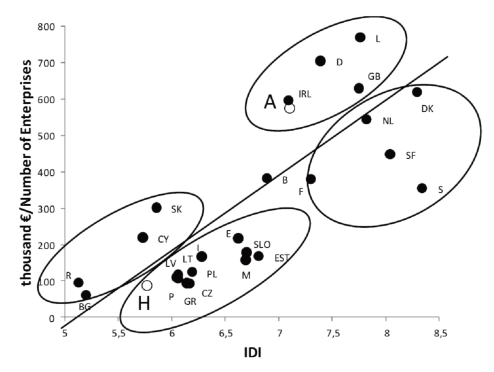
If we take a closer look at the figures, it becomes clear that the member states of the European Union can be divided into four distinct groups.
- Relatively high added value per enterprise with a comparably higher IT development level. This group of countries includes Austria, Germany, the United Kingdom and Ireland.
- Relatively high added value per enterprise with a comparably lower IT development level. Denmark, the Netherlands, Finland, Sweden and France belong to this group.
- 172/173 -
- Relatively low added value per enterprise with a comparably higher IT development level. Four countries can be found in this group, namely Slovakia, Cyprus, Romania and Bulgaria.
- Relatively low added value with a comparably low IT development level. This is the most populous group, comprising Lithuania, Latvia, Estonia, Malta, Spain, Italy, Slovenia, Poland, Greece, the Czech Republic, Portugal and Hungary.
Austria is situated above the regression line while Hungary can be found below it. This means that the average added value generated by the enterprises operating in Hungary is lower than they could achieve by benefiting from their actual IT development level. In contrast, the IT development level in Austria is lower than the average added value produced by the country.
The correlation between added value and the ICT development level of a country is close. Nevertheless, the use of ICT has some beneficial effects that are difficult to quantify. The "Common List of Basic Public Services" is a recommendation for the performance of public service by the European Union which defines obligations for the member states regarding the range and levels of public service provided online. If businesses and citizens have a higher frequency of ICT usage in a country, it can also be assumed that they use the services offered by e-administration to a greater extent.
3. How does organizational use of ICT contribute to better organizational performance
This is a complex and widely researched question and this part of the paper intends to show and introduce the first fundamental element of the value creation process, that is, how information systems are configured.
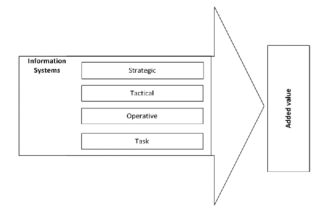
The levels leading to the creation of added value are summarized in a rudimentary model shown in Figure 2, which, according to Resource Based Value theories, contribute to the value creation by enterprises.
Figure 2 • The logical framework of IT added value and the research model of the paper
- 173/174 -
Based on Antony's classification and in line with our assumptions, these systems can be transformed into decision-making and organizational levels of specific activities that are completed with a fourth one. These four levels are associated with the following tasks:
- Top-level management determines the business policy of an enterprise but they should provide guidance for the strategy to be implemented as well. In addition to the preparation of plans, they have to ensure their implementation and the correction or modification of their strategy if circumstances and conditions change.
- Middle-level management has to implement a policy specified by the top-level management, elaborating and implementing tactical tasks.
- The responsibility of the operational level of management is to directly control the implementation of real processes based on the strategy and tactics defined by the upper management levels.
- At the lowest executive level, the implementation of simple mass transactions is done. It can also be called the level of tasks.
Our analysis shows that in all aspects a noticeable difference can be observed between Austria as a high added value performer and Hungary as a catching-up performer. The primary research was based on a questionnaire that had already been filled out by Hungarian enterprises. The same questionnaire was used among the Austrian enterprises, providing a good opportunity to compare and analyze the two countries. The questionnaires were sent out randomly, regardless of company size, business activity and regional location. The sample size for comparison was almost identical as 94 enterprises in Hungary and 99 enterprises in Austria completed and returned the questionnaire by the set deadline.
4. Information systems and corporate decision levels
In order to understand information systems (IS), we need to be aware of their general features, functions and key activities, together with their inter-relatedness to one another. Burt and Taylor define information systems as "an integrated user-machine system for providing information to support the operations, management, analysis, and decision-making functions in an organization. The system utilizes computer hardware and software, manual procedures, models for analysis, planning, control, and decision-making by using a database"[2].
If it is true that certain specific IS can closely be connected to certain decision-making levels, then it is worth examining how each IS is related to the other and exactly what levels of decision-making they are designed to support. An Executive Information System (EIS) is a type of Management Information System (MIS) that facilitates and supports senior executive information and decision-making needs. It provides easy access to internal and external information relevant to organizational goals. It is commonly considered a specialized form of decision support system (DSS). MIS systems are distinct from other information systems because they are used to analyze and facilitate strategic and operational activities. Original-
- 174/175 -
ly, the term MIS described applications providing managers with information about sales, inventories, and other data that would help in managing the enterprise. Over time, the term broadened to include: decision support systems, resource management and human resource management, Enterprise Resource Planning (ERP), Enterprise Performance Management (EPM), Supply Chain Management (SCM), Customer Relationship Management (CRM), project management and database retrieval applications. Transaction processing is a style of computing that divides work into individual, indivisible operations, called transactions. A Transaction Processing System (TPS) or transaction server is a software system, or software/hardware combination, that supports transaction processing. According to the traditional structure, MIS, DSS and EIS are based on a TPS system. CRM, SRM and SCM systems are basically designed to support decision-making at operational and tactical levels but it is inevitably necessary to have an underlying TPS system that addresses the daily tasks. ERP systems include some important functions of TPS, and are able to support the full operational level. Business Intelligence (BI) systems can include all sorts of decision-support systems used at middle and senior management levels that appear as BI applications. BI systems are always based on some lower-level support systems, mostly on ERP systems. ERP and BI systems can also be found in a complex package.
Figure 3 • Corporate decision-making levels with the supporting IS[3]
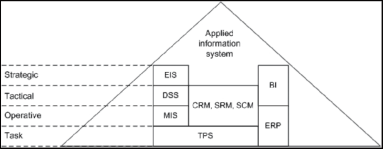
It is needed to emphasize that this categorization should not be regarded as a rule, it describes only the current major trends. There are instances showing that some systems also extend to other levels of decision-making, and general shifts between these levels are also possible due to the continuous development. After giving a more thorough insight into the functions and main activities of the described information systems, the major results of our analysis are highlighted below, showing the main tendencies of using information systems in all of the four examined company size categories.
Nearly two-thirds of the Austrian microenterprises used TPS systems. The proportion of ERP systems (both used and planned to use) was up to 27% in 2012. Using MIS sys-
- 175/176 -
tems reached 23%; their planned use was 3%. Less than one-tenth of the Austrian micro-enterprises reported using SCM and SRM systems. The proportion of the intended use of CRM systems reached 17%, although the rate of their actual use was only 5%. Using DSS did not exceed 1% in Austria. The use of such strategic systems as BI and EIS affected only one-tenth of the microenterprises in Austria in 2012. A quarter of the Hungarian micro-enterprises were using or planning to use TPS systems. The intended use of ERP systems did not exceed 10% in this size category. The planned use of MIS and SRM reached 15%, it was the second highest rate following the intended use of CRM which was 35%. The use of strategic systems was less than 5%. The use of SCM systems did not exceed 5%, either, their intended use was around 15% in 2012. It can be stated that none of the Hungarian microenterprises used IS at a higher frequency rate of 5%. Small-sized enterprises in Austria used TPS systems in the largest proportion; their usage rate was 75%. ERP systems were used by 46% of them. At operational level, MIS systems were used by nearly a quarter of the Austrian enterprises in 2012. The use of different tactical IS in the case of CRM and SRM affected the fifth of small-sized enterprises. Small-sized enterprises in Hungary most commonly used TPS systems (30%) followed by ERP (15%) and CRM (15%) systems. 15% of them reported using SRM systems. Based on the responses, none of the small-sized enterprises in Hungary used any kind of decision support systems. 7% of them used BI and only 4% of them reported using EIS systems.
Table 1 • The penetration rate of IS among micro-enterprises and small-sized enterprises in Austria and Hungary
| Country | Austria | Hungary | |||||
| Levels | IS | Used | Not used, intro- duction is planned | Not used, introduction is not planned, either | Used | Not used, intro- duction is planned | Not used, introduction is not planned, either |
| Micro-enterprise | |||||||
| Strategic | BI | 8% | 8% | 84% | 0% | 5% | 95% |
| EIS | 2% | 0% | 98% | 0% | 5% | 95% | |
| Tactical | DSS | 0% | 5% | 95% | 0% | 5% | 95% |
| SCM | 0% | 8% | 92% | 5% | 10% | 85% | |
| SRM | 7% | 10% | 83% | 5% | 15% | 80% | |
| CRM | 5% | 17% | 78% | 5% | 35% | 60% | |
| Operative | MIS | 23% | 3% | 74% | 0% | 15% | 85% |
| Task | ERP | 20% | 7% | 73% | 0% | 10% | 90% |
| TPS | 60% | 2% | 38% | 5% | 20% | 75% | |
| Small-sized enterprise | |||||||
| Strategic | BI | 29% | 4% | 67% | 7% | 11% | 82% |
| EIS | 4% | 7% | 89% | 4% | 11% | 85% | |
| Tactical | DSS | 0% | 4% | 96% | 0% | 30% | 70% |
| SCM | 4% | 11% | 85% | 11% | 19% | 70% | |
| SRM | 22% | 4% | 74% | 15% | 15% | 70% | |
| CRM | 22% | 4% | 74% | 15% | 19% | 66% | |
| Operative | MIS | 43% | 4% | 53% | 7% | 26% | 67% |
| Task | ERP | 46% | 4% | 50% | 15% | 22% | 63% |
| TPS | 75% | 7% | 28% | 30% | 19% | 51% | |
- 176/177 -
Nearly 90 % of the Austrian medium-sized enterprises used TPS systems. The proportion of using ERP reached 80% in 2012. The use of MIS systems approached 70%, and their planned use was 6%. Over a fifth of the medium-sized enterprises reported using SCM and SRM systems in Austria. The rate of using CRM exceeded 37 %, being the highest frequency rate among the IS used at tactical level. The use of DSS was not typical in this size category. The use of strategic systems, including the use of BI, affected more than a third of the Austrian medium-sized enterprises. More than half of the Hungarian medium-sized enterprises used or planned to use the TPS systems. using ERP systems was more than 40% in this size category. The intended use of MIS and SRM was nearly 40%, and 44% in the case of CRM systems which was the highest rate in the group of IS used at a tactical level. The use of EIS systems was used by nearly a quarter of the medium-sized enterprises. Although, the use of SCM systems affected a quarter of medium-sized enterprises, their intended use was up to 26% in 2012.
Table 2 • The penetration rate of IS among medium-sized enterprises and corporations in Austria and Hungary
| Country | Austria | Hungary | ||||||||
| Levels | IS | Used | Not used, intro- duction is planned | Not used, introduction is not planned, either | Used | Not used, intro- duction is planned | Not used, introduction is not planned, either | |||
| Medium-sized enterprises | ||||||||||
| Strategic | BI | 38% | 6% | 56% | 7% | 19% | 74% | |||
| EIS | 7% | 7% | 86% | 26% | 4% | 70% | ||||
| DSS | 0% | 14% | 86% | 19% | 18% | 63% | ||||
| Tactical | SCM | 19% | 0% | 81% | 26% | 26% | 48% | |||
| SRM | 25% | 0% | 75% | 37% | 19% | 44% | ||||
| CRM | 37% | 12% | 51% | 44% | 15% | 41% | ||||
| Operative | MIS | 69% | 6% | 25% | 41% | 15% | 44% | |||
| Task | ERP | 81% | 0% | 19% | 41% | 7% | 52% | |||
| TPS | 88% | 6% | 6% | 52% | 7% | 41% | ||||
| Corporation | ||||||||||
| Strategic | BI | 92% | 8% | 0.00% | 20% | 15% | 65% | |||
| EIS | 67% | 8% | 25% | 45% | 10% | 45% | ||||
| DSS | 33% | 17% | 50% | 35% | 20% | 45% | ||||
| Tactical | SCM | 55% | 18% | 27% | 40% | 0% | 60% | |||
| SRM | 64% | 18% | 18% | 60% | 5% | 35% | ||||
| CRM | 75% | 17% | 8% | 50% | 10% | 40% | ||||
| Operative | MIS | 92% | 8% | 0% | 60% | 5% | 35% | |||
| Task | ERP | 92% | 8% | 0% | 60% | 10% | 30% | |||
| TPS | 100% | 0% | 0% | 75% | 10% | 15% | ||||
Every responding corporation in Austria reported using TPS systems. The use of ERP by corporations was almost 90%. Nine out of ten corporations used MIS systems at the operational level. In the case of CRM, the use of various IS at a tactical level affected three-fourths of the Austrian corporations. With a usage rate of more than 60%, the use of SRM was the second most commonly used tactical system in Austria. The use of SCM systems was typical of every second, the use of DSS was typical of every third corporation in Austria. The use of
- 177/178 -
BI systems reached an impressive 90% and the use of EIS was also high, affecting more than two-thirds of the enterprises belonging to this size category. The most frequently used information system was TPS among the Hungarian corporations, reaching 75%. It was followed by the use of ERP (60%) and MIS (60%) systems. CRM systems were used by 50% of them. Based on the responses, six Hungarian corporations out of ten used SRM systems. It was also remarkable that only a fifth of the Hungarian corporations used any kind of BI systems and nearly half of them used EIS systems during their daily operations.
5. Conclusions
As it is increasingly visible, information society creates a new type of state, a digital state that becomes, at least partially, a network state following the model of network economy and network society. Therefore, regional and local government administrations become more and more equal players to the central government, which is the traditional holder of the highest executive power. Their primary task is to create an atmosphere for citizens and business enterprises alike to participate rather than being subjects or subordinates. In order to achieve this, all stakeholders (such as citizens, private sector and state) must have adequate technical infrastructure and personnel. This is why it is crucial for the enterprises to be prepared for the challenges and opportunities of a digital state. The frequency rate of using IS by microenterprises in Austria exceeded the same rate as in Hungary. In fact, the same result was found in the case of using IS both at operational and strategic levels. In the case of the surveyed 9 IS it was found that the Hungarian microenterprises hardly used or did not use any of them at all. It can be explained by the complexity of the products and services offered by those enterprises, which, in turn, might affect the added value created by them. There was a more than seven-times difference between Austria and Hungary in this respect in 2012. The use of IS among the Austrian small-sized enterprises was twice as high at the level of performing tasks and six times as high at the operational level as it was found in the case of their Hungarian peers. A 30% handicap could be observed only at the tactical level while the Hungarian added value was barely a third of the Austrian one. The use of IS by medium-sized enterprises at the tactical level was very similar both in Austria and Hungary. It was remarkable, however, that the Hungarian data showed a 30% decrease at the level of tasks and at the operational level while the added value was still only about a third compared to the Austrian figures. The average added value generated by the Hungarian corporations was nearly half of their Austrian counterparts while there was a narrow gap in terms of operational and tactical levels and a more robust difference could be found at the strategic level. ■
NOTES
[1] Abbreviations: A=Austria, B=Belgium, BG=Bulgaria, CY=Cyprus, CZ=Czeh Republic, DK=Denmark, EST=Estonia, SF=Finland, F=France, D=Germany, GR=Greece, H=Hungary, IRL=Ireland, I=Italy, LV=Latvia, LT=Lithuania, L=Luxemburg, M=Malta, NL=Netherlands, PL=Poland, P=Portugal, R=Romania, SK=Slovakia, SLO=Slovenia, E=Spain, S=Sweden, GB=United Kingdom
[2] Burt, E. & Taylor, J. A. - Information and Communication Technologies: Reshaping Voluntary Organizations? - Nonprofit Management and Leadership, 11(2) - 2003 - 131-143 pp.
[3] Kacsukné B. L. & Kiss, T. - Bevezetés az üzleti informatikába - Budapest: Akadémiai Kiadó - 2007