

Tibor László Buskó[1]: The Institutionalisation of Smart Villages and Smart Rural Development in Hungary (Publico, 2023/3., 3-28. o.)
Lessons from a Policy Discourse Analysis[1]
https://doi.org/10.32575/ppb.2023.3.1
Abstract
The aim of this study is to describe and evaluate the institutionalisation process of the so-called smart approach to rural development, i.e. the implementation of "smart villages" in Hungary. Using the methodological tool of discourse analysis, it argues that an overemphasis on a critical approach, which would mainly interpret the institutionalisation of the smart village discourse on the basis of its role in the (re)production of domination, is a rather one-sided approach. In Hungary, local actors and/or grassroots initiatives have played a decisive role in shaping the meaning of the smart village concept right from the beginning. On the other hand, it seems that even at a later phase of the smart village discourse, when the power centre, i.e. the administration would gradually take matters into their hands, it is not appropriate to focus on asymmetric power relations. The analysis of the Hungarian Digital Village Programme launched in 2020 shows that the administration's aim is still to encourage rural municipalities interested in smart approaches to actively participate in the process of meaning construction.
Keywords: discourse analysis, rural development, smart villages, smart rural development, Hungary
Absztrakt - Az okos falu, okos vidékfejlesztés intézményesülése Magyarországon
Egy szakpolitikai diskurzuselemzés tanulságai
A tanulmány célja az úgynevezett okos vidékfejlesztési megközelítés, azaz az okos falu probléma magyarországi intézményesülési folyamatának bemutatása és értékelése. A tanulmány a diskurzuselemzés módszertani eszközével azt igyekszik bizonyítani, hogy a kritikai megközelítés túlhangsúlyozása, amely elsősorban az uralom (újra)termelésében betöltött szerepe alapján értelmezné az okosfalu-diskurzus intézményesülését, meglehetősen egyoldalú választás lenne. Magyarországon a helyi szereplők és/vagy az alulról építkező kezdeményezések már a kezdetektől fogva meghatározó szerepet játszottak az okosfalu fogalmának alakításában. Másrészt úgy tűnik, hogy még az okosfalu-diskurzus későbbi szakaszában, amikor a hatalmi centrum fokozatosan átveszi a kezdeményezést, sem lenne helyénvaló az aszimmetrikus hatalmi relációkra összpontosítani. A 2020-ban indított Digitális Falu Program elemzése azt mutatja, hogy a hatalmi centrum célja továbbra is az, hogy az okos megközelítések iránt érdeklődő vidéki településeket arra ösztönözze, vegyenek részt aktívan a jelentéskonstrukció folyamatában.
Kulcsszavak: diskurzuselemzés, vidékfejlesztés, okos falvak, okos vidékfejlesztés
- 3/4 -
Problem definition
The aim of this study is to describe and evaluate the institutionalisation process of the so-called smart approach to rural development, i.e. the smart village problem in Hungary, using the methodological tool of discourse analysis. There is no consensus in the literature on how exactly to describe the processes behind the smart approach, therefore, I will only outline a simplified trajectory. This will start from the concept of 'industrial revolutions', the major turning points in economic development. The term itself was coined by the French Louis-Guillaume Otto as early as 1799,[2] but its career unfolded in parallel with the theory of the so-called Kondratieff waves. In a study published in 1925, the Soviet economist Nikolai Dmitriyevich Kondratieff identified three long-term cycles of economic development that followed the start of the classical industrial revolution.[3] The first was linked to the invention of the steam engine and the textile revolution (1790-1849), the second to the spread of rail transport (1850-1896), and the third cycle, which he dated from 1896, began with the rise of the chemical industry and the advent of electrical instruments. Each industrial revolution would, according to later interpretations, have initiated long-term cycles of economic development, although the 'revolutionary', i.e. sudden and/or radical, nature of each revolution is widely disputed in academia. Later, there was no clear consensus on the number of Kondratieff cycles, which the literature puts at between 4 and 6. The terms Industrial Revolution 4 and the Industry 4.0 economic development cycle emerged around the turn of the millennium as an extension of Kondratieff's theory[4] and are mainly used in connection with industrial innovations based on automation, digitalisation and robotisation.[5]
For a long time, the issue of smart rural development, including the smart village concept, has been marginalised within smart territorial policies. The smart approach was initially almost exclusively associated with the technological innovations of the 4[th] industrial revolution,[6] and since the incubation areas for technological innovations are traditionally considered to be cities and metropolises, it is hardly surprising that smart territorial policies in this period focused on so-called smart cities. However, this situation seems to be changing in recent times. This shift has been driven by the realisation that the benefits of digital technologies (e.g. various ICT tools) and other innovative smart solutions are not limited to urbanised areas. An acceptable preliminary working definition of smart villages has been formulated by the European Network for Rural Development, which defines them as "communities in rural areas that use innovative solutions to improve their resilience, building on local strengths and opportunities. They rely on a participatory approach to develop and implement their strategy to improve their economic, social
- 4/5 -
and/or environmental conditions, in particular by mobilising solutions offered by digital technologies".[7] This definition suggests that the focus is still placed on the various digital technologies present in smart villages, but the key to becoming smart is instead to rely on (not necessarily technological) innovations introduced by rural communities. The broader socio-technological context of these innovative solutions in rural areas is illustrated by Antje Matern and her fellow researchers using the conceptual pair of hybridisation and peripheralisation.[8]
The concept of hybridisation stems from the argument that the problems associated with urban (urbanised) and rural (non-urbanised) areas in today's world no longer exist in their pure form, but can be better viewed as intertwined. While this does not necessarily mean the end of separate urban and rural development in the traditional sense, it may encourage rethinking and revision of development policy approaches that focus on purely urban or rural problems. It is worth referring here to Sami Mahroum's[9] approach, which proposes significantly more flexibility than the traditional model that clearly differentiates between 'urban' and 'rural' (Table 1). Mahroum argues that today's rural innovations do not necessarily have to be based on supply elements specific to rural municipalities or on the demands specific to the population of rural municipalities. Hybridisation can be interpreted in at least two ways: on the one hand, it is possible that the supply of rural municipalities is not (only) demanded by the local population, and that this should be taken into account in the various rural development policies. A typical example could be rural tourism, which typically attracts people who live in urbanised areas. Another possible interpretation of hybridisation can be derived from the existence of universal demands, i.e. demands that are characteristic of both urban and rural populations. It is apparent that, as modernisation progresses, the demands of people in urban and rural areas are becoming increasingly similar, and that these demands are increasingly likely to be met by Industry 4.0 technologies. For example, access to basic public services supported by advanced technological infrastructure is no longer the privilege of urbanised areas, nor is it regarded as a legitimate demand exclusively on the part of city dwellers. If we accept this, the overlap between development policies for urbanised areas and those for rural areas is now greater than the casual observer might think. For this reason, the importance of a smart approach to ICT-based development in rural municipalities has been increasingly in the spotlight since the 2010s.
- 5/6 -
Table 1: Different types of innovations with rural impact
| Demand | ||||
| Rural | Urban | Universal | ||
| Supply | Rural | x | x | x |
| Urban | x | |||
| Universal | x | |||
Source: Mahroum 2007: 7
The hybridisation phenomena described above do not, however, negate the specific difficulties of rural areas at a lower level of socio-technological development, whose problems are linked to peripheralisation. The literature distinguishes between three aspects of peripheralisation in the context of the so-called centre-periphery relations: location (geographical), development (economic) and power (social) aspects.[10] In our view, one of the keys to the convergence of remote rural, economically underdeveloped municipalities that are vulnerable to the centre in terms of power relations lies in the smart approach. The obstacles of convergence can be regarded from two angles. On the one hand, rural areas still face technological barriers. Although hybridisation is increasingly making its mark in rural areas, not only in terms of demand but also in terms of supply, it is still too early to talk of the disappearance of the division between urban and rural. Instead, new problems are likely to emerge as a result of Industry 4.0 technologies. To mention just one specific challenge, the deployment of 5G networks in rural areas with low population density may be very difficult due to the expected high unit costs/low return on investment. It may, however, turn out to be even more important to overcome societal barriers to digitalisation, which can be achieved by developing basic digital skills (so-called 'digital literacy') and institutionalising the complex processes that build on these skills (learning, working and services online, networking of all kinds, etc.), and which are essential for the effective functioning of the digital society.
The phenomena of hybridisation and peripheralisation help to explain the currency of the smart village problem in general, but fail to reflect the differences between smart development policies. The way smart village development concepts are institutionalised in a given country greatly depends on the specific characteristics of its political system, as well as on the perceived state of the countryside in that country. In the following sections, I will attempt to describe the situation in Hungary by approaching the process of the institutionalisation of the smart village concept as the result of a kind of socio-political discourse.
- 6/7 -
Methodology
As I mentioned at the end of the definition proposed above, I intend to interpret the process of the institutionalisation of the smart village approach in Hungary as a kind of discourse. In methodological terms, the following study is therefore a kind of discourse analysis, which first requires some brief theoretical reflection. In the social sciences, discourse analysis itself is one of the typically soft, i.e. non-quantitative methods of analysis. Its key concept is discourse, which in ordinary language typically denotes conversation, but which modern social sciences have in recent decades attributed a much more complex and profound meaning to. While various authors have come up with a variety of definitions of discourse, they more or less agree that it should be understood as referring to the institutionalised ways of thinking[11] that govern our social life. More practical approaches emphasise the constructionist nature of discourses, where the aim is to show "how the objects and concepts that populate social reality come into being"[12] through (a) discourse.
Within the methodological tool of discourse analysis, several sub-types can be distinguished, depending on how broad of a meaning we wish to give to the term 'discourse' and how we see the nature of discourse itself. Nelson Phillips and Cynthia Hardy's model[13] identifies two axes of discourse analysis (the y axis between textual and contextual approaches, and the x axis between constructivist and critical approaches) and uses them to identify four sub-types. Textual approaches, at one end of the y axis tend to understand discourse as texts in the literal - or moderately metaphorical - sense of the word. A good example is the discourse analysis approach to various types of legal texts. Contextual approaches, at the other end of the y axis, on the other hand, interpret the concept of discourse as being synonymous with a broader social practice, without, of course, excluding the possibility of drawing on literal texts or textual discourses to explore this context. Turning to the y axis, constructivist approaches, at one end of this axis, are concerned with the regularities of the production of the meanings that can be regarded as being the result of discourse (the aforementioned "objects and concepts that populate social reality"), while critical approaches at the other end of the spectrum focus on the power relations that underlie the construction processes just mentioned. On this basis, four varieties of discourse analysis can be distinguished, including textual-constructivist social linguistic analysis, contextual-constructivist interpretative structuralism, textual-critical critical linguistic analysis and, finally, contextual-critical critical discourse analysis (Figure 1).
- 7/8 -
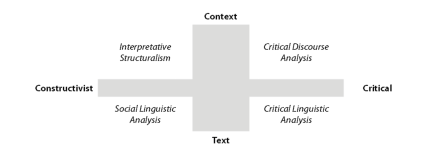
Figure 1: Different approaches to discourse analysis according to Philips and Hardy 2002
Source: Jansen 2008:108
The variety of critical discourse analysis most commonly used in political science is traditionally based on the repressive nature of power,[14] so the related definition attempts to understand the functioning of different discourses in the context of the expectations and rule systems constructed by those in power. The authors associated with this group are most inspired by Michel Foucault's theory of discourse, according to which "we must conceive discourse as a violence which we do to things, or in any case to practice which we impose on them; and it is in this practice that the events of discourse find the principle of their regularity".[15] From this starting point, there are two alternative ways to proceed. Postmodern discourse theories and analyses conceived in the spirit of the negation of 'meta-narratives'[16] can, ironically, often become ideological in character, ranging from interpretations that seek to expose the order of postcolonial discourse[17] to feminist criticism.[18] The other way, avoiding the trap set for the above authors, is much more similar to critical linguistic analysis, and is mostly content to focus "on the role of discourse in the (re)production and challenge of dominance"[19] through specific texts and/or particular practices.
In the light of "the new governmental thinking after 2010, which shows signs of strong centralisation",[20] it would be appropriate to interpret the institutionalisation of the smart village discourse in Hungary in terms of its role in the (re)production of dominance. However, the situation is more complex than that in practice. While it is true that the professional discourse on centre-periphery relations often concludes that the (power) centre generates asymmetric relations, it is also true that it "provides important services, development benefits, knowledge transfer, modernises the periphery, and creates links in
- 8/9 -
networks of spaces and actors".[21] Accordingly, the institutionalisation of the smart village concept can be seen as a process where the power centre - i.e. the administration - moves beyond (re)producing asymmetrical relations and/or ignoring the needs of the periphery, realising that the modernisation of rural areas/villages is in its own interests, if for no other reason than to ensure the political stability of the countryside. We could even go further, because the above-mentioned process would not so much be a discourse in the literal sense, but rather a one-way transfer of good practices related to the issue of smart villages, where the village in the process of becoming smart is satisfied with playing the passive role of a host. In contrast, both academic and policy approaches to rural development (the EU LEADER and CLLD programmes are good examples of the latter) recognise that local communities can play a key role in the introduction of various rural innovations.[22] Accordingly, within the framework of a discourse analysis, a further question obviously becomes unavoidable: To what extent can the periphery in the sense of power become a determining actor in the construction of meanings linked to the smart village discourse?
In the light of the above, our investigation moves away from critical discourse analysis towards a kind of interpretative structuralism. Tus, while we do not exclude the possibility of adding a kind of critical analysis to our study at a later stage of the research, we will for the time being focus our attention on the consensual components of discourse, trying to understand the logic of the discourse's functioning in as much detail as possible. This description can be considered 'thick'[23] in the sense that we attempt to describe and interpret the construction process of the meanings involved within the context of the discourse itself. The focus of our investigation must naturally be placed on the key concept of the discourse, the smart village. Our analysis is therefore concept-centred and, since it grasps the key concept in question as a product of the zeitgeist in its own development, it is also historical. It is historical, in a similar way to Reinhard Koselleck's research, which, on the basis of the methodology he proposes, directs "themselves to the semantics of central concepts in which historical experience of time is implicated".[24] Finally, the study does not aim to discuss the institutionalisation of the smart village problem in the Hungarian scientific literature, if only because (in contrast to the smart city) publications on smart villages and smart rural development have been sporadic until recently.[25] Therefore, our attention here and now is limited to the analysis of the political discourse that has fundamentally influenced rural municipalities and areas in Hungary.
- 9/10 -
The Institutionalisation of the Smart Village Discourse in Hungary
Due to its semi-peripheral location, Hungary is not among the pioneering countries in terms of either academic discourse or policies related to smart rural development. Nevertheless, it will become evident that Hungary's backwardness in the field of 'smart villages' and 'smart rural development' can hardly be considered significant. Below, I will divide the history of the institutionalisation of the smart village discourse in Hungary into two phases, which more or less overlap in time: in the first, so-called bottom-up phase, the process of meaning construction is still dominated by various local actors and/or grassroots initiatives, before the administration gradually took matters into their hands in the subsequent top-down phase.
The bottom-up phase
A useful insight into the bottom-up phase can be gained from a remark by Tímea Boda. In analysing the particularities of the development of disadvantaged rural areas, the author notes that "we must not forget the person who seeks paths and connections, who gives meaning to these terms, who gives them content, and who can act as an innovator in a given environment, building on given resources".[26] There is no doubt that these personal (possibly institutional) innovators, and the particular good practices they institutionalised, revealed a number of important components of the meaning of the smart village that later emerged. For example, the research conducted by Petra Kinga Kézai and Márta Konczosné Szombathelyi,[27] using the typology created by Mahroum, reports a number of specific examples of innovations developed in rural spaces, depending on whether they were triggered by rural, urban or universal demand. Innovation patterns triggered by rural demand include the automated banking service launched in the Alcsútdoboz region, Fejér County, under the name of Savings Smart Point (2017), which gives a distinctly technology-focused meaning to the concept of the smart village. The mobile post office established in the Ózd district of Borsod-Abaúj-Zemplén County, and the local currency, the 'Rigac', introduced in the municipality of Alsómocsolád, Baranya County, also have their own smart characteristics, even if the innovation in these cases is not primarily technology-driven. Among the patterns of innovation created by urban demand, the 'Village for rent' project in the municipality of Megyer, Veszprém County, which was launched in 2006 to renovate and advertise abandoned houses in the village with EU funding, turned out to be too dependent on the mayor-innovator, and after his resignation the innovation itself seems to have disappeared. Another interesting experiment was the memorial forest
- 10/11 -
created in 2014 in Agostyán, part of the city of Tata in Komárom-Esztergom County, where the ashes of deceased loved ones are placed in a biodegradable, environmentally friendly urn at the roots of a pre-selected memorial tree in the forest. Finally, the Renewable Energy Innovation Ecocentre, opened in 2007 in Nagypáli, Zala County, is a good example of innovation patterns created by universal demand. Trough pilot projects, training courses and practical advice, it organises temporary exhibitions, conferences, lectures and workshops on biomass, biogas, solar and wind energy, and on the potential uses and methods of implementing energy crops. The list could, of course, go on. Kézai and Konczosné Szombathelyi, for example, do not mention bottom-up rural innovations in the strictest sense of the word, which are not introduced by various (public) service providers (e.g. the Savings Smart Point or the mobile post office) or by local authorities (e.g. the "Village Publishing House!" project), but are linked to spontaneously-organised rural communities. A good example is the autonomous eco-community of Gyűrűfű in Baranya County, which was completely depopulated in the 1970s but which has now been revitalised by urban intellectuals moving to the countryside, currently numbering 35 inhabitants.[28]
However, these individual innovations and specific examples of good practice are not yet necessarily able to develop into a complex concept of the smart village. It would seem logical that such a construction process can only take place with the will and active participation of the properly resourced power centre - in essence, in the following top-down phase. However, considering the history of the Hungarian smart village discourse, it seems likely that such a view would underestimate the role of the periphery. It will become evident that in some aspects, the smart village discourse in Hungary had already achieved significant results before the concepts of 'smart village' and 'smart rural development' became part of the policies dominated by the administration. In contrast to the above-mentioned particular good practices, where the initiative of the business sector is often evident (such as in the case of the above-mentioned Takarék Smart Point, one of the innovations of the Takarékbank Group, or the mobile postal service of Magyar Posta Ltd.), in the case of complex, explicitly smart village type developments, we will pay special attention to the integrating role of the civil sector and/or local authorities. These stakeholders are of special importance for smart village type developments, if only because the involvement of the business sector cannot be taken for granted in rural areas with low population density and low profit potential, in contrast to the service-oriented initial phase of smart city type developments (Smart City 1.0 phase),[29] which is clearly linked to the market access efforts of large multinational companies.[30]
The contribution of the bottom-up phase to the concept of the smart village as we know it today is first illustrated by the history of the so-called telecottage movement. The origins of the international telecottage movement date back to 1985, the year when
- 11/12 -
Henrich Albrechsten, a retired oil engineer, set up the first telecottage (then without an internet connection) in the village of Vemdalen in northern Sweden.[31] The telecottage is a people-centred innovation whose purpose, as deined by the Hungarian Telecottage Association, is "to develop and shape the community and society, and through this to improve the quality of life of the people living in the village. The Telecottage is also a place which provides the opportunity to organise community programmes (i.e. events, activities), gives tools and assistance for everyday life, for the management of affairs, for the creation of a community scene. Telecottages can function as a community information service, and can be understood as a single community information network".[32] In practice, this means facilities well equipped with modern multimedia tools, which are set up in disadvantaged municipalities where such tools were difficult or impossible to access. In its original sense, the focus on the creation of telecottages - understood as mere information access points - reflected an initial, technologically-focused and optimistic phase in the development of the smart village discourse,[33] in which local actors believed that a very significant proportion of the disadvantages of peripheralisation could be overcome by providing peripheral municipalities with access to ICT tools and telecommunication networks. It has become clear, of course, that providing access alone does not remove the complex social barriers (for example, poor digital literacy rates) to digitalisation. However, on the one hand, it is worth acknowledging the pioneering efforts in this field, and on the other hand, it should be highlighted that, in parallel to the development of the telecottage movement, the concept of the telecottage itself has become more complex, shifting to the community-forming innovation centre of the above definition.
Apart from a short-lived, so-called 'information corner' in the library of Nagymágocs in Csongrád-Csanád County (which closed in 1995), the first telecottage in Hungary was established in 1993 in Csákberény, Fejér County. Its development can hardly be dissociated from the role of Mátyás Gáspár, an innovator who moved from the capital to Csákberény for family reasons and who held a management position in his public administration organisation company. In 1994, 15 librarians, IT specialists, sociologists, journalists, administrative experts, village developers and others who saw the potential in telecottages founded the Hungarian Telecottage Association (hereinafter: Association), aiming to develop the Csákberény initiative into a national movement.[34] MATÁV (Hungarian Telecommunication PLC) also saw an opportunity in the initiative and supported the connection of telecottages with free Internet access. Moreover, the International Telecommunication Union (ITU) also noticed the internationally remarkable results in Hungary, and a visit by experts to Csákberény organised by the ITU contributed significantly to the launch of the international telecottage movement.[35] Thanks to both
- 12/13 -
foreign and domestic funding, including the USAID-funded Democracy Network Programme and grants from various Hungarian ministries, the Association was soon on the way to achieving its goal: by May 2001, the number of telecottages and telehuts (the latter being small facilities, usually equipped with a single computer and linked to larger neighbouring telecottages) in Hungary exceeded 250.[36]
By 2003, the results of the telecottage movement, which basically started as a bottom-up organisation, had finally been integrated into the clearly government-dominated rural development discourse. In that year, the Association concluded an agreement with governmental bodies to implement the Public Network Programme (Közháló Program) aiming to develop network services, including access to electronic services and content, especially that linked to e-government, and to achieve digital literacy. The most important direct result of the programme was the introduction of the eHungary point service, operating in a public, multifunctional community service space with the services of eAdvisors, and the addition of 300 telecottages to the network service system.[37] The success of the eHungary Point service, which integrated the original objectives of the telecottage movement into a government-dominated discourse is well illustrated by the fact that by 2014 a total of 1,376 points had been registered, more than 80% of which were in municipalities with less than 10,000 inhabitants. Two thirds of the host institutions were libraries, municipalities, telecottages or cultural centres.[38]
As a result, the telecottage movement fundamentally shaped the development of the smart village discourse during the bottom-up phase. However, telecottages can only be interpreted as one tool, albeit a very important one, for the institutionalisation of smart villages. In the process of meaning construction, more importance needs to be accorded to the role of local actors and/or grassroots initiatives that were able to go beyond individual innovations and individual good practices and move the concept of the smart village towards a more complex/systematic approach. Although such examples are still exceptional in Hungary, one such exception, the village of Alsómocsolád, should be mentioned. According to an interview with the mayor-innovator László Dicső,[39] who has been leading the village since 1990, the small Baranya County village, of currently 313 inhabitants, has been interested in smart solutions since the second half of the 1990s. Its beginnings were clearly influenced by the telecottage movement: community access to ICT tools has been provided by the village's telecottage since 1997. However, the turning point for Alsómocsolád in it becoming a smart village had to wait until the mid-2010s, when their aforementioned innovation, the local currency 'Rigac', won the Quality Innovation Award of the Hungarian National Committee of the European Organisation for Quality (EOQ MNB). The mayor received the award in Tallinn in 2016, and during his discussions with delegates from several countries, he became aware of the smart city concept, by then well
- 13/14 -
known in academic and policy discourses. Thinking about this, and being somewhat 'ahead of its time' as we will see, at a time when the smart village was not yet at the centre of the EU's development policy discourse, the municipality of Alsómocsolád initiated and organised the first Smart Village workshop in Hungary on 3 May 2016. The most important element of the definition of smart village developed during that workshop is that the 'smart village' is not a watered-down version of 'smart city'. This drew the attention of the Hungarian academic and policy discourse to the concept and represented the start of the creation of the smart village in Hungary in a complex sense. During the interview, the mayor stated that for him, a smart village is more than a digital village. This is demonstrated by the fact that although the smart development of Alsómocsolád since 2016 has been associated with a number of digital innovations (such as the regional interactive public transport support system known as HazaTér; the planetarium, the Boeing simulator or the QR code walking trail representing tourism services), the focus is on achieving a more complex quality of life, greater efficiency and ecological and economic sustainability, and not only through digital solutions. Some good examples of this are projects aimed at improving the quality of life of older people living in the municipality, such as the 'Sample Programme for Quality Ageing' project funded by the Norwegian Civil Fund; or the ERASMUS+ Strategic Partnership Project 'Pro Age Preparing for Ageing', which includes 4 digital learning materials to help citizens prepare for active ageing, which was developed jointly by the Municipality of Budapest District XV and a Norwegian and a Slovenian partner. Finally, it should be noted that the good practice of Alsómocsolád soon spread beyond the borders of the municipality: the Okos Hegyhát Nyilatkozat (Smart Hegyhát Declaration) signed on 10 October 2018 was a decisive step towards the development of a smart region, in which the municipalities of five Baranya County municipalities (Alsómocsolád, Bikal, Mágocs, Mekényes, Nagyhajmás), under the guidance of Alsómocsolád, established the North Hegyhát Micro-Regional Union, the first 'Smart Region' of Hungary.[40]
The top-down phase
The top-down phase, where the administration gradually takes over the initiative from the periphery, in terms of power, is not without precedent. The emergence of digitalisation as a topic in development policy discourse can be observed from the mid-2010s. The turning point came with the protests against the Internet tax announced by the Minister of National Economy, Mihály Varga on 21 October 2014. In his regular morning radio interview on 31 October 2014, Prime Minister Viktor Orbán not only promised to withdraw the proposed tax, but also announced a national consultation on the Internet (InternetKon), which was finally held between 6 May and 30 September 2015. Taking into account the results of the InternetKon, the Government of Hungary addressed the problem
- 14/15 -
of digitalisation in Government Decision 2012/2015 (XII. 29.). Perhaps the most important result of the Government Decision is that the Government launched the Digital Success Programme (Digitális Jólét Program - DJP) "for the development and improvement of Hungarian society and the Hungarian national economy". The DJP was intended to be implemented "in the broadest possible professional and social consultation", which involves a call for the establishment of effective consultation forums and channels with market players, professional bodies and civil society organisations involved in the development of the digital ecosystem, under the leadership of the Prime Minister's Commissioner responsible for the coordination and implementation of government tasks related to the DJP. The aim is to achieve the digitalisation of the domestic economy and society, with a key role for "ensuring widespread accessibility and affordability of the Internet".
From the perspective of the concept of the smart village, point 2(j) of the Government Decision perhaps deserves the most attention. This provided for the launch of a consultation mechanism involving service providers, municipal government representatives and other stakeholders, which could lead to the establishment and operation of a free public broadband wireless Internet service (WiFi) in at least one public building and in at least one public space in every municipality. This text, which is very similar to the original aim of the telecottage movement (access to ICT tools in every peripheral municipality) and its institutional system (eHungary points growing out of telecottages), can be interpreted as the starting point of the commitment of the power centre to the periphery, which in addition to other sections of the Government Decision not (only) relevant to the countryside, e.g. developing the digital competitiveness of small and medium-sized enterprises could have provided a basis for further development towards a later, more complex smart village discourse.
However, the power centre - and with it the DJP - initially remained involved in the process of meaning construction in a rather contradictory way. The continuity with the bottom-up phase is well illustrated by Government Decree 127/2017 (VI. 8.), which established the so-called DJP points on the basis of the existing network of eHungary points in Hungary. Apart from the name change, these DJP points gave a new momentum to the digitalisation of rural areas in several ways. In addition to the existing eHungary Points, a number of new organisations have been able to join the renewed network, which is mainly attributable to the resources of the Economic Development and Innovation Operational Programme (Gazdaságfejlesztési Innovációs Operatív Program - GINOP). GINOP funding has also enabled the technological upgrade of around 1,500 DJP points (standardised equipment packages, bandwidth increase and free WiFi) and the modernisation of advisory services (training of DJP mentors to replace former eAdvisors). It is important to underline that the development of the renewed network of DJP points has also focused on improving the digitalisation of disadvantaged rural settlements: for example, the most developed NUTS 1 region of Central Hungary did not beneit at all from the GINOP grant.[41] As a result, by
- 15/16 -
13 March 2022, the DJP point search engine of the DJP network website already contained the contact details of 1,725 DJP points of mostly rural small municipalities.[42] The only problem is that the service portfolio of the mushrooming DJP points is still dominated by Internet access and, with it, access to electronic public services, while the community-forming, innovation centre function, typical of the emerging phase of the telecottage movement, has been pushed into the background. In an interview with Mátyás Gáspár, the founder of the Hungarian Telecottage Association, he said that the state, in a way that was part of the centralisation reflexes that were observed after 2010, treated the system as its own, and this also meant that the service system of the telecottages, which originally focused on local needs, was becoming 'shallow and uniform'.[43] Taking into account the changing local needs of each region and exploiting the potential of the DJP points to expand their service portfolio is therefore one of the key challenges for the DJP points network in the near future.
Apart from the growth of the network of DJP points, the evolution of the smart village discourse in the second half of the 2010s was even slower. Although several important sectoral digitalisation strategies were adopted within the DJP (Hungary's Digital Education Strategy, Hungary's Digital Export Development Strategy and Hungary's Digital Startup Strategy) in 2016, the Digital Success Programme 2.0, a strategy document setting out the overall vision of digitalisation in Hungary, that was adopted in July 2017, still makes little mention of rural digitalisation. Mentions of people living in 'rural white spots' in the chapter on the Digital Work Programme,[44] the commitment to the "development and cohesion of smaller municipalities and underdeveloped rural areas", and the declaration of their inclusion in the Smart City-type developments of priority areas, primarily tourist destinations, can be regarded as scattered references at best.[45] Typical of these is point 3.4.2, entitled Digital Agricultural Strategy. Support for the Digital Development of Agricultural Regions, which takes a sectoral rather than a rural approach: the fact that the term 'rural' is not used once in this text, and that the Strategy's author prefers to use the term "agricultural regions",[46] is in itself revealing.
The results of the top-down phase up to this point are therefore rather mixed. A real turning point will only be reached when the smart village problem is systematically formulated and implemented by the administration. If it is possible to identify this turning point with a single date, it should be 19 November 2020. That was when Alpár Gyopáros, the government commissioner responsible for the development of modern settlements, announced at the Civitas Sapiens '20 smart city online conference that the Government of Hungary would announce the rollout of the Digital Village Programme (hereinafter:
- 16/17 -
Digitális Falu Program - DFP).[47] This raises the question: what happened around the autumn of 2020 that potentially triggered the changes in the smart approach to include rural and village development policy? Several factors may explain this. It seems obvious that the Covid-19 pandemic and the consequences of the strict lockdown in spring 2020 naturally drew the government's attention to the potential of digitalisation, not only in the field of rural development, but definitely including it. The picture can be further nuanced by highlighting the impact of the infiltration of the EU's smart village discourse. Although publications related to certain elements of the theme of smart villages had already appeared in the academic sphere after the turn of the millennium,[48] the determining turning point for our study occurred only when EU rural development policies started to take a keen interest in both the narrower (technological) and broader (social) issues of digitalisation. This breakthrough was one of the key features of the 2014-2020 programming period: perhaps, without being exhaustive, the EU Action for Smart Villages Package,[49] developed in 2017, and the The Bled Declaration for a Smarter Future of the Rural Areas in EU,[50] adopted on 13 April 2018, could be the most important milestones in this process.
In addition to providing a definition of smart villages and mapping the problems associated with them, in line with the academic discourse, the above documents also identify EU policy areas and funds that can actively support ideas for the development of smart villages. Tus, the Bled Declaration identifies 'four large funding instruments' to stimulate the development of rural areas, namely the Common Agricultural Policy (CAP), the Horizon 2020 research and innovation funding programme (during the current programming period: Horizon Europe), the European Structural and Investment Funds and the European Fund for Strategic Investments (during the current programming period: InvestEU Fund).[51] The DFP could even serve as a useful starting point for preparing the rural communities to successfully access the various EU (and possibly other, e.g. nationally funded) funds that will be opened up in the 2021-2027 programming period. The DFP, which admittedly relies on the European Union discourse, i.e. the ENRD methodology, and highlights the role of the CAP, perhaps the most important large funding instrument from the point of view of the EU's Smart Village discourse, also draws attention to the fact that in the period from 2021 to 2027, "the Commission has decided to include the Smart Village initiative in the Common Agricultural Policy (CAP) Strategic Plans [...] being prepared at national level", and thus it is also among the mandatory actions of the Hungarian CAP strategy.[52]
- 17/18 -
In terms of the top-down phase that will unfold from autumn 2020, a key question is whether the government wants to impose its preferred definition of smart village on the periphery, or whether instead it is willing to give a more serious - as it were, partnering - role to rural municipalities to allow them to autonomously define their own concept of the smart village. This question should not be ignored, because the conceptual history of the smart city, the direct predecessor of the smart village, would at first sight lead us to a kind of critical approach. In Hungary, the definition of the smart city was introduced by the legislator in 2017 in Government Decree 314/2012 (XI. 8.), which is the basic legal document of municipal-level planning, and this definition reflects in a specific way the dominance of the administration in the process of meaning construction. According to paragraph 2 point 5(b) of the Government Decree, a smart city is "a municipality that prepares and implements its integrated settlement development strategy (the subsequently renamed settlement development plan) on the basis of a smart city methodology". Based on the content requirements of Annex 3 of Government Decree 419/2021 (VII. 15.), the Lechner Knowledge Centre Nonprofit Limited Liability Company, a professional background institution of the Prime Minister's Office in the fields of architecture, construction, real estate registration and spatial information, is solely responsible for the development of the methodology in question.[53] The situation appears to be very similar in the case of the smart village discourse. The DJP as a series of political actions launched by the Government ceased to exist at the end of July 2022,[54] and the DFP was subsequently taken over by an institution owned by the Hungarian State, the Neumann János Nonprofit Public Benefit Ltd. (hereinafter: Neumann Ltd.). However, in developing smart village methodology, Neumann Ltd., like its predecessor the DJP, is not so much focused on forcing the adoption and use of a preferred methodology, but rather on helping smart capabilities to flourish.[55]
From this perspective, it is worth examining the 12 actions listed on the DFP website (Table 2). The majority of these actions are vertical in nature (i.e. relevant only to specific sectors such as waste and energy management, air quality protection or agricultural development), but some are horizontal. The latter help local actors to make their communities smarter in a non-sector-specific way. Below I refer in more detail to horizontal actions 4, 5 and 1.
- 18/19 -
Table 2: Actions listed on the DFP website
| 1 | Municipality probe |
| 2 | Let's move to the countryside! Resettlement and investment platform |
| 3 | Buying and selling community, digital farmers' market |
| 4 | Digital spatial development specialist training |
| 5 | Digital spatial development specialist training, alumni network |
| 6 | Municipal drone applications |
| 7 | Career village labour market module |
| 8 | Municipality air quality monitoring, detection and penalties |
| 9 | Energy community |
| 10 | Integrated waste management |
| 11 | Protection of persons and property |
| 12 | Digital services and electronic payment ecosystems |
Source: Digital Village Programme s. a.
According to an interview conducted in 2021 with Attila Balla, the Deputy Managing Director of the Digital Wellbeing Nonprofit Ltd., who was responsible for the DJP and who currently holds the same position at Neumann Ltd., the training of local competences capable of adapting the digitalisation-related scientific and professional discourse to the local development policies can be rightly called the starting point of the preparation.[56] The various training programmes developed for this purpose began to be offered by higher education institutions in Hungary in the late 2010s. The first complex degree level training on the topic of smart cities was the postgraduate training course entitled Digital Spatial Development Specialist, launched in 2018 by the Civitas Sapiens Workshop in cooperation with the University of Public Service, Edutus University and the Moholy-Nagy University of Art and Design. Although the course, which requires a university degree as an entry requirement, has so far been completed by a number of key players in digital spatial development (for example, according to a questionnaire sent out by the author, the mayor of the municipality of Alsómocsolád, the deputy state secretary and the head of department of the Ministry of the Interior),[57] the total number of students (as of autumn of 2021, 52 diplomas had been awarded) hardly represents a breakthrough.[58] This is why a simplified, online version of the Digital Spatial Development specialisation and an alumni network for graduates could be of particular importance. Those who successfully complete the 4-week training course, which requires a secondary education as its entry requirement, will receive a Digital Spatial Development Specialist training certificate. The aim of the course, according to the promoters of the training, is "to have
- 19/20 -
a professional in each municipality who has completed the training, thus being able to successfully participate in the digitalisation and smart transformation of the management of their own- and the surrounding towns/villages".[59] According to Attila Balla, nearly 1,300 Hungarian municipalities within and outside of Hungary had registered for this webinar training starting in January 2021, laying the foundations for the development of a national network that truly understands the concept of digitalisation.
Smart villages can also be helped by the so-called 'municipality probes',[60] which formulate proposals on the most optimal path to becoming a smart village for the municipalities concerned. In the current context, the term 'proposal' is perhaps the key: it is not that the administration wants to impose its own smart village approach on local actors, but rather that it is attempting to partner with villages in the brainstorming phase, where the DFP is mainly involved with providing the technical-methodological background. The methodological tools required for the municipality probes (analysis and processing of existing strategies, analysis of local statistical data, in-depth interviews with opinion leaders, online questionnaires) are of course complex and costly, and it is difficult to imagine the generalised application of such a scale of research for disadvantaged rural municipalities without a higher level of central funding and/or grant funding. For this reason, the various municipality probes are currently still linked to and carried out in the framework of pilot projects in about 40 (mostly more urban) municipalities.
Although the Smart City Marketplace platform[61] launched by the DJP in January 2022 is outside of the scope of the above actions, it could make a significant contribution to their success. This quality-assured platform will enable suppliers, developers and potential customers of smart city (and smart village) products to find each other more quickly and easily than before. All this suggests that the Hungarian administration does not necessarily wish to dominate the smart discourse in this area. On the contrary: in addition to various local actors and/or grassroots initiatives, it also allows certain market actors to play a role in shaping the discourse on smart cities and smart villages.
The 2021 Digital Village of the Year Competition
Near the end of this analysis, it is worth summarising some of the lessons learned from the Digital Village of the Year competition,[62] which was launched for the irst time in 2021. The DJP introduced the competition for municipalities with fewer than 5,000 inhabitants that use digital innovations, with the aim of "being able to use and showcase their digital developments as widely as possible, exploiting their potential".[63]
- 20/21 -
The competition was open to eligible municipalities in four categories - 'Innovative Settlement Environment', 'Sustainable Built and Natural Environment', 'Innovative Social and Community Well-being', 'Innovative Economic Ecosystem' - as set out in the application documents.[64]
In the context of a discourse analysis, it is first worth highlighting that the call for proposals seems to support the DFP's aim of helping municipalities interested in a smart approach to develop their potential. This seems to be confirmed by the prizes offered to the winners. Not counting the cash prize of HUF 1 million, which is hardly sufficient to fully exploit the potential of the proposals, the focus was instead on the possibility of participating in the municipality probe free of charge and being able to register for the Smart Marketplace platform, also free of charge. The key question beyond this is: How can the competition be evaluated in terms of enriching the meaning of the smart village? Based on the content of the call for proposals, the picture is rather positive. Of course, the categories here clearly refer to a central component of the EU and governmental smart village discourse, since:
- the category 'Sustainable Built and Natural Environment' reflects the importance of sustainability (from an energy point of view)
- the category 'Innovative Social and Community Well-being' reflects the importance of removing societal barriers to digitalisation
- the category 'Innovative ecosystem' reflects the importance of smart economic development
Nevertheless, the loose application criteria for the category of "Innovative Municipal Environment" - apart from the somewhat unjustified overemphasis on 'digital mobility systems' - allowed applicants to focus on and employ their own preferred meaning of the smart village concept. This was also the view of the independent professional jury. The winner of the category was Alsómocsolád, which, as we have already seen, has achieved significant results not only in the field of digital (mobility) systems. The main reason for the municipality's success was probably not the individual results detailed in the application documents, but the complex/systematic approach.
The overall picture is less positive in terms of the total number of participants and the general quality of the applications. Only 15 municipalities applied to the call for applications, which was open to all Hungarian municipalities with fewer than 5,000 inhabitants. As detailed in sub-section The bottom-up phase, the villages which won the Innovative Municipal Environment and Sustainable Natural and Built Environment categories (Alsómocsolád and Nagypáli) have been dominant among the Hungarian smart villages from the outset. In the case of Alsómocsolád in particular, this award can be interpreted as a kind of 'lifetime achievement award', a recognition of the successes it has achieved so far. The winners of the Innovative Social and Community Well-being and the Innovative
- 21/22 -
Economic Ecosystem categories (Füzérradvány and Rábapordány) are newer players. In the case of Füzérradvány, Borsod-Abaúj-Zemplén County, the focus was more on the 'becoming smart' of the municipality in general ('Digital media literacy' lectures for the elderly, the provision of CCTV cameras, the construction of a solar energy system to power the local church), while Rábapordány, in Győr-Moson-Sopron County won recognition for an automated pig farm, unique in Hungary but also a rarity in Europe, which met the jury's approval.
The remaining applications received were mostly of poor quality and/or focused on a particular smart solution. As the top-down phase of the smart village discourse continues, and will hopefully be completed in the near future, the administration will thus have further important tasks to perform. Most of all, it should reinforce the importance of the local level, which, with a few isolated exceptions, is still insufficiently involved in shaping the smart village discourse. In the current period of economic crisis, the underfunding of the local government sub-system is becoming increasingly apparent. In such circumstances, access to at least the Municipality Probe and the Smart Marketplace platform should be provided free of charge, not only to the winners of such tenders, but to all interested municipalities. Consideration should also be given to further developing the alumni network, with a view to a broader knowledge exchange. It may be advisable to set up a 'smart village example library' to collect and organise international and Hungarian academic literature as well as examples of good practice. At the same time, a more informal, dedicated knowledge centre format, similar to the network of Local Community Academies[65] already implemented in an earlier project at the Ludovika University of Public Service, could also be given a prominent role. Even the local level can be a partner in such efforts of the administration: the mayor of Alsómocsolád, who achieved perhaps the most significant results in the bottom-up phase, clearly expressed in the interview conducted with him his commitment to setting up a "methodological centre in a small village environment" which could play an active role in disseminating the smart village concept.[66]
Conclusions
The attempted analysis of the institutionalisation of the development of the smart village concept in Hungary with the methodological tool of discourse analysis has furnished several useful insights. Most of all, we tried to prove that the institutionalisation of the political discourse on smart villages and/or smart rural development in Hungary cannot be interpreted only - and perhaps not even primarily - within the framework of a so-called 'critical discourse analysis' that interprets the process in terms of its role in (re)producing or challenging domination. Instead, the discourse analysis technique we propose has
- 22/23 -
resembled a kind of interpretative structuralism, paying more attention to the consensual components of the discourse in question. As a result, it was possible to show that in Hungary, the local level (in particular certain civil or municipal actors), although located further away from the centre of power, played a decisive role in the construction of the meaning components related to the smart village in the initial, bottom-up phase of the discourse. Moreover, it seems that even in the later, top-down phase of the smart village discourse, it is not appropriate to overemphasise the importance of asymmetric power relations dominated by the power centre: the analysis of the DFP showed that the administration is still trying to involve those local actors that are interested in smart approaches and to encourage them to actively participate in the process of meaning construction. Of course, the overall picture is not entirely clear-cut: the analysis has also pointed to some of the problems stemming from the immaturity of the Hungarian smart village discourse that need to be addressed in order to move forward. However, in the light of our results so far, which have highlighted the importance of the consensus components of the smart village discourse in Hungary, this does not seem to be an insurmountable task.
References
Atkočiunienė, Vilma - Vaznonienė, Gintarė (2019): Smart Village Development Principles and Driving Forces: The Case of Lithuania. European Countryside, 11(4), 497-516. Online: DOI: https://doi.org/10.2478/euco-2019-0028
Balla, Attila (2021): Új irányok a digitális térségfejlesztésben [New Directions in Digital Spatial Development]. In A vidéki Magyarország a pandémia korában. RKI Falukonferencia [Rural Hungary in Times of the Pandemic. RKI Village Conference]. PPT Presentation. Pécs: KRTK Regionális Kutatások Intézete. Online: http://falukonferencia.rkk.hu/eloadasok/balla.pdf
Boda, Tímea (2013): Az innováció a vidék fejlődésének a kulcstényezője [Innovation Is Key to Rural Development]. Economica, Special Edition, 102-110.
Butler, Judith (1995): Contingent Foundations: Feminism and the Question of 'Post-Modernism'. In Benhabib, Seyla - Butler, Judith - Cornell, Drucilla - Fraser, Nancy (eds.): Feminist Contentions. A Philosophical Exchange. New York - London: Routledge. 35-58. Online: https://doi.org/10.1017/CBO9780511570940.011
Civitas Sapiens Smart City Knowledge Centre (s. a.): Településszonda [Municipality Probe]. Civitas Sapiens Okos Város Tudásközpont. Online: www.civitassapiens.hu/okos-varos-mintaprojektek
Civitas Sapiens Smart City Knowledge Centre (2022): Elindult az Okos Város Piactér Platform [The Smart City Marketplace Platform Has Been Launched]. Civitas Sapiens Okos Város Tudásközpont. Online: www.civitassapiens.hu/post/elindult-az-okos-varos-piacter-platform
Cohen, Boyd (2015): The 3 Generations of Smart Cities. Fast Company, 08 October 2015. Online: www.fastcompany.com/3047795/the-3-generations-of-smart-cities
- 23/24 -
Crouzet, François (1996): France. In Teich, Mikuláą - Porter, Roy (eds.): The Industrial Revolution in National Context. Europe and the USA. Cambridge - New York - Melbourne: Cambridge University Press. 36-63.
Dicső, László - Varga, Péter (2019): Okos falu, okos térség program fejlesztési lehetőségei egy - a rendszerváltás óta ugyanazon közösségért dolgozó - kistelepülési polgármester szemével [The Development Potential of the Smart Village, Smart Region Programme as Seen through the Eyes of a Small Village Mayor Who Has Been Working for the Same Community since the Change of Regime]. Új Magyar Közigazgatás, 1(3), 62-69.
Digitális Jólét Program 2.0 [Digital Success Programme 2.0] (2017). Online: https://digitalisjoletprogram.hu/files/30/49/304943b37e297ac422f43c46ee5834a1.pdf
Digitális Jólét Program Zárókiadvány [Digital Success Programme Final Publication] (2022). Online: https://digitalisjoletprogram.hu/hu/kiadvanyaink
Digital Village Programme (s. a.). Online: https://digitalisfalu.hu/
Edutus University (s. a.): Digital Spatial Development Specialist Webinar Training Course. Online: www.edutus.hu/oktatas/felnottkepzesi-programok/digitalis-tersegfejlesztesi-referens-webinariumi-kepzes/
ENRD (s. a.): Smart Villages. Working Definition. European Network for Rural Development. Online: https://enrd.ec.europa.eu/smart-and-competitive-rural-areas/smart-villages/smart-villages-portal_en
European Commission (2017): EU Action for Smart Villages.
European Commission - European Parliament (2018): Smart Villages. Bled Declaration for a Smarter Future of the Rural Areas in the EU. Having regard to the conclusions of the meeting at Bled, Slovenia on 13 April 2018.
Fonseca, Luis Miguel (2018): Industry 4.0 and the Digital Society: Concepts, Dimensions and Envisioned Benefits. Sciendo, 12(1), 386-397. Online: https://doi.org/10.2478/picbe-2018-0034
Foucault, Michel (1981): The Order of Discourse. In Young, Robert (ed.): Untying the Text. A Post-Structuralist Reader. Boston - London - Henley-on-Thames: Routledge & Kegan Paul. 48-78.
Gáspár, Mátyás (2019): Az okos falu - egy másik falu. Az új lokalizmus, mint az okos falu és térség fejlesztésének tágabb gondolkodási kerete [The Smart Village - Another Village. The New Localism as a Broader Framework for Thinking about the Development of Smart Villages and Regions]. Új Magyar Közigazgatás, 12(3), 12-19.
Geertz, Clifford (1973): Thick Description: Toward an Interpretive Theory of Culture. In Geertz, Clifford (ed.): The Interpretation of Cultures. Selected Essays. New York: Basic Books. 3-30.
Gere, László - Kocsis, János Balázs (2022): Az okosváros-tervezés fejlődéstörténete kritikai megközelítésben [A Critical Approach to the Evolution of Smart City Planning]. Tér és Társadalom, 36(3), 108-129. Online: https://doi.org/10.17649/TET.36.4.3398
- 24/25 -
Hardy, Cynthia - Harley, Bill - Phillips, Nelson (2004): Discourse Analysis and Content Analysis: Two Solitudes? Qualitative Methods, 19-22. Online: https://doi.org/10.5281/zenodo.998649
Hungarian Telecottage Association (s. a.): Teleház [Telecottage]. Online: www.telehaz.hu/
Hyland, Ken - Paltridge, Brian - Wong, Lillian L. C. (2021): Introduction. In Hyland, Ken - Paltridge, Brian - Wong, Lillian L. C. (eds.): The Bloomsbury Handbook of Discourse Analysis. London - New York - Dublin: Bloomsbury Academic. 1-6. Online: https://doi.org/10.5040/9781350156111.ch-00I
Jansen, I. (2008): Discourse Analysis and Foucault's "Archaeology of Knowledge". International Journal of Caring Sciences, 1(3), 107-111. Online: http://internationaljournalofcaringsciences.org/docs/Vol1_Issue3_01_Jansen.pdf
Kaiser, Tamás (2022): Empowering, Transferring and Downscaling: Three Steps towards Implementing Smart Village Strategies. In Deli, Gergely - Müller-Török, Robert - Prosser, Alexander - Scola, Dona - Urs, Nicolae (eds.): CEE eDem and eGov Days 2022. Hate Speech and Fake News. Wien: Austrian Computer Society. 38-45. Online: https://doi.org/10.1145/3551504.3551561
Kákai, László - Vető, Balázs (2019): Állam vagy/és önkormányzat? Adalékok az önkormányzati rendszer átalakításához [State or/and Local Government? Contributions to the Transformation of the Local Government System]. Politikatudományi Szemle, 28(1), 17-41. Online: https://doi.org/10.30718/POLTUD.HU.2019.1.17
Káposzta, József - Honvári, Patrícia (2019): A smart falu koncepciójának főbb összefüggései és kapcsolódása a hazai vidékgazdaság fejlesztési stratégiájához [The Main Contexts of the Smart Village Concept and Its Links to the Development Strategy of the Hungarian Rural Economy]. Tér és Társadalom, 33(1), 84-97. Online: https://doi.org/10.17649/TET.33.L3091
Kézai, Petra Kinga - Konczosné Szombathelyi, Márta (2021): A rurális innováció európai és hazai példái [European and Hungarian Examples of Rural Innovation]. Tér-Gazdaság-Ember, 9(1), 51-76.
Kiss, Éva - Tiner, Tibor (2021): Az ipari forradalmak és az infokommunikációs fejlődés földrajzi összefüggései a nemzetközi szakirodalom tükrében [The Geographical Context of Industrial Revolutions and Infocommunication Development in the International Literature]. Földrajzi Közlemények, 145(2), 89-105. Online: https://doi.org/10.32643/fk.145.2.1
Kondratieff, Nikolai D. (1993) [1925]: Long Cycles of Economic Conjuncture. In Abalkin, Leonid (ed.): Selected Works. Moscow: Ekonomika. 24-83.
Koselleck, Reinhart (1990): Futures Past. On the Semantics of Historical Time. Translated by Keith Tribe. Cambridge, Mass. - London: The MIT Press.
Kovács, Győző (2001): Telecottages in Hungary. Journal of Computing and Information Technology, 9(2), 153-160. Online: https://doi.org/10.2498/cit.2001.02.06
Kulcsár, László - Hohl, Ferenc - Obádovics, Csilla (2009): Telecottages: Hopes and Results in Rural Development. In Kovács, Péter - Szép, Katalin - Katona, Tamás (eds.):
- 25/26 -
Challenges for Analysis of the Economy, the Businesses, and Social Progress. International Scientific Conference, Szeged, 19-21 November 2009. Szeged: Universitas Szeged Press. 1160-1175. Online: http://acta.bibl.u-szeged.hu/57864/1/proceedings_of_the_challenges_for_analysis_1160-1175.pdf
Lyotard, Jean-François (1979): La condition postmoderne. Paris: Les Edition du minuit. Magyar Építők (2021): Felpörög a Digitális Falu Program [Digital Village Programme gets off the ground]. Magyar Építők, 25 March 2021. Online: https://magyarepitok.hu/aktualis/2021/03/nekunk-elsokent-a-magyar-videket-kell-tamogatni-es-vonzova-tenni-a-digitalizacio-altal-ez-ma-a-legfontosabb-feladatunk-felporog-a-digitalis-falu-program
Mahroum, Sami (2007): Overview: Rural Innovation. In Mahroum, Sami - Atterton, Jane - Ward, Neil - Williams, Allan M. - Naylor, Richard - Hindle, Rob - Rowe, Frances (eds.): Rural Innovation. London: NESTA. 4-11. Online: https://media.nesta.org.uk/documents/rural_innovation.pdf
Matern, Antje - Binder, Julia - Noack, Anika (2020): Smart Regions: Insights from Hybridization and Peripheralization Research. European Planning Studies, 28(10), 2060-2077. Online: https://doi.org/10.1080/09654313.2019.1703910
Murray, Bill (2001): The Hungarian Telecottage Movement. In Latchem, Colin - Walker, David (eds.).: Perspectives on Distance Education. Telecentres: Case Studies and Key Issues. Vancouver: The Commonwealth of Learning. 53-65.
Némediné Kollár, Kitti (2022): Az okos és autonóm falvak területi összefüggései [Territorial Context of Smart and Autonomous Villages]. Studia Mundi - Economica, 9(1), 57-67. Online: https://doi.org/10.18531/Studia.Mundi.2022.09.01.57-67
Nemes Nagy, József (2009): Terek, helyek, régiók. A regionális tudomány alapjai [Spaces, Places, Regions. Introduction to Regional Science]. Budapest: Akadémiai Kiadó.
North Hegyhát Micro-Regional Union (2019): Okos Hegyhát Stratégia - Magyarország Okos Falu Térségi Pilot Programja. Az Okos Hegyhát Program (OHP) részletes stratégiájának tervezete [Smart Hegyhát Strategy - Hungary's Smart Village Regional Pilot Program. The Draft Detailed Strategy of the Smart Hegyhát Program - SHP]. Észak-Hegyháti Mikrotérségi Unió. Online: https://eszakhegyhatiunio.files.wordpress.com/2019/07/okos-hegyhc3a1t-stratc3a9gia_rc3a9szletes_fin.pdf
Okosipar.hu (2022): Rábapordányon átadták Az Év Digitális Faluja díj újabb elismerését [Another Digital Village of the Year Award Was Presented in Rábapordány]. Okosipar.hu, 19 March 2022. Online: www.okosipar.hu/rabapordanyon-atadtak-az-ev-digitalis-faluja-dij-ujabb-elismereset/
Pálné Kovács, Ilona (2021): A centralizáció és a perifériák fejlődési esélyei [Centralisation and Peripheral Development Opportunities]. Tér és Társadalom, 35(4), 215-240. Online: https://doi.org/10.17649/TET.35.4.3372
Phillips, Nelson - Hardy, Cynthia (2002): Discourse Analysis. Investigating Processes of Social Construction. Tousand Oaks - London - New Delhi: SAGE Publications.
Said, Edward W. (1978): Orientalism. New York: Pantheon Books.
- 26/27 -
Sharifi, Ayyoob - Allam, Zaheer - Feizizadeh, Bakhtiar - Ghamari, Hessam (2021): Tree Decades of Research on Smart Cities: Mapping Knowledge Structure and Trends. Sustainability, 13(13). Online: https://doi.org/10.3390/su13137140
Szalai, Ádám - Fabula, Szabolcs (2021): Az okos vidékfejlesztés lehetőségei és korlátai Magyarországon [The Opportunities and Constraints of Smart Rural Development in Hungary]. Modern Geográfia, 16(1), 59-79. Online: http://doi.org/10.15170/MG.2021.16.01.04
Szilassi, Andrea (2017): eMagyarország pontok metamorfózisa - Startol a GINOP 3.3.1. [Metamorphosis of eHungary Points - Launch of GINOP 3.3.1.]. Kemlib, 7(9-10), 35-36.
Teleház (2013): Bevezetés a teleházba. 1. fejezet [Introduction to the Telecottage. Chapter 1]. In Munkaerőpiaci modellek és e-szolgáltatások a teleházban [Labour Market Models and E-Services in the Telecottage]. DemNet TÁMOP 5.2.5 - Új Széchenyi Terv. Online: https://telehaz.wordpress.com/2013/03/15/elso-fejezet-bevezetes-a-telehazba/
University of Public Service (2015): Fejlesztő közösségek. A Helyi Közösségi Akadémiák Hálózata [Developing Communities. The Local Community Academies Network]. Budapest: Nemzeti Közszolgálati Egyetem. Online: http://real.mtak.hu/62198/1/HKA_kiadvany_final.pdf
Van Dijk, Teun A. (1993): Principles of Critical Discourse Analysis. Discourse and Society, 4(2), 249-283. Online: https://doi.org/10.1177/0957926593004002006
Varga, Zoltán (2015): Az eMagyarország pontok és a könyvtárhálózat szinergiái [Synergies between eHungary Points and the Library Network]. Debrecen: KSZR Műhelynapok. Online: https://ki.oszk.hu/sites/default/files/dokumentumtar/varga_zoltan.pdf
Világgazdaság (2020): Indul a Digitális Falu Program [The Digital Village Programme Is Launched]. Világgazdaság, 20 November 2020. Online: www.vg.hu/kozelet/technologia-tudomany/indul-a-digitalis-falu-program-3384982/
Weber, Max (1965) [1925]: The Theory of Social and Economic Organization. New York: Free Press.
Legal references, primary and secondary sources
Government Decree 314/2012 (XI.8.) on the Settlement Development Concept, the Integrated Settlement Development Strategy and Settlement Planning Instruments, as Well as on Certain Specific Legal Instruments of Settlement Planning
Government Decree 127/2017 (VI. 8.) Amending Government Decree 268/2010 (XII. 3.) on Certain Tasks Related to the Implementation of the Digital Success Programme and on the Government Information Technology Development Agency
Government Decree 419/2021 (VII. 15.) on the Content, Preparation and Adoption of Settlement Plans, and on Certain Specific Legal Measures for Settlement Planning
- 27/28 -
Government Decision 2012/2015 (XII.29.) on the Government's Digital Success Programme Based on the Results of the National Consultation on the Internet and Digital Developments (InternetKon)
DJP Point search engine. Available from the website of the DJP point network, 13 March 2022. Online: https://djphalozat.hu/djp-pontok
Documentation for the 2021 Digital Village of the Year competition. With the consent of DJP, available from the Author.
Online interview with László Dicső, mayor of Alsómocsolád. 10 December 2022. Text of the interview available from the Author.
Online interview with Mátyás Gáspár, founder of the Hungarian Telecottage Association. 10 December 2022. Text of the interview available from the Author.
Questionnaire for students of the postgraduate training course 'Digital Spatial Development Specialist'. Prepared and evaluated by the Author. The questionnaire will be collected between 8-22 March 2022.
Tibor László Buskó, PhD (1975) is a Senior Lecturer at the Ludovika University of Public Service, Faculty of Public Governance and International Studies, Department of Public Management and Information Technology. He has more than a decade of experience in higher education in the field of regional and urban studies. His research focuses on the management of local public services, urban and rural development and regional policies at the EU and national level. ■
NOTES
[1] TKP2021-NKTA-51 has been implemented with the support provided by the Ministry of Culture and Innovation of Hungary from the National Research, Development and Innovation Fund, financed under the TKP2021-NKTA funding scheme.
[2] Crouzet 1996: 45.
[3] Kondratieff 1993 [1925]: 24-83.
[4] Fonseca 2018: 386-397.
[5] Kiss-Tiner 2021: 90-91, 97.
[6] For more on the history of the concept see Sharifi et al. 2021.
[7] ENRD s. a.
[8] Matern et al. 2020: 2060-2077.
[9] Mahroum 2007:4-11.
[10] Nemes Nagy 2009.
[11] Hyland et al. 2021: 1.
[12] Hardy et al. 2004: 20.
[13] Phillips-Hardy 2002.
[14] As for Weber 1965 [1925]: 152, power is "the probability that one actor within a social relationship will be in a position to carry out his own will despite resistance, regardless of the basis on which his probability rests".
[15] Foucault 1981: 67.
[16] Cf. Lyotard 1979.
[17] Said 1978.
[18] Butler 1995: 35-58.
[19] Van Dijk 1993: 249.
[20] Kákai-Vető 2019: 24.
[21] Pálné Kovács 2021: 218.
[22] Kézai - Konczosné Szombathelyi 2021: 51-76.
[23] Cf. Geertz 1973: 3-30.
[24] Koselleck 1990: XXIV.
[25] The concept of smart village and smart rural development in the Hungarian academic literature was first discussed in a systematic way by the local actors who are most active in smart village type developments, such as Gáspár 2019: 12-19; as well as Dicső-Varga 2019: 62-69. Among the first achievements of researchers in academia, the following publications are worth highlighting: Szalai-Fabula 2021: 59-79; Kaiser 2022:38-45.
[26] Boda 2013:106.
[27] Kézai - Konczosné Szombathelyi 2021: 66.
[28] Némediné Kollár 2022: 65-66.
[29] Cf. Cohen 2015.
[30] Cf. the first comprehensive smart city experiment in Hungary, the T-City Szolnok programme, which was aimed at testing the Magyar Telekom Plc's soon-to-be-launched services, based on Gere-Kocsis 2022: 115.
[31] Kovács 2001: 153-160.
[32] Hungarian Telecottage Association s. a.
[33] Kulcsár et al. 2009: 1161-1163.
[34] Murray 2001: 55.
[35] Online interview with Mátyás Gáspár, founder of the Hungarian Telecottage Association. 10 December 2022.
[36] Kovács 2001: 154.
[37] Teleház 2013.
[38] Varga 2015.
[39] Online interview with László Dicső, mayor of Alsómocsolád. 10 December 2022.
[40] North Hegyhát Micro-Regional Union 2019: 56.
[41] Szilassi 2017: 35-36.
[42] DJP Point search engine. Available from the website of the DJP point network. 13 March 2022.
[43] Gáspár 2022.
[44] Digitális Jólét Program 2.0 [Digital Success Programme 2.0] 2017: 62.
[45] DJP 2.0. 2017: 121.
[46] DJP 2.0. 2017: 69-74.
[47] Világgazdaság 2020.
[48] Atkočiunienė-Vaznonienė 2019:497-516.
[49] European Commission 2017.
[50] European Commission - European Parliament 2018.
[51] European Commission - European Parliament 2018.
[52] Digital Village Programme s. a.
[53] Government Decree 419/2021 (VII. 15.), Paragraph 2 point 10.
[54] Digitális Jólét Program Zárókiadvány [Digital Success Programme Final Publication] 2022: 1.
[55] In presenting the intersections of the DFP and the smart city discourse (such as the municipality probes or the Smart City Marketplace platform), we will see that even the smart city discourse cannot be reduced to the imposition of a methodology preferred by the power centre.
[56] Magyar Építők 2021.
[57] Questionnaire for students of the postgraduate training course 'Digital Spatial Development Specialist'. Prepared and evaluated by the Author. The questionnaire will be collected between 8-22 March 2022.
[58] Balla 2021.
[59] Edutus University 2021.
[60] Civitas Sapiens Smart City Knowledge Centre s. a.
[61] Civitas Sapiens Smart City Knowledge Centre 2022.
[62] The documentation for the 2022 Digital Village of the Year competition was not available at the time of writing.
[63] Okosipar.hu 2022.
[64] Documentation for the 2021 Digital Village of the Year competition.
[65] University of Public Service 2015.
[66] Dicső 2022.
Lábjegyzetek:
[1] The author is PhD, Senior Lecturer, Ludovika University of Public Service, Faculty of Public Governance and International Studies, Department of Public Management and Information Technology, Busko.Tibor.Laszlo@uni-nke.hu.