

Valéria Limpók: Good Governance in the Field of Taxation (Publico, 2014/3., 179-187. o.)
Abstract
The current crisis draws attention to the problem of the tax systems and welfare state sustainability. Tax competition all around the world and aggressive tax planning techniques resulted in changes in tax systems, shifting the tax burden from capital to consumption or labour. Intensely tax-friendly states for businesses and individuals destroy the tax base of other countries. In 2013, the OECD, the United Nations, and the G20 and G7 called for changes. Their efforts aim to create the minimum standards of good governance in tax matters and therefore increase budget revenues. Currently, the European Union seems to have a common interest in promoting good governance in the taxation as well; which is defined as the principles of transparency, exchange of information and fair tax competition. However the distinction between "fair" and "unfair" tax competition is much easier in theory than in the practice. From 2015 onwards, the EU aims to introduce administrative cooperation including information exchange between tax authorities, as part of the intensified fight against tax evasion. Balancing the tax sovereignty of the individual countries with the legitimate protection of their tax revenues is an enormous challenge.
Motivated by the above facts, in this paper I will present the main characteristics of the efforts creating good governance in the field of taxation.
In the last part of the work an overview will be given about the Hungarian responses to these challenges and with the help of a survey I try to analyze the reactions of the economic actors.
1. Introduction: the aim of the paper
1) A short presentation and analysis of current international efforts to move to the direction of good governance in the field of taxation. This includes a discussion of the principles of good governance, the identification of the endeavours of supranational institutions[1], economic and political partnerships[2] trials to improve the fiscal position of the countries and the same as institution[3] through stronger cooperation furthermore new taxation measures.
2) A presentation and analysis of the main characteristics of some important Hungarian tax changes from the past three years going to the direction of tax good governance. I will present
- 179/180 -
the basic characteristics of some part of Hungarian tax law, their modifications during the last years and some opinions about them.
3) Answer the detailed hypotheses below. The hypotheses are listed as follows:
- H1 The impact of the international efforts for good governance on taxation can be seen in the Hungarian taxation policy.
- H2 "Best practices" can be found in the Hungarian taxation policy.
- H3 Creative tax rule for debt financing can also be seen in the Hungarian taxation policy.
2. Framework for the analysis - the economic background and literature
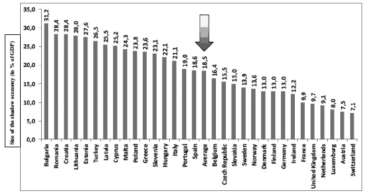
Taxation has become a determining topic of the world economy nowadays. Fight against the shadow economy and tax evasion is an important policy goal among others in Europe. Figure 1 gives an overview of the size of the shadow economy in 31 European countries in 2013. It is clear that in different extent all of the countries are affected.
Figure 1 • Size of the Shadow Economy in 31 European countries in 2013 (in % of GDP)
Source: Schneider, F. 2013[4], P. 3
Almost all studies conclude that the tax and social security contribution burdens are among the main reasons for the existence of the shadow economy.[5] In the recent budget situations when financing the state's debt is a problem in many countries, not only nations but
- 180/181 -
also supranational institutions are looking for ways to have better financial background with the help of taxation.
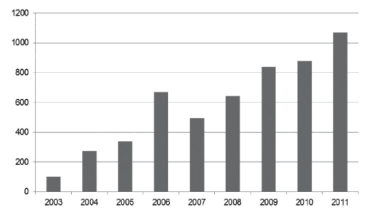
Cooperation is a key word. E.g. in the framework of mutual assistance in tax collection the EU member states collected ten times more tax in 2011 than in 2003, see Figure 2.[6]
Figure 2 • Tax collected in the EU since 2003 on the strength of mutual assistance in tax collection (Index: 2003=100)
Source: Európai Bizottság (2013)
In June 2010 on the G20 industrialized and developing economies' meeting in Toronto United Nations Secretary-General Ban Ki-moon proposed the intensification of international tax cooperation.[7] The 2012 World Economic and Social Survey of the United Nations focuses on instruments that could be relevant as international public finance resources. Taxing sectors considered to have "gained" most from globalization, such as the financial sector, or taxing global public "bads", such as carbon emissions are considered. Internationally coordinated tax revenue might be the background to finance global public goods[8] and defined development purposes.[9]
- 181/182 -
G7, G8 and G20 leaders seem to be pushing forward international tax cooperation. Fight against tax evasion and tax avoidance was one of the main topics on the G8 summit in June 2013.[10] In September 2013 the leaders of the G20 emphasized that shifting profits to low-tax jurisdictions undermine the public finances and they were committed to take actions to change rules and work up greater tax information exchange. "Profits should be taxed where economic activities deriving the profits are performed and where value is created." - declares the summit.[11]
The Organisation for Economic Co-operation and Development (hereinafter OECD) has important role in the battle against tax evasion and avoidance. In February 2014 the OECD presented a new standard on Automatic Exchange of Financial Account Information[12] which is a new global standard on automatic exchange of tax information.
A White Paper of the European Union on the European governance draws up five principles of good governance which are openness[13], participation[14], accountability[15], effectiveness[16] and coherence[17]. In the international practice there are great differences in these fields. On one hand it looks further than Europe and contributes to the discussion on global governance, on the other hand emphasises that "civil society must itself follow the principles of good governance, which include accountability and openness."[18]
In 2013 the European Union created a Platform for Tax Good Governance (hereinafter Platform). The tax authorities of all Member States furthermore organisations representing business,
- 182/183 -
tax practitioners and civil society are members of this Platform. As a helping body of the EU Commission it works on initiatives to foster good governance in tax matters in third countries, to tackle aggressive tax planning and reconsider double taxation conventions.[19] Improving the economic situation with tax cooperation, exchange of tax information is a nice goal, but it cannot be hidden that for the success many direct commercial interests have to be given up.
3. Some changes from the Hungarian tax regulations
In this section I will shortly describe some points of tax changes in the Hungarian tax law of the past few years, focusing on the tax good governance. Interviews were made with companies, tax officers and individuals on taxation in Hungary with the purpose of collecting responses about the tax changes.
3.1. Setting up a company
Starting business in Hungary was quite easy until 2012 when a new procedure, the tax registration process was introduced pursuant to the Act XCII of 2003 on the rules of taxation (hereinafter Taxation Act). Before 2012 there was no investigation about the "past" of the company establishers. E.g. high public debt from their previous enterprise did not keep them away from getting a tax number which is the basis of running businesses. The goal of the process is to strain the "tax payers" who want to establish new company for tax evasion and not for substantive business activity. Since the tax registration method entered into force the National Tax and Customs Administration of Hungary (hereinafter NTCA) examines if the member or executive officer of the company "left" public debt from previous businesses. The NTCA can reject the issuance of the tax number of the company.[20]
The method - despite all of the weaknesses of the regulation - was very welcomed among tax officers working on monitoring.
The next step for improving the regulation could be stricter rules trying to clean the system of "silent partner" relations.
3.2. Online cash registers
In 2012 preventing value added tax[21] fraud the Hungarian government made a decision that about 400 thousand cash registers will be fitted with a device that will establish a direct online
- 183/184 -
connection with the NTCA.[22] In Sweden cash register legislation became effective 1 January 2010. Hungary was not the first EU country where cash register legislation was enacted, but at that time the Hungarian regulation was the most high-tech version in Europe. later on Germany, Poland, Sweden and also Greece began to study the Hungarian method.[23] Following the Hungarian example Croatia decided about the use of online cash registers that have been mandatory since 2013, and the reported turnover increased nearly one-third in the first month of the operation of the system.[24]
According to the data of the Hungarian Central Statistical office[25] the revenue effects of the online cash registers seem to be positive.
Not only businesses but also individuals emphasized in their opinion that the mechanism will definitely help to clean the shadow economy. Businesses gave positive feedback about the financial support from state to the exchange of machines.
3.3. Spreading reversed taxation in VAT
The VAT reverse charge method is an anti-fraud measure in the field of value added tax. In the European union a directive allows the member states in certain specific cases to use this technique. The customer, instead of the supplier, has to account the VAT to the tax office and is liable for paying the tax.[26]
In 2006 the Hungarian tax law established the application of reverse charge taxation to waste materials. Since then the group of applicable goods and services has broadened, e.g. in the Act CXXVII of 2007 on Value Added Tax (hereinafter VAT Act) we can find certain services relating to immovable property, trading in greenhouse gas emission rights. During the past few years the scope of reversed taxation further broadened. In order to battle tax fraud in agriculture, since 1 July 2012 the regulations have been applied for trading between domestic taxpayers for certain cereals, protein crops and oilseeds. Starting 1 April 2013 domestic reverse charge rules have been introduced in the pork trade.
Since the method has proved successful in several fields and it can be stated as "best practice", Hungary tried to introduce it in the sugar trade where substantial VAT fraud has been
- 184/185 -
going on with the participation of Slovak enterprises for many years. The European Commission rejected the request, the last time in April 2014[27].
According to the businesses interviewed the high level of standard rate is the biggest problem connected to VAT. The respondents would propose lower standard rate which could help to clean the shadow economy because VAT fraud would not be a "big business" anymore.
It is a fact that Hungary has the highest standard rate of value added tax in the European union with 27%[28].
3.4. Duty on onerous transfer of property for import vehicles
Importing vehicles into Hungary is a good business. Since 2014 it has higher cost because all vehicles including imported ones are subject to duty on onerous transfer of property (see Act on duties). Table 1 illustrates the duties on onerous transfer of property of vehicles and trailers.
Table 1 • Duties on onerous transfer of property of vehicles and trailers, 2014
| capacity of vehicle power engine (kW) | Age of vehicle from the date of manufacturing | |||
| 0 - 3 years | 4 - 8 years | above 8 years | ||
| Acquisition of vehicle ownership | 0 - 40 | 550 HUF[1]/kW | 450 HUF/kW | 300 HUF/kW |
| 41 - 80 | 650 HUF/kW | 550 HUF/kW | 450 HUF/kW | |
| 81 - 120 | 750 HUF/kW | 650 HUF/kW | 550 HUF/kW | |
| abowe 120 | 850 HUF/kW | 750 HUF/kW | 650 HUF/kW | |
| Acquisition of ownership of trailer | below 2500 kg | HUF 9000 | ||
| abowe 2500 kg | HUF 22 000 | |||
Source: Hungary's act XCIII of 1990 on duties
3.4. Stability Savings Account - Tax amnesty
The Stability Savings Account[29] (hereinafter SSA) is a long-term investment account applicable since 2013, within which untaxed income can be deposited anonymously. Individuals
- 185/186 -
have opportunity to open the SSA at a credit institution with the minimum initial deposit of HUF 5 million. SSA is an instrument of financing the budget deficit because on the securities account only government bonds denominated in Hungarian forints, issued in Hungary or another European Economic Area country, may be accounted.
Responding individuals, the "average people" were not aware of the SSA.
However, individuals have a stake in beginning to use the opportunity to clean their money. According to the data of the NTCA from December 2013 until April 2014 on 74 bank accounts more than HUF 6 billion was collected.[30]
On the basis of the reviewed tax regulations and the answers of the Hungarian respondents, hypotheses 1, 2 and 3 are confirmed.
4. Conclusions
In 2013, after nine years, Hungary was freed from the EU excessive deficit procedure[31]. A few days before my finishing this paper the Economic Forecast for Hungary was published by the EU Commission and the figures are quite optimistic, see Table 2.
Table 2 • European Economic Forecast for Hungary, Spring 2014
| 2012 | 2013 | 2014 | 2015 | |
| GDP growth (%, yoy) | -1,7 | 1,1 | 2,3 | 2,1 |
| Inflation (%, yoy) | 5,7 | 1,7 | 1 | 2,8 |
| Unemployment (%) | 10,9 | 10,2 | 9 | 8,9 |
| Public budget balance (% of GDP) | -2,1 | -2,2 | -2,9 | -2,8 |
| Gross public debt (% of GDP) | 79,8 | 79,2 | 80,3 | 79,5 |
| current account balance (% of GDP) | 1,1 | 3,1 | 3 | 2,7 |
Source: European Comission (2014B)
- 186/187 -
"After increasing by 1.1% in 2013, Hungary's economy is expected to grow by around 2 1/4% and 2% in 2014 and 2015, driven mainly by domestic demand. Unemployment is projected to decline slightly, while inflation is expected to pick up gradually as the output gap closes. The government deficit remained broadly stable at 2.2% of GDP in 2013, but is forecast to rebound to close to 3% this year and next" - states the document[32].
The Hungarian government is henceforward under pressure because of high public debt. Consolidation of public finances is needed not only in Hungary but also in several other EU member states and non-EU countries. Accordingly, it is not surprising that current tax measures are focusing on raising tax revenues worldwide.
If I come back to the headline of this paper "Good governance in the field of taxation", I would emphasize there are efforts on many levels to move to the direction of transparency in the taxation. Nowadays the main point of good governance in the field of taxation means sharing the information about tax payers. Closing the tax loopholes could be the best solution but the lobby against it is very strong.
Today's hyper-regulatory economic environment in the future will be even more regulated. This brings many new challenges for countries, tax offices, businesses and individuals.
Offering competitive and sustainable tax regimes should receive more attention in the future. Protecting the financial interests of the states has priority nowadays.
To sum up the way in which the taxation policies in the developed world are formulated, states should act with more commitment. With this kind of tax policy there would be a chance to respond properly to the increasing demand for the welfare state. It's time to rethink many things. ■
NOTES
[1] E.g. organisation for Economic Co-operation and Development
[2] Like the European union (hereinafter Eu).
[3] See United Nations
[4] Schneider, F. (2013): Size and Development of the Shadow Economy of 31 European and 5 other OECD Countries from 2003 to 2013: A Further Decline, Available at http://www.econ.jku.at/members/Schneider/files/publications/2013/ShadEcEurope31_Jan2013.pdf, last accessed 2014-04-10
[5] See Schneider, F. (2012): The Shadow Economy and Work in the Shadow: What Do We (Not) Know?, IZA DP No. 6423, p. 11, Available at http://ftp.iza.org/dp5769.pdf, last accessed 2014-04-10
[6] Európai Bizottság (2013): Küzdelem az adócsalás és az adókikerülés ellen - A Bizottság hozzájárulása a 2013. május 22-i Európai Tanács számára, Available at http://ec.europa.eu/europe2020/pdf/tax_hu.pdf, last accessed 2014-04-02
[7] Ki-moon, B. (2010): UN Secretary General Letter to G20, 10.06.2010, p. 2, Available at http://www.un.org/en/pdfs/Secretary-General%27s_letter_to_the_G20.pdf, last accessed 2014-02-17
[8] "Public goods become global (sometimes called international public goods) in nature when the benefits flow to more than one country and no country can effectively be denied access to those benefits." E.g. international rules and institutions, control of infectious disease, promotion and protection of cultural diversity, core labour rights, and the environment through global cooperation., About global public goods and global public "bads" see United Nations/World Health Organization (2014): Global Public Goods, Available at http://www.who.int/trade/glossary/story041/en/, last accessed 2014-03-21
[9] United Nations/Department of Economic and Social Affairs (2012): World Economic and Social Survey 2012, In Search of New Development Finance, p. 9, 22, Available at http://www.un.org/en/development/desa/policy/wess/wess_current/2012wess.pdf, last accessed 2013-09-30
[10] See Gov.uk (2013): UK Presidency of G8 2013, Available at https://www.gov.uk/government/topical-events/g8-2013, last accessed 2014-03-27
[11] G20 (2013): G20 leaders' declaration, St Petersburg, September, 2013, p. 12, Available at en.g20russia.ru/load/782795034, last accessed 2013-04-07
[12] OECD (2014): Standard for Automatic Exchange of Financial Account Information, Available at http://www.oecd.org/ctp/exchange-of-tax-information/Automatic-Exchange-Financial-Account-Information-Common-Reporting-Standard.pdf, last accessed 2014-03-27
[13] "The Institutions should work in a more open manner. Together with the Member States, they should actively communicate about what the EU does and the decisions it takes. They should use language that is accessible and understandable for the general public. ..." European Commission (2001): European governance - A white paper, COM/2001/0428, Available at http://eur-lex.europa.eu/legal-content/EN/TXT/HTML/?uri=CELEX:52001DC0428&qid=1397384041221&from=EN, last accessed 2014-04-03 (hereinafter European Commission 2001)
[14] "The quality, relevance and effectiveness of EU policies depend on ensuring wide participation throughout the policy chain - from conception to implementation. . Participation crucially depends on central governments following an inclusive approach when developing and implementing EU policies." (European Commission 2001)
[15] "Roles in the legislative and executive processes need to be clearer. Each of the EU Institutions must explain and take responsibility for what it does in Europe. But there is also a need for greater clarity and responsibility from Member States and all those involved in developing and implementing EU policy at whatever level." (European Commission 2001)
[16] "Policies must be effective and timely, delivering what is needed on the basis of clear objectives, an evaluation of future impact and, where available, of past experience. Effectiveness also depends on implementing EU policies in a proportionate manner and on taking decisions at the most appropriate level." (European Commission 2001)
[17] "Policies and action must be coherent and easily understood. The need for coherence in the Union is increasing: the range of tasks has grown; ..." (European Commission 2001)
[18] European Commission (2001)
[19] See European Commission (2013): Platform for Tax Good Governance, Available at http://ec.europa.eu/taxa-tion_customs/taxation/gen_info/good_governance_matters/platform/index_en.htm#section_3, last accessed 2014-04-03
[20] - Within the previous 5 years the public debt exceeded HUF 15 million (in case of the largest taxpayers HUF 30 million) through 180 days.
- If the company ceased because of having a public debt of the amount mentioned above.
- If the company's tax number has been deleted. (see Taxation Act)
[21] Consumption tax on goods, services and imports of goods into Hungary.
[22] Kormany.hu (2012): Minister Matolcsy announces new fiscal package, October 5, 2012, Available at http://www.kormany.hu/en/prime-minister-s-office/news/minister-matolcsy-announces-new-fiscal-package, last accessed 2014-03-25
[23] Onlinekassza. hu (2013): Egész Európa a magyar kasszákat tanulmányozza, 2013. december 06., Available at http://www.onlinekassza.hu/hirek/osszes-hir/712-egesz-europa-a-magyar-kasszakat-tanulmanyozza, last accessed 2014-04-02
[24] Trademagazin.hu (2013): online cash machines are succesful in Croatia, 2013. 03. 22, Available at http://www.trademagazin.hu/en/hirek-es-cikkek/piaci-hirek/bevalt-az-onlinekassza-horvatorszagban.html, last accessed 2014-04-03
[25] Központi Statisztikai Hivatal (2014): A központi költségvetés bevételei, Available at http://www.ksh.hu/docs/hun/xstadat/xstadat_evkozi/e_qse006g.html, last accessed 2014-04-03
[26] European Council Directive 2006/112/EC on the common system of value added tax
[27] European Commission (2014a): Communication from the Commission to the Council in accordance with Article 395 of Council Directive 2006/112/EC, COM/2014/0229, Available at http://eur-lex.europa.eu/legal-content/EN/TXT/HTML/?uri=CELEX:52014DC0229&qid=1399468521610&from=EN, last accessed 2014-05-02
[28] See European Commission (2014c): "VAT Rates Applied in the Member States of the European union.", Available at http://ec.europa.eu/taxation_customs/resources/documents/taxation/vat/how_vat_works/rates/vat_rates_en.pdf, last accessed 2014-04-10
[29] See Hungary's Act CXCIV of 2011 on the economic stability of Hungary and Hungary's Act CXV of 2013 on the amendment of certain economical law
[30] Hirado.hu (2014): Már több mint 6 milliárd, adózás alól kivont összeget legalizáltak, 2014. 04. 26., Available at http://www.hirado.hu/2014/04/26/mar-tobb-mint-6-milliard-adozas-alol-kivont-osszeget-legalizaltak/, last accessed 2014-05-04
[31] "The excessive deficit procedure is governed by Article 126 of the Treaty on the Functioning of the European Union, under which the Member States are obliged to avoid excessive deficits in national budgets.", Europa.eu (2014): Excessive deficit procedure, Available at http://europa.eu/legislation_summaries/glossary/excessive_deficit_procedure_en.htm, last accessed 2014-05-05
[32] European Commission (2014b): European Economic Forecast Spring 2014, Forecasts for Hungary, Available at http://ec.europa.eu/economy_finance/eu/countries/hungary_en.htm, last accessed 2014-05-05