

Katalin Pallai: Design Considerations and Results of a Large Integrity Training Programme for Civil Servants in Hungary (Publico, 2014/3., 137-147. o.)
Abstract
This article presents the design considerations for a training methodology for integrity education of civil servants in Hungary. During the design process I went beyond the widely used principal agent theory and the positivist approach to corruption prevention. I did it because I considered the principal agent concept in itself inadequate for understanding and preventing corruption in the given context where certain practices that clash with formal regulation and the principles of Western democratic integrity are widely tolerated and are spreading like memes. In such organizational contexts, prevalent in post-communist public sector organizations, the normative clash between formal regulation and informal culture can create a collective action problem situation. In order to solve the normative clash, besides the positivist anti-corruption instruments, an argumentative process for norm socialization is also necessary. Thus, my training method is built on a dual perspective: corruption analysis and integrity development are discussed both from a rational, positivist and a post-positivist, argumentative perspective. The positivist content is conveyed mainly through cognitive channels. The training method itself serves as a live model for the participants to grasp the argumentative process of norm and trust building still unfamiliar for most experts and civil servants in the region. The training workshops already implemented for more than 10,000 civil servants were also followed by an effectiveness assessment survey the results of which are also discussed in the paper.
1. Introduction
Integrity management is aimed at the prevention of corruption by strenthening corruption resistance of public administration. integrity means that the public organization operates according to democratic principles and effectively uses the powers and resources entrusted to it for the implementation of the officially accepted purposes and justified public interest.
Integrity approach to corruption prevention is relatively new in the Hungarian public administration. The decisive turn towards the integrity approach happened in the
- 137/138 -
spring of 2012 when the Government adopted the Public Administration's Corruption Prevention Program.[1] In December 2012, the Ministry of Public Administration and Justice, relying on the funds earmarked for the state Reform operational Programme (SROP), launched a key project (with a budget of approx. 2.3 million euros) entitled "Prevention of Corruption and a Review of the Development of Public Administration". The central idea of the SROP-1.1.21 project is to strengthen the integrity of public administration organs and government officials. The project includes the following components: development of a Code of Public Service Ethics (adopted in 2013.), strengthening integrity management within public institutions through the training and appointment of integrity advisors (introduced in 2012 and 2013), adoption of whistle-blowing protection (adopted in 2013), training of civil servants (since 2013) and dissemination of information.
The SROP project is implemented by the Ministry of Public Administration and Justice (MPAJ) and the National University of Public Service (NUPS). In my position of NUPS associate professor I designed the training methodologies with support of the anti-corruption experts of the MPAJ. I designed two training methodologies for civil servants: a one-day awareness raising training programme on public service ethics and integrity for civil servants, as well as a two-and-a-half-day long integrity management training programme for public service leaders. At the time of writing this article, nearly 9,000 staff and 800 leaders of public administration organizations have been trained with the use of these methodologies, and a training programme was also held for executives with leaders, like secretaries of state and state commissioners attending. Currently an additional 3,500 public servants and 400 leaders are scheduled to be trained. By the end of 2014 approximately 1,200 senior civil servants and 13,000 other civil servants, approximately 15 % of the Hungarian civil service, will have been trained with the use of this methodology.
These training methodologies have introduced a number of important professional and methodological innovations, which have been praised in the EU Anti-Corruption Report (2014) as "training curricula [that] promote innovative learning processes."[2] The methodology was also presented in English as part of an international peer review process, where prominent experts of the field rated it as an excellent educational programme that is also applicable in other countries of the region.
As the scope of this article does not allow a detailed discussion of the training methodology, only key elements will be highlighted in order to give an insight into the design process, the underpinning conceptual framework, the results and impacts, moreover, references will also be offered to other more detailed publications on the subject.
- 138/139 -
2. Key considerations during the methodology design process
2.1 The target group, the challenge and my goal
At the start of the methodlogy design the key question for me was to identify the appropriate learning objectives (cognitive, emotional and behavioral) and to set the adequate priorities. Time did not allow a detailed target group survey or thorough research to underpin the program. Nevertheless a few key characteristics of the target group were clear. The majority of potential participants:
- have relatively high level "technical professionalism"[3]
- live and work in a social and administrative environment tolerant of certain corrupt practices
- have been socialized in a strongly hierarchic culture operating with weak formal communication.
It was also clear that the prevailing culture, patterns of thinking and usage of language blur the boundaries between right and wrong in relation to corrupt practices, and offer ample room for rationalization of practices that clash with the norms of democratic integrity. Public organizations are often overregulated but have no strategy for adjusting personal integrity of their staff and organizational operation, rules and culture.[4]
It was obvious that short programs cannot make major changes. The key challenge I saw was to help participants to grasp the concept of organizational integrity and the viability of progress, i.e. to plant the seeds of commitment, and leave the rest for them, for later projects that aim to support them, to figure out strategies for their own contexts.
2.2 The theoretical underpinnings of the methodology
Surveying approaches of other integrity training providers I saw two basic alternatives. Most integrity trainings limited their focus on public ethics and only a very few attempted to grasp the complexity of corruption and public integrity.[5] While public ethics was obivously a key component for me as well, I wanted develop a complex approach that includes the topics of corruption analysis and integrity development as well.
The result of my survey of training programs that included anti-corruption and integrity components showed that the key underpinning conceptual framework was the pric-
- 139/140 -
ipal-agent theory[6]. This had also been the theoretical foundation of the largest training programme executed in the post-communist region by FLDP and World Bank, supported by most renowned experts, like Klitgaart and Mc Lean Abaroa. While I do not want to challenege the relevance of the selfish perpetrator and the principal-agent theory for anti-corruption, I am convinced that in a context, like ours, where certain corrupt practices are widely spread practices rather than an isolated slip, it does not suffice for capturing the substance.[7]
I had two reasons to go beyond this widely applied framework. One reason was that it seemed obvious that in our case (similarly to many other countries in our region) corruption, defined by a western concept of democratic integrity, even in the case of active perpetrators, is a wider problem than merely selfish individual choice. Many corrupt practices are the products of cultural patterns that are continuously at work.[8] In this cultural context corrupt practices may be interpreted as memes (carrying cultural ideas), which spread rapidly,[9] and render corrupt practices into accepted patterns of behaviour. In such cases a normative clash exists between the formal rules and the informal parctice and informal rules of the culture that tolerate corrupt practices.[10] Understanding the collective process is key to understanding the phenomenon.
The other reason for going beyond the principal agent theory was my deep belief that the overwhelming majority of civil servants enters the service with good intention and moral character and wants to do the right thing. Their problem is not selfishness but defenceless-ness. Faced with the above mentioned cultural clash, they often do not to see any possibilities to resist the practices that are against their personal integrity. in such situations corruption or resistance are not simply a choice between right and wrong. consequences are not so simple and obvious as in rule-obeying contexts, where corruption is sanctioned and integrity is rewarded. in such an environment, where integrity derived from democratic values can clash with the culture of the environment and the patterns of behaviour and actions that be-
- 140/141 -
long to it, an honest civil servant confronts difficult choices. When in such a situation an individual attempts to break free from the cultural pattern of the environment and acts in accordance with the principles of integrity, he/she faces such risks that the majority of the actors have no means to undertake. in most cases, under pressure from the environment, individuals will feel vulnerable and will, although with aversion, drift into the practices which they find unacceptable. Research has shown that the situation will remain unchanged even where the majority, in principle, disapproves the established practices, and consider them harmful. Most individuals will remain unwilling or unable to bear the personal cost of resistance.[11] In many cases, resistance will not even present itself as an alternative on the personal cognitive horizon of the individual.
In such an environment we need to re-conceptualise the situation. The conceptualization of collective action problem has more explanatory power than the principal agent theory. The collective action problem implies that it is difficult to undertake the right action until the individual can assume that others will also take the right path and there should be no concern of taking individual risk.[12] In this conceptual framework, the solution depends not only on taking individual moral responsibility, but also on mutual interpersonal expectations, assumptions and trust. The solution to the collective action problem is beyond the technical solutions of rules and sanction envisioned in the positivist framework. A strong discursive component is also needed, post-positivist argumentative practices to impact on social and organizational processes of perception, mutual expectations, trust and personal beliefs about possibilities. such argumentative processes can change the informal norms, and attitudes, and lead to greater coherence of formal and informal rules and rewards.[13]
This conclusion appears to be supported by the findings of detailed research on anticorruption policies in the post-communist region, published in the 2010 special issue of Global crime, according to which broad social support for anti-corruption efforts played a key role in the cases where positive changes were implemented.[14] such positive processes required the impact of an epistemic community capable of continuously shaping social narratives and norms.[15]
Based on these theoretical conclusions i applied two conceptual frameworks to underpin my methodology: one based on the principal-agent theory and the other on the collective action problem. During the course we discuss the topic at two levels: one is the level of rational interests and rational (positivist) analysis of transactions. This is the positivist dialogue on rules, in-
- 141/142 -
centives and sanctions, i.e. the rule-based component of integrity management. The other is the level of norm socialization within society and organizations. This is the post-positivist approach that explores the argumentative process and the instruments it implies. This second focus on norm socialization and the discursive techniques leads to a deeper understanding of the value-based components of integrity management. This is the new component in my design compared to the earlier courses that I had surveyed before my design.
2.3 The learning objectives
The short review of the theoretical underpinnings above shows that the challenges I identified were complex: they included breaching of formal rules, clash of formal and informal norms and sanctions, collective action problem, interpersonal expectations and trust.
There was one more challenge not mentioned yet. In the social setting that is tolerant of corruption and where various forms of rationalization are widespread, the prevailing social interpretations of democracy, corruption and anti-corruption blur the boundaries necessary for substantive dialogue on the subject. in such an environment, without the reconceptualisation of key concepts, it is impossible to create a frame of reference in which shared understanding of such concepts of democracy, corruption, anti-corruption and integrity can be developed that paves the way for the introduction of the approach to building democratic integrity. In this situation I identified four objectives:
- to develop shared working definitions for key concepts within the group, and construct a conceptual framework that allows the culture and concept of democratic public integrity to be passed on,
- to pass on the basics required for integrity development: the relationships between the required organisational competences, values, ethics and rules,
- to change participants'cultural responses tolerant of corruption, since passing on the professional substance could hardly be beneficial without relearning (revaluation) and changing expectations,
- to involve participants in an argumentative process where they can experience the power of the group in changing perceptions and expectation of peers, and building mutual trust and engagement.
2.4 The method and approach
The method to implement the four objectives was a professional training programme based on an experiential methodology to convey serious professional content. Trough the planned activities the trainer creates a communicative space in which spontaneous reflections may be made, personal narratives shared, situations and critical incidents discussed, and when necessary the conceptual structuring or restructuring by the trainer may take place. While the aim is complex, the methodology ensures that participants experience the training as a reflective and problem solving flow of dialogue that always remains specific, and takes place at a level comprehensible and comfortable for them. Also, unlike in the form of longer, fron-
- 142/143 -
tal cognitive blocks, even new ideas introduced by the trainer are incorporated as summaries, definitions and charts that structure the discourse and, together with the flip charts recording of the joint thinking process, shape and develop the group's knowledge and its attitude to the subject.
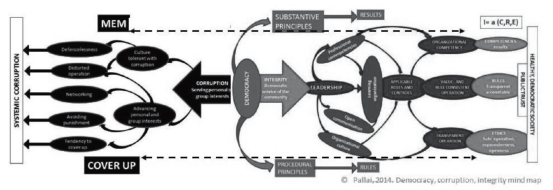
It is also important that key learning is focused on a limited number of elements that are gradually introduced to the dialogue: three shared working definitions are developed for democracy, corruption and integrity, and two metaphors and four visual schemes convey the key concepts and interdependencies and a mind map summarizes the content. This concise verbal and visual language captures the key learning points, and makes it comprehensible and memorable.
Figure 1 • The the work and the wall with the group memory
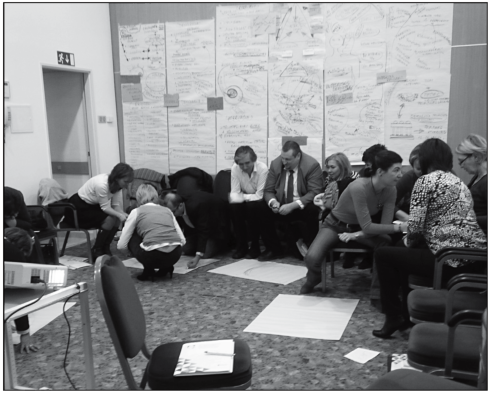
These definitions, methaphores and schemes are recorded on flipcharts together with records of the process that engendered them. During the training the flipcharts are posted on the walls. They are reminders of the common journey. The wall is the group memory that helps participants consolidate the relevant knowldege, remember the connected emotions and reflections, and build them all together to support a change in attitude.
- 143/144 -
With this method, instead of a traditional "teaching space", an argumentative/interpretative space is created, in which participants connect through discourse to the group and recreate their reality together.[16] This process points far beyond unidirectional knowledge transfer. It starts a creative process which also has an effect on the emotions and attitudes towards the substance. This is how the double perspective discussed in the theoretical part can be implemented, as corruption analysis and integrity development is discussed during the course both from a rational, positivist and post-positivist, argumentative perspective.
In sum, the training includes positivist methods of analysis and propagates interventions elaborated on the basis of positivist public administration. At the same time many experience- based components are built into the learning process that are aimed at letting grasp the argumentativ process and instruments, approaches and methods of post-positivist political science. These two are complementing each other: (1) the rational public policy and organisational answers to objective problems (such as infringements, fraud, etc.) provided by the positivist approaches, and (2) the argumentative tools such as the interpretation and re-interpretation of verbal constructs, joint problem definition and conceptualisation, which are suitable to enable the emergence of a discursive process linking the individual and the organization or the wider community, as well as the development of possible solutions and the mutual trust are required for change.
As early as during the design it was obvious that for participants it would be a new encounter to surpass the rational, positivist frame and enter in the world of post-positivist concepts and instruments, not yet familiar even for most experts in our region. The training was designed as an argumentative process itself because content conveyed on cognitive level would have been surely not enough. The method secures that participants collect their own experience of the (for many yet) unfamiliar process of norm and trust building. For this purpose an open, interdependent communicative space was created in the training room with a flow of creative dialogue entailing components aimed at initiating learning on cognitive, emotional and behavioural level.
2.5 The cognitive content of the course
Although participants experience the flow of creative dialogue, the discursive process conveys a very tightly structured professional content. The content reshapes participants' concepts of corruption and integrity starting from democratic values, and progresses from the analysis of ethical dilemmas to the development of ethical organizational culture, then, through the analysis of risks and integrity deficits, to the professional and organisational competences constituting the prerequisites for integrity, and to the systemic interrelations of components. Finally, it explains successful strategies and working systems to make the development of organisational integrity a viable alternative, reinforcing positive expectations. This is how an overall picture is created by the end of the training about ways to reinforce or-
- 144/145 -
ganizational integrity. The cognitive content develops resolution patterns, while the discursive tools build commitment to take responsibility and trust that resolution is possible.
Figure 2 • The cognitive content of the course summarized in the form of a mind map
2.6 The impact on attitudes
In addition to changing attitudes to corruption and integrity development, two things happen in the course of the training which are of significance to developing integrity. On the one hand, participants experience how a constructive discursive environment works, and through the trainer's behaviour, they are offered a pattern for building an interdependent setting.[17] This enables them to experience a pattern or organisational culture and leadership that can effectively support organizational integrity. This very system of mutual accountability, which is not only vertical but essentially horizontal and provides the basis for Sampford's famous bird's nest metaphor of integrity.[18] In the bird's nest, twigs and cementing materials that may be individually weak are bound together so that they are strong enough to protect the fragile egg. According to the metaphor, the integrity system is also constructed in this way from a large number of elements, the cooperation and solidarity of which enables the fragile idea of integrity to be built and protected. Being an interdependent setting, the nest focuses attention to the fact that power can be derived, in addition to formal rules, from the expectations, commitment and cooperation of the actors. Reinforcing horizontal accountability relations is a means of resolving the collective action problem.
- 145/146 -
The experience and model of collaboration provided in the training is particularly important to participants who were not socialised in such an organisational culture, because without experiencing, it is not even possible to imagine and understand such a system, let alone believe in the possibility of its existence. We all know, that without the sense of viability, knowledge transferred will rapidly dissolve.
Naturally, a brief training programme will serve as a first step only. However, if it is followed by similar training programmes within the organisation where staff experiences a similar process together, the professional competence and a responsible and cooperative community that mutually reinforces the positive expectations of its members may develop simultaneously to provide the core of integrity development.
2.7 Research to evaluate the effectiveness of the training methodology
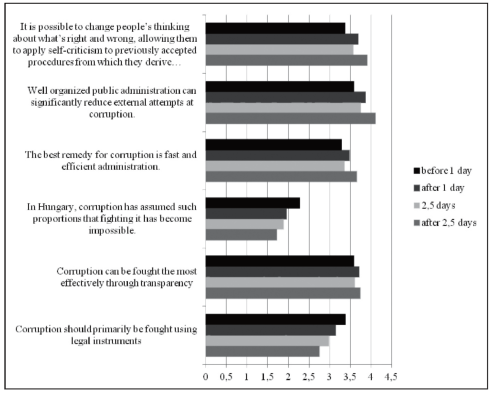
The effectiveness of the methodology in terms of changing knowledge, interpretations, expectations and attitudes has been demonstrated in a follow-up research to the training programme (see chart 1). A key innovation in training design was the abandonment of the common practice of satisfaction questionnaires, which hardly provide any information on effectiveness. instead, an effectiveness assessment developed with Dr. Péter Zsolt was used, an innovation that has since been adopted by a number of organisations. At the beginning and at the end of the training, participants completed the same questionnaire, which essentially measures their attitudes. The questionnaire has many questions, with a couple of important ones among them. It uses a 5-point Likert scale for statements as follows: 5 - strongly agree, 4 - agree, 3 - neutral, 2 - disagree, 1 - strongly disagree. importantly, the questionnaire does not include any questions to which explicit answers are given in the course of the training, because the focus of the survey is not about how well participants can remember the information provided. Chart 1 shows the average score for the most important question before and after training. An analysis of over 15,000 questionnaires shows that the training
- 146/147 -
had a positive impact on all of the dimensions under review. The chart shows only the results in the key dimensions where we targeted change.
1 Sharon Daloz Parks, 2005: Leadership Can Be Taught. A Bold Approach for a Complex World. Harvard Business School Press. MA: Boston. p. 14.
SOURCE: DATA PROCESSiNG STUDY BY PÉTER ZSOLT
The chart shows average values; the results of the work of about 40 trainers with public servants arriving from various regions of the country, representing a variety of responsibilities. Obviously, the results of groups and trainers show considerable deviation. In many groups, the extent of changes was significantly greater. (Detailed findings will be published later.) ■
NOTES
[1] Government resolution no. 1104/2012. (IV. 6.) on government actions against corruption
[2] Annex on Hungary to the EU Anti-Corruption Report, Brussels, 3 February 2014, COM(2014) 38 final
[3] In most cases they have adequate level of education, high level technical skills to meet the operational and technical challenges in their work. Technical professionalism means professionalism in the positivist concept. Technical is emphasized here as later the positivist vs. post positivist approach will be discussed. I will argue that post-positivist approaches will also be needed for effective corruption prevention. Thus, it is important to give insight for civil servants into post-positivist concepts and instruments.
[4] This proposition is supported by the latest research results Integrity Survey of the State Audit Office, 2013. Source: Pulay, Gyula: Preventing Corruption by Strengthening Organizational Integrity. Public Finance Quaterly. 2014./2. pp.133-149.
[5] E.g. Most best practices identified by OECD Anti-Corruption Network for Eastern and Central Europe, SIGMA and OECD Network for Public Integrity in their survey made in 2013 are ethics trainings except fot the Estonian experience.(Source: OECD, 2013, Ethics TRaining for Public Officials)
[6] Principal-agent theory is an important framework of analysis in political science and economics. The principal-agent problem arises when the principal and the agent have different interests and the selfish agent, under inadequately formulated rules, makes a decision that maximizes his personal benefit but it is not aligned with the principal's interest. Characteristics of the situation include conflict of interest, asymmetric information (information that may be withheld from the principal), and ethical risk (benefit is obtained by the agent without being liable for the damage caused).
[7] Persson, Anna- Bo Rothstein and Jan Teorell, 2013: Why Anticorruption Reforms Fail-Systemic Corruption as a Collective Action Problem. Governance: An International Journal of Policy, Administration, and institutions, Vol. 26, No. 3, July 2013 (pp. 449-471).
[8] Six and Lawton base their theory on cases from developing countries but in this aspect discussed here, there are important similarities. Six, F. - Lawton, A. (2013): Towards a Theory of integrity Systems: a Configurational Approach. International Review of Administrative Sciences. 2013 79, p. 639.
[9] I explain this in more depth in more depths in English in Pallai, Katalin.-Kis, Norbert., 2014 and in Hungarian in Pallai, K. 2014: Pallai, 2014b: Pallai, K- Kis, N. 2014: "Towards integrity". integrity Education and Research at the National Public Service University. Public Finance Quaterly. 2014. No. 2. 149-164. and with even more detailed explanation in Hungarian in Pallai, Katalin 2014: Bevezető gondolatok a közigazgatási integritás és integritás menedzsment témájához. Pro Publico Bono - Magyar Közigazgatás. 2014./ 1. p. 181-194.
[10] Finnemore, Martha and Kathryn Sikkink, 1998: international Norm Dynamics and Political Change. International Organization 52, 4, Autumn 1998, pp. 887-917
[11] Rothstein, B. (2011a): Anti-Corruption: The indirect 'Big Bang' Approach. Review of International Political Economy. 18 (2) pp. 228-250.
[12] Persson, A. - Rothstein, R. - Teorell, T. (2013): Why Anticorruption Reforms Fail. Systemic Corruption as a Collective Action Problem. Governance: An International Journal of Policy, Administration, and Institutions, Vol. 26, No. 3, July 2013, pp. 449-471.
[13] Fischer, Frank-Herbert Gottweis: The Argumentative Turn Revisited: Public Policy as Communicative Practice. Durham-London. Duke UP
[14] Moroff, H. - Schmidt-Pfister, D. (2010): Anti-corruption Movements, Mechanisms, and Machines - an introduction. Global Crime. Vol. 11, No. 2, May 2010, pp. 89-98., p. 97.
[15] Moroff, H. - Schmidt-Pfister, D. (2010): Anti-corruption Movements, Mechanisms, and Machines - an introduction. Global Crime. Vol. 11, No. 2, May 2010, pp. 89-98.
[16] Fischer, Frank-Herbert Gottweis: The Argumentative Turn Revisited: Public Policy as Communicative Practice. Durham-London. Duke UP
[17] Pallai, K. (2013): Kooperatív tárgyalás és konfliktuskezelés. Jegyzet. (Cooperative Negotiation and Conflict Management. Notes.) Nemzeti Közszolgálati Egyetem. Vezetőképző és Továbbképzési Intézet. Budapest. (download: http://www.pallai.hu/wp-content/uploads/2010/11/Pallai-Kooperatív-tárgyalás-és-konflktuskezelés.pdf) pp.56-62.
[18] Sampford, C. - Smith, R. - Brown, A. J. (2005): From Greek Temple to Bird's Nest: Towards A Theory of Coherence and Mutual Accountability for National Integrity Systems. Australian Journal of Public Administration. 64(2), pp. 96-108.