

Györgyi Nyikos: Institution-System in Transition (Cohesion Policy In Poland And Hungary) (Publico, 2014/3., 41-52. o.)
Abstract
The preparation of the new 2014-2020 period is taking place, alongside the consideration of the planning and programming tasks there occurs also the question, what kind of institution system would be necessary for the implementation tasks, and whether it is necessary and if yes, what kind of change of the currently existing organizations would be needed and what factors would influence the structure of the cohesion policy's implementation institutional system. Poland and Hungary are two cohesion countries, both of them using significant amounts of structural funds financing public investments. Despite the common regulation at EU level the two countries seem to choose different solutions in order to guarantee smoother implementation that will allow policy objectives and results to be achieved more effectively - Hungary is centralizing and Poland is rather decentralizing the system. What is behind this phenomenon? Which is the best way to strengthen the efficiency of the cohesion policy?
1. Introduction
The Cohesion Policy is changing dramatically from a mere solidarity instrument to an investment policy. Planning, programming and the establishment of the new system of cohesion Policy is in progress. The new cohesion rules have been formed in the spirit of a new approach, result orientation which requires a change of attitude in the operation of the institution system. The question is, what kind of institution system would be necessary for the implementation tasks, and whether it is necessary and if yes, what kind of change of the currently existing organizations would be needed and what factors would influence the structure of the cohesion policy's implementation institutional system.
The present paper explores the practice and the cohesion legislation (both existing: 2007-2013 versus 2014-2020), the institutions systems and mechanism, administrative procedures working in the cohesion policy and compare the Polish and Hungarian system. It will analyze the directions of changes under the new cohesion policy regulation with regards the functioning institutions system and national specificities. At the end of the analysis I try to identify good practices and make general recommendations and responds to the questions set above. The paper uses sources of information based on desk research (analyses of studies, evaluations, official documents and adopted regulations) and
- 41/42 -
experience from managing and implementing operational programs and projects and legal control on them.
2. Main specificity of the cohesion policy institution system
Economic, social and territorial cohesion within and among Member States is a key objective of the European union. The cohesion funds, as a main tool to achieve the above mentioned goals, (in 2014-2020: European Structural and Investment Funds (ESIF)) are governed by common rules and are subject to shared management by the commission and the Member States. In certain Member States, the rate of the development-oriented use of public funds depends on the level of development; and, though with a different financing rate, EU cohesion policy funds make up the sources of finance for development and with the narrowing of available budget resources in the next period this will become even more emphatic.
One of the key factors in the success of the cohesion policy is its decentralized delivery system. The commission has to obtain assurance that the Member States have set up management and control systems which meet the requirements of the regulations, and that the systems function effectively[1]. Member States allocate responsibility for day-to-day administration. This includes the selection of individual projects, the implementation of controls to prevent, detect and correct errors within the declared expenditure and the verification that projects are actually implemented ('first level checks'). The Member States are responsible for carrying out system audits and audits of operations (i.e. projects or group of projects) in order to provide reasonable assurance on the effective functioning of the management and control systems of the programmes and on the regularity of the expenditure certified for each OP. The Member State must also ensure that other areas of Community law such as public procurement, state aid rules, and environment rules are applied properly at the projects. With the evolution of EU cohesion policy the Member States are also responsible for ensuring more specific requirements (transformed into conditionalities) necessary for the use of the budgetary allocations from the EU.
Member States allocate responsibility for day-to-day administration to Managing Authorities (MAs) and Intermediate Bodies (IBs) This includes the selection of individual projects, the implementation of controls to prevent, detect and correct errors within the declared expenditure and the verification that projects are actually implemented ('first level checks'). Certifying Authorities (CAs) verify that 'first level checks' are effectively carried out and, where appropriate, undertake additional checks prior to submitting expenditure declara-
- 42/43 -
tions to the Commission. Audit Authorities (AAs) in the member States are responsible for carrying out system audits and audits of operations (i.e. projects or group of projects) in order to provide reasonable assurance on the effective functioning of the management and control systems of the programmes and on the regularity of the expenditure certified for each OP. They report on these audits to the Commission through annual control reports and annual opinions.
3. Differences in the cohesion policy Implementation Systems in the member states and the new approaches
The general conclusion is that the Structural Funds are effective in the Member States that have an appropriate institutional system[2]. According to the cohesion policy rules performing the tasks of management, certification and monitoring is possible within one organization, but the functions should be separated. Interestingly, there are different approaches in the Member States: in some Member States different tasks were placed in separate organizations and a number of Member States have different functions within one organization (e.g., Denmark, Spain). There also occurs a structure in which the managing authority and the certifying authority functions are in one organization and the audit function is set up independently from the previous two authorities (e.g., Finland, Sweden). There is also an example where the certifying authority and the audit authority work as separate units of the same entity (e.g. the Czech Republic, and Slovenia) and the managing authority is separated in another organization. Finally, the three authorities can work also in different organizations (e.g., Austria, Portugal)[3].
It also varies in the Member States how the implementation tasks are centralized: in some Member States one certifying authority operates with all the operational programs (e.g. Austria, Czech Republic, Denmark, Finland, Portugal, Slovenia, Sweden) in other countries certification authorities are set up by OPs (e.g. Belgium France, Germany, Italy). There are similar solutions also for audit authorities: sometimes one central audit authority shall carry out the duties of all operational programs (e.g. Austria, Hungary), as elsewhere for every programme there are audit bodies (e.g. Germany). In other Member States the audit authority at central level ensures that national operational programs work regularly, while audit authorities work at regional level for the regional operational programs (e.g. Italy, Poland). The Member State may designate also one or more intermediate bodies[4] to the managing or certifying authority to carry out some or all of its functions under its responsibility. The delegations are usually made for implementing regulations or contracts by organizing different responsibilities to different organizations.
- 43/44 -
The establishment and operation of the territorial levels are different in the Member States too: the number of regions and the duties and authorities of territorial structure are different. The question is not only how work is shared between the different territorial levels, but also which organizations (municipalities, decentralized agencies, development councils, and agencies) are addressed to the responsibilities and how these shall function. In fact, the nominal division of roles does not provide precise guidelines for the practice, i.e. managing authorities and intermediate bodies can be judged depending on the skills of the real content. It is important also how the levels of tasks are structured: the complexity increases the extra monitoring and reporting system, in addition, experience has shown that at the lower levels of multi-task operations the audit scope and level of detail increase and this control is associated with a narrow interpretation. The most significant factor leading to increased scrutiny could be that while the programming and implementation of cohesion policy is decentralized, the responsibility for the proper implementation is not decentralized - the Member State is responsible for regularity. This in itself includes the need for tight control, and a complex implementation structure can increase the legal uncertainties, which is only counteracted by a strong coordination[5].
A distinction can be made also between the structure of the institutional systems of each Member State according how the central level is organized and how it operates: with a centralized solution by one central body or managing authorities operating in different ministries, by operational programs independently or in one combined management authority, with the use of intermediate bodies, or without them...etc.
The differences between the programs have a significant impact on how the implementation system is designed. Important factors are i.a. the eligibility of the program, the thematic focus of the program, the financial volume of the program.
It is also important for the establishment and operation of an institutional system, how the use of the EU cohesion funds and national resources is established: in a coordinated way or not and how the delivery systems of the two sources relate to each other. Considering the harmonization of the national regional development systems and the EU cohesion policy implementation system at the international level on the basis of two criteria we meet the following solutions:
- based on the cooperation: integrated - parallel - "mixed" models,
- based on the management: centralized - decentralized - "mixed" models.
With regard to the cooperation criterion in the integrated system the allocation of cohesion funds takes place through the national decision-making channels. Integrated systems also vary between Member States, according to whether the cohesion funds dominate the development of resources (e.g., Poland) or contribute to national development resources (e.g. Germany, Austria). In the parallel institutional systems there operate specific decision-making mechanisms for the domestic and for the EU funds separately. In this
- 44/45 -
structure on one hand the results and costs of the various programs are better visible, on the other hand the setting up of a new system and operation of the two systems in parallel have significant additional costs, moreover, there could be problems with the coordination of funds and programs too (e.g., Hungary). In the coordinated (mixed) model there are specific decision-making mechanisms for the domestic and for the EU funds, however with the recording of the development priorities and objectives and with other consultation and coordination mechanisms it is building on the existing structure and can ensure the coordinated development decisions.
With regard to the second criterion - management - in the centralized system the management tasks are performed by national ministries or other national central organizations with limited decentralization and sometimes with limited partnership too. In most Member States, the central government plays an important role in the implementation of cohesion policy. In some Member States the role of the national level is very strong: the national authorities playing the key role of the management authority define every relevant element of the implementation. In the decentralized (regionalized) implementation system the implementation role and the responsibility for programme implementation is given to the regional level. The role of the central government covers coordination, highlevel negotiations with the Commission, intergovernmental consultation and evaluation of the "best practices". In the decentralized system there is more emphasis on multi-level governance, which can support the effective programme implementation. The development measures may be enjoying the trust and support of local, regional levels. On the other hand the coordination between levels is an important task and additional cost. Many Member States seek to combine the advantages and disadvantages of the two previous system structures. With sectoral and regional programs and with the managing authorities and national ministries the matrix-type responsibility system, involving the regional level, will be implemented in the development programs (Figure 1).
However, the efficiency of regional policy depends largely on the efficiency of the operation of management organizations and in general the quality of the functioning of the administrative system. Corruption and discrimination can significantly reduce the efficiency. As a possible solution the strengthening of institutional capacity and the efficiency of public administrations and public services at national, regional and local level and of the social partners and non-governmental organizations was one of an ESF priority for the 20072013 period[6]. This priority is implemented as a separate operational programme (with one or more priority axes) in four Member States (BG, RO, HU and EL) and ten Members States have chosen to implement it as one priority axe in other programmes, especially regional programmes (CZ, EE, IT, LV, LT, MT, PL, SK, SI, UK Wales). However, looking at the current absorption figures it is evident that there is still room to improve the functioning of the system and remove the different obstacles (Figure 2).
- 45/46 -
In the new cohesion policy rules the general regulation for 2014-2020 (CPR)[7] set off rules to boost the performance and new conditions are introduced to ensure the EU funding to be a strong incentive for Member states to achieve the Europe 2020 strategy objectives. So-called "ex-ante" conditions are defined to be met as precondition for use of the funds, and so-called "ex-post" conditions, which are to be achieved, are preconditions of the total funding. In addition to performance-based reserving also the failure to reach the milestones - if it is caused by a malfunction of the implementation - may cause the suspension or even the loss of resources. In view of this it is essential therefore what kind of the conditions, objectives, indicators are fixed to measure the effectiveness of the programs. There is also strong focus on fulfilling the macroeconomic conditions by the countries and the regions with regard to e.g. public finance regime. Bad performance may cause fines (e.g. stop in paying the allocations under cohesion policy) proposed by the Commission in the case of non-implementing the recommendations to improve.
There is a clear requirement to implement a results-oriented system which is a complex and difficult task. In addition, cohesion policy in the recent period operates rather by the "process-oriented" approach and not by "results-orientation" and the administrative capacity is constantly perceived as a bottleneck to performance. Focusing on results requires a complete cultural shift in the institutional system. The demand of the uniform standards and effective management of this complex system moves the structure towards centralization instead of decentralization, however, the decentralized planning and implementation could be an effective solution because of the knowledge of local circumstances and characteristics, of course a strong methodological guidance and coordination by central level is required.
4. The Hungarian and the Polish System of Implementation in the 2007-2013 and in the 2014-2020 period
Decentralization was a basic element of political democratization and pluralism in Hungary[8] after the regime change in 1989 and with it the Hungarian spatial development policy was also restructured: the act on regional development and territorial planning set up 7 planning-statistical units (NUTS2 region), but with Regional Development Councils[9] and without self-government. Partly because of the lack of self-government and political power the regional entities have played a limited role in the decision-making regarding regional policy and the control on the regional development programs remained at the central government.
- 46/47 -
In Hungary until 2008 there were several domestic development funds available and these earmarked funds were partly centralized and partly decentralized. Hungary set up a centralized system of parallel institutions for national and EU funds management and the management of EU funds operated outside the traditional Hungarian public administration system, with all its advantages and disadvantages. The use of development funds basically followed the sectoral logic. While strengthening the regional level and decentralization was a priority of the programme of successive governments until 2010, the regional level institutions could not become substantially stronger. Not only did the structure of the operational programme strengthen the central administration level but also the structure of the management institutions.
In the 2004-2006 period Hungary - based on the PHARE experience and administrative capacity - set up an institutional system where the sectoral ministries embedded the management authorities. The MA worked with numerous intermediary bodies which were different from the organizations responsible for managing the national sources.
In the 2007-2013 period the National Development Agency (NDA) was set up, which in cooperation with the ministries concerned and the development regions, was responsible for the planning and implementation of the entire New Hungary Development Plan as well as for performing managing authority functions with respect to all operational programmes. The intermediate bodies were usually non-profit state owned companies or in the case of regional OP's the regional development agencies. The regional OPs received only a small share of the funding (2 to 7% of the total), the largest share of support was allocated to the Transport OP and the Environment and Energy OP, which together absorbed more than 40% of the total funding.
In 2010, following the election, at government level the Ministry of National Development was responsible for the coordination and implementation of the cohesion policy. After the Hungarian EU presidency some processual and institutional amendments were introduced, e.g.: simplification in the project selection and implementation, decrease of the number of IB's through mergers, and OP modifications. In 2012 a government restructuring took place which also affected development policy: the supervision of the implementation and the NDA became the responsibility of the Prime Minister's Office and the regional development councils were terminated.
For the next, 2014-2020, period Hungary is planning significant changes in the cohesion policy programme structure and in the institutions system. All the programmes will be implemented at national level. Since January 1, 2014 the management authorities have been working again in the sectoral ministries with twofold responsibilities: for the implementation and closure of the 2007-2013 OP's and for planning and implementing the 2014-2020 OP's. Simultaneously, the NDA was terminated. Additionally very strong coordination functions were established in the Prime Minister's Office, which cover all the ESI funds and programmes with tasks, such as legal and public procurement control, preparation of almost all support decisions. The IB's were terminated on 15[th] April 2014 and at present the relevant ministries are responsible for the IB's tasks.
These changes seem to be risky, because cohesion policy faces three main challenges with respect to the near future. First, it has to solve the absorption problem which is mainly due
- 47/48 -
to the slow implementation of some priority axes and the irregularity issues[10] affecting the majority of Hungarian OPs. The second challenge is the timely preparation for the next period, involving stronger focus on results and channelling the knowledge accumulated during the past two periods into the planning. The final important task of cohesion policy in the coming years is the smooth conduct of institutional changes. All these tasks require a significant increase in management capacities and human resources, the eventual lack of which would significantly hinder the success of development policy.
Accordingly, at the end these changes might lead to a more efficient system, however, currently they need the management resources of the institutions.
In Poland the reform of the territorial structure consisting of decentralization of public authority was of key significance to the development of regional policy. In 1998 regional self-governments were established (together with new division of the country into 16 regions -voivodeships) - the entity entitled to independently set development strategies and plans as well as programmes and projects aimed at their implementation at regional level -the financial category of regional budgets was also introduced as well as numerous competences were shifted from central level to regional level.
In the 2004-2006 financial period Poland had sectoral operational programmes, technical assistance programme, cross-border cooperation programme, and the Integrated Regional Operational Programme (IROP). The IROP covered ca. EUR 3 billion out of EUR 12.8 billion, i.e. ca. 23% of the Cohesion Policy funds. The IROP included 16 regional segments managed by the Ministry of Regional Development in cooperation with self-governments of 16 regions. At the beginning there was a fear of non-sufficient administrative capacity at the regional level and uniform solution was proposed as a better one.
In 2007-2013 the decentralization of the Cohesion Policy funds management system in Poland increased. 16 regional operational programmes managed by Voivodeships' Boards were identified and about 34% of the Cohesion Policy funds were allocated to these 16 OPs and also decentralized part of the Operational Programme Human Capital. In 2009 the government adopted the objectives of the system of Poland's development management, proposing arranging the order and reduction of the number of development strategies binding in Poland. In Poland operational programmes for the 2014-2020 financial period were defined on the basis of a fundamental principle that integrated approach must be reinforced and maximized and sectoral approach must be abandoned or limited. In the years 20142020 the programmes to be implemented at the national level include: European Territorial Cooperation (ETC), 8 sectoral operational programmes and 16 dual-fund (EFRD, ESF) regional operational programmes (15 for the regions classified as "less developed" and one classified as "more developed") will be implemented at the regional level.
- 48/49 -
In Poland the implementation of operational programmes will involve institutions having experience in implementing operational programmes, acquired during one or two programming periods. Thus the evaluation of their institutional capacity will be decisive for granting and verifying their accreditation. Managing Authorities will be responsible for the preparation of programmes and also for expenditure certification. The MA will be allowed to delegate the implementation of a part of tasks to the intermediate bodies.
Evidently, preparations for the future round of 2014-2020 Partnership Agreement and OPs are underway across all EU Member States. It seems that following the new conditions given by the new cohesion regulation in some cases major shifts in the policy architecture are planned. However, the directions of the changes are different.
Poland is taking a further step towards the decentralization of programming: around 60% of the financial allocation will now be transferred to the regional programmes, which seems to be a new challenge for the national ministry as well as for the regions. Similarly, the French regions (Conseil Régionaux) will be fully responsible for managing the ERDF (as MA) and moreover, the regions are considering the option of creating a multi-fund approach combining the ESI funds at regional level. The national government will only have a coordinating role.
By contrast, in Hungary the centralization is strengthened - even if it is going together with the fragmentations at the government level - with stronger coordination and central decision-making power. In Finland also a more centralized approach is planned - only one national multi-fund programme is implemented in two regions - and there are concerns about this leading to a centralized model with less involvement from other actors.
Thus, despite the new rules in the cohesion policy regulation, divergence in the cohesion policy implementation is to be expected to remain considerable in the coming years. It is also noteworthy that result orientation and the incorporation of experience are very important for the last years of the current period as well: together with the strong regularity the focus should be shifted towards results and absorption, and the utilization of evaluations can help with enhancing these aspects.
5. Conclusion
The EU's cohesion policy was undermined by the crisis and wide ranging policy reforms were undertaken. The establishments of the cohesion policy rules have been influenced also by political considerations, setting up a different new system. The effective and efficient cohesion policy will require implementing targeted and complementary measures at all political levels. The integrated interventions have to be in line with the European objectives and tailored to the characteristics of the affected areas because cohesion policy show significant-
- 49/50 -
ly less effectiveness where the individual spatial situations and problems cannot be taken into account[11].
The institutionalization of cohesion policy within Member States has far-reaching consequences for the efficiency and effectiveness of development programmes: the effectiveness of regional policy depends largely on the efficiency of the operation of management organizations and also on the absorption capacities in different fields (not only financial absorption but e.g. the need for innovative solutions among the beneficiaries etc.). The demand of the uniform standards and effective management of the new cohesion policy seems to push the structure towards centralization instead of decentralization, however, the decentralized planning and implementation could be an effective solution because of the knowledge of local circumstances and characteristics, but of course a strong methodological guidance and coordination by central level is required. All in all, the sustainability of the effects of cohesion policy can only be achieved, if the development interventions are implemented in an integrated strategic approach[12].
Following the new conditions given by the new cohesion regulation in some cases major shifts in the policy architecture are planned but the directions of the changes are different. However, the incorporation of experience is very important and besides the strong regularity results should also be focused on. Accordingly, the challenges to be faced by development policy require higher management resources in order to mitigate risks and accomplish the goals set out by the various plans. Ensuring the approach of efficient and effective and decentralized/regionalized cohesion policy seems to be a difficult task under the new conditions.
1. Figure • Centralized, decentralized and mixed implementation systems
| Centralized | Decentralized | Mixed |
| Denmark, Lithuania, Estonia, Latvia, Slovenia, Slovakia, Hungary, Greece, Sweden, Rumania, Bulgaria, Cyprus, Malta, Luxembourg | Germany, Italy, Nederland, Austria, Belgium, Ireland | Poland, France, Finland, Czech Republic, Spain, UK, Portugal |
SOURCE: AUTHOR'S COMPILATION
- 50/51 -
2. Figure • Cohesion Policy spending by MS (July 2014)
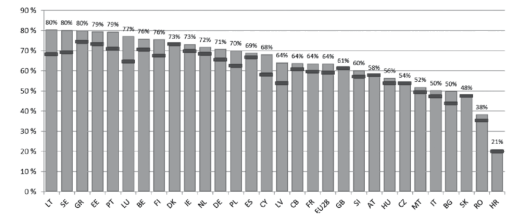
SOURCE: EUROPEAN COMMISSION
3. Figure • Structure of Operational Programmes in Hungary for 2014-2020
| Operational program | ESIF | Managing authority | |
| 1 | Economic Development and Innovation OP (EDIOP) | ERDF, ESF | Ministry of National Economy |
| 2 | Territorial and settlement development OP (TOP) | ERDF, ESF | Ministry of National Economy |
| 3 | Competitive Central-Hungary OP (CCHOP) | ERDF, ESF | Ministry of National Economy |
| 4 | Human Resources Development OP (HDOP) | ERDF, ESF | Ministry of Human Resources |
| 5 | Environment and Energy Efficiency OP (EEEOP) | CF, ERDF | Ministry of National Development |
| 6 | Transport-Mobility Development OP (MOP) | CF, ERDF | Ministry of National Development |
| 7 | Coordination OP (COP) | CF | Prime Minister's Office |
| 8 | Rural Development OP (RP) | EARDF | Ministry of Rural Development |
| 9 | Hungarian Fisheries and Aquaculture OP (HFAOP) | EMFF | Ministry of Rural Development |
| 10 | European Territorial Cooperation OP's | ERDF, ESF | Prime Minister's Office |
SOURCE: THE AUTHOR'S OWN COMPILATION
- 51/52 -
4. Figure • Structure of Operational Programmes in Poland for 2014-2020
| Name of the program | Found | Managing authority | |
| 1. | Smart Growth OP | ERDF | Ministry of Infrastructure and Development |
| 2. | Infrastructure and Environment OP | ERDF, CF | Ministry of Infrastructure and Development |
| 3. | Knowledge Education Development OP | ESF | Ministry of Infrastructure and Development |
| 4. | Digital Poland OP | ERDF | Ministry of Infrastructure and Development |
| 5. | Programme of Development of Rural Areas | EAFRD | Ministry of Agriculture and Rural Development |
| 6. | Fishing and Sea OP [FISH OP] | EMFF | Ministry of Agriculture and Rural Development |
| 7. | Technical assistance OP | CF | Ministry of Infrastructure and Development |
| 8. | Eastern Poland OP | ERDF | Ministry of Infrastructure and Development |
| 9. | European Territorial Cooperation Programmes | ERDF | Ministry of Infrastructure and Development |
| 10. | Regional Operational Programmes | ERDF, ESF | Board(s) of voivodship(s) |
SOURCE: AUTHOR'S ELABORATION ON THE DOCUMENTS OF THE MINISTRY OF INFRASTRUCTURE AND DEVELOPMENT, POLAND ■
NOTES
[1] TFEU Art 317.: "The Commission shall implement the budget in cooperation with the Member States, in accordance with the provisions of the regulations made pursuant to Article 322, on its own responsibility and within the limits of the appropriations, having regard to the principles of sound financial management. Member States shall cooperate with the Commission to ensure that the appropriations are used in accordance with the principles of sound financial management.
The regulations shall lay down the control and audit obligations of the Member States in the implementation of the budget and the resulting responsibilities. They shall also lay down the responsibilities and detailed rules for each institution concerning its part in effecting its own expenditure..."
[2] Ederveen, S., H. Groot and R. Nahuis (2006): Fertile soil for structural funds? a panel data analysis, Kyklos 59(1):17-42.
[3] Davies Sara, Gross Frederike, Polverari Laura (2008): The financial management, control and audit of EU cohesion policy: contrasting views of challenges, idiosyncrasies and the way ahead, EPRC, Glasgow
[4] Organizations can be government agencies, public and private companies, non-profit organizations.
[5] Musiałkowska Ida, Talaga Robert (2013): Legal aspects of the implementation of EU Funds 2007-2013 in Poland - practice and challenges; in: Regionalisation and Inter-regional Co-operation. 21th NISPAcee Annual Conference, Belgrade, 2013, pp.1-10.
[6] Article 3.2(b) Regulation EC 1081/2006
[7] REGULATION (EU) No 1303/2013 OF THE EUROPEAN PARLIAMENT AND OF THE COUNCIL of 17 December 2013 laying down common provisions on the European Regional Development Fund, the European Social Fund, the Cohesion Fund, the European Agricultural Fund for Rural Development and the European Maritime and Fisheries Fund and laying down general provisions on the European Regional Development Fund, the European Social Fund, the Cohesion Fund and the European Maritime and Fisheries Fund and repealing Council Regulation (EC) No 1083/2006 - Art.62-64.
[8] Regarding the systematic transformation and the three functions of local governments, the reform process of the Hungarian system of decentralization has been continuous in the 1990s.
[9] RDC: chairmen of the County Development Councils, representatives of the ministers, representatives of the micro regions, mayors of the big towns and representatives of the economic and social partners
[10] Implementation risks emerged also in 2012 and 2013 also due to irregularity issues linked with the selection criterion of public procurements, although they are at least partly solved, because of the discriminatory methods used by Hungarian authorities the Commission interrupted the programmes implementation and decided a financial correction too. Because of the significant time loss the absorption goals of some OPs are still at high risk of de-commitments due to the n+2 rule.
[11] Nyikos Györgyi (2011): Actualities of the development policy. Conditionality and results orientation, cohesion policy versus territorial development, Spatial Statistic, Journal of the Hungarian Central Statistics Office, 14 (51)/1, 38-51.p.
[12] Nyikos Györgyi (2011): Territorial planning and territorial aspects in development policy - possibility, obligation or dream?! Village, City, Region; Regional Development and Planning journals 2011/2. 35-41. pp. Budapest