

Attila Marján - Chen Xi: China's Regional Policy - How it Could Benefit from the EU Experience (Publico, 2015/3., 88-108. o.)
Absztrakt
In the domain of regional policy there exist major differences between the EU and China as regards institutions, needs, policy considerations, tools and concrete measures. And yet, there are important lessons Chinese regional policy actors can learn from the EU experience. EU cohesion policy has clear boundaries, rules, institutions, and financial instruments. Cohesion policy in the EU has a longstanding and relatively stable institutional setup, and also stability in policy directions once these directions are established by the member states. A certain level of flexibility is also present. There is also a clear and stable regional demarcation regime to manage and control regional policy. Moreover designing and implementing regional policy in partnership with a broad spectrum of stakeholders (partnership), instead of applying a government dominated investment policy has important positive social and efficiency effects. This is important for China since it suffers from increasing domestic regional inequalities and contrary to large-scale regional policy measures, regional disparities tend to grow in the country while enjoying a high speed of economic growth.
Keywords: EU-China cooperation, regional policy, cohesion policy
1. Introduction
China indeed looks at the EU as a reference point in the domain of regional policy. The cooperation between China and the EU on regional policy already started ten years ago. In 2006 a memorandum of understanding on regional policy cooperation was signed between the European Commission and the National Development and Reform Commission (NDRC) to exchange information and share best practices in the field of regional policy. in 2009 it was amended to make room for a strategic cooperation in the field of innovation and on regional clusters. Based on this cooperation a comprehensive study comparing the key aspects of Chinese and EU regional policy was published in 2010 (EU-China Cooperative Research Programme on Regional Policy - Research Report of the Chinese Expert Group, March 2010.). In 2010 the European Commission launched CETREGIO, a Chinese European Training Series on Regional Policy. CETREGIO intends to offer
- 88/89 -
Chinese regional experts a source of reference for designing regional development policies focusing on regional policy legislation; statistical information systems; innovation and clusters; territorial cohesion; urban-rural linkages; and sustainable urban development. The programme also aims at strengthening links between European and Chinese regions. since 2010 more than 220 Chinese decision makers from all 31 regions at provincial level have visited EU regional policy best practices sites. About 100 EU experts (officials, scholars and business representatives) have visited China for mutual exchanges. The EU-China Dialogue on Regional policy Cooperation has also been set up, which helps direct contacts between regional and urban authorities in a decentralized way, including the participation of the private sector in the dialogue. The commonly agreed key themes for the work programme of the Dialogue for 2014 were sustainable urban development, the issue of large cities, and major urban challenges including energy efficiency, low carbon economy. Industrial clusters and enhancing innovation capacity of regions also made to the priority list. The EU Commission and the Chinese National and Reform Commission agreed to create a joint multiannual roadmap to frame the common work, moreover the Guangzou Development Zone was selected as a pilot area of EU-China regional policy cooperation. Finally even the overarching "EU-China 2020 Strategic Agenda for Cooperation" includes a chapter on regional policy stressing the importance of the work done by the EU-China Dialogue on Regional Policy Cooperation and the need to continue direct contacts between regional policy authorities, joint research, training programmes and pilot projects. On 29 June 2015 a joint statement was signed by the national Development and Reform Commission and DG Regio (Directorate General for Regional and Urban Policy of the European Commission) in order to "comprehensively deepen EU-China regional policy cooperation. The joint statement acknowledges the positive effects of the cooperation since 2006, which helped know-how and expertise exchange but also concrete joint pilot actions between Chinese and European regions, but most importantly sets out a cooperation master plan for the future, including a multi-annual road map, a series of joint studies that could feed the preparation of China's regional development policy. More interregional pilot actions are also foreseen as well as an innovation cooperation platform for cities and an increased level of personnel exchange and capacity building. Cooperation in regional policy has thus been well established and ongoing for a decade, the question is how relevant it is for the parties.
Since its reform and "opening up" policy began in the late 1970s, China has undoubtedly been one of the most rapidly growing countries in the world. Meanwhile, however, there are increasing concerns over social and political instability resulted from regional economic disparities and polarization. Increasing imbalances can be observed not only in the economic development, but also in incomes, the quality and accessibility of public services, the level of development of a liberal market economy and economic openness in general. The Chinese government has been impelled to implement a series of regional policy that aim at alleviating the regional disparities and promoting a coordinated regional development. However, after more than decades, how effective those measures are remains largely controversial.
- 89/90 -
EU regional policy is not a perfect model, especially when efficiency is concerned, but still has important lessons to offer to China. This is supported by the fact that there is now a decade long cooperation between the EU and China on exchanging know-how and good practice as demonstrated above. Having studied relevant official documents and also both European and Chinese scholarly works (see references in footnotes), we found that this know-how transfer (mostly from the EU towards China) is not focused enough, which is the result of the lack of an established list of priorities based on deficiencies in the Chinese practice. Therefore we looked for areas where suboptimal Chinese performance can be matched with a relevant EU good practice.
In this paper, we first evaluate the development of regional inequalities in China to shed light on whether regional policy measures have had a significant impact on reducing these inequalities. Furthermore, we will reveal four crucial factors that put a constraint on China's regional policy to result in a more balanced and less polarized pattern of regional development, and also propose how EU's experience may serve as reference points for improvement for China.
2. Regional Gaps Keep Widening in China
In 1999, the "Western Development Program" (or "Go West Strategy") was launched to boost the economic development of 12 provinces in western China. It has been a top agenda for the Chinese government since the Tenth Five-Year Plan began in 2001. Not only large-scale capital investments but also abundant preferential policies have been provided in order to enhance the development of western China. During 2000-2007, central fiscal transfers to the West was as high as more than 1.5 trillion, other kinds of government investments were nearly 0.8 trillion.[1] In May 2010, the Central Work Conference decided to build the Kashgar special economic zones, hoping that Kashgar would become another Shenzhen and achieve the economic miracles Shenzhen once did.
After the earliest "Western Development Program", China's government subsequently took a series of measures aimed at improving three other regions, namely the North-eastern, the Central and the Eastern region. According to different natural endowment each of them has specified goals. According to the 12th Five-Year Plan (2011-2015),[2] besides consistent
- 90/91 -
support to the development of Lao-Shao-Bian-Qiong areas[3] (namely old revolutionary base areas, areas populated by ethnic minorities and border areas), great importance has been attached to four regions:
• Western region: promote a new round of large-scale development. According to the plan, infrastructure construction is the core strategy in developing western China, especially those related to water conservation and ecological projects, among which energy projects are top priorities. Besides, attentions should also be paid to the development of agriculture and tourism.
• North-eastern region: revive the old industrial base. Here the plan is to upgrade industry and the financial sectors, deepen the SOE reform,[4] consolidate north-eastern area's role as the "national grain base", and generally restructure the resource-exhausted region.
• Central region: acceleration of development. Key policy objectives include consolidating the central region's role as the national grain production base, and also as the energy and raw material base; building a comprehensive center of modern equipment manufacturing and transportation; promoting the agglomeration of industry and population; strengthening the connection with surrounding cities.
• Eastern region: Support the eastern region's leading role in economic development. The main focus for this regional action is to encourage Eastern-China to participate in international cooperation and global competition, foster the development of strategic innovative sectors, modern services and cutting edge manufacturing, promote institutional innovation and reform in this region to achieve socialist-market-economy.
- 91/92 -
Figure 1 Eastern, Central, Western and North-eastern China[5]
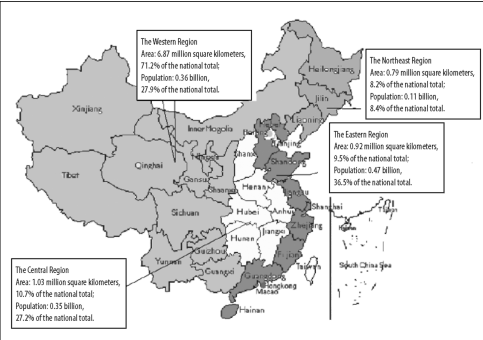
The basic goals of China's regional policy are to gradually narrow the regional disparities, equalize basic public services, highlight respective advantages of different regions, and deepen regional cooperation.
The question here is: How does it work? It is reasonable to expect a development at an observable level in the targeted regions, especially in the western, central and north-eastern areas, as a result of regional policy actions, yet whether these regions can develop fast enough to catch up with the East remains an open question. Among China's four region strategies briefly outlined above, the Western Development Program was the earliest, and it has the longest lifecycle to assess. Therefore, we take it as our case to study the effect of China's regional policy.
On the one hand, some researchers are optimistic about the Go West Strategy's role in reducing regional inequality. For example, by assessing Total Factor Productivity (TFP), Zhu, Yue and Li[6] argued in their paper that the Go West Strategy has accelerated largely the growth of TFP in Western China from -0.9% up to 1.2% over the past ten years. The West has already surpassed the East in terms of TFP growth, and the regional
- 92/93 -
technological gap has been narrowing due to the Go West Program. Besides, some indicators lend further support to the positive influences of the Go West strategy. The growth rate of GDP increased from 7.2% in 1999 to 10.6% in 2004, and per capita GDP has also doubled in five years. Import-Export trade in the West grows by 19.5% annually, and Foreign Direct Investment (FDI) rises to a total of nearly 15 billion dollars. since 2008 the economic growth rates of the central, western and north-eastern regions have surpassed that of the East. The growth rates of the eastern, central, western and north eastern regions in 2009 increased by 10.7%, 11.6%, 13.4% and 12.6%, with the western region ranking the highest of all.
But on the other hand, it is a fact that per capita GDP in western provinces accounts only for two thirds of the national average and less than 40% of that of the East. Many more scholars[7] argued that the Go West strategy could hardly alleviate interregional inequality and some[8] even concerned that the "Go West Strategy" would finally turn out to be a "Go East process". Programs, such as the West-East pipeline[9] and the West-East electricity transmission project,[10] speed up the process that natural resources and raw materials flow from the West to the East at artificially underestimate prices.[11] scholars also criticize the Go West Strategy for over-focusing on infrastructure constructions and overlooking the significance of building soft-environment (such as improving legislations, providing an open market).[12]
First, Coefficient of variation (CV), Gini coefficient and Theil index are the three most commonly used and popular measures in the literature of China's regional inequality, which all reveal a similar trajectory of interprovincial inequality for the period 1978-2006. According to Figure 2, interprovincial inequality increased only slightly from about 1999 to 2004, and declined for two consecutive years from 2004 to 2006. The relative plateau of inequality reached in the late 1990s and the subsequent decline since 2004 hint at a downward trend of interprovincial inequality, possibly related to efforts such as the Western Development Program.
- 93/94 -
Figure 2 Interprovincial inequalities in per capita GDP, 1978-2006[13]
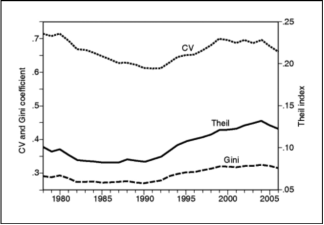
Figure 3 Decomposition of interprovincial inequality, 1978-2006[14]
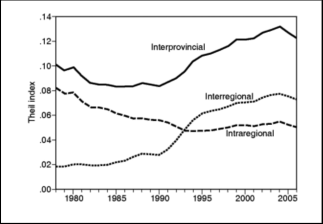
But when we dig deeper into the decomposition of the Theil index into its interregional (between-region) and intraregional (within-region) components (Figure 4), it is obvious that interregional inequality increased sharply and continuously during the period 1999-2004, and replaced intraregional inequality as the main determinant of changes in interprovincial inequality from 1993.
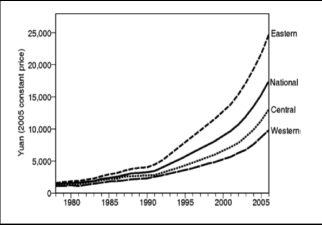
Second, per capita GDP is an indicator of the overall level of economic development. Figure 4 illustrates the eastern region's accelerated growth in per capita GDP from the 1990s.
- 94/95 -
As presented in the figure below, the gap between eastern provinces and the central and western regions continued to enlarge. This gap accounted for the increase in interregional inequality from the early 1990s.
Figure 4 Per capita GDP of China and its three regions, 1978-2006[15]
Despite a smaller disparity in growth rate between the regions in recent years, the absolute disparities are still growing. The disparity in per capita GDP between the eastern and the western regions increased from RMB 14 885 to RMB 22 129 during 2005-2009.
Table 1 Relative Disparity and Absolute Disparity in per capita GDP[16]
| 1978 | 200 | 2009 | |
| Relative Disparity (times) | 1.8 | 2.4 | 2.4 |
| Absolute Disparity (times) | 203 | 7120 | 17523 |
Soutce: China Statistical Yearbooks (2001 and 2007)
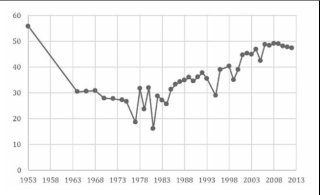
The Gini coefficient after 2005 lend further support to the argument that interregional gap is not narrowing as considerably as imagined after launching the Go West program. As showed in Figure 6, which is based on the latest data from World Income Inequality Database, after a short decline after 2004 the Gini coefficient quickly bounced back to nearly 0.5 and then stayed there. According to the World Bank, China has become the least equal country in the world.
- 95/96 -
Figure 5 Gini coefficient of China, 1953-2012 (WIID V3.0A)
Besides the level of economic development, disparities exist in education, health, culture and public services. The per capita educational expenditure budget of the western region was only 73.5% of that of the eastern region in 2008. At the end of 2008, the unemployment insurance[17] coverage rate in the western region was 12.2% lower than that in the eastern region, and the coverage rate of social pension insurance in rural areas of the western region was only 10% of that of the eastern region, less than 20% of the national average.[18]
In a word, although abundant money and policy preference were provided for disadvantaged regions, China's regional policy is relatively limited in realizing a more balanced and less polarized pattern of regional development.
3. A Brief Review of EU Regional Policy[19]
The European Union is not a country governed by a single government; it lacks federal administration as well as a common language. EU cohesion policy framework is decided by member states and the European Commission, and implementation is done mostly by
- 96/97 -
national authorities.[20] EU regional policy (sometimes called cohesion policy[21] - causing thereby a slight uncertainty) targets regions, cities and poorer member states (through the Cohesion Fund) in the European Union to support job creation, business competitiveness, economic growth, sustainable development, improve citizens' quality of life and decrease regional development differences. Economic and social cohesion - as defined in the Single European Act 1986 - is about reducing disparities between the various regions and the backwardness of the least-favoured regions. The Lisbon Treaty adds another facet to cohesion, referring to economic, social and territorial cohesion. The accession of poor countries such as Greece (1981), Spain and Portugal (1986) significantly boosted the EU's consciousness of regional differences in the level of development; therefore the common regional policy was reinforced.
The EU applies a 7 year-long budgetary framework for planning and implementation. (The current one runs from 2014 until 2020. In this period the EU spends EUR 351.8 billion - one third of the total EU budget - on cohesion policy.) The EU regional policy is basically delivered through three funds: the European Regional Development Fund, the Cohesion Fund and the European Social Fund. Together with a separate agricultural fund on rural development and a maritime and fisheries fund they constitute the EU's Structural and Investment Funds.
The so-called big-bang EU enlargement[22] of 2004 was not only a historical event but also increased the heterogeneity of the union on an unprecedented scale: the new member states, mostly former communist countries increased the EU's population by 20%, but its GDP by only 5%. The EU had to devote significant amounts to reduce the development differences between the old and the new members. National governments negotiated how the funds should be distributed in the EU Council and, even though all regions still benefit from the cohesion policy, priority was given to the countries and regions whose development was lagging behind. More than half of the budget - €182.2 billion - has been set aside for less
- 97/98 -
developed regions, which have a GDP of less than 75% of the EU average. €35 billion has been allocated to transition regions, which have a GDP of between 75% and 90% of the EU average, and €54 billion to more developed regions which have a GDP of more than 90% of the EU average. Wealth inequalities in the EU based on per capita GDP are also very significant: a major East-West divide is visible. This in fact is the most important challenge that EU cohesion policy is set to deal with.
Regional policy is the EU's most important common investment policy. EU cohesion policy helps other EU policy objectives such as education, employment, energy, environment, research and innovation policies. It is a key financial support for the EU's overarching Europe 2020 Strategy. In the eighties EU regional policy was relevant mainly for the public sector in the form of state help for big companies and large-scale infrastructure subsidies, now it is much more focused on SME's and knowledge economy.
For the 2014-2020 programming period, there are eleven thematic objectives that are financed by the EU cohesion policy funds. (Areas such as research and innovation, SME support, environment, transport, low carbon economy, transport and energy, employment, training, and public administration.) National and regional authorities specify in their operational programmes how they intend to distribute the available funding between the different thematic objectives. In some poor member states EU cohesion transfers are the most important sources of public investment (representing sometimes the 4% of these countries GDP), thereby alleviating the countries' national budgets helping them maintain a modest budget deficit, which is an EU requirement for both Eurozone and non-Eurozone members. In some cases (Slovakia, Hungary, Bulgaria) government investments are financed up to 90% from EU funds.
At the same time the assessment of the impact and efficiency of the EU's regional policy is a controversial matter.[23] The European Commission publishes a so-called Cohesion Report on the development of European regions and the impact of EU cohesion policy. According to the data published by the European Commission,[24] for the 2007-2010 period the GDP per capita in the so-called Convergence Regions (regions with per capita GDP under the 75 percent of EU average) increased from 60.5% of the EU-27 average to 62.7% between 2007 and 2010. Nevertheless the direct impact of EU cohesion policy is very difficult to discern. It is estimated that EU cohesion policy generated an additional 600 000 jobs from 2007 to 2012, at least one third of them in the SME sector. 25 000 km of roads and 1800 km of rail were constructed or modernised in the same period, 200 000 SMEs received direct financial support, and cohesion policy helped some 80 000 start-ups get up and run. Every year, around 15 million people take part in the thousands of projects co-financed by the European Social Fund (ESF) across the EU. 2.4 million participants in ESF actions supporting access to
- 98/99 -
employment found a job within 6 months between 2007 and 2010, and some 60 000 research projects were supported in the period 2007-2012.[25]
The direct impact of EU cohesion policy on economic growth is also a widely debated matter in the scholarly discourse[26] but most research evidence suggests that this impact is possibly less significant than intended by policy-makers.
Moreover, EU cohesion policy especially in the phase of its implementation is not without problems. Occurrences of misuse, waste or even corruption in relation to EU cohesion funds are well-known. The poorer the country the graver these problems prove to be. This is one of the biggest obstacles to the decrease of territorial differences through cohesion funds in the EU.[27]
To analyse territorial competitiveness at the regional level, the European Commission developed the Regional Competitiveness Index (RCI) in 2010, which indicates the strengths and weaknesses of the EU NUTS 2 regions. The index builds on the methodology developed by the World Economic Forum for the Global Competitiveness Index, covering a wide range of issues including innovation, quality of institutions, infrastructure (including digital networks) and measures of health and human capital.
Figure 7 below shows the ten most competitive EU regions based upon RCI 2013 scores normalized between 0 (lowest level of competitiveness) and 100 (highest).[28] Eight out of the top ten regions in 2013 were also featured on the 2010 list. It is also very important to note that seven out of the top ten most competitive regions are either capital regions or regions including large cities. It is even more important that at the lower end of the European competitiveness scale, regions also seem to have been stuck, therefore indicating the lack of success of EU's cohesion efforts in levelling territorial differences.[29] The poorest regions are mainly Bulgarian, Greek and Romanian ones. The Greek economic crisis is yet another stark indicator that - since Greece was and still is one of the major beneficiaries of EU cohesion support - financial transfers do not work if the recipient countries' or region's institutional and legal framework is inadequate.[30]
- 99/100 -
Table 2 The 10 most competitive EU regions[31]
| Region | RCI 2013 |
| Utrecht | 100 |
| London area | 94 |
| Berkshire, Buckinghamshire, Oxfordshire | 94 |
| Stockholm region | 93 |
| Surrey, East and West Sussex | 91 |
| Amsterdam region | 90 |
| Frankfurt region | 89 |
| paris region | 89 |
| Copenhagen region | 89 |
| Zuid-Holland | 88 |
4. EU's Experience as Reference Points for China
Although EU's cohesion policy is far from perfect, there are institutional, financial and policy solutions and good practices that are merit consideration by other countries.
In this paper we focus on four crucial aspects in the process of designing regional policy that China could learn from EU's experience, according to problems within China's regional policy designing and related good practice of EU's regional policy. Good blueprint does not necessarily mean good implementation and desired results, but no one can deny the fundamental importance of a scientific guideline.
4.1. Official organization specialized in regional management
Regional policy is the most important instrument for a government to achieve coordinated regional development, it is necessary to set a specialized official organization to design, implement, supervise and evaluate the whole process of regional policy.
4.1.1. China lacks a single organization in regional management
Currently, the Chinese National Development and Reform Commission (NDRC) is in charge of designing regional policies. However, regional development is only one of the many duties of the NDRC. There are two main offices in the State Department that also take responsibility to promote the Go West Strategy and the Rejuvenation Strategy of Old Industrial Bases in Northeast China, which are far from being powerful and effective
- 100/101 -
leading organizations. In the implementation of regional policies, the Ministry of Land and Resources, and the Ministry of Housing and Urban-Rural Development also take part.
Apparently, none of the above organizations has the full capacity and legitimate status to address the issue of regional disparities in a comprehensive and forceful manner. In practice, due to the lack of a single organization, different parties often have conflicts, overlaps and blind spots in regional policy management.
4.1.2. DG Regio - EU's leading organization in regional management
As opposed to China, the EU - as a department of the European Commission - has its central department for regional policy (Directorate General for Regional and Urban Policy of the European Commission), which is the key player in designing, implementing, managing and controlling Union cohesion policy. DG Regio employs some 700 professionals from all over the European Union using a wide range of expertise. Besides being the centrepiece of regional policy design and implementation DG Regio has become a knowledge base within the European Commission to inform policy making with regional data and intelligence. DG Regio works with EU member states, regions and other stakeholders to assess needs, finance investments and evaluate the results of EU cohesion policy in a comprehensive manner.
4.2. Identifying the optimal target regions
Regional demarcation is an important step in formulating a regional development strategy, and they are dependent on each other - without a long- demarcation it would be less stable and without practical importance, while without a reasonable regional demarcation, a specific strategy (measure) is impossible to implement. Without comparable figures among regions, the formulation of reasonable regional strategies and measures is out of the question.
4.2.1. China's ambiguous regional demarcation
Regional policy should target specific problems from which regions are suffering. As mentioned above, China's current regional policies mainly focus on four regions - the East, the West, the Central and the Northeast. But China is such a big country that even the smallest region is larger than several European countries combined. Considering rather complicated and diverse situations inside different regions, it is impossible to fix the regional problems by only four sets of predetermined toolboxes.
At present, provincial units are generally regarded as the basis for China's regional policy formulation. The Chinese government should think about a better-identified framework for considering and formulating regional strategies and policy measures. In other words, there is a need to shift the basic level of regional policy formulation from merely administrative demarcation to problem-oriented areas which are based on similar economic features and suffer from similar problems. Only by this can the regional policy be specific and clear, and therefore be effective. There are three levels of regional demarcation in China, namely the
- 101/102 -
provincial level, the municipal level and the county level, which are generally comparable. However, the county-level statistics in China are far from perfect, lacking comprehensive statistical indicators. To strengthen the county-level statistics is a major challenge of the Chinese regional policy. As the report of the joint EU-China regional policy committee of 2010 states: the county-level statistics in China is unable to provide comprehensive and stable statistical indicators. Moreover, the regional demarcation system in China has changed frequently.[32] As the report claims, in addition to a rapid social and economic growth and changes in the macro environment, there is no definite, long-term regional development strategy - frequent adjustments to the regional development strategy have led to frequent changes in regional demarcations.[33] The authors of the report urge the Chinese government to decide which basic level should be used for regional strategies and policy measures. There is also a need to shift the basic level of regional policy formulation from the provincial level down to municipal or even county-level units, to reduce administrative complexity and get closer to the level of implementation.
Table 3 Territorial features of the four regions
| Region | Scope |
| China | 31 cities, autonomus regions and provinces |
| Eastern region | 10 cities and provinces: Beijing, Tianjin, Hebei, Shanghai, Jiangsu, Zhejiang, Fujian, Shandong, Guandong and Hainan |
| Central region | 6 provinces: Shangxi, Anhui, Jiangxi, Henan, Hubei and Hunan |
| Western region | 12 cities, autonomus regions and provinces: Chongquin, Sichuan, Guizhou, Yunnan, Tibet, Shaanxi, Gansu, Qinghai, Ningxia, Xinjiang, Inner Mongolia and Guangxi |
| North-eastern region | 3 provinces: Liaoning, Jilin and Heilongjiang |
4.2.2. EU's NUTS system
In the EU's NUTS system, countries are divided into three levels - NUTS1, NUTS2 and NUTS3. Regional policies are mainly targeting the NUTS2 areas, in order to avoid the targeted area from being over-ambiguous or over-fragmented. The main purpose of the EU's NUTS is to acquire comparable statistical data among the member countries.[34] For example, by means of the EU NUTS system, the UK, which only covers about 243000 sq. km, can
- 102/103 -
be divided into 12 NUTS-1 areas and 37 NUTS-2 areas and take diverse regional policies targeting different problems.[35]
The current NUTS 2013 classification (Nomenclature of territorial units for statistics) is valid from 1 January 2015 and lists 98 regions at NUTS 1, 276 regions at NUTS 2 and 1342 regions at NUTS 3 level. The NUTS classification is a hierarchical system for dividing up the economic territory of the EU for the purpose of:
- The collection, development and harmonisation of European regional statistics;
- Socio-economic analyses of the regions
NUTS 1: major "socio-economic" regions
NUTS 2: basic regions for the application of regional policies
NUTS 3: small regions for specific diagnoses
- Framing of EU regional policies (at NUTS 2 level)
At the beginning of the 1970s, Eurostat (the EU's central statistical office) set up the NUTS classification as a single, coherent system for dividing up the EU's territory in order to produce regional statistics. For around thirty years, implementation and updating of the NUTS classification was managed under a series of "gentlemen's agreements" between the Member States and Eurostat - now it is rule-based. The EU rules establish stability of the classification for at least three years with no change. Stability ensures that data refers to the same regional unit for a certain period of time (this is crucial for statistics, in particular for time-series analysis). Sometimes however Member State national interests require changing the regional breakdown of a country. When this is the case, the county concerned informs the European Commission accordingly. The Commission in turn amends the classification at the end of the period of stability according to the rules of the NUTS Regulation.
The basic principles of the NUTS system are the following:
- Principle 1: The NUTS regulation defines minimum and maximum population thresholds for the size of the NUTS regions:
| LEVEL | MINIMUM | MAXIMUM |
| NUTS 1 | 3 million | 7 million |
| NUTS 2 | 800 000 | 3 million |
| NUTS 3 | 150 000 | 800 000 |
- Principle 2: NUTS favours administrative divisions - normative criterion. For practical reasons the NUTS classification is based on the administrative divisions applied in the Member States that generally comprise two main regional levels. The additional third level is created by aggregating administrative units.
- 103/104 -
- Principle 3: NUTS favours general geographical units because general geographical units are normally more suitable for any given indicator than geographical units specific to certain fields of activity.[36]
4.3. Financial support instruments
4.3.1. China's limited financial toolbox
China lacks such a comprehensive financial toolbox to meet local needs. Policy largely depends on individual central fiscal transfers and China hardly deploys funds or loans addressed to specific regional issues. Thus, without a stable and institutionalized financial support mechanism, economic assistance to the least developed regions is largely funded via national economic and social development plans.
4.3.2. EU's financial instrument
The effective implementation of EU's regional policy largely relies on its financial instruments. In the EU five major funds (European Structural and Investment Funds) constitute the financial framework of regional policy:
- European Regional Development Fund (ERDF)
- European Social Fund (ESF)
- Cohesion Fund (CF)
- European Agricultural Fund for Rural Development (EAFRD)
- European Maritime and Fisheries Fund (EMFF)
Every EU region has the right to receive transfers from the ERDF and ESF (mostly poorer regions do so). Cohesion Fund is solely devoted to the poorest regions.
The European Regional Development Fund aims to strengthen economic and social cohesion in the European Union by reducing imbalances between NUTS 2 regions. The ERDF focuses its investments on several key priority areas, such as innovation and research; digital development; support for SMEs and low-carbon economy. The ERDF also gives particular attention to specific territorial characteristics. ERDF action is designed to reduce economic, environmental and social problems in urban areas, with a special focus on sustainable urban development. At least 5% of the ERDF resources are set aside for this field, through 'integrated actions' managed by cities. Areas in a naturally disadvantageous situation (remote, mountainous or sparsely populated areas) benefit from special treatment.
The European Social Fund invests in people to improve employment and education opportunities. It also aims to improve the situation of the most vulnerable people that are at
- 104/105 -
risk of poverty. More than €80 billion is earmarked for human capital investment in Member States between 2014 and 2020.[37]
The Cohesion Fund is - as already mentioned - aimed at Member States whose Gross National Income (GNI) per inhabitant is less than 90% of the EU average. It aims to reduce economic and social disparities and to promote sustainable development.[38] The Cohesion Fund allocates a total of €63.4 billion to activities under the following categories: trans-European transport networks, notably priority projects of general European interest, and also big infrastructure projects under the so-called Connecting Europe Facility; environment; energy and transport projects, as long as they benefit the environment (energy efficiency, renewable energy, rail transport, intermodality, etc.) It is important to note that the payments from the Cohesion Fund can be suspended if the beneficiary Member State has higher deficit than tolerated by EU rules (3% of GDP).
The European Agricultural Fund for Rural Development (EAFRD) is devoted to the development of rural and agricultural territories, while the European Maritime and Fisheries Fund (EMFF) is directed to the fisheries and maritime sector.
Also the EU has a separate fund for countries that are on their way to join the EU as members (including Turkey), the so-called Instrument for Pre-Accession Assistance (IPA). The IPA is made up of five different components: assistance for transition and institution building; cross-border cooperation (with EU Member States and other countries eligible for IPA); regional development (transport, environment, regional and economic development); human resources (strengthening human capital and combating exclusion); rural development.
A relatively new instrument is the European Fund for Strategic Investments (in which, as mentioned earlier, China also indicated its interest to participate), which is established in close partnership with the European Investment Bank (EIB) in the order of at least €315 billion in private and public investment across the European Union. This will especially support strategic investments, such as broadband and energy networks, as well as smaller companies with fewer than 3000 employees. The proposal also sets up a European Investment Advisory Hub to help with project identification, preparation and development across the
- 105/106 -
Union. Finally, the European Investment Project Pipeline will improve investors' knowledge of existing and future projects.[39]
As opposed to the EU, China lacks such a comprehensive financial toolbox to meet local needs. Policy largely depends on individual central fiscal transfers and China hardly deploys funds or loans addressed to specific regional issues. Thus, without a stable and institutionalized financial support mechanism, economic assistance to the least developed regions is largely funded via national economic and social development plans.
4.4. Roles of government and non-governmental actors
4.4.1. China's regional policy is over-dependent on government and therefore fail to include non-governmental actors
A great achievement of China's economic reform over the last 30 years is to diversify the source of capital input. Less fiscal investment from government, more capital resources allocated by the market, such as private investment and foreign direct investment. But the least developed regions are still over-dependent on government investment. China's regional development unduly depends on government investment, leading to several negative consequences. Excessive fiscal investment may distort the allocation of capital resources and consequently be inefficient. In other words, the capital is less productive. The productivity of capital in western areas is much lower than the eastern ones. In the East, if capital increases by 1%, GDP will rise by 1.03%; while every 1% increase in capital can only deliver 0.933% increase of GDP in the West.[40] In the given managing mechanism of the West, namely being over-dependent on state investment and inefficient in using capital, increasing investment cannot necessarily bring a better outcome.
Due to worse soft-environment - lacking educated human resources, weak law enforcement, dysfunction of market and so on - the foreign direct investment (FDI) in the West is far behind than that in the East. FDI plays an important role in improving regional economy. It cannot only provide more capital supplies, but also brings advanced technologies and management experience. FDI can be an indicator of the quality of investment conditions, legislations, labours, and the degree of openness. During the period 1987-2007, the FDI in the West accounted for less than 5% of the total amount.
- 106/107 -
Besides, government investments prefer heavy industry and infrastructure construction. The qualities of investing conditions, legislation, labour market and the degree of general economic openness in the West remain relatively low.
The Chinese government has tried to motivate other players' involvement by introducing preferential tax measures. At the beginning, it did play a positive role in enhancing economic growth and also boosting corporate profits in the West. Both foreign and domestic enterprises investing in the West can enjoy tax reduction or exemption. But tax incentives have been losing their positive impact since 2002. Tax preferences in the West benefited state owned enterprises more than privately owned ones. In general over-dependence on government policies does not produce optimal results.
4.4.2. EU's "partnership" policy
As opposed to the Chinese practice, the outreach of regional policy institutions towards other (including different types of non-governmental) stakeholders is well established and institutionalized. One of the key principles of the management of EU regional policy is "partnership". DG Regio, as the central hub of EU regional policy builds partnerships with and between business, research, educational and public actors. The European Commission also encourages the Member States and regions, as well as enterprises, universities and research centres to cooperate in order to maximize the effects of Cohesion Policy investments and other EU financial sources and programmes. The 'RegioNetwork' is an online collaboration platform for representatives of European regions and other stakeholders in the European Union's regional policy. The so-called Regions for Economic Change Initiative fosters networking and mutual learning of other regions' experiences in improving their innovation capacity, ICT connections and human capital or in giving their industrial clusters development.[41]
5. Conclusions
In the field of regional policy there are several differences as regards institutions, needs, policy considerations and tools between China and the EU. Moreover, as opposed to China, in the EU the Union-level cohesion policy has an additional function in nation state development policies, although in some poorer regions and Member States it constitutes the entirety of development policy in itself.
The EU cohesion policy has clear boundaries, rules, institutions, and financial instruments. The EU regional policy's status and also longevity are also guaranteed by the reference to them in the basic EU Treaty. Cohesion policy in the EU has a longstanding and relatively stable institutional setup, and also stability in policy directions once these directions are established by the Member States. At the same time a considerable level of flexibility is
- 107/108 -
also present through flexibility instruments, funds and procedures. The system of regional demarcation in the European Union is also dependable and stable. The funding framework is complex but rule-based. The planning and implementation of regional policy in the EU is an inclusive act: people, local institutions, market forces, regions, civil society are involved.
By presenting several indicators of regional inequality, we have shown in this paper that the trend of regional inequality in China after implementing the Go West Strategy in 1999 has been continuously aggravating. We identified some of the key aspects for this underperformance, and after a brief introduction of EU's cohesion policy as a basis of comparison we indicated four crucial areas where China could learn from EU's practice. We have found that China's four regional strategy pillars lack a single management entity; regional demarcation is over-ambiguous and based largely on administrative districts instead of specialized issues to tackle; the Chinese financial support toolbox is underperforming and cannot serve local and regional needs in an optimal way; China's regional policy is over-dependent on government actions and fails to involve non-governmental actors. Further research is necessary to analyse how these findings may be interpreted in China. ■
NOTES
[1] See more in: Liu Shenglong, Wang Yahua and Hu Angang: The Effect of Western Development Program and Regional Economic Convergence in China, Economy Research, No. 9. 2009, 94-105.; and also Liu Jun, Qiu Chang-rong: Implementation Appraisal for Tax Preferential Policies in West China Development, Modern Economic Science, Vol. 28. No. 4 Jul 2006, 64-71.
[2] Part V of the 12[th] Five Year Plan: Optimizing the structure, accelerating the coordinated regional development and sound urbanization development. Translated version in English language, www.cbichina.org.cn/cbichina/upload/fckeditor/Full%20Translation%20of%20the%2012th%20Five-Year%20Plan.pdf
[3] Lao-Shao-Bian-Qiong areas, is a fixed expression of the least developed places in China, composed of three situation - old revolutionary base areas, areas populated by ethnic minorities, and border areas -born with disadvantaged location and weak capacity to compete in the market, most of them lack natural resource or necessary infrastructure or money to develop their economy. In the modern history of China, the old revolutionary base areas are local strongholds established by the Communist Party of China and its revolutionary army, which were usually remote areas with mountainous or rough terrain far from the centre cities and extremely difficult for enemy forces to reach. These might be advantages for a revolution, but definitely are disadvantages for economic development. Therefore, after so many years since the Communist Party won the war and took the power, those old revolutionary base areas have still remained to be the least developed areas in contemporary China. Lao-Shao-Bian-Qiong area is a term defined economically, which is different from the four geographical regions mentioned later. According to statistics in 2004, more than 1000 counties in China are regarded as Lao-Shao-Bian-Qiong areas and enjoy preferential policies of the central government. www.360doc.com/content/10/1020/15/357883_62463925.shtml
[4] The industrial base in north-eastern China had been the most important backbone of heavy industry for decades after the PRC established in 1949. Due to its rich natural resources such as coal and oil, north-eastern region played a key role in developing an integrated industry system in China. After the reform and opening up policy in the late 1970s, the share of north-eastern industrial base decreased from more than 15% to less than 10%, for which the main reason was that the monopolized SOEs were unable to adapt to the rule of market economy. Therefore, deepening the SOE reform has been a key to the revival of the industrial base in northeastern China.
[5] EU-China Cooperation Activity on "Regional Policy" Within the Policy Dialogue between DG REGIO and NDRC Final Report of the Chinese Experts - English Language Version, December 2010, 53.
[6] Zhu Chengliang, Yue Hongzhi, Li Ting: A performance evaluation on the western region development: based on the total factor productivity perspective, Studies in Science of Science, Vol. 27. No. 11. Nov. 2009, pp. 16631667.
[8] See Yue Liping, Bai Yongxin: Performance evaluation on the strategy of western region development of China based on the difference between east and west regions using PCA, Science Research Management, Vol. 29. No. 5. September 2008, 84-88.
[9] A pipeline transmitting natural gas from western China to the East.
[10] An electricity network transmitting electricity from Guizhou, Yunnan, Guangxi to Guangdong.
[11] See Lin Yi-fu, Liu Pei-lin: Chinese Development Strategy and Economic Convergence, Economy Research, No. 3. 2003, 19-25.
[12] Liu Shenglong, Wang Yahua and Hu Angang: The Effect of Western Development Program and Regional Economic Convergence in China, Economy Research, No. 9. 2009, 94-105.
[13] C. Cindy Fan and Mingjie Sun: Regional Inequality in China, 1978-2006, Eurasian Geography and Economics, 49. No. 1. 2008, 7.
[14] Ibid, 8.
[15] Ibid
[16] EU-China Cooperation Activity on "Regional Policy" Within the Policy Dialogue between DG REGIO and NDRC Final Report of the Chinese Experts - English Language Version, December 2010, 121.
[17] The unemployment insurance, together with social pension, medical insurance, employment injury insurance and maternity insurance are five basic components of China's social security insurance. They are monetary assistances provided by the state for pensioners and those who are unemployed, disabled or mothers on maternity leave. The difference in providing public service presents a main respect of regional gaps.
[18] EU-China Cooperation Activity on "Regional Policy" Within the Policy Dialogue between DG REGIO and NDRC Final Report of the Chinese Experts - English Language Version, December 2010, 31.
[19] This part aims to give a brief overview especially for the Chinese readership. NB.: From a Chinese perspective LI Gang: The Origin of EU Regional Policy In a Theoretical Perspective. Chinese Academy of Social Sciences, Working paper Series on European Studies. Vol. 6. No. 5. 2012 gives a theoretical introduction.
[20] Member States then use the EU funds to finance programmes - thematic programmes covering the whole country (on the environment or transport, for instance) or regional programmes. The European Commission is not involved in selecting projects (except for a small number of major projects) - this is done by the national and regional authorities responsible for managing the programmes. These 'managing authorities' lay down selection criteria, organise selection committees and - via a project tendering procedure open to all - decide which projects will receive European funding. The programmes are prepared by each Member State and/or region, and financed under the European Regional Development Fund or the Cohesion Fund for the European Social Fund (ESF) programmes. 'Major Projects' are usually large-scale infrastructure projects in transport, environment and other sectors such as culture, education, energy or ICT. As they receive more than €50 million in support through the ERDF and/or Cohesion Fund, they are subject to an assessment and a specific decision by the European Commission. Search the database for details of Major Projects.
[21] Cohesion policy should also promote more balanced, more sustainable 'territorial development' - a broader concept than regional policy, which is specifically linked to the ERDF and operates specifically at regional level, but the use of these terms in practice is not really precise. The term cohesion policy gained true relevance after the accession of poorer southern countries and especially once Eastern-European countries joined in 2004.
[22] For the 2007-2013 budget period (in 2007 the two poorest countries, namely Romania and Bulgaria joined too), the cohesion budget grew to EUR 347 billion of which 25 percent has been earmarked for research and innovation, and 30 percent for environment protection and climate action. In the 2014-2020 budgetary period the budget's size remained untouched contrary to heavy lobbying by rich member states who pay for the bill.
[23] See more in: Böhme et al., Study on promoting multi-level governance in support of Europe 2020, Inception Report, European Commission Regional and Urban Policy, 2013., and in: London School of Economics (LSE), Study on the Impact of the Single Market on Cohesion: Implications for Cohesion Policy, Growth and Competitiveness, Study commissioned by DG Regio, London, 2011.
[25] European Commission regional Policy statistics http://ec.europa.eu/regional_policy/cooperate/international/china_en.cfm
[26] For reference see for instance: G. Pellegrini, F. Terribile, O. Tarola, T. Muccigrosso and F. Busillo: Measuring the effects of European Regional Policy on economic growth: A regression discontinuity approach, Papers in Regional Science, 92(2013), 217-233. Or.: Sascha O. Becker, Peter Egger and Maximilian von Ehrlich: Too much of a good thing? On the growth effects of the EU's regional policy. Working Paper. Coventry, UK: Department of Economics, University of Warwick, CAGE Online Working Paper Series, Volume 2012, Number 70.
[27] EU Competitiveness report 2010; EU Competitiveness report, 2013; EU regional GDP Data: http://ec.europa.eu/eurostat/statistics-explained/index.php/GDP_at_regional_level
[28] Dijkstra, Lewis, Annoni, Paola, Kozovska, Kornelia: A new European regional competitiveness index.
[29] Michele Boldrin, Fabio Canova: Europe's regions - Income disparities and regional policies, CEPR, 2001.
[30] This has been reiterated by several authors, including Jean Pisani-Ferry, Guntram Wullf, Darvas Zsolt in 'Europe's growth problem and what to do about it? Bruegel, March 2013, Brussels
[31] Source: European Commission, Joint Research Centre: EU Regional Competitiveness Index RCI 2013.
[32] See more in EU-China Cooperation Activity on "Regional Policy" Within the Policy Dialogue between DG REGIO and NDRC Final Report of the Chinese Experts - English Language Version, December 2010, 98-99.
[33] Ibid
[34] See more at: Eurostat, regional statistics. http://ec.europa.eu/eurostat/documents/3217494/5785629/KS-HA-14-001-EN.PDF/e3ae3b5c-b104-47e9-ab80-36447537ea64
[35] Zhang Keyun: The Institution base of EU regional policy and China's regional policy in the future, March 2010.
[36] Source: Eurostat. Eurostat Regional Yearbook, 2014.
[37] For the 2014-2020 period, the ESF focuses on the below four thematic objectives: promoting employment and supporting labour mobility, social inclusion and combating poverty, investing in education, skills and lifelong learning, enhancing institutional capacity and efficient public administration. 20% of ESF investments are committed to activities improving social inclusion and combating poverty.
[38] For the 2014-2020 period, the Cohesion Fund is open to the following EU member states: Bulgaria, Croatia, Cyprus, the Czech Republic, Estonia, Greece, Hungary, Latvia, Lithuania, Malta, Poland, Portugal, Romania, Slovakia and Slovenia.
[39] Besides the different EU Funds the European Investment Bank (EIB) also contributes to the execution of EU policies through loans, guarantees and equity investment. The EIB is owned by the EU member states, more than 90% of its activity is focused on Europe but it also supports the EU's external policies to some extent. The EIB also provides professional advice and project management capacity. The EIBS four priority are innovation and skills, SME finance, climate action, strategic infrastructure. EIB generally finance one-third of the projects but sometimes 50%. It employs around 2000 people. Its younger brother, the European Investment Fund is a specialist in SME risk finance. The EIB is the majority EIF shareholder with the remaining equity held by the European Union (represented by the European Commission) and other European private and public bodies. From 10bn in 1988, the EIB's annual lending jumped to EUR 79bn in 2009, and it was EUR 77bn in 2014.
[40] Liu Jun, Qiu Chang-rong: Implementation Appraisal for Tax Preferential Policies in West China Development, Modern Economic Science, Vol. 28. No. 4. Jul 2006, 67.
[41] See more on this in: Van den Brande, L., Multilevel Governance and Partnership - The Van den Brande Report - Prepared at the request of the Commissioner for Regional and Urban Policy Johannes Hahn, October 2014.