

Tibor Pintér[1]: The Legal and State Theory Problem of Federal Somalia in the 21st Century[1] (Publico, 2024/2., 87-102. o.)
https://doi.org/10.32575/ppb.2024.2.5
Abstrakt
Somalia is one of the most unstable states in Africa, and this instability is the result of power-political rivalries, due to the historical influences of different eras. Three separate entities with the capacity to influence the state can be distinguished: the oldest is the Somali clan system and hence the clans, followed by the current end product of the significant Islamic expansion in the region, the jihadist organisation al-Shabaab, and finally the Somali government, which is the main enforcer of the federal state apparatus. My aim is to examine the triad's relationship and the extent of their power from a legal and state-theoretical perspective, which requires a descriptive analysis of the actors in order to reveal their legal and state-theoretical implications. The study concludes that all three actors are in varying relationships with each other, which may be a hostile relationship or a state of dependency, and this is at the root of Somalia's instability, the resolution of which will be a long-term process.
Keywords: 4.5 formula, al-Shabaab, clan system, FGS, heer, legal pluralism, Shari'ah, Somalia
- 87/88 -
Introduction
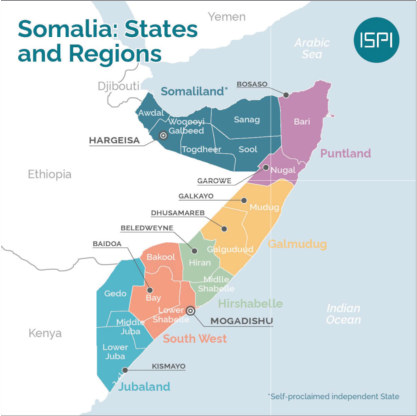
Figure 1: Map of Somalia and its seven Federal Member States (FMS)
Source: ISPI 2021
As the map in Figure 1 shows, Somalia lies in the Horn of Africa, bordering Kenya, Ethiopia and Djibouti. The country is poor in mineral resources and is not strategically important in terms of natural resources. However, its geographic and geopolitical location makes it an essential player, as it lies on the African coast of the Gulf of Aden, an important stage on one of the world's busiest shipping routes. However, in recent decades, the coastal country has become synonymous with chaos. Somalia has met the criteria for a fragile state, as shown by the fact that it ranks second worst in the 2022 Fragile State Index, ahead of only one country, civil war-ravaged Yemen.[2] Since 2004, Somalia has been governed under a federal structure, which has not been able to fully alleviate inter-clan tensions and
- 88/89 -
a generalised distrust in the state. This is compounded by two other factors. One is the presence of al-Shabaab, which is still able to maintain a presence in rural areas. The other is perhaps partly a consequence of the former, in that the state has only a limited ability to exercise its authority beyond the capital, Mogadishu.[3] Both of these factors are further affected by a particularity of Somali society: clanism.
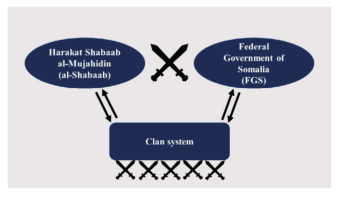
Figure 2: The three main actors in Somalia and their relationship to each other
Source: compiled by the author
This paper examines the roots of the instability in Somalia from a legal and state theory perspective, highlighting and explaining the problem illustrated in Figure 2 below, namely the presence of multiple actors in the Somali administration. The figure illustrates that this is a multidimensional problem, and the analysis is further complicated by the fact that all three actors are in a mutual relationship with each other, which can be both hostile and interdependent.
The paper concludes by suggesting an answer to the question of why Somalia cannot escape the chains of instability and why the international community cannot afford to leave Somalia in this condition. In order to answer this question, it is first necessary to examine the three actors, to demonstrate how all three actors have a significant capacity to influence the life of the Somali state. The scope of the study only allows us to approach this kind of influence from a legal and state-theoretical perspective, which requires an outline of the judicial systems of the three actors, the identification of their legal frameworks and the dissemination of these remedies.
From a state-theoretical point of view, it is interesting to note that there are three actors in the region with the capacity to influence states. It is also worth considering the physical and population size of these actors, which of them dominate urban and which rural areas, and exploring the possible reasons for this. I would like to stress that this study focuses on
- 89/90 -
the southern part of Somalia, which is the cradle of decades of instability and the site of the main power struggles between actors.
The main actors in Somalia
Figure 2 shows in simplified form the three actors and their relationship and interdependence. The emergence of such a situation is quite unique and is due not only to the civil war that broke out in 1991, but also to the preceding Siad Barre dictatorship (1969-1991), as well as the processes of decolonisation and colonialism.
The clan system
The Somalis are spread across an area that stretches from the Indian Ocean to the eastern highlands of Ethiopia and from the Gulf of Aden to the northern part of Kenya, beyond the borders of Somalia. They are the most extensive population in the Horn of Africa. Ethnologically, the Somalis are a segmented society.[4] This means that they are divided into a number of segments or lineages based on their genealogical distance from a common ancestor, which is the basis of a particular social structure, the clan system.[5]
The role of clans and the system that unites them is so fundamental to society that they are an inescapable feature of Somalia. For a Somali, clan affiliation is the most important link to other Somalis, as this bond goes back hundreds of years.[6] The clan system itself is based on kinship and a specific social contract that defines the conditions of collective unity within and between patrilineal clans. At the basis of all this is a common ancestor, which determines the affiliation of relatives to particular clans. Each Somali belongs to a genealogical lineage that also functions as a basic political unit. At the top of the system are four major clan families:[7] the Dir, the Darood, the Hawiye and the Rahanweyn.[8]
Each of these four groupings is divided into ten to twenty clans, which are further divided into dozens of sub-clans. In a country where virtually everyone shares the same religion, language and ethnic origin, clan membership is the main characteristic that distinguishes one person from another. This is the main factor that Somalis struggle over when it comes to the distribution of power.[9]
- 90/91 -
In pastoral societies, such as Somalia, elders are still highly respected in clans. They control resources and networks that transcend clan boundaries, ethnic identity and generations.[10] They play the most important role in pressuring the parties to a conflict to accept a ceasefire and in initiating negotiations between the parties.[11] However, the civil war, the inter-clan fragmentation caused by the civil war[12] and al-Shabaab's clan politics" have begun to erode the role of the clan in society.
Al-Shabaab
Al-Shabaab grew out of a community-based, bottom-up Islamic jihadist movement inspired by Somali Islamic scholars trained as followers of the Wahhabi movement in Saudi Arabia.[14] It rejects the central government of Somalia and its founding principles, aims to oust foreign peacekeepers and other external armed actors and seeks to establish a completely new political order, an Islamic state in Somalia.[15]
The amount of territory controlled by the group started to expand rapidly from 2009 onwards. By 2010, al-Shabaab was free to operate in much of southern Somalia, an area the size of Denmark with a population of about 5 million, about 50% of Somalia's total population at the time.[16] Despite al-Shabaab's control over a large territory, the number of its fighters was only around 5,000. As a result, it could not properly govern the areas under its nominal control.[17] In August 2010, during the Ramadan offensive in Mogadishu, al-Shabaab launched large-scale frontal attacks against the TFG (Transitional Federal Government) and its ally AMISOM (the African Union Mission in Somalia). The failure of this offensive was a turning point and the jihadists began to withdraw. Overall, al-Shabaab forces were reduced by about 25% at this time.[18]
As the battlefield defeats increased, so did the internal tension and frustration in the movement. The organisation's then emir Ahmed Abdi Godane came in for heavy criticism. The organisation began to disintegrate and to become highly decentralised. Godane's radical measures saved al-Shabaab from falling apart, with the leader's response being quick and brutal. Several senior figures were killed or forced to desert.[19] As the internal cleansing took place and a strong structure emerged within the organisation, the US eliminated several senior leaders of al-Shabaab between 2014 and 2015, including the emir
- 91/92 -
Godane in September 2014.[20] The new emir is Ahmad Umar Diríja Ubajda, who at the time of writing as the incumbent leader is capable of holding the organisation together.[21]
Al-Shabaab controls some rural areas in South-Central Somalia, mainly in Galmudug, Middle and Lower Shabelle, Gedo, and Lower Juba. In South-Central Somalia, their military presence often extends from rural areas to the main supply routes serving the main urban centres and their surroundings. However, the group's military presence and territorial control does not accurately reflect al-Shabaab's real area of influence, since it has control over the population extending beyond the areas where it has a direct geographical presence.[22]
The Federal Government
The first decade after independence in Somalia was a decade of democracy, until General Mohamed Siad Barre took power in 1969, building a regime which combined elements of both nationalism and communism, with strong Soviet support. He reached the apex of his popularity in 1977, when he attempted to fulfil the Greater Somalia ideal by invading and occupying the Ethiopian Ogaden region, a territory largely populated by Somalis. Barre suffered a major defeat, however that set him on the road to his eventual failure. The 1980s saw the internal collapse of the regime, with the result that Barre fled in early 1991, leaving the country in chaos.[23]
The most devastating period of the civil war was in the early 1990s, when the central government collapsed, followed by a wave of ethnic cleansing and a subsequent famine. This was the decade of warlords and militia leaders, whose power was based on looting, warfare and the acquisition of humanitarian aid. After years of devastation in the early years and the failure of several foreign operations, Somalia eventually entered a quieter period, with sporadic clashes and low-intensity warfare. Political reconciliation between the factions peaked in 2002-2004, when negotiations took place in the neighbouring Kenyan town of Mbagathi. An agreement was finally reached, which forms the basis of the political system. This led to the formation of the TFG in 2004, which was replaced by the FGS (Federal Government of Somalia) in 2012.[24]
The branches of power under the Provisional Constitution of the Federal Republic of Somalia comprise:
- Legislative power: In Somalia, this is the Federal Parliament, whose main task is to pass, amend or reject legislation put before it. The Parliament is a bicameral legislative branch consisting of the House of the People and the Upper House. The Provisional
- 92/93 -
Constitution stipulates that the House of the People is composed of 275 ordinary members. De jure, they are directly elected by Somali citizens, but de facto they are (still) indirectly elected, through a clan-based power-sharing formula (the 4.5 formula, to be discussed later). The Upper House is elected by direct, secret and free ballot by the people of the federal member states.[25] In practice, the members of the upper house are elected by the assemblies of the Federal Member States, with a total of 67 senators.[26]
- The President and the executive power: the president is the Head of State, symbol of national unity and guardian of the Constitution. He is elected by the houses of the Federal Parliament by a 2/3 majority for a 4-year term. The President has a number of powers, including being Commander-in-Chief of the Armed Forces and appointing the Prime Minister. He signs bills passed by the federal parliament into law.[27] The Council of Ministers is the supreme executive body of the Federal Government and consists of the Prime Minister, the deputy prime minister(s), ministers, ministers of state and deputy ministers. The Prime Minister appoints the deputy prime ministers, ministers, state ministers and deputy ministers.[28]
- The justice system. In accordance with the Provisional Constitution, the judiciary, which is independent of the legislative and executive branches, is organised into three levels: the Constitutional Court; the Federal Government level courts, of which the Federal Supreme Court is the highest court, and the Federal Member State level courts of which the Federal State Supreme Sourt is the highest court.[29]
It is worth briefly outlining the relationship between the FGS and Mogadishu, as the situation is not straightforward. Historically, whoever has previously owned the capital has occupied a dominant position in the political and economic life of the country. Currently, however, a power-sharing arrangement operates in the governance of Mogadishu. The Provisional Constitution states that Mogadishu is the capital, but this is not its final status, but requires further clarification, which has not yet taken place. It follows that the FGS has de facto control of the capital, but the Governor of the Banadir region, where the capital is located, is also the Mayor of Mogadishu. However, the authorities of the region do not have any local electoral or accountability arrangements, they do not represent the population of the capital, and instead the revenues from the capital are used for the operation of the FGS, not to improve the living standards of the population. This situation continues to blight the perception of the FGS in the capital to this day, which, for example, is an obstacle to a broader political settlement and to development throughout Somalia.[30]
- 93/94 -
Legal pluralism
As Griffith defines it, legal pluralism refers to a situation in which not all law is state law and a territory is not governed by a single set of state legal institutions, and thus the application of the law is not systematic and uniform. Although such pluralism is not limited to the colonial and postcolonial context, it is most typically encountered in this field.[31] Somalia fits this pattern, with a complex, fragmented, plural legal system rooted in long years of colonialism, wars, power vacuums, culture, customs and religion. The majority of Somalia's population is made up of traditional nomadic, pastoral and agro-pastoral people. The formal legal system is weak outside and even within the major cities. Social interactions are based on clan dynamics, deeply embedded traditional structures and customs, and Shari'ah law. The different regions of present-day Somalia maintain a complex plural legal system consisting of heer (xeer) the traditional law of the Somalis, an emerging formal legal system, and Shari'ah law, with significant jurisdictional overlap and contradictions between them.[32]
Heer
In order to get a clearer picture of the legal divide, it is necessary to consider the coexisting legal systems separately. It is logical to begin this with a description of the oldest body of law, Somali customary law, heer, which is, in La Sage's terminology, the set of rules and obligations developed between traditional elders to mediate peaceful relations between Somalia's competitive clans and sub-clans.[33] As the heer was never fully codified, it remains a set of customary law that has been passed down through generations. Although there have been attempts to codify it, both in the late 1960s[34] and in the last 20 years by the Danish Refugee Council,[35] little progress was made. In pastoral societies and clans, elders are still highly respected to this day.[36]
Shari'ah
Islamic law, or shari'ah, basically covers marriage, inheritance, property law, punishments and tribal institutions in the political field. In contrast to heer, Islamic law established
- 94/95 -
group solidarity and overcame the hereditary blood structure.[37] Shari'ah as a legal system has four main sources:
- The most important source of law is the Qur'an, which concerns, among other things, the foundations of faith, morality, wisdom and various forms of human relations.[38]
- The Sunnah, which is the words and deeds of the Prophet Muhammad, recorded in the Hadith in well-attested stories.[39]
- Indeed, one of the accepted sources of Islamic law is the consensus of Muslim jurists, the Ijma.
- Finally, there is the analogical interpretation, the Qias, which provides a means of deciding an unprecedented case where the solution cannot be found in the Qur'an, the Sunnah or the Ijma.[40]
The system is not without problems. Most Shari'ah judges were educated in Somalia solely through informal religious studies. However, some from Sudan, Egypt and Saudi Arabia also have formal training. None of the Shari'ah courts in Somalia follow the school of Islamic jurisprudence, but simply apply their personal reading according to their knowledge of the Qur'an and Islam.[41]
Finally, it is important to recognise the significance of al-Shabab's courts, where justice is one of the most prominent means of recruitment. Many Somalis first turn to these courts for a number of reasons, including community pressure, lack of trust in other jurisdictions and easy physical access. They choose these courts despite the Somali government's punishment of people who turn to them. Even so, they undertake to do so because of the rapidity with which decisions are made and the legal enforcement power provided by al-Shabaab fighters. The punishments are simple and drastic, including stoning for adultery, amputation of hands for theft and detention and flogging for other offences.[42]
Formal legal system
In terms of legal sources, the following three can be highlighted:
- The Provisional Constitution of the Federal Republic of Somalia in force since 1 August 2012.[43]
- The Penal Code, which was adopted in December 1962 but has only been in force since 3 April 1964.[44] The Code has not been renewed since then, but the Constitution
- 95/96 -
states that provisions contrary to Shari'ah law must be repealed and that all provisions repealed by the Constitution are nullified.[45]
- The Civil Code of Somalia entered into force on 1 June 1973. The Code does not regulate matters of personal law, but covers the full range of civil law, including obligations, contract law, tort and property law.[46]
The formal justice system faces a number of problems, with recent reports suggesting that the Somali justice system is fractured, understaffed and rife with corruption. Its powers are not respected, state officials ignore court decisions and citizens often turn to Islamic or customary law as an alternative. Furthermore, the judicial system is overburdened and long delays can occur before cases are heard due to the large number of prisoners and the limited number of prosecutors and judges.[47]
The Somali basis for legal pluralism
The question arises: how can three different legal systems operate simultaneously? The answer in the case of the formal legal system is simple, as the sources of law are codified and it is the formal legal system which governs the Somali state. It works in places where the government can fully extend its influence, especially in cities. This problem can also be traced back to the colonial period. A common feature of the regional capitals of the southern half of Somalia (Kismayo, Baidoa, Beledweyne, the capital Mogadishu and Dhusamareb) is that they are all adjacent to water, with only the centre of central Somalia not being located either on the ocean or on a river bank. The colonialists paid little attention to the governance of rural areas, leaving it largely to local leaders. The Europeans concentrated on cities of strategic importance for trade, which laid the foundation for the pattern of state development that Somalia is struggling with today, namely that the government, like the colonialists, has exclusive power only over the centres, and access to rural areas remains a major challenge.[48]
Shari'ah owes its support to several factors including practical reasons connected with the above-mentioned al-Shabaab. Furthermore, 99% of the population is Sunni Muslim,[49] which means that the constitution enshrines Islam as the state religion. In legal terms, however, the most important element is the Constitution within the meaning of Article 2, third paragraph: "No law can be enacted that is not compliant with the general principles and objectives of Shari'ah."[50] In other words, the Constitution and Islamic law have
- 96/97 -
been elevated to the same level as other law. The reason for this can be traced back to historical roots, as on the one hand the recognition of the Shari'ah at all times increased the legitimacy of the current incumbent power, while on the other hand, Islamic courts as institutions became increasingly embedded in the Horn of Africa during colonialism. This continued during the period of decolonisation and the dictatorship of Siad Barre, but the outbreak of civil war brought about a restructuring of the Islamic courts as they were brought into close contact with religious leaders of clans and sub-clans rather than the non-existent government in order to improve local security conditions.[51] Although the main representative of radical Islam in Somalia is al-Shabaab and its courts, the popularity of the Islamic courts, especially among the rural and urban population, is not due to the jihadists, but to the Islamic courts that have gradually become embedded in society over the past centuries.
Since the social structure is based on the clan system, the associated customary law, the heer, is the most prevalent law, especially in the more rural areas, and it is the oldest of the three legal systems in Somalia. It is estimated that heer is used in 80-90% of criminal cases.[52] For this reason, it is an inescapable element of Somali society, which makes it difficult to create a more attractive alternative on the state side, as the rural scope of government power does not allow it, and the federal executive is a distinctly new institutional form compared to the clans and the heer, with only a weak tradition among the Somali population.
State theory issues and problems
Somalia is a federal state under the Constitution with the following member states: Somaliland, Puntland, Galmudug, Hirshabelle, SouthWest, Jubaland and Banadir Regional Administration with the capital city.[53] The federal structure of the state has never been in question, yet its effectiveness is questionable because it risks, as Menkhaus writes, turning the country into a 'weak collection of clanustans'.[54] Two reasons for the weakness of the central government include the presence of al-Shabaab in the countryside and the still remaining 4.5 formula, which limits but does not mitigate the power struggles of the clans.
Starting from the classical concept of the state as formulated in Georg Jellinek's General Theory of State,[55] according to which the state is a triangle of sovereign power over the people living in a given territory, in classical terms Somalia would be a smaller territory than it is today. This is because al-Shabaab's rural presence limits the extent of the government's power in rural areas. Added to this is the issue of the monopoly of violence, which the state, including the main power, cannot fully claim as it still needs foreign backers. The two
- 97/98 -
regions most distant from the capital, Somaliland and Puntland, are the most self-sufficient, the former having been an autonomous state since 1991, although it is not recognised as an independent state, and the latter having been an autonomous region since 1998.[56] Thus, it can be stated that the full extent of the government's authority actually extends to the capital and its surrounding region, as well as to the larger towns and their surroundings in southern Somalia.
The other problem is the bid for power between clans at the level of the main power. To remedy this, the so-called 4.5 formula was created in 2004, a Somali version of the Lebanese consensual democratic model, in which each of the four main clan groups[57] is equally represented in the 275-seat parliament, so that representation is negotiated more between clan families, each of which elects 61 representatives from its own family. The remaining half are minorities who do not belong to the main clan groups.[58] The 4.5 formula, which was supposedly created to provide Somalia with much-needed stability, has in practice been counterproductive and harmful to the country's development. As political power in the country is divided according to clan affiliation, clan loyalty has become more important than loyalty to the state.[59]
Conclusion
Somalia in sub-Saharan Africa presents a particular paradox in that the Somalis are a homogenous society, with many things in common, including religion, language, culture and customs, yet they favour clans rather than cohesion, and it is this kind of tribalism that has set Somalia on the path to becoming one of the most unstable states in the world today.[60] The lack of unity is well illustrated by legal pluralism, which results in three legal systems functioning and coexisting side by side, backed by the three main actors, which are able to make their own jurisprudence exclusive in the areas under their influence. The state apparatus represents and upholds formal law, al-Shabaab operates Shari'ah courts in its territory of influence, while the clans, including the elders, govern their society according to customary law. This is compounded by the federal system of the state, which to function effectively would require a strong government at the federal level, which is not the case in Somalia. Thus, the areas further away from the capital are in fact partly or entirely autonomous. Furthermore, al-Shabaab prevents the FGS from extending its influence to rural areas.
Thus, although federalism is on paper the best solution, the interaction between the three actors in Somalia poses a formidable obstacle to its functioning. The clan system
- 98/99 -
is an unavoidable element in the country, both under the centralised supreme power, Siad Barre, and al-Shabaab, both of which tried to dominate the clans and the system itself. However, neither of the actors succeeded, and as the introductory diagram shows, they instead developed a kind of symbiosis with the clan system, engaging in clan dynamics. Siad Barre sought to marginalise the clan system under scientific socialism, as well as religion, but this was reversed with the defeat of the Ogadeni in the war, and fragmentation along clan lines eventually broke his system. During the sudden rise of al-Shabaab, a state within a state built a system which prioritised the idea of jihad-ism over clan affiliation, but as the organisation weakened, clan politics dragged it down and today al-Shabaab is able to operate in rural areas only by using effective clan politics. Finally, the donor states of the international community, especially AMISOM or now the ATMIS (African Transition Mission in Somalia), fear the spill-over effects mentioned by Peter Marton,[61] namely that either destabilisation itself or the rise of al-Shabaab could trigger a security crisis that would also drag the other East African countries down with it. It is important to remember that the government is able to maintain its position due to foreign forces, most notably ATMIS. Also, neighbouring states fear the spill-over effect the most, which is why both Kenya and Ethiopia support any measure that does not endanger their security.
The final conclusion is that of the three actors, al-Shabaab can only conceive of a Somali state without the Somali government, and vice versa, i.e. by weakening the rival party to the point where it is unable to be a state-building factor. Since the third actor, the clan system, is indispensable for achieving these goals, the clans can be both strategic assets and deterrents, as the 4.5 formula and the clan infighting in al-Shabaab's top leadership show the clan system's continued domination from behind the scenes.
References
Abbink, G. J. (2009): The Total Somali Clan Genealogy (2nd edition). Leiden: African Studies Centre. Online: www.ascleiden.nl/publications/total-somali-clan-genealogy-second-edition
Ahmed, Abdirizak - Ali, Sagal - Harper, Erica - Chopra, Tanja - Mydlak, Robin eds. (2020): The Shari'ah in Somalia. The Expanding Access to Justice Program in Somalia (EAJ). Nairobi.
Ali, Abdisaid M. (2008): The Al-Shabaab Al-Mujahidiin - A Profile of the First Somali Terrorist Organisation. IGAD Capacity Building Programme against Terrorism (ICPAT), Jinja, 28-29 April.
- 99/100 -
Bakayr, Mohamed M. (2007): Somalis: The Trouble with This Homogenous Society. Hiiraan Online, July 2008. Online: www.hiiraan.com/op2/2007/july/somalis_the_trouble_with_this_homogenous_so ciety.aspx
Brosius, René (2021): The 4.5 System - An Instrument of Exclusion? Africanlegalstudies. blog, 25 June 2021. Online: https://africanlegalstudies.blog/2021/06/25/the-4-5-system-an-instrument-of-exclusion/
Burke, Roison (2020): Somalia and Legal Pluralism: Advancing Gender Justice Through Rule of Law Programming in Times of Transition. Loyola University Chicago International Law Review, 16(2), 177-213.
European Asylum Support Office (EASO) (2021): Somalia Actors - Country of Origin Information Report. Online: https://doi.org/10.2847/446144
Fund For Peace (2022): Fragile State Index Annual Report. Washington, D.C.
Griffiths, John (1986): What is Legal Pluralism? Journal of Legal Pluralism and Unofficial Law, 18(24), 1-55. Online: https://doi.org/10.1080/07329113.1986.10756387
Hansen, Stig Jarle (2013): Al-Shabaab in Somalia: The History and Ideology of a Militant Islamist Group: 2005-2012. London: Hurst. Online: https://doi.org/10.1093/acprof:oso/9780199327874.001.0001
Hansen, Stig Jarle (2014): An In-Depth Look at Al-Shabab's Internal Divisions. CTC Sentinel, Special Issue, Vol. 7, Issue 2.
Herbst, Jeffrey (2000): States and Power in Africa: Comparative Lessons in Authority and Control. Princeton University Press.
Hiraal Institute (2018): Taming the Clans: Al-Shabab's Clan Politics. 31 May 2018.
Home Office (2020): Country Background Note Somalia. Version 1.0.
ISPI (2021): Somalia, States and Regions. 11 May 2021. Online: www.ispionline.it/en/pubblicazione/somalia-states-and-regions-30387
Jany, János (2018): Az iszlám jog. Internetes Jogtudományi Enciklopédia. Online: https://ijoten.hu/uploads/az-iszlam-jog.pdf
Jellinek, Georg (1900; 1905; 1914): Allgemeine Staatslehre (= Recht des modernen Staates.). 2nd Edition; 3rd Edition. Berlin: O. Häring.
Jones, Seth G. - Liepman, Andrew M. - Chandler, Nathan eds. (2016): Counterterrorism and Counterinsurgency in Somalia: Assessing the Campaign Against Al Shabaab. RAND Corporation. Online: https://doi.org/10.7249/RR1539
Kulow, Mohamed Malim (2018): Silent Cry of Somali Customary Law 'Xeer'. In Proceedings of the International Conference on Social Science, Humanities & Education, Berlin, 21-23 December 2018, 110-131.
Le Sage, Andre (2005): Stateless Justice in Somalia Formal and Informal Rule of Law Initiatives. Centre for Humanitarian Dialogue. Online: https://hdcentre.org/insights/stateless-justice-in-somalia-formal-and-informal-rule-of-law-initiatives/
Lewis, I. M. (2002): A Modern History of the Somali, Revised, Updated and Expanded. Ohio University Press. Online: https://doi.org/10.1515/9781782049876
Marsai, Viktor (2020): Főnixmadár Afrika Szarván - Az as-Sabáb Tevékenysége 2015-2017. Budapest: Nemzeti Közszolgálati Egyetem.
- 100/101 -
Marton, Péter (2006): A liberális vs. a libertariánus Leviatán, avagy Predator vs. Alien az államkudarc kritikai elméletében. In Államok és államkudarcok a globalizálódó világban-Teleki László Intézet Külpolitikai Tanulmányok Központja, 12-42.
Maruf, Harun - Joseph, Dan (2018): Inside Al-Shabaab: The Secret History of Al-Qaeda's Most Powerful Ally. Indiana University Press. Online: https://doi.org/10.2307/j.ctv6mtfn2
Menkhaus, Ken (2007): The Crisis in Somalia: Tragedy in Five Acts. African Affairs, 106(204), 357-390. Online: https://doi.org/10.1093/afraf/adm040
Menkhaus, Ken (2018): Elite Bargains and Political Deals Project: Somalia Case Study. Stabilisation Unit. Online: www.gov.uk/government/publications/elite-bargains-and-political-deals
Ministry of Planning, Investment and Economic Development - Federal Republic of Somalia: Federal Member States (FMS). mop.gov.so, 2022. Online: https://mop.gov.so/federal-member-states/
Nogueira Pinto, Teresa (2022): The Somalian President's 'Mission Impossible'. GIS, 19 August. Online: www.gisreportsonline.com/r/somalian-president/
Office of International Religious Freedom (2022): 2021 Report on International Religious Freedom: Somalia. U.S. Department of State, 2 June 2022. Online: www.state.gov/reports/2022-report-on-international-religious-freedom/somalia/
Prieger, Adrienn - Mátyás, Imre (2014): Az iszlám jog. Publicationes Universitatis Miskolcinensis Sectio Juridica et Politica, Tomus, 32, 103-112.
Simojoki, Maria Vargas (2011): Unlikely Allies: Working with Traditional Leaders to Reform Customary Law in Somalia. In Harper, Erica (ed.): Working with Customary Justice Systems: Post-Conflict and Fragile States. Rome: IDLO, 33-51.
Somalia: Penal Code. 3 April 1964.
Somali Public Agenda (2022): Policy Options for Resolving the Status of Mogadishu. Rift Valley Institute, 14 September 2022. Online: https://riftvalley.net/publication/policy-options-resolving-status-mogadishu/
The Federal Republic of Somalia (2012): Provisional Constitution, Mogadishu, 1 August 2012.
United Nations High Commissioner for Refugees (UNHCR) - Norwegian Refugee Council (NRC) - United Nations Human Settlements Programme (UN-HABITAT) (2008): Land, Property, and Housing in Somalia. Online: www.nrc.no/resources/reports/land-property-and-housing-in-somalia/
Weller, Marc - Nobbs, Katherine (2010): Asymmetric Autonomy and the Settlement of Ethnic Conflicts. University of Pennsylvania Press. Online: https://doi.org/10.9783/9780812205756
- 101/102 -
Tibor Pintér has been a PhD student at the University of Szeged Doctoral School of Faculty of Law since September 2020. Since this time, he has been a member of the Institute of International and Regional Studies, where he teaches courses about Africa as a PhD student and participates in conference organisation. His research focuses on the regionalisation trends of jihadist movements in the ungoverned spaces in East Africa, i.e. the competition between al-Qaeda and ISIS for the region. In this context, he has published three papers: one in 2021 in Nation and Security - Security Policy Review (about the ADF in Congo) and the most recent in 2022 in the IDK conference book in Pécs (about Mozambique). In addition, a study by him was published in Honvédségi Szemle [Hungarian Defence Review] (about the Cabo Delgado crisis). ■
NOTES
[1] Supported by the ÚNKP-23-3-SZTE-11 New National Excellence Program of the Ministry for Culture and Innovation from the Source of the National Research, Development and Innovation Fund.
[2] Fund For Peace 2022: 7.
[3] Nogueira Pinto 2022.
[4] EASO 2021: 46.
[5] Lewis 2002: 6-7.
[6] Maruf-Joseph 2018: 17.
[7] Several sources consider the Isaaq to be a separate clan family, but as the 4.5 formula, which will be described later, also distinguishes between four major clan families, I will follow the same scheme.
[8] EASO 2021: 46.
[9] Maruf-Joseph 2018: 17-18.
[10] Kulow 2018: 115.
[11] UNHCR - NRC - UN-HABITAT 2008: 160.
[12] Abbink 2009:4-5.
[13] Hiraal Institute 2018: 3-5.
[14] Ali 2008: 1.
[15] Menkhaus 2018:4.
[16] Jones et al. 2016: 18.
[17] Hansen 2013: 83.
[18] Jones et al. 2016: 20.
[19] Hansen 2014: 11-12.
[20] Jones et al. 2016: 49-50.
[21] Marsai 2020: 8.
[22] EASO 2021: 58-59.
[23] Maruf-Joseph 2018: 9-11.
[24] Menkhaus 2018: 6.
[25] The Federal Republic of Somalia 2012: 16-21.
[26] EASO 2021: 23-24.
[27] The Federal Republic of Somalia 2012: 27-29.
[28] The Federal Republic of Somalia 2012: 31-32.
[29] The Federal Republic of Somalia 2012: 33-34.
[30] Somali Public Agenda 2022: 2.
[31] Griffiths 1986: 5.
[32] Burke 2020: 193.
[33] Le Sage 2005: 32.
[34] La Sage 2005: 34.
[35] Simojoki 2011: 39.
[36] Kulow 2018: 115.
[37] Jany 2018: 2-3.
[38] Prieger-Mátyás 2014: 106-107.
[39] UNHCR - NRC - UN-HABITAT 2008: 155.
[40] Ahmed et al. 2020: 6-7.
[41] UNHCR - NRC - UN-HABITAT 2008: 156.
[42] Ahmed et al. 2020: 25-27.
[43] The Federal Republic of Somalia 2012.
[44] Somalia: Penal Code 3 April 1964.
[45] The Federal Republic of Somalia 2012: 1.
[46] Xeerka Madaniga - Civil Code 2 June 1973.
[47] Home Office 2020: 44.
[48] Herbst 2000: 65-67.
[49] Office of International Religious Freedom 2021.
[50] The Federal Republic of Somalia 2012: 1.
[51] La Sage 2005: 14.
[52] Simojoki 2011: 36.
[53] Ministry of Planning, Investment and Economic Development 2022.
[54] Menkhaus 2018: 19.
[55] Jellinek 1900; 1905; 1914.
[56] Weller-Nobbs 2010: 278.
[57] The 4 main clan groups are the Darood, the Dir, the Hawiye and the Rahanweyn. The Dir group includes the Isaaq clan, which is the dominant force in the north of Somaliland.
[58] Menkhaus 2007: 360; Brosius 2021.
[59] Brosius 2021.
[60] Bakayr 2008.
[61] Marton 2006: 30.
Lábjegyzetek:
[1] The author is PhD student, University of Szeged, Doctoral School of the Faculty of Law and Political Sciences, teibor93@gmail.com.